The bottom line
A useful result keeps its limits attached.
Set a money limit, time limit, and stopping rule before opening a research session. Do not raise stakes to recover a loss or prove a model. Use operator limits and self-exclusion where needed. In the United States, call or text 1-800-MY-RESET or chat at 1800myreset.org for free, confidential help.
Get help now
In the United States, call or text 1-800-MY-RESET for free, confidential support 24 hours a day, 7 days a week, or use chat at 1800myreset.org. In an immediate emergency, call local emergency services.
The National Council on Problem Gambling changed its national helpline branding after September 29, 2025. Older apps and articles may still display 1-800-GAMBLER, but that is not NCPG's current national number. The contact above was verified on August 26, 2026.
Set limits before you see a pick
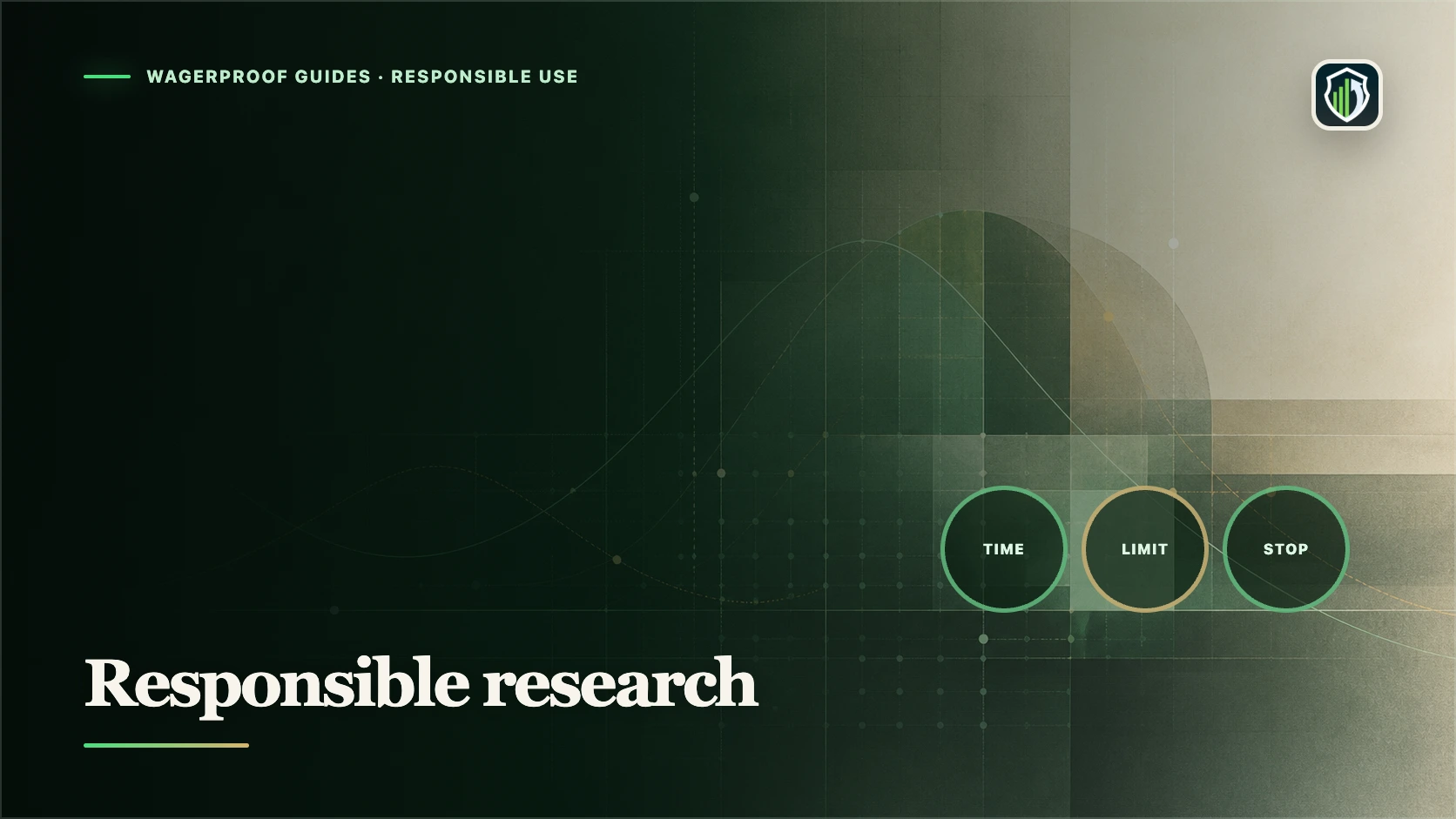
Urgency changes decisions. Set three boundaries before opening an odds or research screen:
- A money limit you can afford to lose without affecting bills, savings, debt, or other people.
- A time limit for the research and any resulting activity.
- A stopping rule that does not move after a loss, a win, or a model alert.
Do not use borrowed money. Do not increase stakes to recover a loss. Do not treat a strong model label, consensus flag, streak, or line move as permission to ignore a limit.
Separate research from action
A research product can show probabilities, trends, movement, and graded records. It cannot make the decision automatic. Add a pause between reviewing information and acting on it. Preserve the exact price and rationale, then step away long enough to notice whether the decision is driven by evidence or by urgency.
WagerProof does not accept wagers or handle money. That separation helps, but it does not remove the risk that research itself becomes compulsive.
Use account controls
Regulated operators may provide deposit limits, wager limits, time-outs, and self-exclusion. Massachusetts regulations, for example, require sports-wagering operators to offer daily, weekly, and monthly deposit and wager limits. The controls available to you depend on the jurisdiction and operator.
Use the strictest practical setting before a problem escalates. If you are trying to find a way around a limit you set, treat that as a signal to stop and seek support.
Watch for research-shaped chasing
Chasing does not always look like an impulsive wager. It can look like searching for one more model, adding filters until the past result turns green, changing a rule after a losing stretch, or refreshing prices until a desired number appears.
Common warning signs include:
- spending more time or money than planned
- hiding activity or records
- using gambling to change mood
- increasing stakes after losses
- treating a model as certain
- feeling unable to stop researching or checking results
- abandoning work, sleep, relationships, or bills
If any of these feel familiar, stop the session. Use a time-out or self-exclusion tool and contact a qualified support resource.
Keep the performance record honest
A complete log can reduce selective memory when it includes every decision and every loss. It becomes harmful if the record is used to justify increasing risk or to chase a target ROI. The performance-tracking checklist keeps uncertainty, price, and rule changes visible.
Review at a fixed interval instead of after every result. Do not let one win erase a limit or one loss trigger a larger stake.
Make alerts earn their place
Disable push alerts that create urgency without adding necessary information. Group research into planned windows. A price alert should not override your money or time limit. If an opportunity disappears while you pause, letting it go is a valid outcome.
Recheck help information
Helpline names, phone licensing, and jurisdictional resources can change. This page has a monthly review date because stale help information is unacceptable. The NCPG helpline page and your state regulator are the sources of truth.
Plain answers
Frequently asked questions
What limits should I set before sports betting research?
Set a maximum amount of money, a session time limit, and a stopping rule before viewing picks or prices. Use operator deposit, wager, time-out, or self-exclusion controls when available.
Can more analytics remove gambling risk?
No. Models and market data can organize uncertainty, but they cannot guarantee an outcome. More research can also increase time spent and false confidence, so personal limits still matter.
What is the current U.S. national problem gambling helpline?
As of August 26, 2026, call or text 1-800-MY-RESET for free, confidential support at any time, or use chat at 1800myreset.org. In an immediate emergency, call local emergency services.
Evidence ledger
Sources
Sources were opened on the listed date. Product features, prices, platform coverage, fees, and help information can change.
- About the National Problem Gambling HelplineNational Council on Problem Gambling · Accessed August 26, 2026
Current 1-800-MY-RESET call, text, and chat details
- National helpline stakeholder FAQNational Council on Problem Gambling · Accessed August 26, 2026
September 2025 transition away from national use of 1-800-GAMBLER
- 205 CMR 248.16: player limit controlsMassachusetts Gaming Commission · Accessed August 26, 2026
Regulator-backed deposit and wager limit controls
- WagerProof App Store listingApple and WagerProof, LLC · Accessed August 26, 2026
Current product limitation that WagerProof does not accept wagers or handle money

About the author
Chris Habib
Chris builds WagerProof and writes practical guides about sports research, product methodology, and responsible use of betting data. He focuses on inspectable workflows rather than outcome promises.
Keep the boundary visible
If the process feels hard to stop, stop the process.
Free, confidential U.S. support is available at any time. Limits and time-outs are valid research decisions.
Have a correction or a newer first-party source? Email the editorial team.