
Checklist for Accurate Betting Performance Tracking
Accurate betting performance tracking can help you avoid common pitfalls like selective memory and poor bankroll management. Here's why it matters and how to do it effectively:
- Track Every Bet: Log details like date, time, sport, league, teams, bet type, odds, stake, and sportsbook. This helps identify patterns and calculate ROI and win rates.
- Document Pre-Bet Research: Record why you placed the bet (e.g., injury news, weather) and rate your confidence (1–10). This helps improve future strategies.
- Verify Bets: Double-check details before placing bets and save proof (e.g., screenshots).
- Log Results Immediately: After events, note outcomes, profit/loss, and compare your odds to the closing line to measure Closing Line Value (CLV).
- Regular Reviews: Analyze performance by categories (e.g., sport, bet type) and calculate metrics like ROI, CLV, and win rates.
- Organize Data: Use tools like Google Sheets or apps for consistent tracking. Back up data and use clear naming conventions for accuracy.
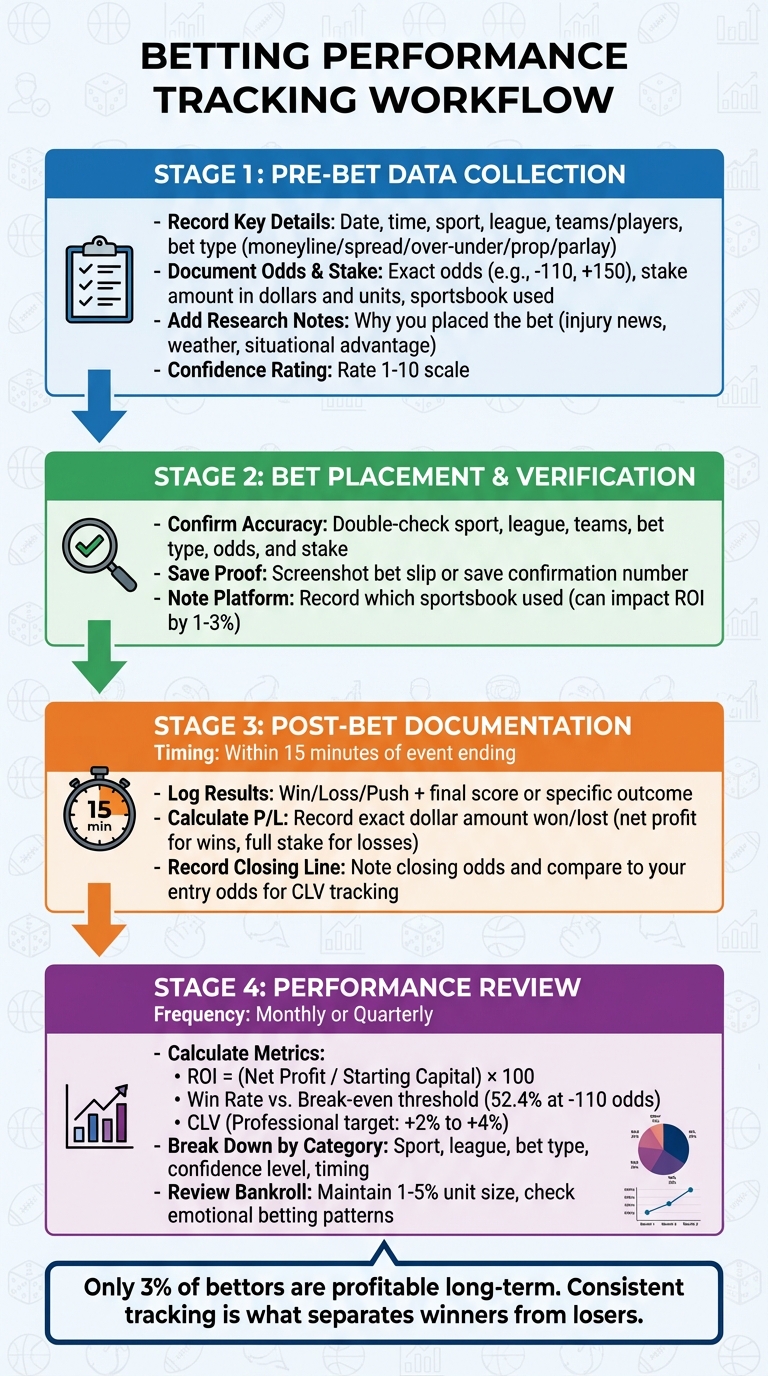
Complete Betting Performance Tracking Workflow: Pre-Bet to Review
FREE Bet Tracking Google Sheet (Decimal & American Odds Versions Included)
Pre-Bet Data Collection Checklist
Start tracking your bets before placing them. Many bettors wait until after the game to log their wagers, but by then, memory fades, details get murky, and the reasoning behind your choice is often clouded by the outcome. Recording your information upfront ensures an honest baseline, shields you from hindsight bias, and sets the stage for meaningful analysis later. This habit creates a solid foundation for evaluating your betting performance.
Record Key Bet Details
Keep your bets organized by date, time, sport, league, and teams/players. This structure helps you spot patterns over time.
Be specific about the bet type - whether it's a moneyline, spread, over/under, prop, or parlay. Also, note if it's a pre-game or live bet. These distinctions are critical because your results for live wagers might differ significantly from your pre-game bets.
Document Odds and Stake Information
Write down the exact odds or line (e.g., -110, +150, -3.5). This data is crucial for calculating ROI and comparing your entry odds to the closing line. For example, with standard -110 odds, you need a 52.4% win rate just to break even. Knowing your odds helps you determine if you're on track to surpass that threshold.
Also, track your stake amount in dollars, convert it to units, and note the sportsbook you used. For instance, if your standard unit is $25 and you bet $50, that's a 2-unit wager. Measuring in units allows you to compare performance across bankroll sizes and simplifies long-term tracking. Accurate odds and stake details are essential for calculating win rates and ROI later.
Add Research Notes
Include a quick note explaining why you placed the bet. Was it based on injury news, weather conditions, or a situational advantage? As Jimmy Boyd of BoydsBets advises:
"It's a great idea to jot down a few notes about each bet... These notes personalize your log and are gold when you review them later. They help you remember the context of each bet, so you can learn from mistakes and successes".
These notes provide valuable context when reviewing your results.
Finally, assign a confidence rating (1–10) to each bet. This rating helps you assess whether your high-confidence picks perform better than your speculative ones. When you revisit your log, you'll be able to distinguish between a "bad beat" (a well-researched bet that lost due to an unexpected event) and a "bad read" (a bet that failed because of flawed research). Understanding this difference is key to improving your betting strategy.
Bet Placement and Verification Checklist
When you click "submit", that's often where mistakes creep in. Maybe you picked the wrong team, misread the odds, or entered the wrong stake. These small errors can mess up your entire record. Taking just a few seconds to double-check everything before finalizing your bet can save you hours of headaches later.
Confirm Bet Accuracy
Before you hit submit, go over every detail: the sport, league, teams or players, and the type of bet you're placing. It's surprisingly easy to pick the wrong side of a spread or accidentally choose a moneyline instead of the total. Confirm the odds at the moment you're placing the bet, and make sure your stake aligns with your bankroll strategy. For instance, if you’re working with a unit system (e.g., 1 unit = $25), double-check that a $50 bet is correctly logged as 2 units, not 1. Entering these details in real time helps avoid memory slips. Once everything checks out, save a record of the transaction.
Save Proof of Bet
Always save proof of your bet right after placing it. A quick screenshot of your bet slip or saving the confirmation number can act as your safety net if any discrepancies arise. Some tracking apps, such as Pikkit, simplify this process by linking directly to your sportsbook account, automatically importing transaction details and reducing the chances of manual errors.
Note Betting Platform
Keep track of which sportsbook you used for each wager. Different platforms can yield different outcomes - what works on DraftKings might not work as well on FanDuel, thanks to variations in odds or market behavior. Over time, noting the platform can help you identify trends and potentially boost your annual ROI by 1% to 3%.
Post-Bet Documentation Checklist
Make it a habit to document outcomes within 15 minutes of the event ending. This helps avoid selective memory and ensures your data stays accurate and honest.
Log Final Results
Start by noting whether the bet was a win, loss, or push, and include the final score or specific outcome. For prop bets, write down precise player stats - like "Patrick Mahomes threw for 287 yards." These details are crucial for identifying patterns. For instance, you might discover you're excelling with NBA totals but struggling with NFL player props. Additionally, having this data on hand can protect you if a sportsbook makes an error when grading your bet. Once you've logged the results, move on to calculating your financial outcome.
Calculate Profit or Loss
Record the exact dollar amount won or lost. Keep in mind, a win at -300 odds is very different from a win at +300 odds, even though both are technically victories. For wins, log the net profit (total return minus your stake). For losses, record the full stake. If you're using a unit system - where, for example, 1 unit equals $25 - be sure to log results in units as well. This approach gives you a consistent way to track performance over time, even as your bankroll fluctuates.
Record Closing Line Information
Write down the closing line odds just before the event started and compare them to the odds you locked in. This metric, known as the closing line value (CLV), is one of the best indicators of long-term profitability. As Jimmy Boyd from BoydsBets explains:
"If over time you're beating the closing line on a good percentage of your bets, it means you're likely making +EV (positive expected value) decisions, even if short-term results vary".
Performance Review Checklist
Taking time to regularly analyze your betting data is essential. It helps you spot strengths, fix mistakes, and fine-tune your approach. Performance reviews reveal profitable trends and areas for improvement, ensuring you stay on track. Setting time aside - whether monthly or quarterly - can make a big difference. It’s a habit that separates the top 3% of profitable bettors from the rest.
Calculate ROI and Win Rate
Start by figuring out your Return on Investment (ROI) with this formula:
(Net Profit / Starting Capital) × 100.
For instance, if you started with $1,000 and now have $1,150, your ROI would be 15%. However, don’t let a high win rate fool you - sometimes, a few high-odds wins can outperform a streak of smaller, low-odds wins. To stay accurate, record the exact dollar amount won or lost for every bet.
Break Down Results by Category
Dive deeper into your data by breaking it down into categories like sport, league, bet type, confidence level, and timing. This approach can reveal where you’re thriving and where you’re struggling. As professional bettor Rob Pizzola says:
"The hardest part of betting is being honest with yourself - and the data never lies".
Using color-coded spreadsheets can make patterns easier to spot - green for profits and red for losses. If one category consistently shows positive results over a large sample, you might consider increasing your unit sizes for that specific area.
Review Bankroll Management
Make sure your bankroll management is on point. Stick to your defined unit size (usually 1%–5% of your bankroll) and ensure your higher-confidence bets are yielding better returns. Watch out for emotional betting behaviors like chasing losses or making impulsive decisions . If certain bets, like parlays or live wagers, are eating into your funds disproportionately, it might be time to rethink your strategy. Regularly reviewing these factors helps you stay disciplined, navigate natural variance, and keep your bankroll sustainable. Use these insights to refine how you organize and track your data moving forward.
Data Organization Checklist
Keeping your data organized is key to spotting clear betting performance trends. A cluttered or inconsistent tracking system can lead to missed insights, broken formulas, and wasted time. By organizing your records properly from the beginning, you make performance analysis easier and more accurate. A solid system starts with detailed and structured bet records.
Set Up a Consistent Tracking System
Pick a tracking method and stick with it. Google Sheets is a popular choice because it’s free, cloud-based, and accessible from any device - perfect for most bettors. If you prefer automation, consider using dedicated tracking apps. These apps sync directly with sportsbooks, pulling data automatically to minimize manual entry errors.
No matter which tool you choose, maintaining consistency in how you input data is essential. For example, convert all odds into decimal format (e.g., -110 becomes 1.91) to simplify profit and loss calculations. Use dropdown menus for fields like "Status" (Won, Lost, Push) and "Bet Type" (Moneyline, Spread, Total) to avoid typos that could mess up your formulas. Jimmy Boyd, founder of BoydsBets, sums it up perfectly:
"The 'best' tracking method is the one you'll actually use".
For more detailed analysis, consider adding tags to your bets. Use labels like "Fade the public" or "Injury angle" to track specific strategies. This way, you can easily identify which approaches are the most profitable. Once your data is consistent, make sure it’s also well-protected.
Back Up Your Data Regularly
Imagine losing months - or even years - of betting records due to a tech failure. It’s avoidable! Cloud-based tools like Google Sheets automatically save and sync your data, protecting it from local hardware issues. If you’re using a local spreadsheet, get into the habit of exporting backups to a cloud service like Google Drive. Dedicated tracking apps often store your data on encrypted remote servers, adding another layer of security.
Use Clear Naming Conventions
Unclear or inconsistent naming can make data analysis a headache. For instance, entering "TeamX" one week and "Team X" the next will prevent your spreadsheet from grouping them together. Stick to one format for team names and apply it consistently. Additionally, keep your data organized by separating the event (e.g., "Lakers vs. Celtics") from your specific wager (e.g., "Lakers -4.5") in different columns. This keeps your records clean and searchable.
Using dropdown menus can further ensure consistency, making your historical data more reliable. Accurate and comparable data over multiple seasons is critical for spotting long-term trends and measuring your improvement.
Key Metrics Tracking Checklist
Once your data is organized, the next step is analyzing key metrics to fine-tune your betting strategy. A simple win–loss record only scratches the surface. To truly understand and improve your performance, focus on measuring efficiency, value, and profitability.
Track Win/Loss Records
Keep a detailed record of the dollar or unit amounts won or lost on each bet. This approach helps you evaluate performance across different stake sizes and sports. Make sure your win rate matches the break-even threshold for the odds you typically wager. Break your records down further - by sport, league, bet type, or even time of day - to uncover where you excel and where you struggle. Using units (generally 1–2% of your bankroll) instead of dollar amounts makes it easier to compare results across varying stake sizes and timeframes. Reviewing these records weekly can reveal patterns and highlight areas where adjustments are needed.
Measure Closing Line Value (CLV)
Closing Line Value (CLV) is a key indicator of long-term success. It measures whether you're consistently securing better odds than the market's closing line, which reflects all available information right before an event starts. Professional bettors often achieve a CLV of +2% to +4%. As BetPredictionSite explains:
"CLV is process. Results are noise."
To track this, record the closing line odds and compare them to the odds you secured. Regularly review your worst 10 negative CLV bets to identify if you're chasing steam (following late market moves) or relying on slower sportsbooks. Tools like WagerProof (https://wagerproof.bet) can simplify this process by automatically tracking CLV and flagging value bets when prediction market spreads reveal potential edges before the market adjusts.
Monitor Profitability Metrics
Beyond win-loss records and CLV, profitability metrics provide a broader view of your performance. Return on Investment (ROI) is a key measure, showing how much profit you generate relative to the total amount wagered. Other important metrics include average stake, total profit or loss, and maximum drawdown (the largest decline in your bankroll from a peak) to ensure your bankroll management can handle normal betting variance. It’s crucial to log every bet, no matter how small, to maintain an accurate performance history. Don’t forget to account for the vig (sportsbook margin), as ignoring it can lead to an inflated perception of your edge. These metrics not only help you assess your current performance but also guide adjustments for long-term sustainability.
Conclusion: Building Better Betting Habits
Tracking your betting performance accurately can turn sports betting from a game of chance into a disciplined, data-centered activity. The truth is, consistent tracking is what separates the small group of profitable bettors from the majority who lose money. Following a structured approach allows you to pinpoint where you're losing, manage emotional highs and lows during streaks, and, most importantly, take responsibility for every single wager.
The key difference between winning and losing bettors isn't luck - it's discipline. Keeping detailed logs highlights your strengths and weaknesses. For example, you might be consistently beating point spreads but losing heavily on parlays, or thriving in NBA bets while struggling with MLB. By recording every bet, even the impulsive ones, you avoid the trap of selective memory that often ignores those frequent, small losses. This honest self-evaluation helps you separate bad luck from poor strategy.
Think of your betting like running a business. Your tracking system acts as your financial report, showing exactly where you have an edge and where you don't. By logging every bet promptly and reviewing your records regularly, you can spot patterns as they develop. Tracking in units - typically 1–2% of your bankroll - also helps you stay disciplined and avoid overextending yourself.
To make the process easier, consider using technology. While manual tracking works, automation can save time and reduce mistakes. Platforms like WagerProof (https://wagerproof.bet) take this to the next level. It automatically logs your bets, monitors Closing Line Value, and identifies potential edges based on prediction market spreads. Its AI tools analyze matchups around the clock, while WagerBot Chat combines weather, odds, injuries, and model predictions into a single, comprehensive recommendation - giving you a sharper edge without the guesswork.
FAQs
What’s the minimum I should log for every bet?
To keep track of your betting performance effectively, make sure to log the following details for every bet:
- Odds: The odds at which the bet was placed.
- Stake: The amount of money wagered.
- Market: The specific type of bet or event (e.g., moneyline, over/under).
- Sportsbook: The platform or bookmaker where the bet was made.
- Date/Time: When the bet was placed or the event occurred.
- Outcome: The result of the bet (win, loss, or push).
By recording this information, you’ll have a solid foundation for analyzing patterns, identifying strengths or weaknesses, and refining your approach. It’s a step toward transforming casual betting into a more structured and informed strategy.
How do I calculate CLV if I can’t find the closing line?
If the closing line isn't readily available, you can estimate your CLV (Closing Line Value) by comparing the odds you took with the final odds from a sharp bookmaker or a trusted tool. Another way to approximate closing odds is by keeping an eye on live updates close to the event or analyzing historical data. Certain platforms even automate this process by tracking your bets and comparing them to the final market odds, making it much easier to evaluate your CLV.
How many bets do I need before ROI and win rate mean anything?
To ensure that ROI and win rate metrics are reliable, you need a large enough sample size, typically consisting of several hundred bets. This helps eliminate the influence of short-term variance, making your performance data more dependable.
Related Blog Posts
Ready to bet smarter?
WagerProof uses real data and advanced analytics to help you make informed betting decisions. Get access to professional-grade predictions for NFL, College Football, and more.
Get Started Free