Positive EV Betting Strategies for Beginners
Find +EV bets through line shopping, CLV tracking, hedging promos, AI models, and disciplined bankroll rules for long-term profit.
Expert insights on sports betting analytics, strategies, and data-driven predictions
Find +EV bets through line shopping, CLV tracking, hedging promos, AI models, and disciplined bankroll rules for long-term profit.
Use Bayesian updating to convert priors into posteriors and spot value bets by exploiting slow market adjustments with updated probabilities.
Compare seven odds-alert tools that spot mispriced lines, send real-time notifications, and offer filters for casual and pro bettors.
Understand closing line value (CLV), how to calculate and track it, and tactics to secure better betting odds over time.
Compare backtesting and walk-forward analysis: speed vs realism, overfitting risks, and when to use each for betting strategies.
How AI tracks live odds, spots mispriced bets, and uses agents and alerts to improve prediction accuracy and ROI.
How pro 'sharp' bettors move lines, create reverse line movement, and expose mispriced odds to find +EV bets.
How to weigh consistency, CLV and ROI in betting models—when win rate matters, when ROI wins, and how AI helps.
Partition streaming sports data and apply temporal validation to keep live predictive models accurate, low-latency, and resilient to drift.
Accuracy alone won’t make you money in sports betting — calibration, value detection, and smart staking drive ROI.
Compare error detection, real-time data handling, and transparency across three AI sports betting platforms to find the best fit.
Detect live betting anomalies using LSTM/RNN models, Flink streaming, and hybrid ML+rule pipelines to reduce false positives.
How live feeds, event-driven pipelines, and AI combine to deliver millisecond sports data and actionable betting insights.
Public bet splits and cross-sport odds often hide mispriced markets—AI detection exposes fade-and-value opportunities.
Read ticket vs money splits to spot sharp-money signals like reverse line movement, steam moves, and value opportunities.
Understand how sportsbook implied probabilities (with vig) differ from true probabilities and how that gap reveals value bets and positive EV.
How to measure and improve sports betting ROI using AI, real-time data, micro-betting insights, and disciplined bankroll management for sustainable returns.
Compare six top RLM tools for spotting sharp money and steam moves with real-time odds, public-bet splits, and feature comparisons to sharpen betting strategy.
Real-time odds alerts reveal short-lived value by spotting sharp-market moves, outliers, and juice shifts so bettors can act faster and place smarter wagers.
Event-driven pipelines using Kafka, Spark Streaming, and Druid enable sub-second model validation in live sports betting with drift detection, LEV/ECE monitoring, and failsafes.
Audit betting algorithms with calibration, ROI, CLV, drift detection and real-time logs to ensure transparent, reliable, and accountable models.
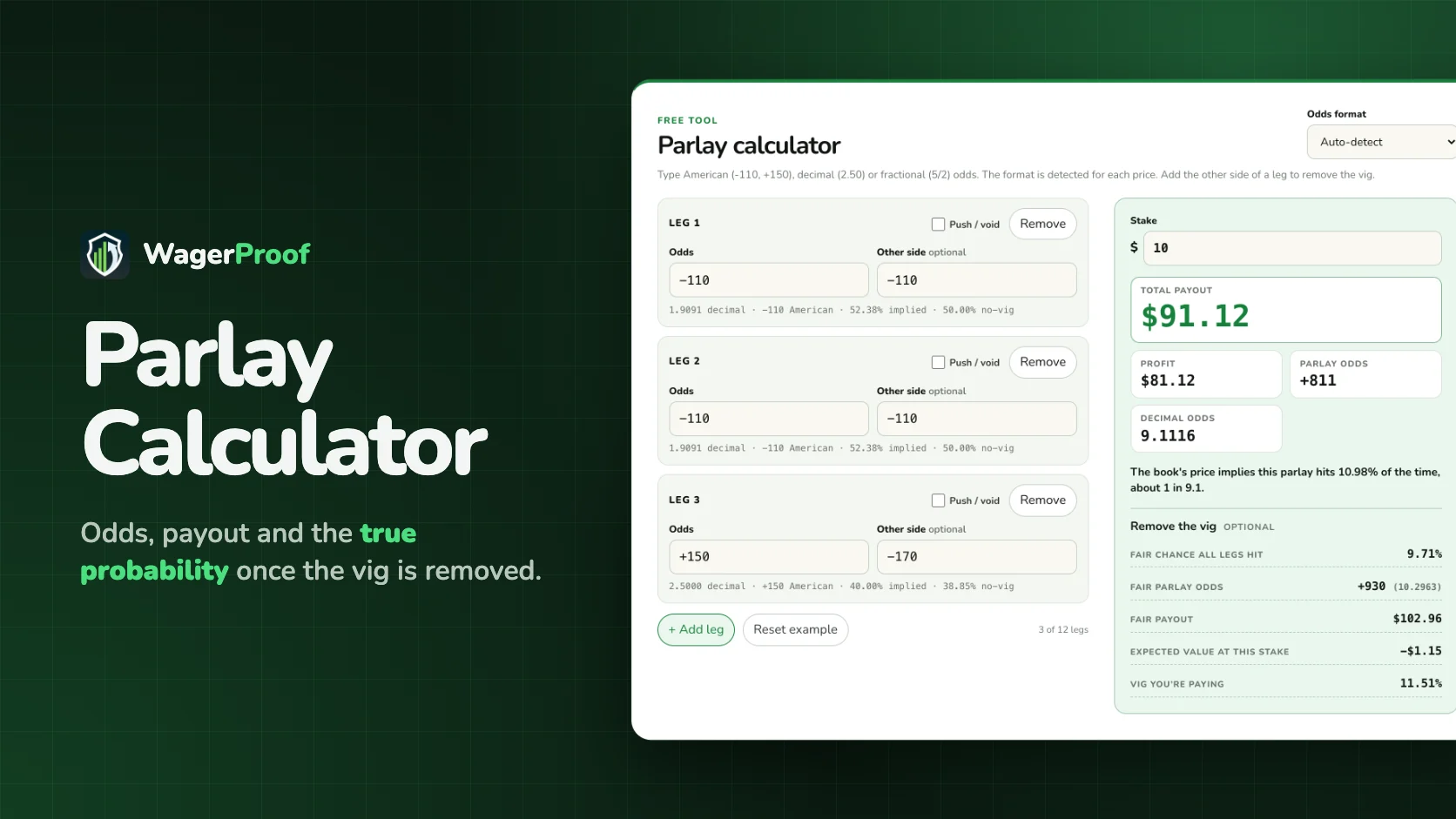
Compare the best Expected Value calculators and tools for bettors—inputs, outputs, odds formats, and platforms that scan for +EV opportunities.
AI detects momentum shifts in live sports by analyzing xT, pressing, turnovers and live odds within seconds, giving bettors data signals; humans add context.
Seven-step checklist to validate a betting edge: set clear criteria, collect 500+ bets, measure ROI/EV/CLV, run significance tests, model variance, verify, and scale.
Sportsbooks have tightened NFL teaser payouts; breakeven rates rose, meaning only targeted 2-leg teasers on low-scoring road games stay viable.
Accurate bet tracking—log every wager, record pre-bet research, track CLV and ROI, and review bankroll data to improve long-term betting results.
How data-driven sharps use RLM, steam moves, CLV and niche markets to spot pricing errors and secure +EV in sports betting.
How real-time streaming, distributed SQL, and AI analytics enable low-latency, scalable systems for live odds and sports betting operations.
Referee foul patterns and pace can shift NBA totals 3–5 points—use crew-level foul data, shooting-foul %, and AI on 30–40 games to find an edge.
Compare five staking plans—flat, percentage, target profit, secure, and Kelly—to manage bankroll, control risk, and grow profits from value betting.
Learn five causes of betting line movement—injuries, public and sharp money, weather, and market reactions—to spot timing and value in wagers.
Split your betting bankroll by sport, set sport-specific unit sizes, limit correlated exposure and rebalance after ~20% shifts to manage variance and risk.
Analyze your sports betting performance with our free win rate tool. Input your bets and odds to see if you're on track for profit!
By 2026 sportsbooks raised teaser juice and shifted lines, erasing most Wong-teaser edges—only -120 or better keeps slight value; -130 is break-even.
Calculate your sports betting ROI with our free tool! See if you're profiting or losing and get insights on your betting performance.
Monte Carlo simulations reveal your true betting edge, quantify variance, and guide bankroll and staking choices to manage risk over thousands of bets.
Missouri's early sports betting losses mean no tax revenue for schools as March Madness raises integrity concerns.
Spot sharp money and key-number line moves—learn RLM, steam moves, ticket vs. handle signals and timing to capture betting value.
How sharp (professional) vs public bets move lines, affect liquidity, and create value using ticket/money splits and reverse line movement.
Validate betting models with walk‑forward backtests, Monte Carlo simulations, scenario analysis, and Bayesian methods to spot overfitting and manage bankroll risk.
How NFL teaser bets trade bigger win chances for lower payouts — learn break-even rates, key-number strategy (3 & 7), common mistakes, and data tools.
Detect and manage concept drift in betting models with ICM, ADWIN and Page-Hinkley; use real-time data, ensembles, and retraining to maintain predictive edge.
How travel, time zones and back-to-backs reduce player and team performance—and where bettors can find mispriced edges in sportsbooks and prediction markets.
Checklist to evaluate a betting model’s scalability: EV stability, probability calibration, bankroll and bet sizing, diversification, metrics, and operational resilience.
Understanding correlation turns same-game parlays from guesswork into strategic bets by revealing when sportsbooks overcharge for linked outcomes.
How line movement and reverse line movement expose sharp bettors, timing edges, and tools to spot value in real-time prediction markets.
Short-term ROI is noisy and misleading; long-term ROI reveals your true betting edge—learn why sample size, bankroll rules, CLV, and tracking matter.
How live betting models use millisecond in-play data, Bayesian updating, market signals and safeguards to update odds, detect value, and manage risk.
Compare five top EV tools for sports betting — from AI-driven scanners to simple calculators, with notes on accuracy, inputs, and bankroll integration.
Compare the Kelly Criterion and dynamic bankroll adjustment: trade-offs between long-term growth, volatility, and practical risk control for bettors.
Calibrated probabilities, not raw accuracy, drive betting profits. Learn EV math, break-even odds, bet sizing, and why calibration improves ROI.
Learn the key features that keep gambling in check — deposit/wager limits, time controls, self-exclusion, activity tracking, and AI alerts.
How public betting skews odds, why sharp money moves lines, and when to time bets using ticket vs. money splits and data tools.
Spot professional bettors using reverse line movement, money-vs-ticket gaps, steam moves and real-time tools to track sharp money across sportsbooks.
Five signs—sharp line moves, high-stakes volume, odd bet patterns, expert mismatches, and unusual timing—to spot insider bets or market manipulation.
Clear comparison of Expected Value (EV) and Edge—how to calculate them, find +EV bets, size wagers with Kelly, and manage bankroll.
How prediction markets differ from sportsbook odds—pricing, fees, probability accuracy, and spotting mismatches to find value and hedge bets.
CFTC says it can police designated contract markets after Kalshi reported two insider trading cases.
Kalshi sues Utah officials, arguing federal CFTC oversight preempts state gambling enforcement of its prediction markets.
How AI analyzes betting behavior to flag risky patterns, enable early intervention, and support responsible gambling.
Adaptive retraining improves prediction accuracy but complicates historical benchmarks; use calibration, NLL and real-time validation to avoid collapse.
Purged cross-validation plus walk‑forward backtesting reveals whether betting models truly generalize — CV finds overfitting, backtesting verifies ROI and risk.
Clear live-betting rules for stake sizing, fractional Kelly, hedging, and bankroll limits to control emotion and manage in-play risk.
Why ROI—not hit rate—determines betting success: odds, value bets and calibration drive real profitability, not raw win percentage.
Step-by-step checklist for using NLP in sports betting: collect and clean data, track sentiment and odds, find value bets, backtest and validate.
Why public bettors often lose, how consensus models improve predictions, and where mismatches create value bets for profitable sports wagering.
Real-time drift alerts tied to automated retraining minimize model decay and downtime, keeping sports-betting predictions reliable.
How AI assigns Possession Value to every action using tracking, EPV, xT and pitch-control to reveal hidden player impact and live betting insights.
Learn how prediction-market edges erode over time, how to spot decay using CLV, spreads and calibration, and practical hedging and sizing tactics.
Calibration-focused hyperparameter tuning (learning rate, depth, batch size, min samples per leaf) yields higher ROI in sports betting than accuracy-only models.
Learn to spot betting market outliers using reverse line movement, public money splits, devigged odds and real-time tools to find +EV opportunities.
AI detects and fixes delayed feeds, mismatched odds, and anomalies in live sports betting—identifying errors in milliseconds to protect bettors and ensure data accuracy.
Prevent model drift and protect ROI: spot warning signs, follow sport-specific retraining schedules, use walk‑forward and ensemble methods, and validate with CLV.
Compare betting model returns across NFL, college football, NBA, college hoops, MLB and NHL with CLV, EV, fractional Kelly staking, and sport-specific tactics.
Core data layers—official league feeds, historical stats, and real-time odds—plus validation and tools to build reliable niche sports betting models.
How injury reports shift spreads, moneylines, and totals, why markets often overreact, and how to spot early-value betting opportunities.
Calculate and segment historical betting ROI, use CLV and xROI, and leverage tracking tools to spot value and improve profitability.
Use real-time stats, betting splits, and prediction-market gaps to spot live-betting edges; time wagers after plays and validate with AI and community tools.
Compare linear vs logistic regression for sports betting: when to use score/spread models versus probability-based moneyline models, plus calibration tips.
Bettor behavior reveals market biases and value bets. Learn key metrics, machine learning methods, real-time signals, and bankroll tactics to improve ROI.
Learn to read ticket % and handle % to spot sharp money, reverse line movement, and market inefficiencies for smarter sports bets.
Use public betting splits as signals and confirm them with team stats and analytics to spot value, reverse line movement, and improve betting decisions.
Bet with the crowd when sharps agree, but fade the public on marquee games when reverse line movement reveals sharp money.
High liquidity in prediction markets often magnifies crowd noise and can reduce accuracy despite higher trading.
Use prediction market prices and simulations to spot mispriced sportsbook odds, build 2–3 leg correlated parlays, and manage correlation risk.
How AI uses data, machine learning, and real-time adjustments to project player props, find +EV bets, and deliver transparent, fast betting insights.
Early sharp bets and late public action create odds mispricings; track line shifts, compare sportsbooks, and use CLV and bet-to-dollar signals.
Compare machine learning and time series for sports betting—pre-game prediction vs live momentum, why calibration matters, and when to use a hybrid approach.
Overfitted sports models mislead bettors; early stopping and calibration protect bankrolls by preventing models from memorizing noise.
Use Closing Line Value (CLV) to separate skill from luck: calculate no‑vig closing odds, track CLV vs ROI, and test strategies over large samples.
Why lines move against public bets, how ticket vs. money splits reveal sharp money, and how real-time data helps you spot RLM.
Compare sports data APIs and prediction markets: pros, cons, update speed, costs, and when to use each to find betting value.
Five practical steps to collect data, build, validate, and recalibrate win-probability models for more reliable sports-betting predictions.
Use CLV, ROI, win rate, Brier Score, and Log Loss to validate betting models, check calibration, and distinguish long-term skill from short-term luck.
Learn how to combine injury reports and line movements to spot mispriced odds, reverse line movement, and exploit public overreactions in sports betting.
Professional bettors turn historical stats, situational context, and calibrated models into systematic edges to spot mispriced bets and improve ROI.
Use WPA, clutch shooting splits, free-throw accuracy and turnover rates to spot late-game betting edges, with historical backtesting and WagerProof tools.
Why expected ROI and actual ROI often diverge in sports betting — learn how variance, sample size, CLV, model limits, and bankroll rules affect results.
Learn to read line movement and spot reverse line movement to separate public bets from sharp money in sports betting.