AI Models for Player Prop Predictions
AI is changing sports betting, especially with player prop bets. These bets focus on individual player performances, like passing yards or strikeouts, rather than game outcomes. AI tools process massive data sets, predict outcomes with high accuracy, and adjust in real time based on factors like injuries or weather. This makes them faster and more reliable than traditional methods.
Key Takeaways:
- Player prop bets: Wager on specific player stats, independent of team results.
- AI advantages: Processes data quickly, removes human biases, and predicts outcomes with 70–80% accuracy.
- Real-time updates: Models adjust projections instantly for breaking news or game conditions.
- Better decisions: AI avoids common betting mistakes by analyzing trends and situational factors.
- Tools like WagerProof: Help find value bets, compare sportsbook odds, and provide transparent insights.
AI tools are reshaping how bettors approach player props, offering faster, data-driven predictions that improve decision-making.
The AI Betting Model That’s Printing Money 💰 | NFL Week 11 Props
How AI Models Predict Player Props
How AI Models Predict Player Props: 3-Step Process
AI models take raw data and transform it into predictions that bettors can rely on. By breaking down the process, it becomes clear why these systems often outshine traditional methods of handicapping.
Data Collection and Preprocessing
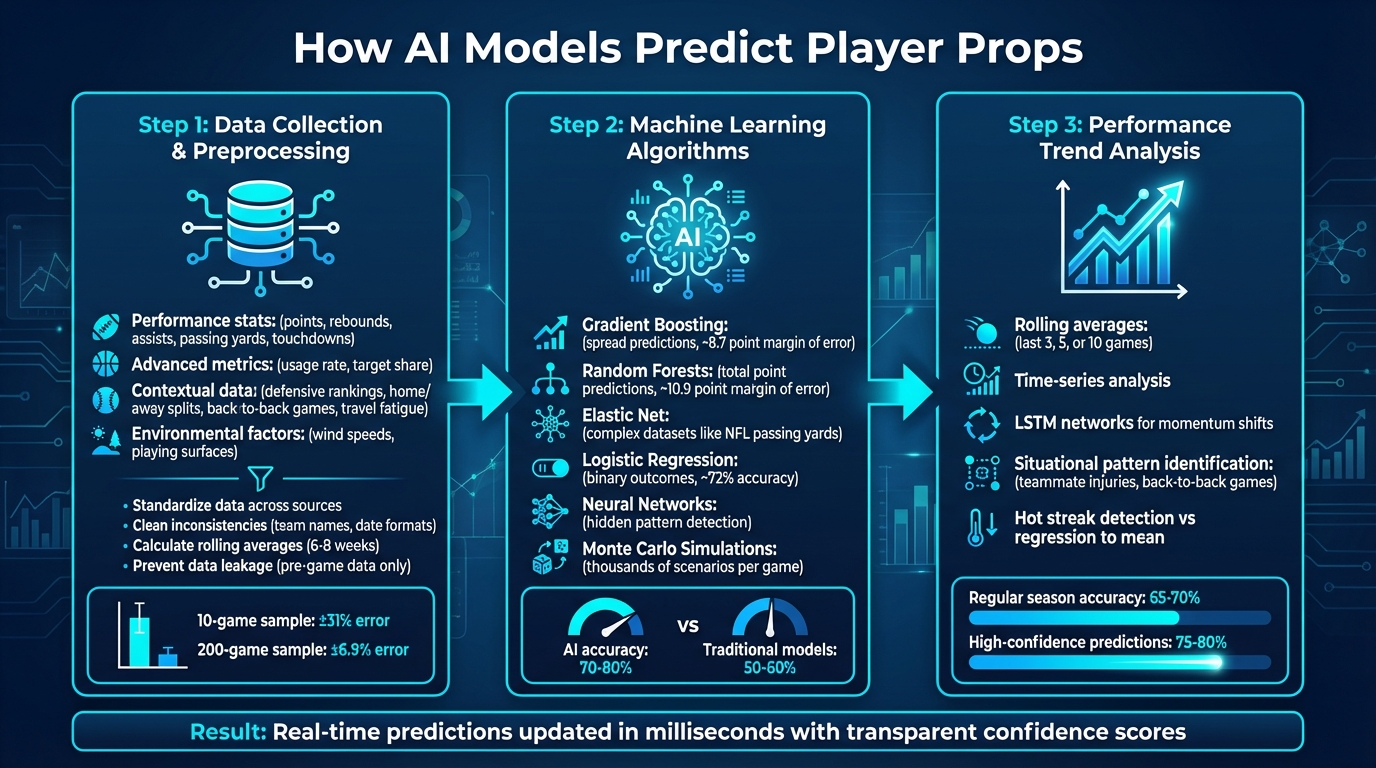
The first step for AI models is gathering a massive amount of data from various sources. This includes basic performance stats like points, rebounds, assists, passing yards, and touchdowns. More advanced systems dig deeper, focusing on metrics like usage rate (the percentage of team plays involving a player) and target share (how often a receiver is the target of passing plays).
But it doesn’t stop there. These models also pull in contextual details - such as how defenses rank against specific positions (e.g., slot receivers versus outside receivers), home and away performance splits, back-to-back game schedules, and travel fatigue. Even environmental factors, like wind speeds or playing surfaces, are part of the equation. Once all this data is collected, it’s standardized for consistency across sources - ensuring, for example, that "LA Rams" and "Los Angeles Rams" are treated as the same team.
The preprocessing phase is just as important. AI systems clean the data, correcting inconsistencies in team names, date formats, and statistical labels. They also transform raw stats into more meaningful variables, such as rolling averages that typically cover the last 6–8 weeks to reflect a player's current form. Another critical step is avoiding future data leakage - ensuring that only pre-game data is used in training. This means ignoring post-game injury updates or final scores, which wouldn’t have been available to bettors at the time. By the end of this process, the data is accurate, timely, and ready for analysis.
Machine Learning Algorithms
Once the data is prepped, machine learning algorithms take over. Popular techniques include Gradient Boosting and Random Forests, which combine multiple models to improve accuracy and avoid overfitting. Simpler projections might use linear regression, while Elastic Net - a mix of Ridge and Lasso regression - handles more complex datasets, such as NFL passing yard models.
For binary outcomes, like predicting whether a player will score a touchdown, logistic regression is the go-to choice, often achieving win probabilities with around 72% accuracy for game outcomes. More advanced setups, like neural networks, uncover hidden patterns in historical data that simpler models might miss.
The choice of algorithm depends on what the model is predicting. For instance, Gradient Boosting models are commonly used for spread predictions and typically have a lower margin of error (about 8.7 points), while Random Forests, often used for total point predictions, face higher variance (around 10.9 points). High-end systems also employ Monte Carlo simulations, running thousands of hypothetical scenarios for a single game to estimate the most likely outcomes. After the algorithms crunch the numbers, the models adjust predictions based on recent performance trends.
Performance Trend Analysis
AI models don’t just rely on raw data or algorithmic outputs - they refine their predictions by analyzing performance trends. Using rolling averages over specific timeframes (like the last 3, 5, or 10 games), these models focus on a player’s current form rather than their season-long stats.
This method smooths out short-term anomalies that can mislead human bettors. For example, increasing the sample size from 10 games (with an error margin of ±31%) to 200 games can shrink that margin down to just ±6.9%. Advanced models also use time-series analysis and Long Short-Term Memory (LSTM) networks to account for momentum shifts and performance cycles over a season.
Trend analysis goes even deeper by identifying situational patterns. How does a player perform when a teammate is injured? What about back-to-back games? By isolating these situations, AI can spot "hot streaks" or predict regression to the mean by comparing recent stats to historical averages. This level of detail is why modern AI models achieve 70–80% accuracy, far surpassing traditional statistical models that often hover between 50–60%.
Benefits of Using AI for Player Prop Predictions
Better Accuracy and Speed
AI models can process millions of data points almost instantly, giving them a clear advantage over traditional handicapping methods. These systems update projections in milliseconds, often adjusting odds before a replay even airs.
During the regular season, AI models often hit accuracy rates of 65–70%, with high-confidence predictions climbing to 75–80%. This level of performance comes from advanced techniques like ensemble learning, which combines methods such as gradient boosting, random forests, and neural networks. These approaches help reduce overfitting and reveal patterns that human analysts might overlook.
Unlike human bettors who may overreact to recent standout performances or flashy headlines, AI incorporates multi-season data and schedule-adjusted efficiency metrics to minimize biases. As Eric Pauly, Co-Founder & COO at BetSmart, explains:
"Smarter betting isn't about winning every night - it's about avoiding dumb losses and playing a high-volume, +EV game over time."
AI also excels at detecting subtle "micro-trends" that might go unnoticed by the human eye. For example, it can identify pressure changes or signs of player fatigue 30–60 seconds before these factors impact the game outcome. This gives sharp bettors a chance to act on valuable insights before sportsbooks adjust their lines. The combination of precision and speed makes AI especially effective for real-time betting adjustments.
Real-Time Updates and Adjustments
AI’s ability to integrate real-time data is a game-changer for bettors. Whether it’s a last-minute player injury, an unexpected weather shift, or a sudden lineup change, AI models can instantly update their projections - often faster than sportsbooks can react.
This instant adaptability is especially valuable in live betting. AI continuously tracks game metrics like possession speed, pass networks, and defensive intensity. For instance, if a defense shows a 10% drop in pressing intensity, AI can predict a goal is likely and adjust odds 30–60 seconds ahead of time. As PerformanceOdds.com puts it:
"Humans need seconds to process - AI needs milliseconds."
AI also accounts for situational dynamics. In blowout games (with spreads over 11 points), starters might see their playing time reduced by about 12 minutes, which can significantly impact their ability to hit certain prop bets. Automated alerts notify bettors when odds shift due to game conditions rather than public sentiment, giving them a critical edge.
Transparency and Data-Driven Decisions
Transparency in AI-driven predictions is another major advantage for bettors. These models clearly show their inputs - like usage rates, injury updates, and travel schedules - and provide confidence scores (e.g., High, Medium, Low) to help bettors assess risk and decide on stakes.
This clarity allows bettors to cross-check AI predictions with live game events. Virginia Gandolfo, Editor and Specialist at Action Network, highlights the importance of this:
"Choose tools that show their work: inputs used, refresh rates, and whether projections are live... Without transparent data, picks lack the depth of true AI analysis."
Platforms like WagerProof enhance transparency by flagging outliers and value bets. They send alerts when market spreads don’t align with AI predictions and spotlight signals to avoid certain games. With tools like WagerBot Chat, bettors gain access to real-time insights backed by both live stats and historical data.
Transparent systems also help bettors evaluate Closing Line Value (CLV), a critical metric for measuring long-term success. Consistently beating the final market lines with your model’s odds is a strong indicator of an effective betting strategy. This kind of validation not only builds trust in the tools but also helps refine betting approaches over time.
Using AI for Player Prop Betting
Finding Value Bets
AI tools are incredibly effective at uncovering mismatches between sportsbook lines and actual player probabilities. Instead of relying solely on basic stats, these systems dive into advanced metrics like usage rate, target share, and pace-adjusted efficiency to spot opportunities. For example, if a star player’s teammate is injured, AI can sift through historical data to evaluate "games played without [Teammate Name]" and predict how usage patterns might shift.
Even small differences in sportsbook lines can have a big impact on your long-term return on investment (ROI). AI models analyze these variations across multiple sportsbooks in real time, flagging profitable opportunities before the odds are adjusted.
The math behind value betting is straightforward: (Win Probability × Profit) – (Loss Probability). Joey Shackelford explains it best:
"Expected value is the mathematically rigorous way to evaluate any bet... It tells you, on average over many repetitions, how much you stand to gain or lose per dollar wagered."
AI tools can automate this calculation, helping you focus only on bets with positive expected value, saving time and reducing errors.
But AI doesn’t just find value - it also helps sidestep common betting mistakes.
Avoiding Common Betting Mistakes
One of the biggest advantages of AI is its ability to eliminate emotional decisions. Instead of relying on raw averages, it prioritizes comprehensive data distributions. For instance, a 10-game sample has a ±31% error margin, while a 200-game sample reduces that uncertainty to about ±6.9%. By factoring in rolling averages from the past 6–8 weeks, AI captures a player’s recent form and avoids the trap of small sample sizes.
AI also adjusts for situational dynamics that casual bettors may overlook. For example, when point spreads exceed 11 points, starters typically play about 12 fewer minutes - roughly 33% less time on the court. AI accounts for these scenarios, ensuring projections are more accurate before you place your bet.
Take Anthony Edwards during the 2021–22 NBA season as an example. His scoring showed a noticeable improvement in away games. AI models pick up on these home/away splits and other subtle trends that might otherwise go unnoticed.
Another often-overlooked factor is foul trouble risk. AI evaluates stats like "Fouls Committed Per 36 Minutes" (PF/36) and even referee tendencies to adjust projections for players prone to fouling. This helps you avoid bets that look promising on the surface but come with hidden risks.
These data-driven insights create a strong foundation for more accurate predictions.
How WagerProof Improves Player Prop Predictions

WagerProof takes AI-driven betting to the next level by identifying outliers and value bets in real time. The system sends alerts whenever prediction market spreads deviate significantly from its AI projections.
One standout feature is its transparency. WagerProof shows the inputs, refresh rates, and live data behind every projection. This allows you to verify its recommendations against current game conditions, helping you make more confident betting decisions.
For deeper insights, WagerBot Chat offers pro-level data on player matchups, injury impacts, and situational trends. You can ask specific questions and receive answers backed by up-to-date stats and models.
The platform’s Edge Finder tool simplifies line shopping by comparing odds across multiple sportsbooks and highlighting the most favorable discrepancies. This ensures you’re always getting the best numbers for your bets.
WagerProof also includes expert picks from Real Human Editors, who break down their reasoning to help you learn how to evaluate props on your own. Plus, its exclusive Discord community connects you with other sharp bettors, providing a space to share insights and discuss real-time opportunities. Available on web, iOS, and Android, WagerProof makes professional-level tools accessible to all bettors.
The Future of AI in Player Prop Predictions
Key Takeaways
AI is transforming player prop betting into a precise, data-driven activity. Instead of focusing solely on raw accuracy, the emphasis has shifted to creating predictions that are better calibrated. Research shows this approach can lead to a significant boost in ROI - models that align predicted probabilities with actual outcomes have shown an ROI of +34.69%, compared to a dismal –35.17% when accuracy is the sole focus.
The market for AI-driven betting analytics is booming. Estimates suggest it will grow from about $1.7 billion in 2025 to $8.5 billion by 2033. Today’s advanced AI models are capable of predicting game winners with 75–85% accuracy, a leap forward from the older systems that hovered around 50–60%. For bettors, this translates to a potential 10–20% increase in win rates compared to relying on intuition.
Transparency is also becoming a hallmark of AI betting tools. Platforms now explain how their projections are developed, highlighting which player stats or team dynamics are most dependable and flagging areas where the models may falter. This clarity empowers bettors to make informed decisions, moving away from blindly trusting algorithmic recommendations.
These advancements are paving the way for next-generation AI tools that will personalize betting strategies in real time.
Using AI for Smarter Betting
Building on this progress, new tools are emerging that adapt to individual bettors. The future lies in personalized AI advisors - platforms that craft recommendations tailored to your betting history and risk tolerance. Cutting-edge technologies like reinforcement learning will allow these systems to adjust instantly to changes, such as a star player’s injury or shifting game dynamics. Additionally, innovative ensemble models are combining traditional stats with data from news and social media, offering more nuanced and comprehensive probability insights.
These advancements enhance the transparency and real-time updates already revolutionizing player prop analysis. The result? Adaptive systems that continuously learn from both market trends and individual betting behaviors.
WagerProof is at the forefront of this shift. With features like real-time alerts, clear projections, and WagerBot Chat connected to live professional data, bettors can identify value opportunities and avoid common pitfalls. The platform’s Edge Finder compares odds across sportsbooks, while expert picks from Real Human Editors provide additional guidance. You can also join the exclusive Discord community via web, iOS, or Android to access professional-level insights and elevate your betting game today.
FAQs
What data matters most for AI player prop models?
AI player prop models draw from a mix of essential data points, including historical performance metrics, recent trends, and situational factors. Key inputs often involve season averages, usage rates, efficiency stats, and matchup-specific details. Context matters too - factors like injuries, rest days, and team dynamics can heavily influence predictions. By feeding this data into machine learning algorithms, these models pinpoint valuable insights and detect anomalies to make more precise forecasts.
How do AI models adjust props for injuries and weather?
AI models fine-tune player props by processing real-time data like injury updates and weather conditions. Through machine learning, they constantly analyze these variables to update predictions, adapting to new information and delivering precise, current insights.
How can I tell if an AI prop pick is actually +EV?
To determine if an AI prop pick offers a positive expected value (+EV), you need to compare the model's predicted probabilities with the implied probabilities derived from the betting odds. For a pick to be considered +EV, the model's probabilities must exceed the market's implied probabilities.
It's also crucial to ensure the model is making reliable predictions. You can do this by evaluating its calibration using tools like the Brier Score or reliability curves. These metrics help confirm whether the predicted probabilities align well with the actual outcomes.
Related Blog Posts
Ready to bet smarter?
WagerProof uses real data and advanced analytics to help you make informed betting decisions. Get access to professional-grade predictions for NFL, College Football, and more.
Get Started Free