Error Detection in AI Sports Betting Models
In sports betting, accurate predictions depend on error detection. AI models like WagerProof, Platform B, and Platform C use different methods to identify issues in real time, such as data anomalies, mismatched spreads, or suspicious betting patterns. Here's a quick summary of their strengths and weaknesses:
- WagerProof: Offers fast, precise error detection with live updates on injuries, odds, and weather. It prioritizes transparency and accuracy but may feel complex for casual users.
- Platform B: Focuses on scalability and automated retraining but updates data slower, which can impact live betting.
- Platform C: Uses a voting system to classify anomalies and tracks 31 variables but sometimes delivers conflicting signals due to its multi-model setup.
Quick Comparison
| Platform | Strength | Weakness | Best For |
|---|---|---|---|
| WagerProof | Real-time updates and transparency | Complex for casual bettors | Serious bettors |
| Platform B | Scalability and customization | Slow updates, less user visibility | Data science teams |
| Platform C | Simple anomaly alerts | Conflicting signals from sub-models | Users wanting clear insights |
For bettors, WagerProof's focus on speed and open data stands out, while Platform B suits technical teams, and Platform C appeals to those seeking simplicity.
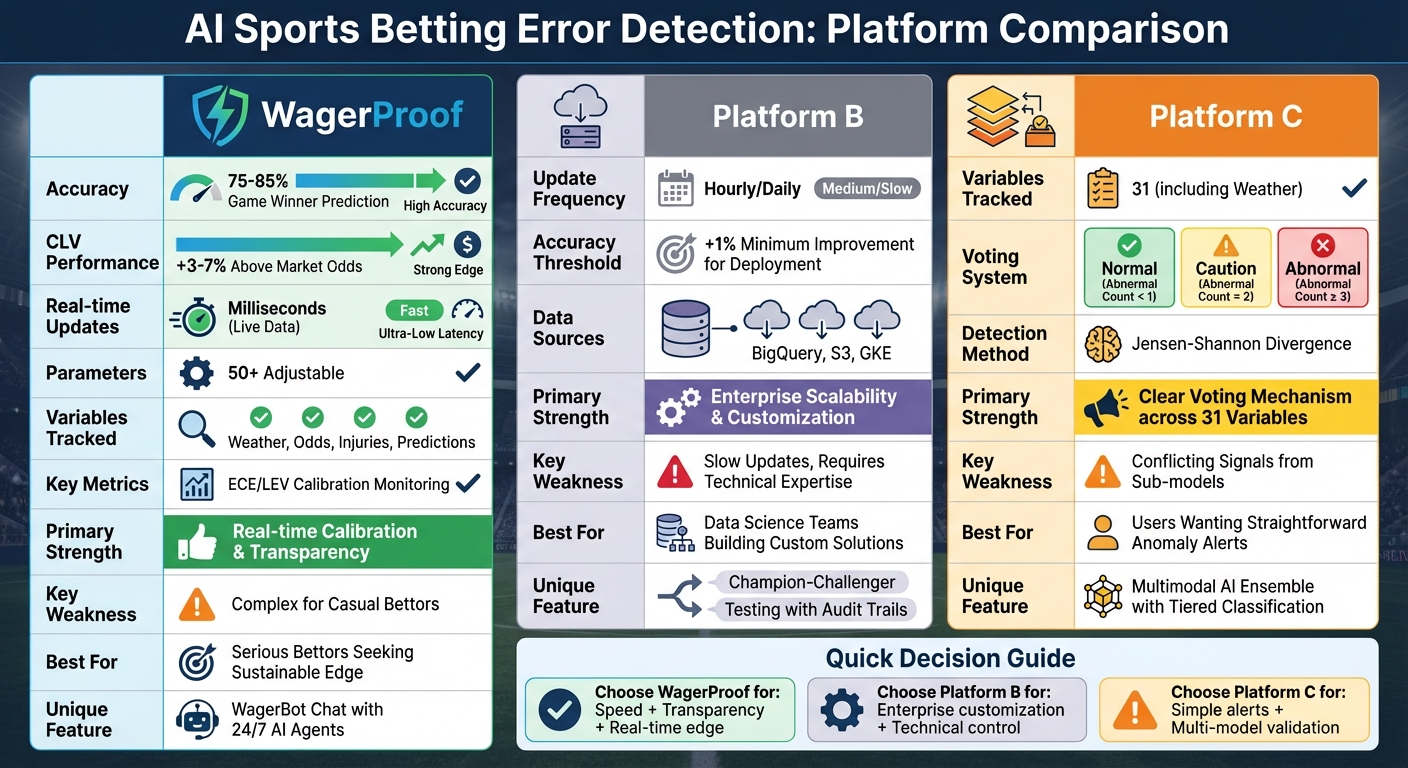
AI Sports Betting Platforms Comparison: WagerProof vs Platform B vs Platform C
1. WagerProof
Error Detection Accuracy
WagerProof's AI research agents deliver an impressive 75–85% accuracy in predicting game winners, far surpassing traditional models. This success comes from the platform's 50+ adjustable parameters, which constantly refine predictions by analyzing historical data, injury reports, and weather conditions. These features work together to identify discrepancies, such as mismatched prediction market spreads or odd betting lines, ensuring a detailed and precise analysis.
Rather than focusing solely on hit-rate accuracy, WagerProof emphasizes model calibration, aligning predicted probabilities with real-world outcomes. This approach provides dependable estimates for stake sizing, allowing the platform to outperform market odds by 3–7% on closing line value (CLV). Using advanced statistical techniques like Jensen-Shannon divergence for numerical data (e.g., odds or spreads) and L-infinity distance for categorical data (e.g., bet types, league IDs), the system identifies anomalies before they impact predictions. This ensures a robust and reliable betting framework.
The platform's ability to process real-time data further enhances its error detection capabilities.
Real-Time Data Handling
WagerProof integrates live data in milliseconds, enabling it to detect errors as games unfold. Through WagerBot Chat, the platform connects directly to professional data feeds, pulling in updates on weather, odds, injuries, and model predictions - all while avoiding misinformation. This allows the system to swiftly respond to sudden changes, such as a quarterback injury altering point spreads or weather shifts impacting baseball props, and notify users before betting markets adjust.
By combining machine learning for pre-game variables with time-series analysis for live events, WagerProof identifies outliers and value bets. Alerts are triggered when prediction market spreads deviate from statistical models, giving bettors the chance to act quickly. This hybrid approach ensures users are informed of risks and opportunities in real time, helping them make smarter decisions.
This seamless real-time processing leads directly into the platform's commitment to transparency and user trust.
Transparency and User Trust
WagerProof operates with complete transparency - there are no hidden tipsters or manipulated records. Users can review predictions against historical data and live updates, with full access to the platform’s parameters. This openness allows bettors to verify how predictions are made and how anomalies are flagged, fostering trust in both the process and the results. By making its error detection methods fully visible, WagerProof empowers users to understand every recommendation, building confidence in the platform's reliability and accuracy.
2. Platform B
Error Detection Accuracy
Platform B relies on TFDV within cloud-native systems to monitor and measure data drift against historical models. Similar to WagerProof, it uses statistical metrics for baseline comparisons to spot anomalies. When drift surpasses predefined thresholds, an automated retraining process kicks in. This process includes a champion-challenger test, which ensures any new model achieves at least a 1% accuracy improvement before deployment. This mechanism helps prevent updates that could compromise performance from being released to users.
Real-Time Data Handling
When it comes to real-time data, Platform B takes a notably slower approach. Instead of processing data continuously, it updates hourly or daily, drawing from sources like BigQuery, S3, and GKE. While this setup ensures complete audit trails for all data, the delayed update cycle may struggle to keep up with fast-changing conditions, such as those seen during live games. If validation fails, events are sent to Dead Letter Queues (DLQ) for manual review. This lag in processing can hinder responsiveness to real-time events, potentially impacting the platform's efficiency in the fast-paced world of sports betting.
Transparency and User Trust
Platform B's use of multiple data sources enables it to maintain detailed audit trails, recording prediction logs and error corrections. However, the system's transparency is more geared toward technical teams rather than end users. This means that while data teams benefit from clear documentation of errors and corrections, everyday users have limited visibility into how errors are flagged and addressed. This approach underscores a balance between providing thorough technical oversight and delivering actionable insights for users, making Platform B stand out in the realm of real-time error detection for sports betting analytics.
3. Platform C
Error Detection Accuracy
Platform C uses a multimodal AI ensemble that combines inputs from various sub-models, each tailored to handle specific data types. This design allows the system to cross-check information from multiple perspectives before flagging potential issues. It also employs Jensen-Shannon divergence to analyze odds movements, which aids in spotting anomalies.
One standout feature is its voting mechanism. When processing match data, the platform sorts findings into three categories: Normal (Abnormal Count < 1), Caution (Abnormal Count = 2), and Abnormal (Abnormal Count ≥ 3). This tiered structure provides users with a clear and simple way to gauge data reliability. To avoid processing the same data point multiple times and mistakenly flagging it as an error, the system enables idempotence by setting enable.idempotence: True.
Real-Time Data Handling
Platform C doesn't just excel in accuracy - it also shines in real-time monitoring. It keeps track of 31 variables, including weather conditions, and uses Jensen-Shannon divergence to detect anomalies as they happen. This ensures that deviations are flagged instantly, keeping the data as up-to-date as possible.
Transparency and User Trust
By tracking anomalies in real time and presenting the findings clearly, Platform C builds confidence among its users. The voting mechanism highlights how many sub-models have flagged a specific data point, making it easier for bettors to use AI for sports betting predictions by evaluating the reliability of the information. Instead of hiding error detection within a complex system, Platform C openly displays the process, showing exactly how many sub-models identified a potential issue. This openness strengthens trust and ensures users feel informed.
Let's Talk About AI And Sports Betting
Advantages and Disadvantages
When it comes to real-time error detection in live sports betting, each platform has its own strengths and challenges. Let’s break them down.
WagerProof (https://wagerproof.bet) stands out with its focus on calibration monitoring. By using real-time ECE (Expected Calibration Error) and LEV (Logarithmic Error Value) tracking, it aligns forecast probabilities with actual outcomes. This precision supports smarter bankroll management through tools like Kelly Criterion staking. However, its complexity - boasting over 50 parameters - might feel overwhelming for casual bettors. On the brighter side, WagerProof's autonomous AI research agents and its WagerBot Chat provide direct access to live professional data, reducing errors like hallucinations and offering clear, actionable insights.
On the other hand, Platform B emphasizes enterprise-level scalability and customization. While it’s highly flexible, it requires significant technical expertise to operate. Another drawback is its lack of transparency, as it doesn’t explain why certain data points are flagged.
Lastly, Platform C uses a voting mechanism to classify findings as Normal, Caution, or Abnormal. It tracks 31 variables, including factors like weather, which provides broad coverage. However, its reliance on multiple sub-models can lead to conflicting signals, often requiring manual intervention to resolve discrepancies.
| Platform | Primary Strength | Key Weakness | Best For |
|---|---|---|---|
| WagerProof | Real-time calibration monitoring (ECE/LEV) with transparent AI agents | Advanced metrics may be complex for casual bettors | Serious bettors seeking a sustainable edge |
| Platform B | Enterprise scalability and extensive customization | Requires significant technical expertise and lacks transparency | Data science teams building custom solutions |
| Platform C | Clear voting mechanism across 31 variables | Multiple sub-models can produce conflicting signals | Users desiring straightforward anomaly alerts |
The best platform for you depends on your priorities. If transparency and calibration-driven risk management are key, WagerProof is a solid choice. For those needing maximum flexibility and customization, Platform B is better suited. Meanwhile, Platform C appeals to users who want simple, visual anomaly alerts without diving into technical details. Whichever option you choose, it’s clear that real-time data integrity is essential for accurate predictions and building trust in AI-driven sports betting.
Conclusion
WagerProof is redefining the landscape of sports betting with its cutting-edge AI research and real-time capabilities. At its core, success in sports betting depends on two key factors: transparency and speed. WagerProof excels in both, making it a standout choice for anyone serious about accuracy. Its AI research agents operate 24/7, meticulously analyzing matchups and identifying anomalies, such as mismatched spreads or overlooked value bets, before the market adjusts.
What truly sets WagerProof apart is its WagerBot Chat, which provides live updates on critical factors like weather, odds, injuries, and predictions. This ensures bettors can adapt instantly. The platform’s speed is complemented by its unwavering commitment to data transparency, fostering trust among users. This approach has already proven its worth, with GenAI-powered tools turning 50% hit rates into profitable outcomes exceeding 60%.
By offering open data and making agent results fully public, WagerProof addresses a major pain point in the sports betting world: trust. There are no hidden experts or gimmicks - just tools designed to help users bet smarter, not just follow tips blindly. This rigorous system uncovers valuable opportunities that others might miss.
For bettors looking to gain a real edge, WagerProof combines precision, speed, and transparency to deliver tools that empower smarter, more profitable decisions. It’s a game-changer for anyone aiming to stay ahead in the ever-evolving world of sports betting.
FAQs
What is model calibration, and why does it matter for betting?
Model calibration refers to how well a model's predicted probabilities match actual outcomes. For instance, if a model predicts an event has a 60% chance of happening, that event should occur 60% of the time over many trials.
This alignment is crucial for making informed betting decisions. When a model is well-calibrated, its predictions can be trusted to reflect real-world probabilities, ensuring decisions are based on reliable data.
How does WagerProof catch bad data in live games?
WagerProof pinpoints unreliable data in live games through a combination of anomaly detection, cross-referencing multiple data feeds, and latency monitoring. It actively identifies problems such as delayed updates or conflicting information. When disruptions occur, it temporarily halts betting to prevent errors. Additionally, it compares odds from different sources to ensure the information remains accurate and trustworthy.
How should I use anomaly alerts to size my bets?
To get the most out of anomaly alerts, keep a close eye on them to identify irregularities such as mismatched odds or unexpected betting patterns. Use this information to adjust your betting strategy on the fly. For example, you can increase your bet size when anomalies reveal a potential advantage or scale back when they hint at higher risks or questionable data. Pair these alerts with your model's confidence levels to fine-tune your decisions and make smarter choices about managing your bankroll in real time.
Related Blog Posts
Ready to bet smarter?
WagerProof uses real data and advanced analytics to help you make informed betting decisions. Get access to professional-grade predictions for NFL, College Football, and more.
Get Started Free