
Bankroll Segmentation for Multi-Sport Betting
Want to bet smarter across multiple sports? Bankroll segmentation is your answer. It’s about dividing your betting funds into sport-specific segments, like NFL, NBA, or MLB, to manage risk and protect your bankroll. Here’s why it works:
- Isolates losses: A bad streak in one sport won’t drain funds for others.
- Tailored strategies: Adjust bet sizes for each sport’s unique dynamics (e.g., smaller bets for MLB’s high variance).
- Tracks performance: Clear separation shows which sports are profitable.
For example, with $5,000, you might allocate $2,500 to NFL, $1,500 to NBA, and $1,000 to MLB. Each segment operates independently, with its own unit size and risk strategy. Start small, track results, and rebalance when a segment grows or shrinks by 20%.
This method isn’t just about organization - it’s a way to stay disciplined, control losses, and build a long-term betting strategies.
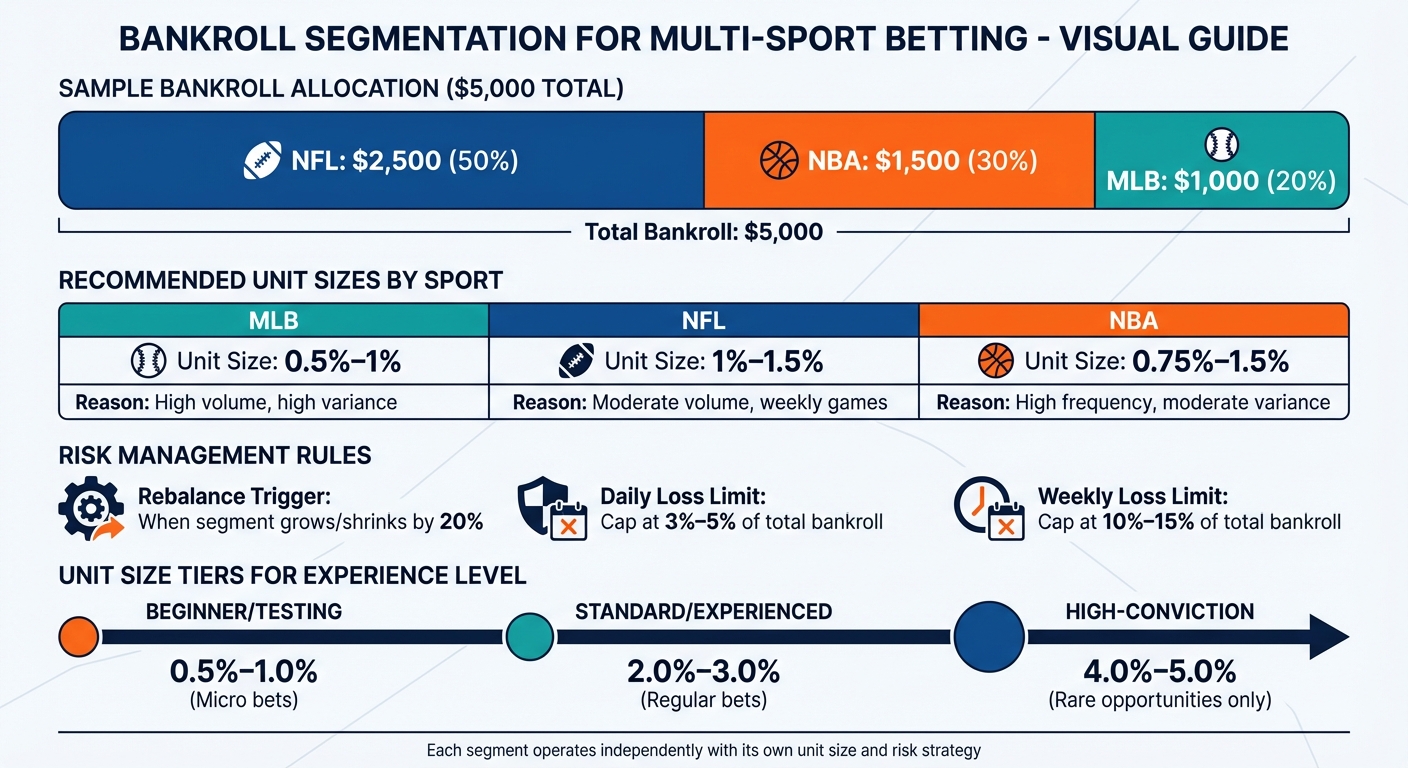
Bankroll Segmentation Strategy: Allocation Example and Unit Sizing by Sport
Bankroll Segmentation Basics
What is Bankroll Segmentation?
Bankroll segmentation involves dividing your total betting capital into separate portions, each dedicated to specific sports, betting markets, or bet types. Instead of pooling all your funds into one account for every wager, you allocate specific amounts for each area of focus. For example, if you have $5,000, you might set aside $2,500 for NFL betting, $1,500 for NBA, and $1,000 for MLB. Each segment operates independently with its own unit size and risk strategy, ensuring that performance in one area doesn’t impact another.
This method differs from using a single bankroll because it isolates losses. If one sport underperforms, it won’t drain funds set aside for others. Think of each sport as its own mini-investment within a larger portfolio. For instance, you might choose conservative 1% units for MLB, a high-volume market, while opting for 3% units in a sport where you’ve identified a stronger edge.
Why Segment Your Bankroll
Now that the concept is clear, the advantages of segmentation stand out. The most important is downside protection. A losing streak in one sport stays confined to its segment, preserving funds for other opportunities. This approach emphasizes targeted risk management, which is crucial given that roughly 95% of sports bettors lose money over time - often due to poor money management rather than bad picks. Segmentation also provides clarity by showing exactly which sports are profitable and which are not. This way, profits from one area don’t hide losses in another.
"Separate bankrolls for different sports... prevents your strong area from subsidizing your weak one."
– Authoritative Source, Bet2026Expert.com
Different sports come with varying levels of risk, which means unit sizes should be adjusted accordingly. Even with a solid 55% win rate, a bettor can still experience a 10-game losing streak. Betting 10% per game in such a scenario could wipe out your entire bankroll, whereas sticking to 2% units would limit the loss to 20%.
Common Mistakes to Avoid
While segmentation can be effective, there are common mistakes that can undermine its purpose. A key one is overcomplicating the strategy. Creating too many sub-banks or rigid rules can lead to frustration and abandonment of the approach. Start simple - use a single bankroll until you’ve developed a clear edge in a specific sport. Remember, segmentation is a tool to preserve capital, not a shortcut to success. It should complement disciplined handicapping and a focus on value.
Another frequent error is commingling funds. Mixing your betting bankroll with money earmarked for essentials like rent or groceries increases emotional pressure and can lead to impulsive decisions. To avoid this, use a dedicated betting account or e-wallet. Additionally, watch out for correlated overexposure - placing multiple bets on a single event within a segment. If your main prediction is wrong, you could lose on multiple fronts. To manage this risk, set a "max exposure per game" rule, limiting total wagers to 2–3 units across all bets on a single event.
"I feel that it is almost as important to implement good money management tactics as it is to pick winners."
– Jerald, Veteran Handicapper, Predictem.com
How to Segment Your Bankroll
Determine Your Total Bankroll
Your bankroll should consist ONLY of money you can afford to lose without causing financial stress. This is crucial because sports betting comes with natural ups and downs. Even bettors with a strong 55% win rate can experience losing streaks as long as 10 games.
A good starting point is to think of your bankroll in terms of 100 units. For instance, if one unit equals $10, a bankroll of 100 units would total $1,000. If a unit is $20, the bankroll would be $2,000. This "unit system" helps you manage your funds and prepare for inevitable variance while protecting your capital. Keep this money separate from other finances to avoid mixing funds.
Once you’ve defined your total bankroll, the next step is to allocate it based on your strengths in different sports.
Divide Funds by Sport
Break your bankroll into segments based on your expertise in each sport. For example, if you have a $5,000 bankroll, you might allocate 50% to NFL, 30% to MLB, and 20% to NBA. These percentages should reflect where you’ve shown consistent success, helping you manage risk more effectively.
You’ll also want to adjust the size of your betting unit for each sport depending on its volume and variance. For example, you might bet 2% of your NFL bankroll per wager, but only 1% for MLB, which has a higher volume of games and more variance over the season.
Account for Seasonal Changes
Your bankroll allocation should shift with the sports calendar. During busy months like September through January - when the NFL, college football, NBA, and MLB playoffs overlap - you might allocate around 35% of your yearly bankroll to this period. On the other hand, during slower months like the summer (when MLB and WNBA dominate), a 20% allocation might make more sense.
Consider adopting a monthly budgeting system. For example, if you have a $12,000 yearly bankroll, you might allocate $1,500 for October (a high-activity month) but only $800 for July (a quieter month). At the start of each month or quarter, recalculate your unit sizes based on your current bankroll. If your bankroll grows or shrinks by roughly 20%, adjust your unit sizes to maintain consistent risk levels. This approach ensures your strategy evolves with the sports seasons, keeping your risk management sharp.
Advanced Allocation Methods
Allocating Based on Risk
Fine-tuning your allocations based on the risk level of each sport can make a big difference. For example, in MLB, it's recommended to use 0.5%–1% units, while in the NFL, you might go with 1%–1.5%, and for the NBA, 0.75%–1.5% is a good range to consider. To better manage your bankroll, divide it into risk tiers: dedicate about 80% to low-volatility, high-confidence plays and the remaining 20% to high-volatility, speculative bets.
If you're just starting out or testing strategies in a new sport, sticking to smaller "micro" bets (0.5% to 1.0%) is a safer approach. More experienced bettors with solid performance tracking might move up to the "standard" range (2.0% to 3.0%). For those rare, high-conviction opportunities, some may even explore more aggressive allocations, typically in the 4.0% to 5.0% range. These strategies allow you to manage risk effectively, even when dealing with overlapping markets in correlated sports.
Managing Correlated Sports
Correlated bets come with their own challenges, so managing exposure is key. One method is to set a hard cap of 2–3 units per game across all markets. Adjust your stakes based on the level of correlation:
- For highly correlated bets (0.75 or higher), cut your stake by 50%.
- For moderate correlation (around 0.50), reduce it by 30%.
- For lower correlation (approximately 0.25), trim it by 15%.
To prevent overexposure, limit your total open bets to 5%–10% of your bankroll across a slate of games. This approach ensures that you don't take on too much risk in a single game or betting session.
When and How to Rebalance
Adjusting your bankroll and unit sizes at the right time is critical for maintaining consistency. A good rule of thumb is to recalculate unit sizes whenever your bankroll changes by 20%–25%. This method helps keep your exposure stable without constant adjustments. Similarly, if you face a 25% drawdown, it's a clear signal to reduce your unit size and reassess your overall strategy.
Stop-loss measures are another essential tool. Cap your daily losses at 3%–5% and weekly losses at 10%–15% to avoid spiraling losses. Additionally, set withdrawal goals to lock in profits - such as cashing out 25% of your gains when your bankroll doubles. These measures not only protect your bankroll but also help you stay disciplined over the long term.
Combining Segmentation with Bet Sizing
Staking Strategies for Each Segment
Once you've divided your bankroll into segments, the next step is choosing a staking strategy for each one. Flat betting is a straightforward option, especially for beginners or when dealing with high-variance sports. It involves wagering the same amount - usually 1%–2% of the segment - on every bet, helping to limit risk. Another option is percentage betting, where you bet a fixed percentage of the current segment bankroll. This approach adjusts your wager size as your bankroll grows or shrinks, offering more flexibility.
For those confident in their mathematical edge, the Kelly Criterion is a tool to maximize long-term growth. It calculates bet sizes based on your perceived advantage over the bookmaker's odds. However, using the full Kelly Criterion can lead to significant volatility, with a 100% Kelly strategy risking around 60% of your bankroll for a potential 104% growth. To manage this risk, many professionals opt for fractional Kelly strategies, such as Half- or Quarter-Kelly. For example, a 30% Kelly approach typically risks about 24% of your bankroll, striking a balance between growth and stability.
By aligning staking strategies with your segments, you can fine-tune your risk and reward balance across different sports or markets.
Setting Independent Unit Sizes
After deciding on a staking strategy, the next layer of control comes from setting independent unit sizes for each segment. This step ensures that poor performance in one segment doesn’t negatively impact the others. For example, if you allocate $2,500 to your NFL segment, a 1% unit size translates to $25 per bet. Meanwhile, a $1,500 NBA segment would use $15 units under the same 1% rule. This separation keeps risks contained within each segment.
"Bankroll segmentation... prevents a bad run in one sport from depleting your entire bankroll." - Vivatbet
Adjust your unit sizes based on market characteristics. High-variance bets, like player props or longshots, might require smaller units (around 1%) to manage swings. On the other hand, more predictable markets with reliable data may justify larger units, such as 3%–5% of the segment. These calculated adjustments create a disciplined, data-backed framework for managing risk across multiple sports or betting markets.
Tracking Results and Adjusting Allocations
Key Metrics to Track
Once you've set up your segments and staking strategies, the next step is keeping a close eye on performance. Start with Return on Investment (ROI) - this metric shows how much profit you're making compared to the amount you've wagered. A positive ROI is a solid indicator that you're on the right track. Another key metric is your win rate (also called hit rate) - the percentage of bets you win. For standard -110 spread bets, you'll need a win rate above 52.4% just to break even. Additionally, keep tabs on your total profit/loss, both in units and dollars, to get a clear picture of how your bankroll is affected.
Don't stop at performance metrics - make sure you're tracking risk as well. Maximum drawdown is a critical metric that measures the worst decline you've experienced, from a high point to a low point. For example, if your NFL segment sees a 25% drop, that’s a warning sign that demands immediate review. Breaking down performance by sport, league, and market type (like spreads versus props) can also help you identify which segments might be draining your bankroll.
Triggers for Rebalancing
Rebalancing isn’t about constant adjustments - it’s about knowing when to act. Reassess your unit sizes and reallocate funds when a segment grows or shrinks by 20% or faces a 25% drawdown. If a segment grows by 20%, you can consider increasing unit sizes. On the flip side, if it drops by the same percentage, scale back to protect your bankroll.
Set firm stop-loss limits to control risk: consider capping daily losses at 3–5% and weekly losses at 10–15%. These limits align with the risk tiers you’ve already established. This approach helps you avoid emotional "tilt" betting after a rough day. Only increase your base unit sizes after a segment has grown by at least 50% - this ensures you're scaling up from a position of strength.
"I feel that it is almost as important to implement good money management tactics as it is to pick winners." - Jerald, Veteran Handicapper, Predictem
By following these metrics and triggers, you can make data-driven adjustments that keep your bankroll strategy on course.
Using Data Tools for Tracking
Real-time data tools can uncover patterns you might otherwise miss. For instance, WagerProof (https://wagerproof.bet) aggregates historical stats, public betting trends, and prediction market data. It identifies value bets by flagging mismatches in prediction market spreads and even recommends when to fade certain games. Another tool, WagerBot Chat, connects you to live professional data, consolidating weather updates, odds, injury reports, and model predictions. These tools simplify your decision-making process, making it easier to rebalance your strategy based on real-time insights.
Sports Betting 101: The Ultimate Guide to Bankroll Management
Conclusion
Bankroll segmentation lays the groundwork for lasting success in sports betting. By splitting your funds by sport, you can manage risk more effectively and adapt your strategy to the unique dynamics of each market. This method not only helps safeguard your funds but also equips you to handle the inevitable ups and downs that come with betting.
Even small errors in risk management can spiral into major losses. For example, with a 55% win rate, a 10-game losing streak is entirely possible and could severely deplete your bankroll if unit sizes are miscalculated. Sticking to 1%–3% of your funds per wager and keeping your segments separate allows you to absorb variance and capitalize on your edge over the long run.
"Always remember that it is a marathon, not a sprint, and the best way to grow our bankroll is to grind out profits over a period of time."
– Jerald, Handicapper, Predictem.com
Start with a bankroll you can afford to lose, then divide it by sport based on your proven strengths. Set strict limits on your exposure, track every bet carefully, and adjust your unit sizes if a segment changes by 20% or more. If losses start piling up, reassess your strategy immediately.
FAQs
How many bankroll segments should I use?
When managing your bankroll for multi-sport betting, it's often suggested to use a single bankroll segment or unit, typically between 1-5% of your total bankroll. Many bettors lean toward a flat betting system, where every wager represents a fixed percentage of the bankroll. This method helps keep risks in check while ensuring a consistent approach across different sports.
How do I pick the right unit size for each sport?
When deciding on your unit size, base it on a percentage of your total bankroll rather than sticking to a fixed dollar amount. A good starting point is to use 1 unit per bet until you’ve tracked at least 200 bets. Most experts suggest wagering between 0.5% and 2% of your bankroll per bet to keep risk under control. Think of your bankroll as a business budget - track every single bet, monitor your performance, and adjust your unit sizes based on your results and confidence levels.
When should I rebalance my sport allocations?
When major shifts happen - like a drop in ROI, reduced prediction accuracy, or changes in market conditions such as roster updates or rule changes - it’s time to rethink your sports allocations. Seasonal trends or fluctuating confidence in specific markets can also signal the need for adjustments. By regularly reviewing performance metrics, you can ensure your allocations stay in line with your strengths and risk tolerance, safeguarding your bankroll and keeping your betting strategy steady.
Related Blog Posts
Ready to bet smarter?
WagerProof uses real data and advanced analytics to help you make informed betting decisions. Get access to professional-grade predictions for NFL, College Football, and more.
Get Started Free