
How Bayesian Analysis Finds Value Bets
Bayesian analysis helps sports bettors refine probabilities and make smarter decisions by updating predictions as new information emerges. This approach identifies discrepancies between your calculated probabilities and bookmaker odds, creating opportunities for value bets. Here's how it works:
- Start with a Prior Probability: Use sports betting data analysis to establish a baseline likelihood of an outcome.
- Update with New Evidence: Incorporate real-time data like injuries, weather changes, or lineup adjustments using Bayes' Theorem.
- Identify Value Bets: Compare your updated probability (posterior) to the implied probability from bookmaker odds. If your calculation shows a higher likelihood, you've found a potential value bet.
- Leverage Tools: Platforms like WagerProof automate Bayesian updates, highlight value bets, and provide real-time insights.
Bayesian methods give you an edge by exploiting delays in market adjustments. This data-driven approach ensures your betting decisions are based on probabilities, not guesswork.
Understanding Bayes' Theorem for Probabilities
Key Components of Bayes' Theorem
Let’s break down the essential pieces of Bayes' Theorem, which is the backbone of Bayesian probability calculations. There are four main components that work together to refine probability estimates:
- Prior probability: This is your starting point - the initial likelihood of an outcome before factoring in new information. For example, in sports betting, this might come from historical win rates, Elo ratings, or head-to-head records.
- Likelihood: This measures how likely the new evidence is if your hypothesis holds true. For instance, if a key player gets injured, historical data may suggest a lower win rate for the team.
- Evidence (or marginal likelihood): This represents the overall probability of seeing the new information, accounting for all possible scenarios. It helps normalize the probabilities.
- Posterior probability: This is the updated probability after incorporating the new evidence. Bettors often compare this with bookmaker odds to identify value opportunities.
Here’s a quick summary of how these components translate to betting:
| Component | Betting Equivalent | Function |
|---|---|---|
| Prior P(A) | Baseline Win % | Initial belief based on historical stats |
| Likelihood P(B|A) | Impact of News | Probability of evidence given the hypothesis |
| Evidence P(B) | Market Frequency | Overall probability of the new information |
| Posterior P(A|B) | Updated Win % | Refined probability after considering the evidence |
Now, let’s see how these components come together in a sports context.
Applying Bayes' Theorem to Sports Events
Imagine a real-time sports scenario to see this in action. Take a Golden State Warriors game, where the initial belief (prior) was a 65% chance of winning. Then, news breaks that Stephen Curry is injured. Historical data shows the team wins only 45% of games without him. Using Bayes' Theorem, you multiply the prior odds by the likelihood ratio, which compares how much more likely the evidence (Curry’s absence) is under a win versus a loss. This calculation might lower the updated probability (posterior) to around 48%. If the bookmaker’s odds reflect a 55% win probability, this discrepancy could signal a value bet on the opposing team.
Bayesian updating isn’t just for single-game scenarios - it’s also a powerful tool in broader analyses. For example, during the English Premier League's 2020–2021 season, researcher Rodrigo Morales analyzed home win rates during the COVID-19 pandemic. He started with a prior of 0.46 (based on 1,900 matches from earlier seasons) and updated this using data from 380 new matches, where the actual home win rate dropped to 0.38. By adjusting the prior sample size, Morales determined there was a 99% posterior probability that home advantage had genuinely declined.
What’s fascinating here is the sequential updating process. Each posterior probability becomes the new prior for the next calculation. This method keeps bettors ahead of slow market adjustments, helping them spot mispriced lines before they correct. It’s a dynamic approach that shows how historical data can continually refine priors for sharper predictions.
Using Historical Data to Set Priors
Collecting Historical Data
Building a solid Bayesian betting model starts with well-grounded priors, and that means relying on high-quality historical data. The best starting point? Official league statistics and Vegas opening/closing lines. These sources reflect the expertise of sharp bettors and bookmakers, making them a trusted baseline validated by real-money betting outcomes.
To refine your priors, include game-state variables like scoring margin, time remaining, possession, and field position. Efficiency metrics - like Expected Goals (xG) in soccer or Effective Field Goal Percentage (eFG%) in basketball - are also key. For example, sportsbook point spreads explain 86% of the variability in median NFL match outcomes, while point totals account for 79%. This high level of predictive accuracy comes from integrating detailed game data, not just simple win-loss records.
Another important factor is sample size. You need thousands of predictions to achieve reliable calibration. Professional bettors also emphasize roster stability - at least 70% continuity is ideal - when using data from the previous 1–2 seasons. Major roster changes can significantly impact a team's performance, reducing the predictive value of historical stats. Tools like WagerProof simplify this process by consolidating pro-level betting data, including historical stats, prediction markets, and statistical models, into one easy-to-use platform. This can save hours of manual data collection while ensuring your priors are built on a solid foundation.
Once you’ve established robust priors, the next challenge is maintaining their reliability as conditions change.
Evaluating Data Quality for Priors
After gathering data, the next step is ensuring its quality, as this directly impacts the accuracy of Bayesian updates. A critical first step is ensuring data cleanliness - accurate labeling and the removal of duplicates are non-negotiable. Poor data hygiene can skew your model’s predictions. One way to measure data quality is through Closing Line Value (CLV). A strong model should consistently beat the closing line by 1%–2%, while top-tier AI models can achieve a 3%–7% edge on average. If your model isn’t surpassing the closing line by at least 1%, it’s time to reassess your data.
Another pitfall to watch out for is short-term data bias. Overreacting to recent trends - like a team’s last three wins - can distort your priors. To strike a balance, combine recent head-to-head matchups (3–5 games) with full-season data. Also, be mindful of venue bias. For instance, home dominance might reflect situational advantages rather than true team strength. Situational factors like short rest, travel fatigue, or weather conditions can also heavily influence performance. For example, NBA teams playing three games in four nights often show reduced efficiency, and West Coast NFL teams playing 1:00 PM ET games tend to underperform due to travel fatigue.
Lastly, focus on calibration over raw accuracy. It’s not just about predicting winners - it’s about ensuring your probabilities align with actual outcomes. If you assign a 70% chance to an event, it should happen 70% of the time. Use techniques like quantile binning and regular drift tests to keep your priors sharp and aligned with evolving team dynamics. Calibration ensures your model remains reliable, even as conditions shift.
Ep: 119 - Betting with Modeling, Statistics and Bayes Theorem
Updating Probabilities with New Evidence
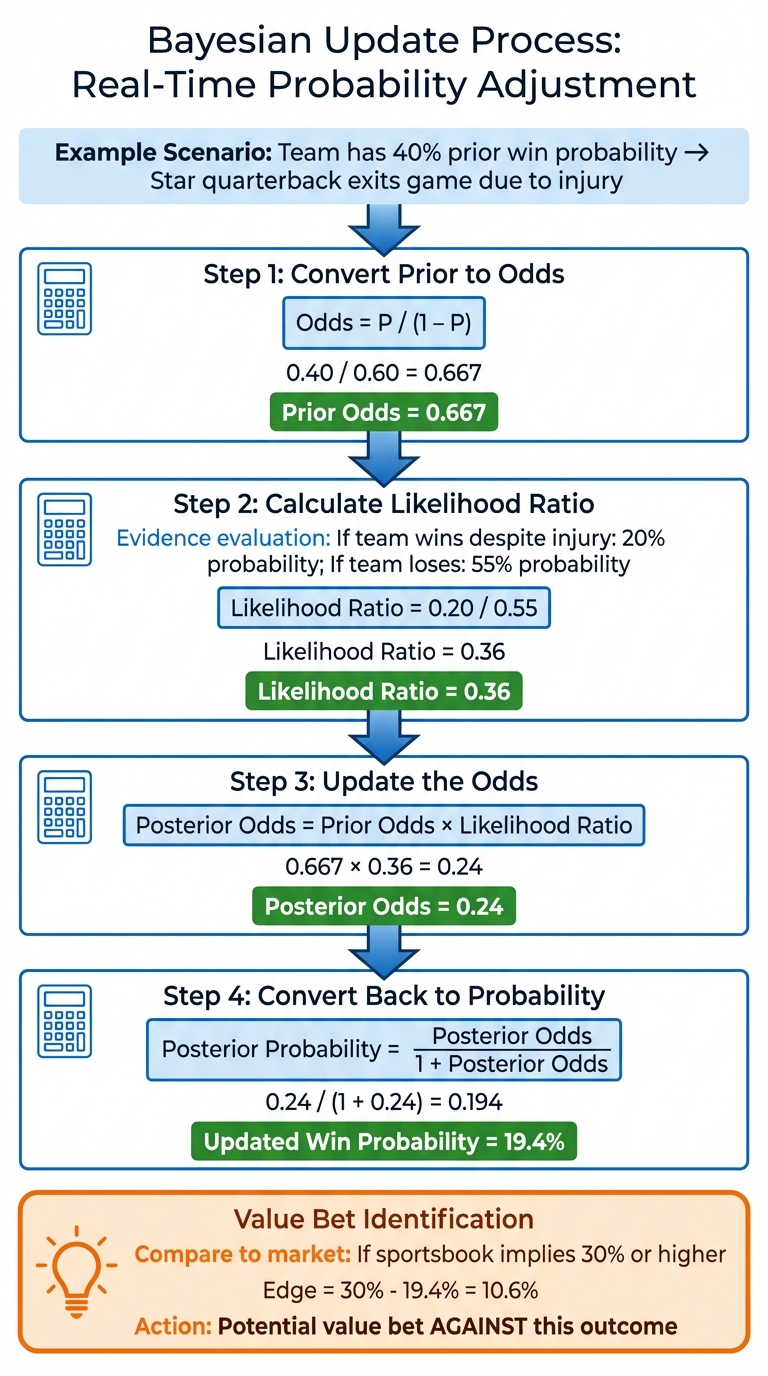
How Bayesian Analysis Updates Betting Probabilities: 4-Step Process
Incorporating Real-Time Evidence
Bayesian analysis thrives on the ability to adjust probabilities as new information comes to light. By starting with well-informed priors and integrating real-time data, bettors can better identify fleeting market inefficiencies. This approach is particularly valuable when new evidence shifts win probabilities, separating skilled bettors from casual participants.
Take personnel changes, for instance. A sudden injury report or the unexpected return of a key player can dramatically influence odds. Consider this: when Cristiano Ronaldo was confirmed to return to a lineup, odds shifted from 2.03 to 1.86. This reflects how markets respond to such impactful updates. Metrics like usage rate and target share can help quantify the effect of a player’s presence or absence on a team’s performance.
Environmental factors also require immediate adjustments. For example, strong winds exceeding 15 mph can reduce passing efficiency and field goal accuracy, directly affecting point totals. Similarly, in-game variables - such as scoring margin, possession, time remaining, and field position - provide fresh evidence that should inform Bayesian updates. For pre-game data like point spreads, applying time-decay functions (e.g., multiplying the spread by ((clock_in_seconds / 3,600)^3)) helps reduce the influence of outdated information as live data becomes available.
Tools like WagerBot Chat streamline this process by allowing users to ask questions in plain English, such as, "How do 15+ mph winds affect this team's passing?" The tool uses live data to provide actionable insights, saving time and effort while ensuring accurate Bayesian updates.
This approach lays the groundwork for a step-by-step framework to apply Bayesian updates in real-time.
Step-by-Step Example of Bayesian Updates
Let’s walk through an example of how Bayesian analysis works during a game, focusing on the continuous adjustments that make this method so effective. Imagine you’ve set a 40% prior win probability for a team before kickoff. Then, the team’s star quarterback exits the game due to an injury - this becomes your new piece of evidence.
Step 1: Convert the prior probability into odds using the formula:
Odds = P / (1 - P).
For a 40% probability, the calculation is (0.40 / 0.60 = 0.667), giving you 0.667 prior odds.
Step 2: Estimate the likelihood ratio by evaluating how likely the evidence is under two scenarios. If the team wins despite the injury, the probability of this evidence occurring might be 20%. If they lose, it could be 55%. The likelihood ratio is calculated as (0.20 / 0.55 = 0.36).
Step 3 and 4: Update the odds by multiplying the prior odds ((0.667)) by the likelihood ratio ((0.36)), resulting in posterior odds of 0.24. Then, convert this back into probability using the formula:
Posterior Probability = Posterior Odds / (1 + Posterior Odds).
This gives you a 19.4% win probability.
Now, compare this updated probability to the sportsbook’s implied probability. If the market still prices the team at 30% or higher, you’ve identified a potential value bet to wager against that outcome. The beauty of Bayesian analysis lies in its ability to "chain" updates - your posterior probability becomes the new prior as additional evidence surfaces during the game.
To manage risk, use fractional Kelly sizing and set clear timestamps for updates to avoid reusing the same evidence. If your model frequently diverges from the closing line, revisit your likelihood ratios to ensure your assumptions remain accurate.
With updated probabilities in hand, bettors can now identify opportunities where the market undervalues an outcome.
Identifying Value Bets Using Posterior Odds
What Are Value Bets?
A value bet occurs when the probability you've calculated (posterior probability) is higher than the bookmaker's implied probability. In essence, value betting means spotting odds that offer better returns than the actual likelihood of an outcome happening.
The concept of Expected Value (EV) is crucial here. A positive EV suggests that, over time, the math is in your favor, even if individual bets don't always win. In simple terms, a bet has "value" when your estimated probability is greater than the implied probability.
Now, let’s break down how to calculate this edge using Bayesian odds.
Calculating Value Bets with Bayesian Odds
To start, convert the bookmaker's decimal odds into an implied probability using this formula:
Implied Probability = 1 / Decimal Odds
For example, if the odds are 2.50, the implied probability is 40% (1 / 2.50 = 0.40).
Next, compare this implied probability to your posterior probability, which you’ve updated using Bayesian analysis. The difference between the two gives you your edge:
Edge = Posterior Probability − Implied Probability
Let’s say your model estimates a 48% chance of an outcome, while the market implies only 40%. That 8% difference represents your edge - a potential value bet.
To determine profitability, calculate the Expected Value (EV) with this formula:
EV = (Posterior Probability × Decimal Odds) − 1
For example, using a 48% posterior probability and odds of 2.50, the EV would be:
(0.48 × 2.50) − 1 = 0.20
This means a 20% expected return on each dollar wagered. A positive EV like this signals a value bet.
However, not every small discrepancy is worth acting on. To avoid noise and errors in your model, many bettors set a minimum edge threshold - commonly between 2% and 5% - before placing a bet.
"The rare moments when your posterior diverges sharply from the market price after a careful update - those are the trades worth taking".
How WagerProof AI Tools Support Bayesian Betting

Bayesian updates are a fantastic way to refine probabilities, but let’s face it - manually updating them for every new piece of information can be a grind. That’s where automation steps in. WagerProof makes this process seamless, delivering transparent, real-time updates that take the heavy lifting off your plate.
Personalized AI Research Agents
Think of WagerProof's AI research agents as your personal Bayesian experts. These agents don’t just monitor matchups - they actively update probabilities as new evidence rolls in and even highlight value bets automatically. You can fine-tune over 50 settings, like risk tolerance, favorite sports, or betting style, to align perfectly with your approach.
Here’s an example: say a star player gets ruled out just 30 minutes before the game. Your AI agent recalculates the probabilities instantly, applying Bayesian logic to the new data. If the updated edge fits your criteria, you’ll get an alert right away. And because transparency matters, all results are fully open and accessible.
To make things even easier, WagerBot Chat ties everything together, consolidating live data into actionable insights.
Live Data and Transparent Insights
WagerBot Chat is like having a Bayesian toolbox in one place. Got a question like, “How will tonight’s weather impact the over in the Chiefs game?” Ask away. It’ll provide a detailed analysis that pulls in weather data, injury updates, historical trends, and model predictions. By connecting to live professional data sources, WagerBot ensures you’re working with real-time, reliable information.
Then there’s the Edge Finder, which compares your updated Bayesian probabilities with market consensus. This tool surfaces outliers and highlights gaps in the consensus, giving you a clear advantage. The AI Game Simulator runs thousands of game simulations to create posterior probabilities, while the Public Money Splits tool reveals where sharp money diverges from public bets - a crucial indicator for revisiting your priors. Together, these tools turn Bayesian betting into a practical, repeatable strategy you can rely on.
Conclusion
Bayesian analysis offers a way to refine probabilities as new data becomes available. This method is particularly useful for spotting value bets when sportsbooks are slow to adjust their odds. By starting with a prior probability based on historical patterns, incorporating new information, and recalculating to get a posterior probability, you create a sharper, more accurate picture of the betting landscape.
The ability to act quickly on these updated probabilities is what sets successful bettors apart. Timing is everything when it comes to leveraging fresh evidence.
WagerProof simplifies this process by automating Bayesian updates. Its AI agents identify value bets and notify you when the odds are in your favor. WagerBot Chat compiles real-time data into practical insights, while the platform's advanced tools transform updated probabilities into actionable betting opportunities. This combination of data and AI showcases how Bayesian methods can lead to smarter, more informed sports betting decisions.
With WagerProof, you're not relying on guesswork. You’re using a data-driven, transparent approach to calculate and make smarter bets.
FAQs
How do I choose a good prior probability?
A good prior probability represents your initial belief about how likely an event is before considering new data. You can base this on historical trends, expert opinions, or what you already know. For instance, if past results indicate a 50% chance of success, that percentage becomes your prior. The trick is calibration - pick a realistic starting point that allows for adjustments as new evidence comes in, helping you fine-tune your betting approach over time.
How often should I update probabilities with new info?
To keep your probabilities accurate, you should update them regularly, tailoring the frequency to the market's volatility. For steadier sports like the NFL, quarterly updates might suffice. On the other hand, more unpredictable markets, such as horse racing, could require weekly revisions. By applying Bayesian analysis, you can adjust probabilities whenever new information emerges - like player injuries or sudden weather shifts. This approach helps ensure your predictions stay in sync with real-world developments.
What edge is big enough to bet?
An edge in betting arises when the estimated probability of an outcome surpasses the implied probability derived from the bookmaker's odds. This creates a scenario with a positive expected value (EV). Tools like Bayesian analysis and correlation methods play a key role in spotting these opportunities. They work by refining probabilities with fresh data and identifying discrepancies in market odds, helping bettors uncover potential value bets.
Related Blog Posts
Ready to bet smarter?
WagerProof uses real data and advanced analytics to help you make informed betting decisions. Get access to professional-grade predictions for NFL, College Football, and more.
Get Started Free