Best Practices for Betting with Line Discrepancies
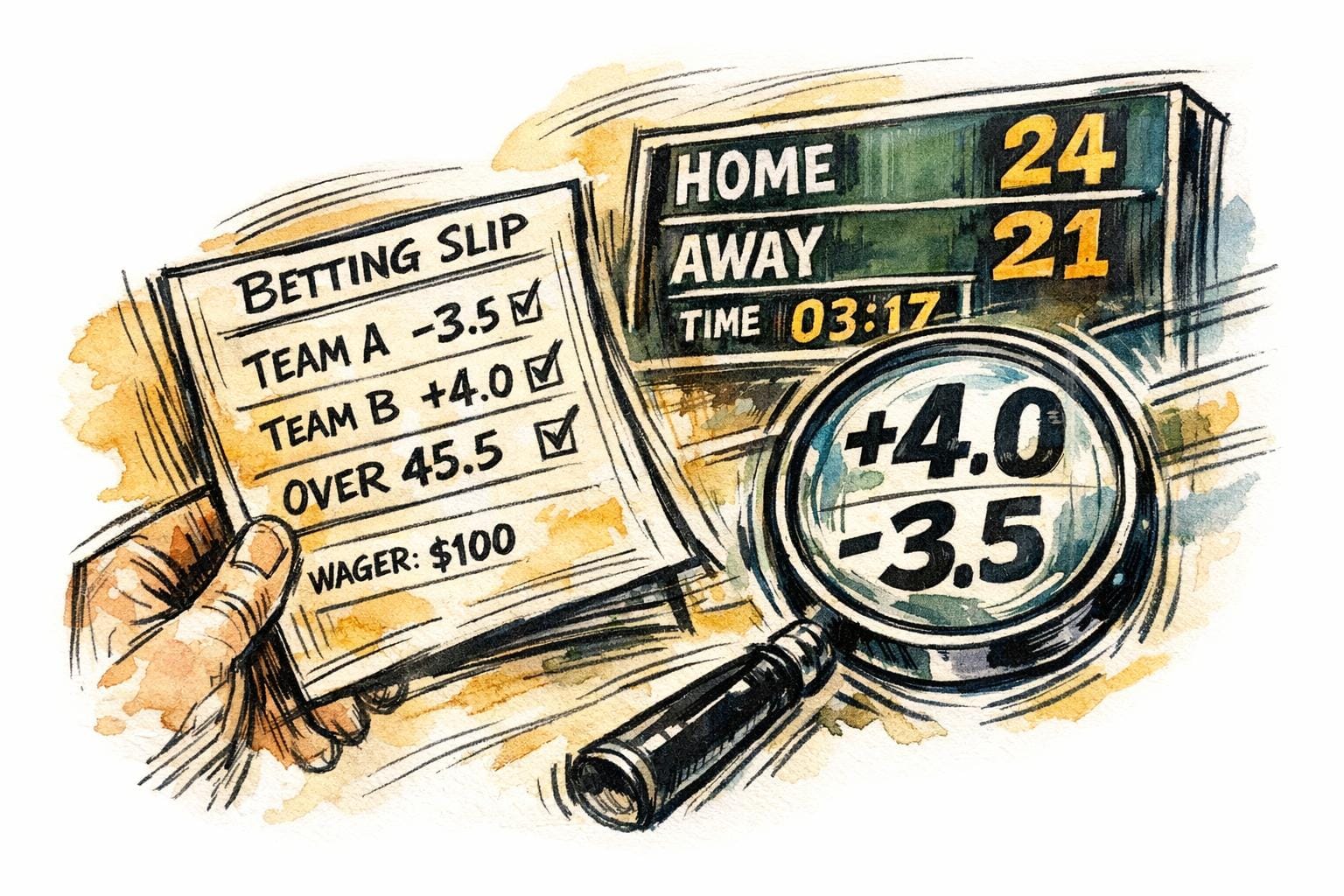
Line discrepancies in sports betting occur when odds, spreads, or totals differ across sportsbooks or deviate from market averages. These differences arise due to varying reaction times to news and unique line-setting models. By identifying and acting on these gaps, you can gain an edge and improve your betting outcomes.
Key takeaways:
- What are line discrepancies? They’re variations in odds between sportsbooks due to differing models or delayed updates.
- Why they matter: Better odds can lower your breakeven win rate and boost profits. For example, -105 odds require a 51.2% win rate to break even compared to 52.4% at -110.
- How to find them: Use real-time tools like WagerProof to monitor odds across sportsbooks, track sharp money movements, and calculate expected value (EV).
- Avoid common mistakes: Don’t chase sudden line shifts or overreact to minor news. Focus on disciplined execution and long-term strategies.
Tools like WagerProof help automate data tracking, calculate EV, and alert you to opportunities, making the process more efficient. Consistently beating the closing line and refining your approach over time are essential for long-term success.
Former Wall Street Trader EXPLAINS Sports Betting Line Movement ($1 Million Trick)
How to Find Line Discrepancies Using Data and Tools
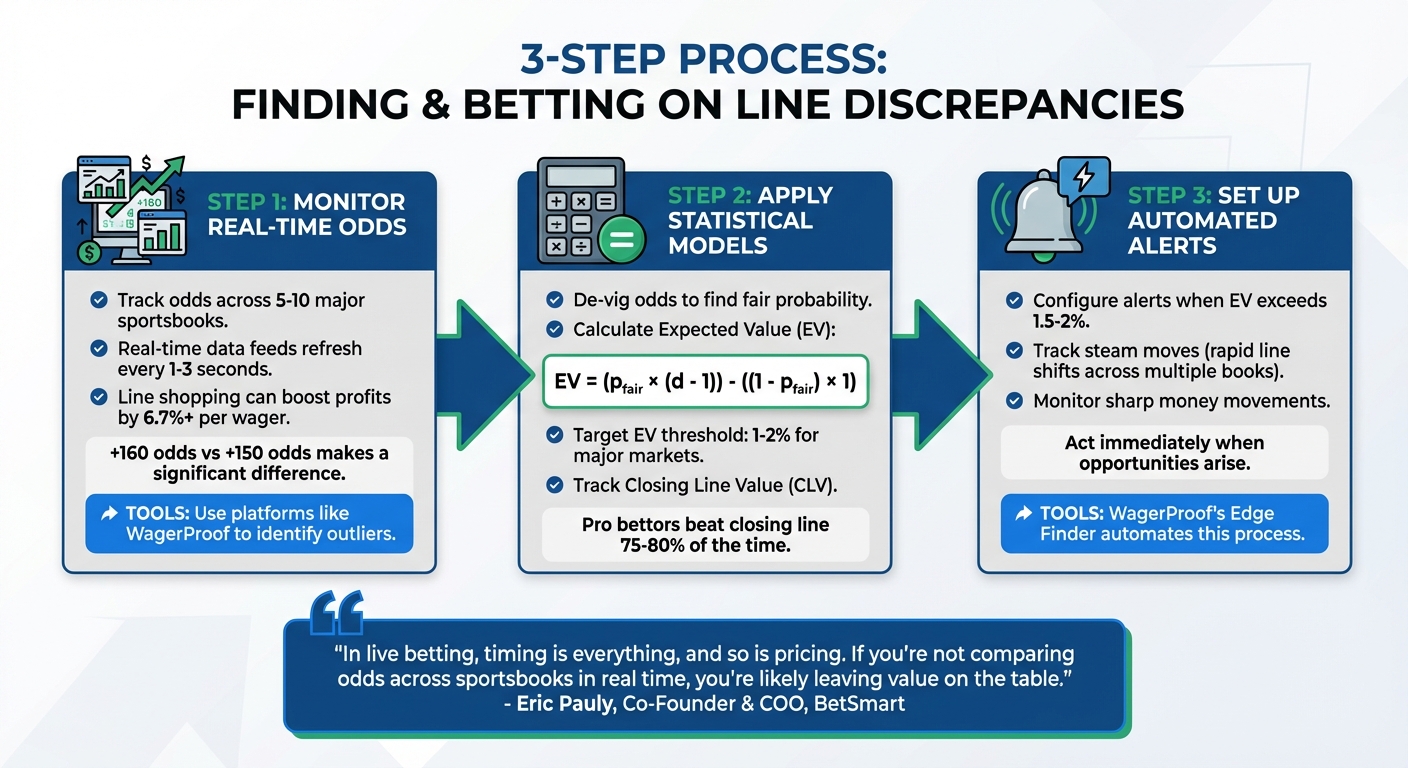
3-Step Process for Finding and Betting on Line Discrepancies in Sports Betting
Monitoring Real-Time Odds
Keeping tabs on odds across multiple sportsbooks is key to spotting line discrepancies. Real-time data feeds pull odds directly from sportsbooks, refreshing as often as every 1 to 3 seconds. This allows you to catch changes in point spreads, totals, and player props before they vanish. Sharp sportsbooks adjust quickly in response to professional betting activity, while recreational books tend to lag, creating brief windows of opportunity.
"In live betting, timing is everything, and so is pricing. If you're not comparing odds across sportsbooks in real time, you're likely leaving value on the table."
- Eric Pauly, Co-Founder & COO, BetSmart
Line shopping can significantly boost your profits - by as much as 6.7% or more on a single wager. For instance, choosing +160 odds instead of +150 can make a noticeable difference. Tools like WagerProof streamline this process by identifying outliers and value bets. They alert you when one sportsbook's odds deviate significantly from the market consensus, giving you the chance to act quickly. These real-time insights set the stage for applying statistical models to pinpoint value bets more effectively.
Using Statistical Models
Once you've got real-time data, statistical models help refine the process by cutting through the noise. A great starting point is de-vigging, which removes the sportsbook's built-in profit margin to reveal the fair probability of an outcome. Advanced models give more weight to sharp sportsbooks, ensuring more accurate line adjustments.
To calculate expected value (EV), you can use this formula:
EV = (p_fair × (d - 1)) - ((1 - p_fair) × 1).
Here, p_fair is the fair probability, and d is the book's decimal odds.
For major markets, an EV threshold of 1–2% is a practical starting point. Professional bettors often track Closing Line Value (CLV) - comparing the odds they secured with the final odds at game time - to gauge long-term success. Many pros beat the closing line 75–80% of the time by analyzing line movements. Tools like WagerProof simplify this process by automatically calculating EV, analyzing historical trends, and highlighting promising opportunities based on current market conditions.
Setting Up Automated Alerts with WagerProof

Manually tracking odds can be a grind. WagerProof’s Edge Finder and prediction market alerts make this easier by identifying value bets in real time. You can set custom alerts to trigger when a bet’s expected value exceeds a specific percentage - say, 1.5% or 2% - so you don’t have to constantly monitor the odds boards.
The platform also tracks steam moves, which are rapid, significant line shifts across multiple sportsbooks, often signaling sharp money entering the market. These alerts notify you the moment a discrepancy arises, whether it’s a sportsbook lagging behind or an outlier price that stands out from the market average. Maintaining funded accounts at 5–10 major sportsbooks ensures you can act immediately when a high-confidence opportunity pops up. WagerProof filters these alerts to focus on actionable bets tailored to your strategy.
Confirming and Betting on Line Discrepancies
Cross-Checking with Betting Volume and Patterns
When you spot a line discrepancy, the next step is to confirm whether it’s a real opportunity. One key indicator is reverse line movement (RLM) - this occurs when the betting line shifts in the opposite direction of public betting trends. Let’s break it down: if 75% of bets are on Team A, but the line moves to favor Team B, it’s a sign that sharp money is influencing the line. A great example of this happened during NFL Week 12 in November 2025. The Green Bay Packers opened as -4.5 favorites against the Minnesota Vikings. Despite over 75% of public bets backing the Packers, the line shifted to Packers -3 by game time. This movement hinted at sharp action on the Vikings, who ultimately covered the spread.
Another critical factor is the distinction between tickets and handle. Tickets represent the number of bets placed, while handle reflects the total dollar amount wagered. When a team has a small percentage of tickets but a large share of the handle, it’s a strong signal of sharp action. Sloan Piva from The Sporting News explains:
"If a team has a significantly lower percentage of bets but a much higher percentage of money, it indicates large sharp bets".
To simplify this analysis, platforms like WagerProof provide side-by-side comparisons of tickets and handle. This makes it easier to identify sharp money trends and confirm when a line movement is backed by meaningful action. Once you’ve confirmed sharp activity, you can quantify the potential advantage using expected value (EV) calculations.
Calculating Value Bets
After verifying a discrepancy, the next step is to calculate the expected value (EV) to determine if the bet offers a worthwhile edge. Start by converting the odds into an implied probability. For example, with -150 odds, the implied probability is calculated as 150/(150+100), which equals 60%. Compare this implied probability to the fair probability derived from sharp sportsbooks using the formula: EV = (Win Probability × Profit) - (Loss Probability × Stake).
Here’s an example: if you estimate a team’s win probability at 65% but the sportsbook odds imply only a 60% chance, you’re looking at an 8.33% edge for every $100 wagered.
A real-world scenario occurred in March 2024, when a bettor identified a 1.73% edge on the "Over 4.5 Runs" market for a St. Louis Cardinals vs. Chicago White Sox game at MGM (-105). Sharp books like Pinnacle had shifted to -118, and Caesars went even further to -130, confirming the market was leaning toward the Over. To manage risk, a Quarter Kelly approach (25% of the standard Kelly formula) is a smart way to size your bets and handle variance. For major markets, targeting an EV threshold between 1–2% is a practical strategy, with the flexibility to scale up to 1.25 units when sharp consensus supports your position.
| Sportsbook | Odds | Implied Probability | Fair Probability | EV |
|---|---|---|---|---|
| MGM | -105 | 51.2% | 54.0% | +2.8% |
| FanDuel | +110 | 47.6% | 54.0% | +6.4% |
| Pinnacle | -118 | 54.1% | 54.0% | -0.1% |
Once you’ve calculated the EV, the focus shifts to disciplined execution.
Avoiding Common Mistakes
Even with accurate EV calculations, poor execution can erode your edge. One common mistake is chasing steam - placing bets purely because of a sudden line movement. By the time most bettors notice these shifts, the value is often gone. As highlighted by The Outlier Team:
"Chasing the steam can be a risky betting strategy, as it involves placing a bet solely on the sudden shift in the odds or line without considering other factors".
Another pitfall is falling for head fakes, where sharp bettors place small early bets to manipulate the line, only to bet heavily in the opposite direction once limits increase closer to game time.
Also, avoid overreacting to recent results or minor news. For instance, giving too much weight to a team’s last couple of games might lead you to bet on "soft" lines that are actually market corrections. A notable example occurred during Super Bowl XLIX when sportsbooks froze the line at Patriots -1.5 to guard against sharp action, halting further line movement despite ongoing betting volume.
Improving Your Approach Over Time
Analyzing Results and Backtesting Models
Tracking your performance is key to determining whether your betting strategy is truly effective. Pay attention to metrics like win rate, Return on Investment (ROI), and Closing Line Value (CLV) - a measure of whether you're consistently securing better odds than the market's final consensus. As Chris Tashjian from Outlier puts it:
"Beating the closing line more often means you're consistently getting better odds than the market's final consensus, which directly correlates with long-term profitability."
To draw meaningful conclusions and distinguish between skill and random variance, you'll need to analyze at least 1,000 bets [29,30]. Most successful betting models aim for a long-term ROI in the range of 3% to 7%. When evaluating performance, give more weight to recent results rather than season-long averages, as they better reflect current conditions.
Continuous feedback plays a vital role in refining your betting model. For example, in June 2025, a soccer bettor reviewed a model that was breaking even after 600 bets. By benchmarking, they discovered their model was falling short on CLV by 0.10 odds points because it failed to account for late-breaking lineup changes. After incorporating injury reports and weather data into the model, the bettor saw their ROI jump from 0% to 4.2% over the next 1,200 bets.
The key takeaway? Regular analysis and adjustments keep your models sharp and effective. Tools like those from WagerProof can help you streamline this process and enhance your strategies further.
Using WagerProof's Community and Tools
Once you've fine-tuned your betting model, WagerProof offers tools and community insights to take your strategy to the next level. Their AI Game Simulator runs thousands of simulations using up-to-date team stats, player performance data, and historical matchups. This allows you to explore a range of possible outcomes and test different scenarios before committing to a bet [27,28].
For on-the-spot guidance, the WagerBot Chat acts as a personal betting assistant. You can ask it questions like how a team performs under specific conditions - such as playing on short rest or in adverse weather - and receive instant, data-backed insights [27,28].
Additionally, WagerProof's historical analytics process massive amounts of data to uncover trends you might overlook with manual tracking [27,28]. You can also join their Discord community for real-time discussions on strategy. While AI-powered predictions have reportedly boosted bet success rates by 15–20%, the real advantage comes from combining these tools with your own research and judgment. The synergy between automated insights and personal expertise can lead to smarter, more informed betting decisions.
Conclusion
Line discrepancies present opportunities when sportsbooks' odds don't reflect true win probabilities. However, these chances don't last long, as lines adjust almost immediately.
Because lines shift so quickly, staying informed in real time is crucial. Monitoring line movements can reveal where sharp money is going, helping guide your bets. Skilled bettors who can interpret these changes effectively often beat the closing line 75–80% of the time, compared to the typical 60–70%.
WagerProof takes data analysis to a new level by providing transparency and precision. The platform addresses the challenge of transparency by showing the data and calculations behind every recommendation. It processes thousands of data points at once - covering factors like referee tendencies, travel schedules, and weather conditions - delivering insights that would be nearly impossible to gather manually.
For a well-rounded betting strategy, combine automated tools with your own expertise. Tools like WagerProof's Edge Finder and AI Game Simulator can help you filter through vast amounts of data and identify value bets. By integrating these tools with your personal research, you can analyze hundreds of games efficiently while staying in control of your decisions.
Achieving long-term success requires consistently finding edges and maintaining disciplined bankroll management. Tools that offer speed, transparency, and actionable insights lay a solid foundation for smarter, data-driven betting.
FAQs
What are the best strategies for using line discrepancies in sports betting?
To get the most out of line discrepancies, start by determining a fair line using power ratings or true-probability models. Once you’ve calculated your line, compare it to the odds or spreads available across various sportsbooks. If you spot a noticeable difference - like shifts between opening and closing lines, reverse or steam moves, or clear gaps between books - place your bet on the side that seems undervalued. This method can help you lock in positive expected value over time.
For a more streamlined way to identify these opportunities, tools like WagerProof can highlight real-time outliers, value bets, and other actionable insights. By combining data-driven strategies with smart betting decisions, you’ll not only boost your long-term outcomes but also sharpen your overall betting approach.
What mistakes should I avoid when betting on line discrepancies?
When betting based on line discrepancies, it's easy to fall into a few traps that can hurt your chances of success. Here are some missteps to watch out for:
- Thinking line movement is random: Line changes often reflect sharp money at play, not just random fluctuations. Understanding this can give you an edge.
- Overlooking sharp-money trends: Sharp bettors often spot value before the general public. Pay attention to these signals - they can guide you toward better opportunities.
- Skipping odds comparison: Don’t settle for the first odds you see. Shopping around at different sportsbooks can help you secure the best possible return.
- Chasing public-driven moves: Late line shifts caused by public betting don’t always reflect true value and can lead to poor decisions.
- Acting too slowly on soft lines: Favorable odds don’t last forever. If you hesitate, you might miss out on great opportunities.
To improve your betting strategy, discipline and the right tools are key. Platforms like WagerProof can help you spot value bets and identify outliers in real time, keeping you one step ahead.
How does WagerProof help you spot and use line discrepancies in sports betting?
WagerProof streamlines the process of spotting and taking advantage of line discrepancies. By analyzing sportsbook odds alongside prediction market spreads, public betting trends, and advanced statistical models, the platform pinpoints outliers and real-time value opportunities.
With features like automated alerts and fade signals, WagerProof enables you to react swiftly to these discrepancies. It equips you with the tools to make informed, data-backed betting decisions, helping you identify hidden advantages and refine your betting strategy with clarity and simplicity.
Related Blog Posts
Ready to bet smarter?
WagerProof uses real data and advanced analytics to help you make informed betting decisions. Get access to professional-grade predictions for NFL, College Football, and more.
Get Started Free