
Best Staking Plans for Value Betting
Want to maximize your betting profits while managing risk? Choosing the right staking plan is just as important as finding value bets. Your staking strategy can make or break your bankroll, especially during losing streaks or winning runs. Here’s a quick breakdown of the five most effective staking methods:
- Flat Betting: Bet the same amount every time. Simple and great for beginners, but growth is slower.
- Percentage Staking: Bet a fixed percentage of your bankroll, adjusting stakes as it grows or shrinks.
- Target Profit Staking: Bet amounts tailored to achieve a specific profit per wager, focusing on odds sensitivity.
- Secure Staking: Combines percentage staking with risk adjustments for different odds ranges.
- Kelly Criterion: A formula-based approach to maximize growth based on your edge and the odds, with Fractional Kelly offering lower risk.
Each method has its pros and cons, balancing risk, ease of use, and long-term growth potential. Below, we’ll dive into these strategies and help you decide which one fits your betting style.
Best Sports Betting Staking Strategy?
5 Best Staking Plans for Value Betting
When it comes to value betting, mastering your bankroll management is critical. Below are five staking strategies, each offering a unique way to approach your bets, depending on your style and experience level.
1. Flat Betting
Flat betting means placing the same amount on every bet, no matter the odds. For instance, if your unit size is $50, you’ll bet $50 whether the odds are 1.50 or 5.00. This straightforward method is a favorite among beginners because it removes emotions from the equation and discourages chasing losses.
As Bet-Analytix points out:
"Flat betting is the healthiest approach to build iron discipline."
While flat betting offers steady, predictable growth, it’s slower compared to percentage-based methods. For those with smaller bankrolls, where percentage adjustments barely impact stake sizes, this approach is practical. Reassess your unit size once your bankroll changes by 25%.
2. Percentage Staking
Percentage staking adjusts your bets based on a fixed percentage of your current bankroll, typically between 1% and 3%. For example, with a $5,000 bankroll and a 2% staking plan, your next wager would be $100. This method takes advantage of compounding: your stakes grow after wins and shrink during losses. Over the course of 5,000 bets, percentage staking can generate 1.5 to 3 times the profits of flat betting.
WinnerOdds explains:
"Percentage betting protects against ruin during losing streaks while accelerating growth during winning streaks."
The beauty of this method is its flexibility - it adjusts to your bankroll size, making it nearly impossible to go broke. However, it’s best suited for bettors who have tested their edge over at least 1,000 bets.
3. Target Profit Staking
Target profit staking tailors your stake to achieve a consistent profit per bet. For example, if you aim to win $10, you’d wager $20 on a 1.50 favorite but just $5 on a 3.00 underdog. This method naturally results in larger bets on low-odds favorites and smaller ones on longshots.
From January to October 2024, Betaminic’s "Banker???" strategy for home favorites delivered 361 bets. Using flat staking, the profit was 4.66 units, but switching to Whitaker Staking - a hybrid of target profit staking - boosted the bankroll by 59% during the same period.
That said, losing streaks on favorites can lead to significant drawdowns. This approach works best when you have a proven edge on lower-odds bets.
4. Secure Staking
Secure staking combines percentage staking with tailored risk levels for different odds ranges. For instance, you might bet 3% of your bankroll on odds between 1.50 and 2.00, but only 1% on odds above 5.00. This method balances risk and reward based on the volatility of each bet.
Here’s a snapshot of Whitaker Staking for different odds:
| Odds | Whitaker Stake % | Target Profit Stake (to win $10) |
|---|---|---|
| 1.50 | 3.98% | $20.00 |
| 2.00 | 2.51% | $10.00 |
| 3.00 | 1.47% | $5.00 |
| 4.00 | 1.04% | $3.33 |
| 8.00 | 0.48% | $1.43 |
This approach minimizes exposure to high-risk bets while allowing meaningful stakes on more predictable outcomes. It’s a solid choice for bettors seeking structure without diving into complex calculations for every wager.
5. Kelly Criterion
The Kelly Criterion is a mathematical formula designed to maximize bankroll growth by calculating the ideal stake based on your edge and the odds. The formula is:
f = (bp - q) / b
Where:
- f: Fraction of your bankroll to bet
- b: Decimal odds minus 1
- p: Probability of winning
- q: Probability of losing (1 - p)
As Football-Bookie.com explains:
"The elegance of Kelly lies in its dual function: it tells you how much to bet when you have an edge, and it tells you not to bet when you do not."
However, full Kelly staking can be risky - there’s about a 33% chance of halving your bankroll before doubling it. Many professionals prefer Fractional Kelly, betting only 25% or 50% of the full Kelly amount. For example, Half Kelly retains 75% of full Kelly’s growth rate while significantly reducing variance. Quarter Kelly offers even better stability, with a profit-to-drawdown ratio of 4.1 compared to the 2.2 ratio seen with flat or standard percentage betting.
Fractional Kelly is especially helpful when estimating probabilities in complex sports like football. Regardless of the staking plan you choose, it’s wise to limit your bets to no more than 5% of your bankroll.
Staking Plan Comparison
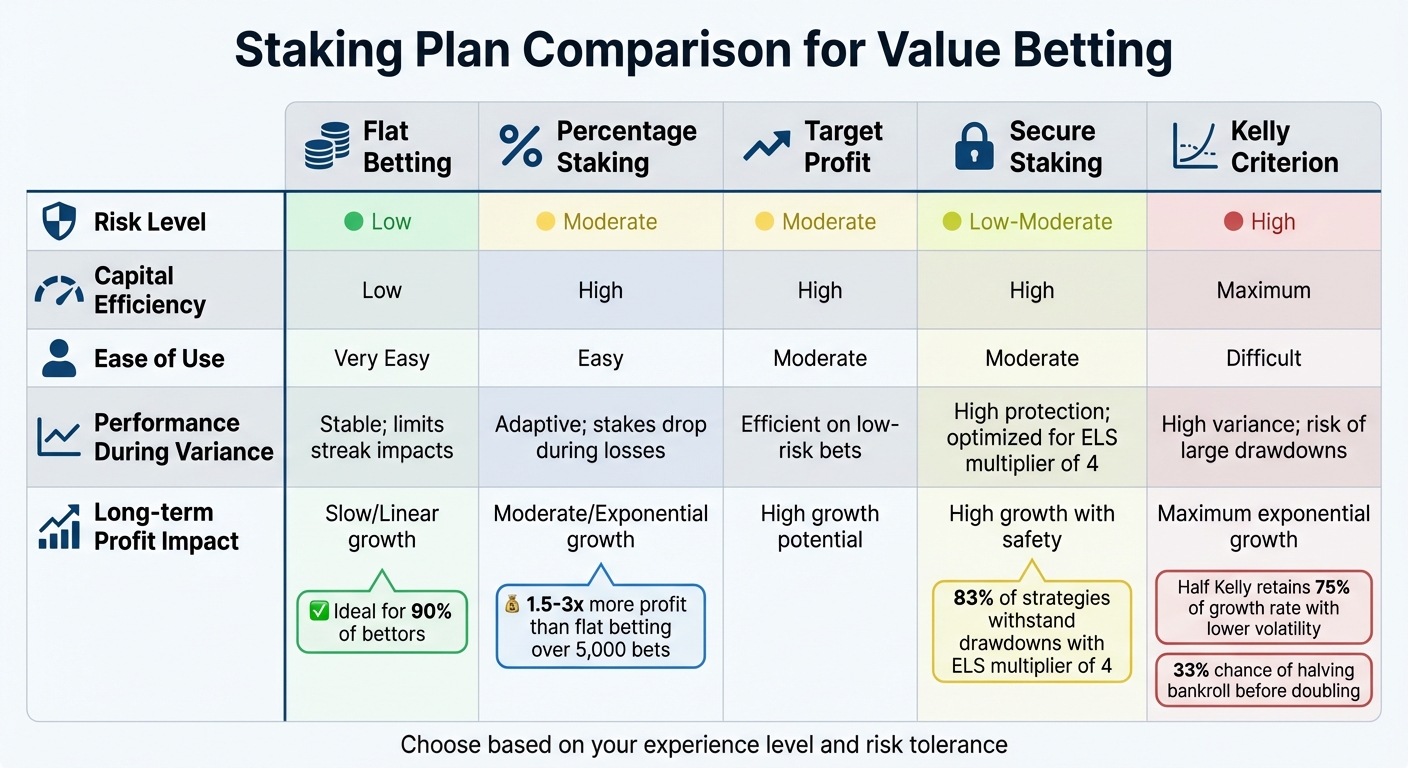
Staking Plans Comparison: Risk, Efficiency, and Growth Potential for Value Betting
This section dives into how different staking methods balance growth and risk. Flat betting is a straightforward approach with low risk and steady, albeit limited, growth. It's ideal for 90% of bettors, particularly beginners, since it removes emotional decision-making from the equation. However, it doesn't adjust to changes in your bankroll, which limits scalability.
On the other hand, percentage staking and secure staking adjust stakes automatically based on your bankroll. Simulations show that percentage staking handles losses more effectively than flat betting. Secure staking takes it a step further by varying percentages based on odds, minimizing risk on longshots.
Target profit staking focuses on odds sensitivity, placing larger bets on safer outcomes and smaller ones on riskier bets. This makes it a smart choice for bettors with an edge on favorites, as it optimizes capital use.
The Kelly Criterion is a mathematically proven method for maximizing growth, but it comes with significant variance. Many professionals prefer Fractional Kelly, betting only 25% or 50% of the suggested amount. Interestingly, using Half Kelly preserves 75% of the growth rate while significantly reducing volatility.
Comparison Table
Here’s a breakdown of how these methods stack up:
| Staking Plan | Risk Level | Capital Efficiency | Ease of Use | Performance During Variance | Long-term Profit Impact |
|---|---|---|---|---|---|
| Flat Betting | Low | Low | Very Easy | Stable; limits streak impacts | Slow/Linear growth |
| Percentage Staking | Moderate | High | Easy | Adaptive; stakes drop during losses | Moderate/Exponential growth |
| Target Profit | Moderate | High | Moderate | Efficient on low-risk bets | High growth potential |
| Secure Staking | Low-Moderate | High | Moderate | High protection; optimized for ELS multiplier of 4 | High growth with safety |
| Kelly Criterion | High | Maximum | Difficult | High variance; risk of large drawdowns | Maximum exponential growth |
Research analyzing over 700 public betting strategies revealed that 83% of them could withstand maximum drawdowns when using a bankroll designed for an Expected Losing Sequence (ELS) multiplier of 4. This finding sheds light on why experienced bettors often lean toward secure staking or fractional Kelly methods. These approaches allow for growth while keeping risks manageable, making them a reliable choice for those aiming for long-term success. WagerProof tools can help you make an informed decision about which plan aligns best with your goals.
How to Choose Your Staking Plan with WagerProof

Finding the right staking plan starts with knowing your true edge. WagerProof's AI research agents dig into your betting history, analyzing your strategy's edge (yield/ROI) across specific odds ranges. This helps identify where you're consistently profitable. For example, you might find a strong edge with underdogs between +150 and +250, while heavy favorites could be dragging your results down.
A standout feature is the platform's automated outlier detection, which helps you avoid falling off the "edge cliff." This occurs when your model suggests an unrealistically high edge due to missing key market information. In mature betting markets, overly high theoretical edges often point to incomplete data, not actual value. Betting big in these cases can lead to losses instead of gains. WagerProof automatically flags these outliers, steering you away from overconfidence and risky bets.
The WagerBot Chat tool takes decision-making a step further by providing real-time, reliable data. You can ask it to compare how different staking plans would perform based on your betting style. Using live odds, historical data, and model predictions, it offers a detailed analysis. This means you can test whether flat betting or percentage staking aligns better with your risk tolerance, all based on hard data - not guesswork.
Beyond these basics, WagerProof runs Monte Carlo simulations to stress-test your strategy. By simulating 100,000 betting scenarios, the platform reveals whether your plan holds up during tough losing streaks or under extreme conditions. It even explores profit-taking strategies, like resetting your bankroll after it doubles, to ensure your staking method remains safe and effective.
But numbers alone aren't enough. Success also depends on how comfortable you are with your plan. If large bet sizes make you anxious during losing streaks, your strategy might be too aggressive. WagerProof emphasizes long-term profitability by helping you balance mathematical optimization with psychological comfort. Tools like profit curve visualizations and variance projections let you see what to expect, so you can pick a staking plan that supports growth without causing unnecessary stress.
Conclusion
Picking the right staking plan isn't just about crunching numbers - it can be the deciding factor between long-term success and failure. As Bet-Analytix Academy explains:
"An unsuitable staking strategy is the #1 cause of failure among bettors, as it can reduce to zero the benefits of excellent analyses".
Even the best analysis won't help if your staking method doesn't align with your goals and risk tolerance.
Flat betting is a solid starting point for about 90% of bettors, especially for beginners working on discipline. Proportional staking offers the potential for compound growth but requires a proven edge. Meanwhile, the Kelly Criterion is mathematically powerful but carries significant risk - full Kelly, for example, has a 33% chance of halving your bankroll before it doubles. The key is choosing a strategy that matches your experience and comfort level, not just what seems advanced or impressive.
Once you've chosen a staking plan, tools like WagerProof can help you put it into action. WagerProof uses AI to analyze your betting history, identify anomalies, and run Monte Carlo simulations to ensure your strategy holds up - even during tough losing streaks.
It's also important to remember that no staking plan can turn bad bets into profit. As Toby from Punter2Pro wisely points out:
"No staking plan can fix a strategy that lacks value. If your selections don't have an edge, no amount of discipline or clever staking will turn long-term losses into success".
The real foundation lies in finding bets where the odds are in your favor. Staking plans simply help you manage your bankroll to maximize growth and ride out the inevitable ups and downs.
The bottom line? Test your approach thoroughly and stick with it. WagerProof provides the data and simulations you need to make decisions based on logic, not emotion. Choose a plan you can commit to, especially during losing streaks, because consistent execution will always beat overly complicated strategies.
FAQs
What unit size should I use for my bankroll?
Your unit size should align with your staking strategy and risk tolerance. Generally, experts suggest risking between 1-5% of your bankroll per bet. This helps manage risk and minimizes the chance of substantial losses.
For a more cautious approach, strategies like flat staking involve betting a fixed amount on each wager. On the other hand, the Kelly Criterion adjusts your bet size dynamically, taking into account your perceived edge and the odds.
A practical rule of thumb? Stick to risking 1-3% of your bankroll for a balanced approach to risk management.
When should I switch from flat betting to percentage staking?
Switching to percentage staking can be a smart move if you’re looking to align your bet size with your bankroll. This approach helps manage risk while promoting growth. Unlike flat betting, where you stick to a fixed stake, percentage staking adjusts dynamically. This means it protects your funds during losing periods and allows you to capitalize on winning streaks. It’s a good idea to consider this method once your bankroll has reached a stable size and can handle the natural ups and downs of proportional betting.
How can I safely estimate my edge for Fractional Kelly?
To estimate your edge for Fractional Kelly safely, use this formula: (Probability of winning × Decimal odds) - 1. This calculation helps you determine how much of an advantage you have. Then, compare your probability of winning to the implied probability derived from the odds.
Using Fractional Kelly involves betting only a portion of the full Kelly stake. This reduces risk while still allowing you to capitalize on your advantage. It’s a strategy designed to protect your bankroll and promote steady, controlled growth over time.
Related Blog Posts
Ready to bet smarter?
WagerProof uses real data and advanced analytics to help you make informed betting decisions. Get access to professional-grade predictions for NFL, College Football, and more.
Get Started Free