Break-Even Analysis for Sports Bettors
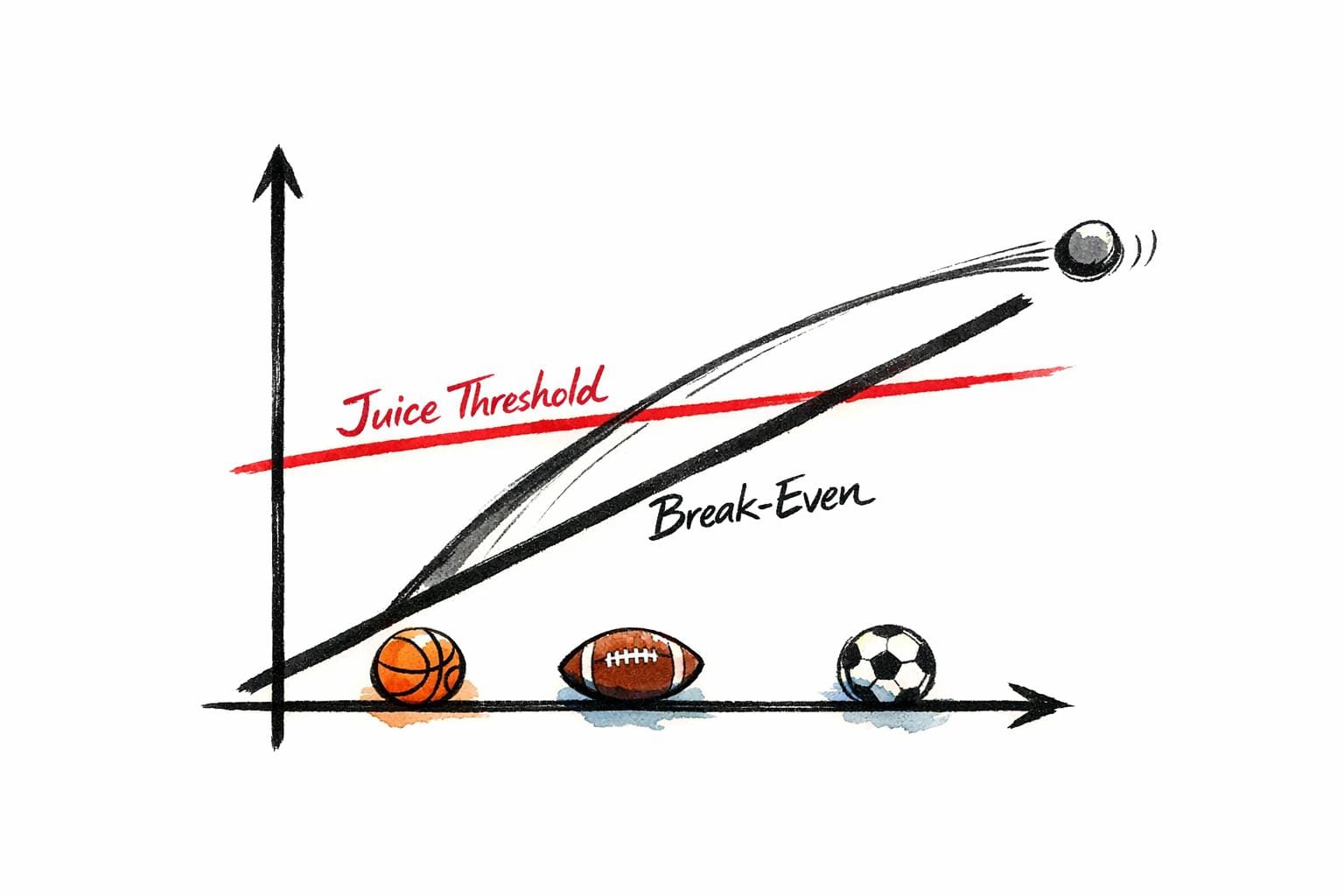
To make money in sports betting, you need to win more than just half of your bets. The break-even point depends on the odds and the sportsbook's commission (the "juice"). For standard -110 odds, you need to win 52.38% of your bets to avoid losing money. This percentage increases with higher juice or less favorable odds.
Key takeaways:
- Break-even percentage: The win rate required to avoid losses at specific odds.
- Juice impact: At -110 odds, the sportsbook's cut raises the break-even rate to 52.38%.
- Odds matter: The break-even rate varies with odds (e.g., 60% at -150, 40% at +150).
- Professional bettors: Typically win 54-55% of bets, barely surpassing the break-even mark.
To succeed, focus on:
- Calculating the break-even percentage for every bet.
- Identifying "value bets" where your estimated win probability exceeds the break-even rate.
- Shopping for better odds to lower your break-even threshold (e.g., moving from -110 to -105).
Understanding this math is essential for long-term betting success.
What Is Break-Even Percentage?
Defining Break-Even Percentage
The break-even percentage is the minimum win rate you need to avoid losing money over the long run at specific betting odds. This percentage changes depending on the odds - what works at one set of odds might not work at another. For instance, a 55% win rate can be profitable at +120 odds but unprofitable at -200 odds. Take -110 odds as an example: the break-even rate here is 52.38%. If your win rate falls below this threshold, you'll gradually lose money. On the flip side, exceeding it puts you in the profit zone.
"If you know your breakeven percentage every time you see a line, you'll instantly separate yourself from 99% of bettors." - Bettor Ed
Think of this percentage as a benchmark. Before placing a bet, calculate the break-even rate based on the odds being offered. If your estimated probability of winning is higher than this percentage, you may have found a value bet. If it's lower, the numbers suggest skipping that wager. This fundamental understanding is crucial before diving into how the sportsbook's juice - its built-in commission - affects these calculations.
How Juice Affects Break-Even
Odds determine the break-even percentage, but sportsbooks add a commission - known as juice or vigorish - that pushes this percentage higher. Without any house edge, a 50/50 bet would require exactly a 50% win rate to break even. However, the juice is baked into the odds, creating a higher threshold.
At standard -110 odds, the juice bumps the break-even rate to 52.38%. That extra 2.38% represents the sportsbook's profit margin. For a balanced -110 point spread, the house typically holds 4.8% of the total money wagered on the game.
"The juice (or vigorish) in sports betting is the house's greatest edge, and it's what prevents the vast majority of bettors from becoming long-term winners." - Baltimore Sun
Even small changes in juice can shift the break-even percentage. For example, if a sportsbook offers -105 odds instead of -110, the break-even requirement drops from 52.4% to 51.2%. Around even money, every 10-cent adjustment in odds (like moving from -110 to -120) changes the required win rate by roughly 2%. This is why line shopping - comparing odds across sportsbooks - is so important for maximizing your profitability in the long run.
Sports Betting Break Even %
Calculating Break-Even for Different Odds
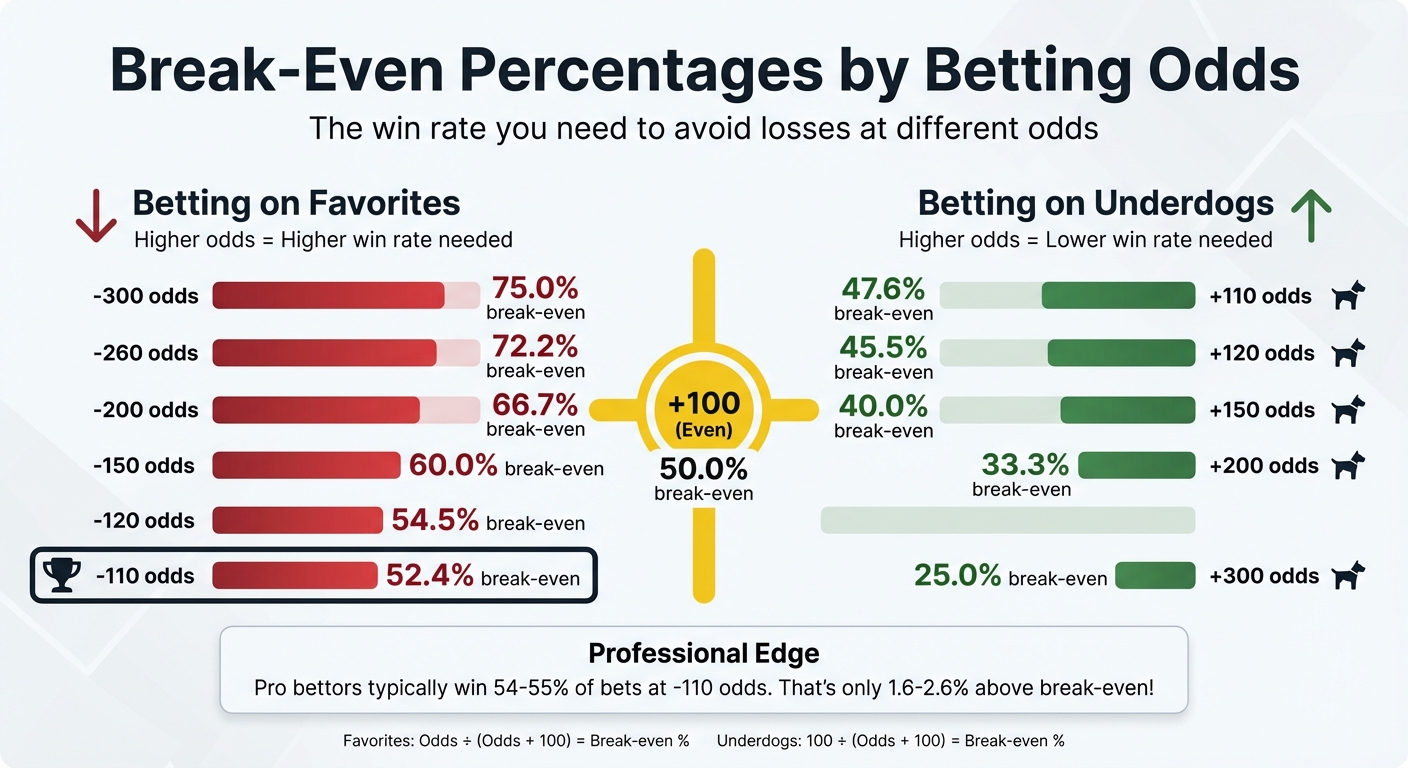
Sports Betting Break-Even Percentages by Odds: Complete Reference Chart
Break-Even for Negative Odds (Favorites)
When dealing with favorites (negative odds like -110, -150, or -260), figuring out the break-even percentage is straightforward. You divide the absolute value of the odds by the sum of the odds and 100. For example:
- At -110 odds, the calculation is 110 / (110 + 100), which equals about 52.38%.
- At -150 odds, it's 150 / (150 + 100), or 150/250, giving you 60.0%.
- For heavier favorites like -260 odds, you calculate 260 / (260 + 100), which equals 260/360, or roughly 72.2%.
The stronger the favorite, the higher the win rate you need to break even because you're risking more money to win less.
Break-Even for Positive Odds (Underdogs)
For underdogs (positive odds like +100, +150, or +200), the break-even percentage is calculated differently. Divide 100 by the sum of the odds and 100. Here's how it works:
- At +100 odds, you calculate 100 / (100 + 100), which equals 50.0%.
- At +150 odds, the formula is 100 / (150 + 100), or 100/250, resulting in 40.0%.
- For +200 odds, it's 100 / (200 + 100), or 100/300, giving you approximately 33.33%.
With underdog bets, you can still come out ahead even if you win less than half of your wagers, thanks to the higher payouts.
"Convert everything to break-even percentages and work with those... People who think in American odds rather than converting to break-even percentages are prone to making many errors due to this effect of the ever-changing value of 'cents.'" - Ed Miller, Author, The Logic of Sports Betting
Odds and Break-Even Percentage Table
Here’s a handy table to reference, showing how American odds translate into break-even percentages:
| American Odds | Decimal Odds | Break-Even Percentage |
|---|---|---|
| -300 | 1.33 | 75.0% |
| -260 | 1.38 | 72.2% |
| -200 | 1.50 | 66.7% |
| -150 | 1.67 | 60.0% |
| -120 | 1.83 | 54.5% |
| -110 | 1.91 | 52.4% |
| +100 (Even) | 2.00 | 50.0% |
| +110 | 2.10 | 47.6% |
| +120 | 2.20 | 45.5% |
| +150 | 2.50 | 40.0% |
| +200 | 3.00 | 33.3% |
| +300 | 4.00 | 25.0% |
For those who prefer decimal odds, calculating the break-even percentage is even simpler: just take the reciprocal of the decimal odds (1 divided by the decimal odds).
How to Use Break-Even Analysis in Your Betting
Why You Need to Beat Break-Even
Understanding your break-even percentage is crucial - it’s the baseline you need to surpass to turn a profit. At standard -110 odds, you must win 52.38% of your bets just to break even. Falling short of this mark means losses will pile up due to the bookmaker’s juice. Breaking even might sound better than losing, but it also means you’re not making money.
Profit starts when your win rate exceeds this percentage. Even a small edge can make a big difference. For instance, if you win 53% of your bets at $50 each (just 0.6% above break-even), you’d earn $30 over 100 wagers. Professional bettors, often referred to as sharps, usually maintain a win rate between 54% and 55% on standard -110 bets. These slim margins highlight why every percentage point matters.
By using data tools, you can identify bets that give you an edge and help push your win rate above the break-even point.
Finding Value Bets with Data Tools
A bet becomes valuable when its estimated win probability exceeds the break-even percentage. For example, if you believe a team has a 56% chance of covering the spread, but the -110 odds only require a 52.38% win rate to break even, you’ve found a positive expected value (+EV) opportunity.
Tools like WagerProof make spotting these opportunities easier. By analyzing prediction market spreads and identifying outliers across multiple sportsbooks, the platform pinpoints bets with potential value. Instead of relying on instinct, you can use data to see when retail sportsbooks offer odds that differ significantly from sharp market consensus. These mismatches often signal value. Features like the Edge Finder and real-time alerts give you a structured, data-driven approach to betting decisions.
"Any bet with positive expected value, or a perceived edge, can be considered a value bet." - Patrick Cwiklinski, Evergreen Manager, SportsBettingDime
Line Shopping to Lower Break-Even
After identifying value bets, you can further boost profitability by line shopping - comparing odds across different sportsbooks to find the best price. This simple practice can lower the juice you pay, reducing your break-even percentage and increasing your potential profits. For example, moving from -110 odds to -108 drops your break-even requirement from 52.38% to 51.9%. While that difference might seem small, over 500 wagers at $100 each with a 55% win rate, the lower juice adds an extra $450 to your profit.
Even better, finding -105 odds instead of -110 reduces your required win rate to 51.2%. This is why it’s crucial to always shop for the best line before placing a bet. The odds you choose directly influence the win rate you need to succeed - and every fraction of a percent counts.
Common Break-Even Mistakes to Avoid
When it comes to break-even analysis in sports betting, there are a few common missteps that can seriously derail your strategy. Let’s take a closer look at some of these pitfalls and how to steer clear of them.
Confusing Win Rate with Profitability
One of the biggest misconceptions in sports betting is assuming that a win rate above 50% guarantees profit. It doesn’t. The odds - or price - determine your break-even point, not just your win rate. For example, a 55% win rate might be highly profitable at +120 odds but would result in losses at -200 odds. This is because different odds require different break-even thresholds.
"Price sets the target. A 55% record at -200 is losing. A 55% record at +120 is crushing." - Bettor Ed
This highlights why understanding how juice (the bookmaker's cut) affects break-even percentages is so critical.
Ignoring Variance and Bankroll Management
Break-even analysis assumes consistent bet sizing, but varying your bet amounts can throw off the math. Even if you’re hitting a win rate above the break-even point, betting larger amounts on losing wagers and smaller amounts on winning ones can still leave you in the red.
Variance - the natural swings in short-term results - can also wreak havoc on your bankroll, even if you’re placing positive expected value (+EV) bets. Losing streaks happen, and they can drain your bankroll if you’re not careful. This is where bankroll management becomes essential. It ensures you can withstand short-term losses and stay in the game long enough for your edge to pay off.
Chasing losses to "break even" is another trap. Every bet should be evaluated on its own merits, not based on emotions or previous results. Regular strategy reviews can help you avoid these mistakes and keep your approach grounded.
Failing to Reassess Break-Even Over Time
Your break-even percentage isn’t set in stone. It shifts every time the odds change. For instance, a win rate that works at +120 odds won’t hold up at -200 odds. Even small changes in juice can make a big impact. For example, moving from -105 to -115 odds increases your required win rate by 2.3%. Over hundreds of bets, that slight adjustment can mean the difference between profit and loss.
To stay on top of this, track every bet you make. Break them down by sport and bet type, and wait until you’ve logged at least 50 to 100 wagers before making major changes to your strategy. What might look like a winning streak could just be variance, and what feels like bad luck might actually point to a flaw in your approach. Keeping detailed records helps you separate fact from feeling.
Conclusion
Break-even analysis is at the heart of informed betting, giving you a clear win rate target to overcome the sportsbook’s juice. This benchmark shapes every decision in your betting strategy.
Odds play a crucial role in determining profitability. For example, a 55% win rate could yield strong profits at +120 odds but fall short at -200 odds. Since every shift in odds changes your break-even percentage, tracking every wager and its exact odds is essential. Without detailed records, you’re essentially betting blind.
Once you’ve mastered break-even concepts, the next step is identifying value. This involves comparing your estimated win probability to the break-even threshold. If your probability exceeds this hurdle, you’ve found a positive expected value (+EV) bet. However, manually calculating break-even percentages, removing the vig, and sizing bets with methods like the Kelly Criterion can be tedious and error-prone. That’s where tools like WagerProof come in. The platform simplifies these calculations, helping you spot value bets by leveraging data from prediction markets, historical stats, and advanced models. It equips you with the insights needed to bet smarter.
Most professional bettors achieve a win rate of 54%–55%, which is considered a realistic upper limit. Reaching this level requires discipline, consistent line shopping to reduce juice, and regular strategy adjustments. Even small changes, like moving from -110 to -105 odds, lower your required win rate from 52.4% to 51.2%. Over the course of hundreds of bets, this small shift can lead to substantial profits.
FAQs
How do I calculate the break-even percentage for different betting odds?
To figure out the break-even percentage for betting odds, you need to calculate the minimum win rate required to neither lose nor gain money in the long run. The formula you use depends on whether the odds are negative (favorites) or positive (underdogs).
-
For favorites (negative odds, like -110):
Break-even % = |Odds| / (|Odds| + 100)
Example: For -110 odds: 110 / (110 + 100) = 52.38% -
For underdogs (positive odds, like +150):
Break-even % = 100 / (Odds + 100)
Example: For +150 odds: 100 / (150 + 100) = 40%
Knowing this percentage helps you decide if a bet has potential value. If your estimated probability of winning is higher than the break-even percentage, the bet might be worth considering. These simple calculations can guide you toward more informed betting choices.
What is line shopping, and why is it important for sports bettors?
Line shopping means comparing odds across various sportsbooks to snag the best possible lines for your bets. Why does this matter? Even the tiniest difference in odds can add up over time, having a big impact on your overall profits.
By always hunting for the most favorable odds, you can boost your returns and enhance your profitability in the long run. It's one of the easiest ways to gain an edge in sports betting.
What is a value bet, and how can it help you make better profits in sports betting?
A value bet happens when a sportsbook offers odds that are higher than the true likelihood of an event occurring. In other words, the potential payout outweighs the actual risk, giving you a chance to achieve positive expected value (EV).
Focusing on value bets allows you to shift from relying on luck to making calculated, data-driven decisions. Over time, this approach can boost your profitability by capitalizing on opportunities where the odds are in your favor. Tools like real-time sports data platforms are especially useful for spotting these chances, as they can reveal mismatched odds or inefficiencies in the market.
Related Blog Posts
Ready to bet smarter?
WagerProof uses real data and advanced analytics to help you make informed betting decisions. Get access to professional-grade predictions for NFL, College Football, and more.
Get Started Free