How to Calculate Unit Size for Fixed Betting
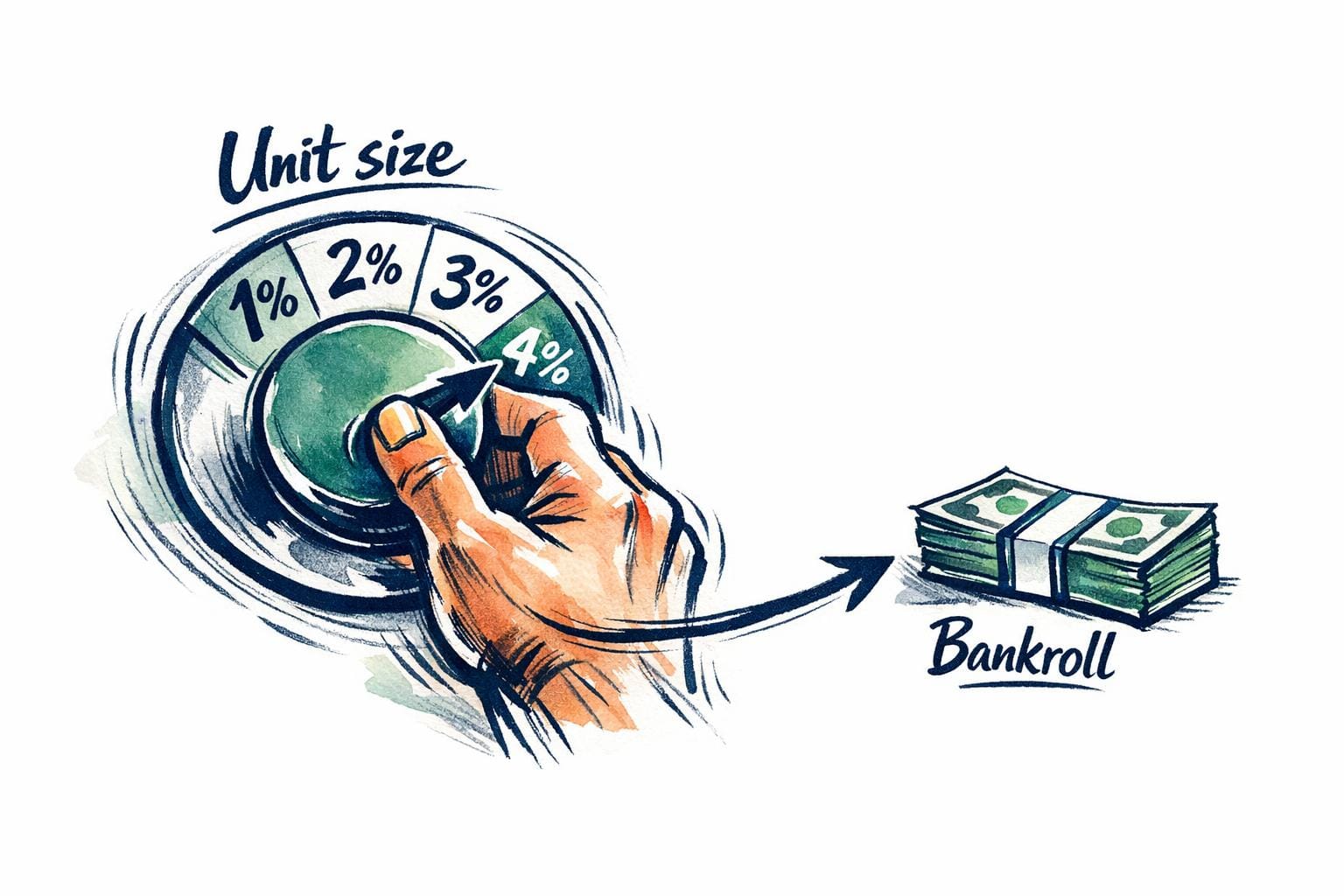
Fixed unit betting is a simple way to manage your betting bankroll. You bet a fixed percentage of your total funds on every wager, helping control risks and stay consistent. Here's the key process:
- Define Your Bankroll: Only use disposable income, separate from daily expenses.
- Choose a Unit Percentage: Typically 1%-2% of your bankroll; beginners should stick to the lower end.
- Calculate Unit Size: Multiply your bankroll by the chosen percentage and divide by 100. For example, with $1,000 and 2%, your unit is $20.
- Stick to Your Strategy: Avoid increasing bets during losing streaks or after big wins. Adjust your unit size only as your bankroll changes significantly.
This approach minimizes emotional decisions and helps you focus on long-term results, not short-term wins or losses.
How To Succeed In Sports Betting Using These Bankroll & Unit Sizes
Determine Your Total Bankroll
Before working out your unit size, you need to establish your total bankroll - the amount of disposable money you're dedicating solely to betting.
How to Define Your Bankroll
Your bankroll should consist only of disposable income - money left after covering all your bills, savings, and essential expenses. If losing this amount would affect your daily life or financial stability, it’s too much.
Start by reviewing your monthly income and expenses. Identify the extra funds that won’t interfere with your necessities - this surplus becomes your betting bankroll. Never use borrowed money or credit cards to fund it. Stephen, founder of Fast Break Bets, emphasizes:
"Don't bet money you need for rent, food, tuition, and other expenses. Just as important, absolutely do not use credit card debt to fund your bankroll."
For a solid foundation, experts suggest at least $1,000 as a starting bankroll. This amount typically covers 50 to 100 betting units, giving you enough cushion to handle inevitable losing streaks. That said, your starting amount should match your financial situation and comfort level.
Separating your betting funds from your personal finances not only safeguards your money but also encourages disciplined bankroll management.
Why Keep a Separate Bankroll
Once you’ve defined your bankroll, keeping it separate is key to maintaining discipline. Using a dedicated account or digital wallet creates a clear boundary, reducing the temptation to chase losses impulsively. This separation also simplifies tracking your actual return on investment - mixing personal and betting funds makes it nearly impossible to gauge your true profits.
Poor bankroll management is the leading reason why 90% of sports bettors lose money over time - even those who win more often than they lose. Treating your bankroll like a business investment, instead of personal cash, is crucial for long-term success. Jerald from Predictem.com underscores this point:
"Remember, do not bet with money you can't afford to lose! It is not worth the stress or problems that will arise if you lose the rent money."
Defining and separating your bankroll is a critical first step before moving on to calculate your ideal unit size for betting.
Select Unit Size Percentage Based on Risk Tolerance
Fixed Betting Unit Size Calculator: Risk Levels and Bankroll Impact Comparison
Choosing your unit size percentage is all about aligning with your risk tolerance and betting goals. The right percentage depends on your experience, comfort with fluctuations, and how much of your bankroll you're prepared to risk during inevitable losing streaks.
Understanding Risk Tolerance
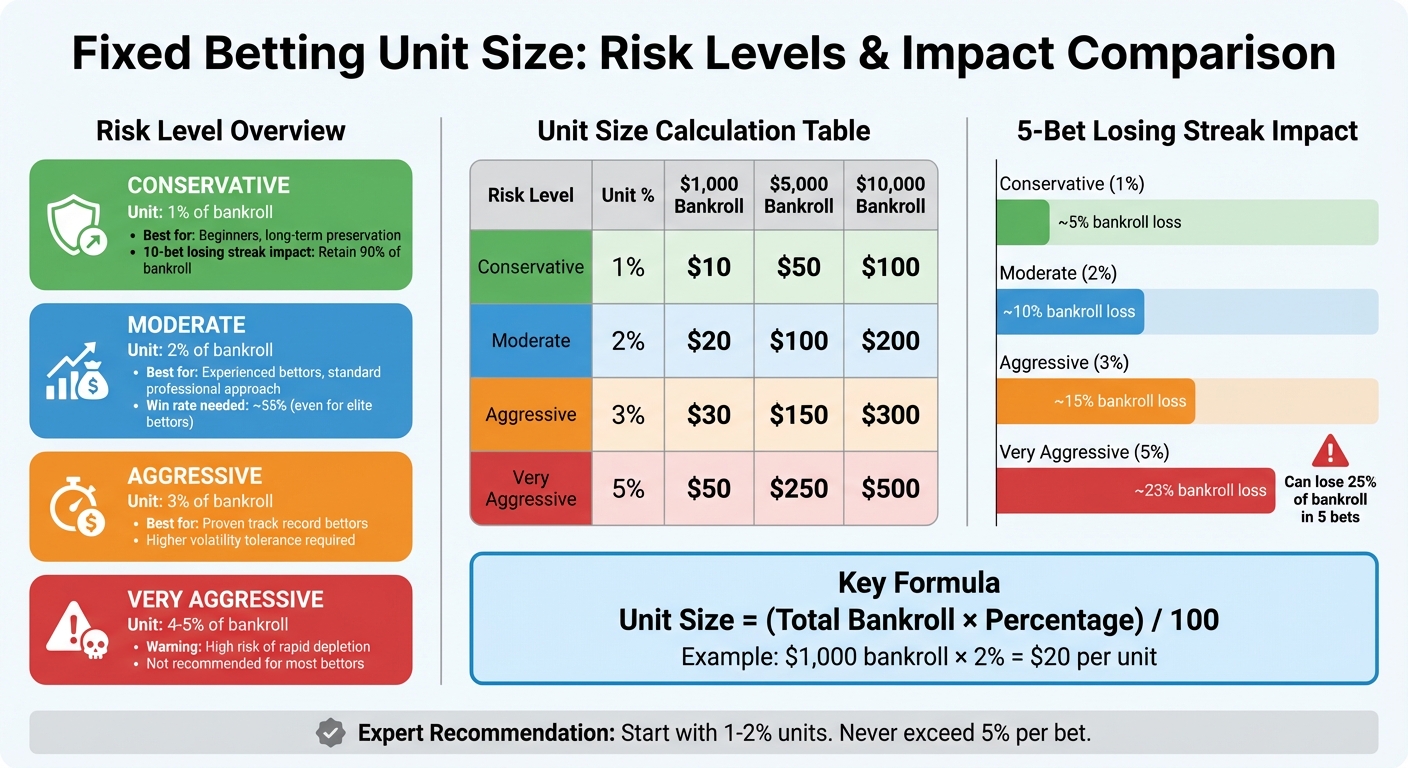
Risk tolerance reflects how much loss you can handle without compromising your strategy. Conservative bettors often stick to 1% units, which help them weather long losing streaks while maintaining discipline over time. This approach is popular among beginners and professionals who focus on preserving their bankroll rather than chasing rapid growth.
For moderate bettors with a proven track record, 2% units strike a middle ground between growing the bankroll and managing volatility. This is widely regarded as the standard professional approach. Even elite bettors typically win only about 55% of the time, making strict unit control essential. As Johnny Perun, a writer at BettingPros, explains:
"It is typically a good rule of thumb... your 'unit' should be 1-2% of that total bankroll."
Aggressive bettors might push to 3% units, with highly aggressive strategies going as high as 4–5%. However, staking more than 5% of your bankroll on a single bet is considered highly risky and often results in rapid bankroll depletion during normal losing streaks. Even seasoned professionals with a strong edge rarely go beyond 2% per bet.
High unit percentages can lead to emotional decisions and chasing losses because losing streaks feel more financially painful. It's important to remember that losing 6 to 10 bets in a row is normal variance in sports betting, not a failure of strategy.
Unit Size Impact by Bankroll Size
To see how different unit percentages affect your bankroll, let’s examine the impact of a five-bet losing streak. This is a common scenario, even for successful bettors. The table below outlines how various risk levels translate into actual dollar amounts for different bankroll sizes and the potential damage from consecutive losses:
| Risk Level | Unit % | $1,000 Bankroll | $5,000 Bankroll | $10,000 Bankroll | 5-Loss Drawdown |
|---|---|---|---|---|---|
| Conservative | 1% | $10 | $50 | $100 | ~5% Loss |
| Moderate | 2% | $20 | $100 | $200 | ~10% Loss |
| Aggressive | 3% | $30 | $150 | $300 | ~15% Loss |
| Very Aggressive | 5% | $50 | $250 | $500 | ~23% Loss |
At the aggressive 5% level, a five-bet losing streak can wipe out nearly a quarter of your bankroll. If the streak continues, the damage can escalate quickly, potentially halving your total bankroll. On the other hand, a conservative 1% approach ensures that even after a 10-game losing streak, you’ll still retain 90% of your bankroll.
Starting with a conservative unit size is the safest path. You can increase your unit percentage gradually, but only when your bankroll grows and you’re confident in your edge. As Sports Insights puts it:
"Smaller bet sizes are more prudent and allow you to stick to your approach and stay disciplined."
With these principles in mind, you're ready to calculate your exact unit size.
Calculate Exact Unit Size
Once you've decided on your risk percentage, the calculation becomes pretty simple. The formula to figure out your unit size looks like this:
Unit Size = (Total Bankroll × Percentage) / 100
Your Total Bankroll is the amount you've set aside strictly for betting. The Percentage is the level of risk you've chosen - commonly 1%, 2%, or 3%. To calculate, multiply your bankroll by the percentage you selected and divide by 100. For example, with a $1,000 bankroll and a 2% risk level, the math is: ($1,000 × 2) / 100 = $20 per unit. That $20 becomes your standard bet size. If your bankroll is $5,000 and you opt for a 3% risk level, the calculation is: ($5,000 × 3) / 100 = $150 per unit.
This method ensures consistency in your betting approach. You're not making decisions on the fly; instead, you're sticking to a pre-set strategy based on your available funds and risk tolerance. Now, let’s see how this works in real-world scenarios.
Unit Size Formula
Step-by-Step Examples
Here are two detailed examples to show how bankroll and risk levels translate into actual wagers, particularly when betting at standard -110 odds (the most common for point spreads and totals).
Example 1: $1,000 Bankroll at 2% (Moderate Risk)
- Bankroll: $1,000
- Risk Percentage: 2%
- Calculation: ($1,000 × 2) / 100 = $20 per unit
- At -110 odds, betting one unit means risking $20 to win about $18.18. Alternatively, wagering 1.1 units ($22) would yield a full unit profit of $20.
Example 2: $5,000 Bankroll at 3% (Aggressive Risk)
- Bankroll: $5,000
- Risk Percentage: 3%
- Calculation: ($5,000 × 3) / 100 = $150 per unit
- At -110 odds, betting one unit risks $150 to win about $136.36. If you bet 1.1 units ($165), you’d net a full unit profit of $150.
Because of the juice at -110 odds, the amount you risk is slightly higher than the unit's profit. Most bettors stick to one approach - either wagering one unit or 1.1 units - and apply it consistently to every bet.
As your bankroll changes, so does your unit size. Here's a quick reference table showing how different bankrolls and percentages translate into unit sizes:
| Bankroll | Risk Percentage | Calculation | Unit Size |
|---|---|---|---|
| $1,000 | 2% | ($1,000 × 2) / 100 | $20 |
| $1,000 | 3% | ($1,000 × 3) / 100 | $30 |
| $5,000 | 2% | ($5,000 × 2) / 100 | $100 |
| $5,000 | 3% | ($5,000 × 3) / 100 | $150 |
For instance, if your $1,000 bankroll grows to $1,200, your 2% unit size increases from $20 to $24. This adjustment keeps your risk percentage steady, ensuring your betting remains disciplined and aligned with your overall strategy.
Adjust Unit Size Over Time
Managing your unit size is key to adapting your betting strategy as your bankroll fluctuates. Regular adjustments ensure your approach stays consistent with your financial situation, without letting emotions dictate your decisions.
When to Recalculate Unit Size
Recalculating your unit size is essential for keeping your bets proportional to your bankroll. However, this doesn’t mean adjusting after every single bet. Instead, set specific benchmarks for when to reassess. For example, if you’re placing bets frequently - several times a week - a weekly review might make sense. For more casual bettors, a monthly check-in could work better. Another option is to recalculate whenever your bankroll changes by a set amount, like $100 or $250.
If you hit a major win or suffer a significant loss, it’s smart to adjust immediately. For instance, if your bankroll drops from $2,000 to $1,500, your 2% unit size would decrease from $40 to $30. This adjustment protects your remaining bankroll from being depleted too quickly. On the flip side, if your bankroll grows to $2,500, your unit size should increase to $50. This allows you to take advantage of your gains while sticking to your chosen risk level.
One mistake to avoid is sticking to a fixed dollar amount for your units no matter how your bankroll changes. A $100 bet might be manageable with a $10,000 bankroll but could be risky with just $2,000. Using a percentage-based system ensures your bets scale appropriately with your financial situation.
Fixed Unit Betting vs. Variable Systems
Recalibrating your unit size keeps risk in check, but how you structure your bets matters too. Fixed unit betting is one of the simplest and most reliable methods. With this approach, you consistently wager the same percentage of your bankroll on every bet, regardless of confidence levels. This method emphasizes consistency and is particularly useful for beginners or anyone looking to avoid the complexities of more advanced systems.
For those seeking a more dynamic approach, the Kelly Criterion is a popular alternative. This formula adjusts your bet size based on your perceived edge and the odds. While it aims to maximize long-term growth, it can be volatile and requires precise estimates of your win probability. For instance, if you believe you have a 55% chance of winning at -110 odds, the Kelly Criterion might suggest betting 5.5% of your bankroll - much higher than the standard 1–2% many professionals prefer. However, even a small error of 3% in estimating your win probability could turn a profitable strategy into a losing one.
"The Kelly Method... suggests you bet more depending on how great the value is, but it also means you have to assess the probability of a given outcome with consistency." - BettingExpert Academy
To mitigate its risks, many experts advocate using a Fractional Kelly - betting only 25% or 50% of the suggested amount. This reduces volatility while still leveraging the formula’s potential. That said, for most bettors, fixed unit betting strikes the best balance. It’s straightforward, sustainable, and shields you from the inevitable losing streaks that even the best bettors face.
Conclusion
Proper unit sizing is central to maintaining discipline in betting. Even top-tier bettors with a 55% win rate face an 18.4% chance of losing five bets in a row. This highlights just how crucial it is to manage unit sizes effectively to mitigate the ups and downs that come with betting.
The process is simple: start by defining your true bankroll - money you’re entirely okay with losing. From there, select a unit size between 1% and 5%, depending on your comfort with risk, and adjust it regularly as your bankroll fluctuates. For those who prefer to play it safe, sticking to 1–2% per bet is advisable. On the other hand, risking 3–5% per bet might appeal to more aggressive bettors, but it comes with a significantly higher chance of depleting your funds.
"Always remember that it is a marathon, not a sprint, and the best way to grow our bankroll is to grind out profits over a period of time."
- Jerald, Veteran Handicapper, Predictem.com
To stay disciplined, resist the urge to chase losses, steer clear of flashy "100-unit bombs" promoted online, and keep your betting funds in a separate account. Track every wager you make, and reassess your unit size monthly or whenever your bankroll changes significantly. This methodical approach removes emotion from the equation and treats betting as a calculated, long-term endeavor.
While proper bankroll management doesn’t guarantee success, it ensures you’ll stay in the game long enough to give yourself a real shot at achieving it.
FAQs
How do I figure out the right unit size for my betting strategy?
To figure out the right unit size, start by considering your bankroll, your level of experience, and how comfortable you are with potential losses. For those just starting out or who prefer a cautious approach, a good rule of thumb is to bet 1-2% of your total bankroll per wager. This helps keep risks manageable. On the other hand, seasoned or more daring bettors might go as high as 3-5%, but this approach carries a greater chance of significant losses during rough patches.
Think carefully about how much short-term ups and downs you can handle - both emotionally and financially. Pick a percentage that allows you to remain steady, even during difficult times, and make sure it’s always within an amount you can afford to lose. Managing your bankroll responsibly is crucial for maintaining success and longevity in betting.
How should I adjust my unit size if my bankroll changes?
If your bankroll shifts substantially, it’s crucial to adjust your unit size to match your updated financial position. A practical way to do this is by setting your unit size as a fixed percentage of your current bankroll, which helps you maintain disciplined bankroll management.
For instance, if your bankroll grows, you might consider slightly increasing your unit size to make the most of the larger pool of funds. On the flip side, if your bankroll shrinks, lowering your unit size can reduce risk and safeguard what’s left. By regularly revisiting and recalculating your unit size, you can stay consistent and better navigate changes over time.
Why should I keep my betting bankroll separate from my personal finances?
Separating your betting bankroll from your personal finances is a smart move for anyone who wants to gamble responsibly. This approach ensures that the money you set aside for betting doesn’t overlap with funds meant for essentials like rent, bills, or savings. By drawing this line, you safeguard your financial well-being and avoid the temptation to dip into money reserved for important expenses.
Having a dedicated bankroll also makes it easier to follow solid money management practices. For example, many bettors stick to wagering just 1–3% of their bankroll on each bet. This method not only helps you stay disciplined but also keeps emotions in check during losing streaks. Plus, it sets you up for steadier, long-term success. Separating your betting funds gives you greater control, lowers stress, and encourages a more balanced way to enjoy sports betting.
Related Blog Posts
Ready to bet smarter?
WagerProof uses real data and advanced analytics to help you make informed betting decisions. Get access to professional-grade predictions for NFL, College Football, and more.
Get Started Free