
Clutch Performance Betting: Key Indicators
Clutch performance betting focuses on identifying players who excel under high-pressure moments, like the final minutes of a close game. Metrics such as Win Probability Added (WPA) and clutch shooting stats provide insights into late-game impact, which sportsbooks often overlook when setting season-average-based lines. Here's what you need to know:
- WPA measures how a player's actions affect their team's chances of winning, emphasizing critical moments over routine plays.
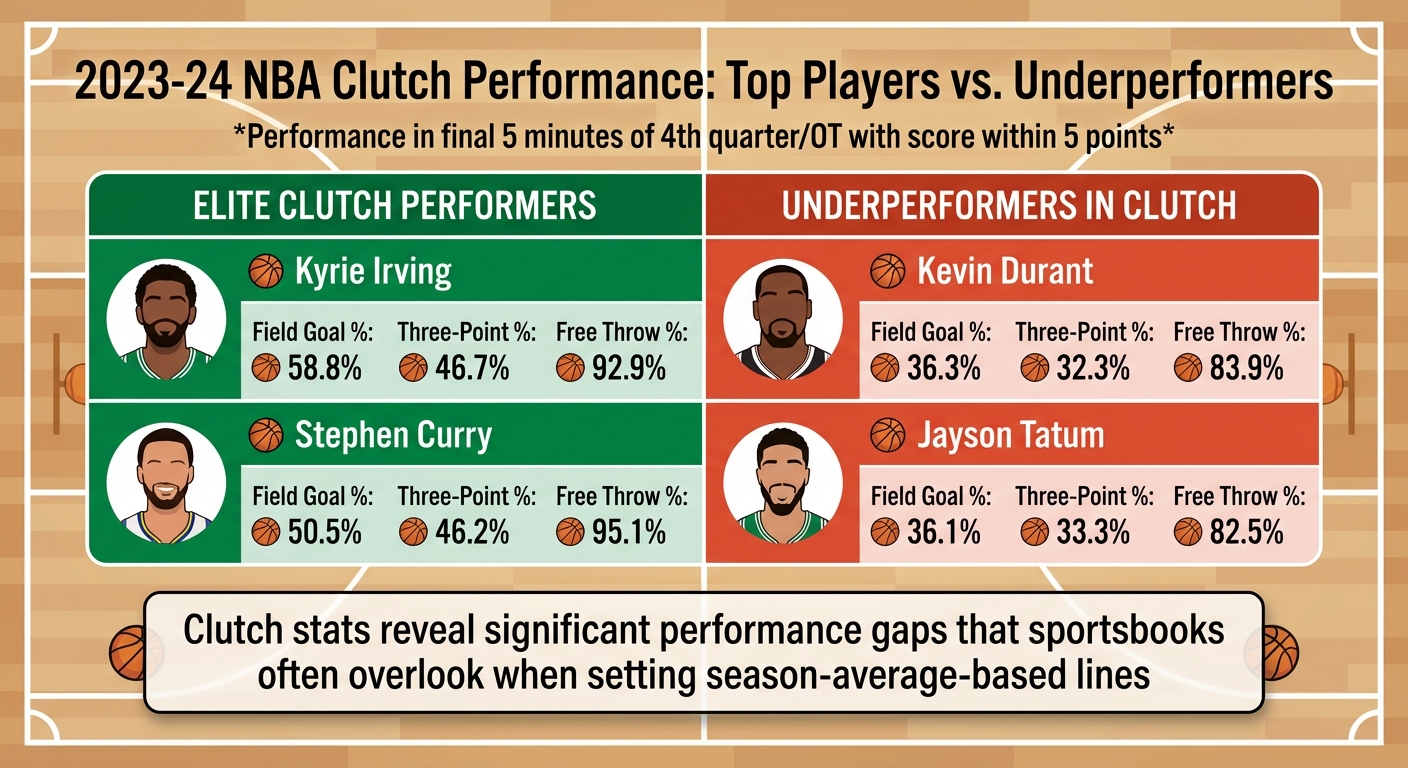
- Clutch stats highlight performance in the last five minutes of a close game. For example, in the 2023–24 season, Stephen Curry shot 50.5% from the field, 46.2% from three, and 95.1% on free throws in clutch situations, outperforming stars like Jayson Tatum.
- Free throws and turnovers are pivotal in close games. Players with high free throw percentages and low turnover rates often provide an edge for bettors.
- Historical data and tools like WagerProof help track trends, validate strategies, and spot live betting opportunities.
Core Clutch Performance Metrics
2023-24 NBA Clutch Performance Statistics Comparison
Win Probability Added (WPA)
Win Probability Added (WPA) is a stat that measures how much a player's actions directly impact their team's chances of winning. Developed by Mike Beuoy in 2014, this metric gives extra weight to plays that occur in clutch or high-pressure moments, unlike traditional plus-minus stats that treat all plays equally. For example, a game-tying shot in the final seconds counts far more than a basket during a blowout.
"A 10-point swing is much more meaningful if the game is tied compared to that same team being down by 25 points in the fourth quarter." - Justin Lipitz, University of Pennsylvania
WPA focuses on critical scoring moments - made shots, missed shots, turnovers, and free throws - while ignoring non-scoring plays during these pivotal stretches. It uses "stints", or periods when the same ten players are on the court, to track how win probability shifts based on specific lineups.
The stat relies on logistic regression models, which predict game outcomes with about 77.5% to 78.1% accuracy. Interestingly, WPA z-scores show only a moderate correlation (0.36–0.45) with other advanced metrics like RAPTOR and Box Plus-Minus, indicating that WPA captures clutch-specific data that other stats may miss.
For bettors, players with WPA z-scores that outperform their standard box-plus-minus are worth watching. These outliers often include clutch performers who are undervalued by sportsbooks. Top-tier players like Nikola Jokic and Kevin Durant excel here, as they deliver consistently under pressure and avoid wild swings in performance. WPA also filters out "garbage time" plays, as actions during moments when a win is nearly assured (99% probability) or highly unlikely (1% probability) have minimal impact on the metric.
Next, let’s dive into clutch-specific shooting stats, which provide even more insight into players' performances under pressure.
Clutch Time Statistics
Clutch time refers to the final five minutes of the fourth quarter or overtime, with the score within five points. This is where the stakes are highest, and performance in these moments can reveal a lot about a player's value.
Take the 2023-24 season, for example. Kyrie Irving posted incredible clutch shooting numbers: 58.8% from the field, 46.7% from three-point range, and 92.9% from the free-throw line. Similarly, Stephen Curry delivered with 50.5% field goal accuracy, 46.2% from deep, and 95.1% at the line. These stats far exceed what many other players achieved in similar situations.
On the other hand, some stars struggled. Kevin Durant's clutch shooting fell to 36.3% from the field and 32.3% from three, while Jayson Tatum managed just 36.1% from the field and 33.3% from beyond the arc. These differences matter, especially for spread and totals betting, as sportsbooks often rely on overall season stats rather than focusing on clutch-specific performance.
| Player (2023-24) | Clutch FG% | Clutch 3P% | Clutch FT% |
|---|---|---|---|
| Kyrie Irving | 58.8% | 46.7% | 92.9% |
| Stephen Curry | 50.5% | 46.2% | 95.1% |
| Kevin Durant | 36.3% | 32.3% | 83.9% |
| Jayson Tatum | 36.1% | 33.3% | 82.5% |
Free throw shooting becomes especially critical in these moments, as teams often foul to stop the clock. Players with elite free throw percentages, like Curry and Irving, are more reliable for clutch player props and team totals. On the defensive side, lengthy wings like Mikal Bridges and Aaron Gordon often shine in WPA models, as their impact in high-pressure situations is more pronounced than traditional defensive metrics suggest.
Player Efficiency Rating (PER) in High-Pressure Situations
While WPA and clutch shooting splits are key, Player Efficiency Rating (PER) can also shed light on who performs best under pressure. Standard PER combines box score stats into a single number but doesn’t automatically account for clutch scenarios. When applied specifically to clutch time, PER can reveal which players maintain their efficiency in critical moments and which ones falter.
Fatigue resistance plays a big role here. Players who can sustain high shooting percentages and minimize turnovers in tight games demonstrate true clutch ability. Comparing their season-long stats to clutch-specific splits highlights those who thrive under pressure versus those who struggle.
Shot selection also matters. Players who force tough, contested shots often see their efficiency drop in crunch time. On the other hand, those who stick to high-percentage looks - like open threes or drives to the basket - are more likely to maintain their effectiveness.
Interestingly, a player might have a high overall PER but a poor WPA if their efficiency comes mainly in low-stakes situations. Looking at both metrics together helps identify whether a player’s production contributes to winning in close games or simply inflates their stats when the outcome is already decided. These insights can guide smarter live betting decisions, especially when using real-time sports data platforms in high-stakes matchups.
Characteristics of High-Impact Clutch Players
Building on key clutch metrics, certain traits set apart players who thrive during game-deciding moments.
Late-Game Free Throw and Shooting Accuracy
Reliable free throw shooting and smart shot selection are hallmarks of clutch performers. Players with high free throw percentages under pressure - like Stephen Curry - become invaluable, especially when intentional fouls can dictate the outcome of close games. In fact, a single missed free throw can sway the result in spread betting scenarios.
Clutch players also avoid inefficient isolation plays, instead focusing on high-percentage shots. For example, Kyrie Irving's impressive 58.8% field goal percentage in clutch situations highlights this discipline. Contrary to the myth of a "clutch boost", data shows that maintaining consistent efficiency is what truly matters.
Metrics like True Shooting Percentage (TS%), which accounts for field goals, three-pointers, and free throws, offer a more comprehensive view of a player's reliability under pressure. When paired with defensive contributions, these shooting skills complete the profile of a dependable clutch player.
Defensive Rebounds and Turnovers
Turnovers can dramatically hurt win probability in tight games by ending possessions without a shot attempt. Metrics like Win Probability Added (WPA) penalize turnovers heavily in high-stakes moments. Players with historically low turnover rates are often the ones to watch in these situations.
Defensive rebounding is another critical factor, as it prevents opponents from gaining second-chance points when every possession counts. While WPA focuses on scoring efficiency, broader metrics like the Estimation of Clutch Competency (EoCC) include rebounds to provide a fuller picture of a player's impact. Coaches often rely on players who excel in rebounding during crunch time, recognizing their momentum on the boards.
Steals and blocks also play a big role, creating extra possessions and preventing high-percentage shots. Players like Josh Hart and Saddiq Bey bring clutch value through their hustle plays - whether it's grabbing key rebounds or handling the ball carefully - even if scoring isn’t their primary role. These defensive efforts can make or break spread betting outcomes, especially in games decided by just one or two possessions.
Using Historical Data for Clutch Performance Evaluation
Historical data adds depth to clutch performance analysis, offering a long-term perspective that short-term results can’t match. A player who consistently excels in high-pressure situations across hundreds of games provides more reliable predictive insights than someone who shines in just a handful of moments. This type of analysis helps distinguish genuine skill from random variance, giving bettors a clearer understanding of who truly thrives under pressure. By leveraging historical trends, bettors can lay the groundwork for systematic backtesting of clutch performance indicators.
Backtesting Metrics and Betting Applications
When backtesting, it’s essential to meticulously record every bet. Include details like the timestamp, league, market, odds, model probability, edge, and stake to create a comprehensive dataset for analysis. These records allow you to compare your bets against the closing line, widely regarded as the best measure of true probability. Capturing closing odds from trusted sportsbooks ensures the accuracy of your clutch performance metrics.
One key metric to monitor is Closing Line Value (CLV), which reflects your model’s ability to predict fair price movement. As Sports-AI.dev explains, "CLV is your variance-resilient quality signal confirming your model anticipates fair price movement". If your bets on clutch performers consistently yield a positive CLV, it validates the strength of your analysis. Another useful measure is Expected ROI (xROI), which filters out the effects of luck. By analyzing final scores and game flow, xROI calculates how often bets should have won, providing a clearer picture of your strategy’s effectiveness.
Sample size is critical for meaningful conclusions. A strategy based on just 20 bets won’t offer much insight. To truly validate your approach, aim for a dataset of at least 500–1,000 bets. Organizing these bets by player, game situation, or point spread range can help identify which clutch indicators consistently deliver an edge. For example, tracking blowout risk is essential - when point spreads exceed 11, there’s a 35–50% chance of a blowout, which can eliminate clutch moments entirely. Adjusting for this by reducing expected minutes (e.g., cutting starters’ minutes by 12 or about 33%) ensures your projections account for players sitting out during garbage time.
Using WagerProof to Analyze Clutch Performance

Once you've identified key clutch metrics and historical patterns, the next step is putting those insights to work in real time. That’s where WagerProof comes in. It brings together professional-level betting data - like prediction markets, statistical models, public betting trends, and historical stats - into one easy-to-use platform. Instead of relying on vague, unexplained picks, WagerProof provides tools to highlight value bets by identifying mismatches between model consensus and live market spreads. This is especially valuable for analyzing clutch performance, where timing and context are just as critical as the stats themselves. With WagerProof’s real-time tools, you can quickly act on these trends as games unfold.
Real-Time Stats and Edge Finder
The Edge Finder tool makes spotting value bets more straightforward. It works by comparing multiple statistical models to live market spreads. When there’s a noticeable gap between what the models predict and what the market reflects, the platform flags these as potential opportunities. For clutch performance, this could mean identifying a player with strong late-game metrics who’s undervalued in prop markets or spotting team totals that don’t account for a roster’s ability to perform under pressure.
WagerProof also factors in the concept of information decay, adjusting its assessments in real time based on game-changing events. For example, if a key player picks up early foul trouble or a sudden scoring run shifts the game’s momentum, the platform recalibrates its evaluations to reflect these developments.
WagerBot Chat for Clutch Performance Analysis
WagerProof’s WagerBot Chat takes real-time analysis a step further. By connecting directly to live professional data sources, it ensures accurate insights during live events, avoiding the risk of fabricated or irrelevant responses. You can ask specific questions about clutch performance, like a player’s free throw accuracy under high-pressure conditions, and receive precise, data-backed answers.
The AI assistant also helps you apply metrics like Win Probability Added (WPA) in real time. For instance, you can ask WagerBot Chat about a player’s WPA performance to see if their reputation for clutch play matches their actual impact. This lets you validate your research or uncover new insights that might not be obvious from standard box scores.
Conclusion
Betting on clutch performance isn't about relying on gut feelings or assumptions - it's about using measurable data to identify players who genuinely excel under pressure. Win Probability Added (WPA) is a key metric for assessing game-changing impact, while clutch splits reveal which players step up in critical moments. The numbers speak for themselves: using clutch metrics to guide player selection can raise success rates to 51.2%, compared to just 41.3% for standard clutch shot selections.
The real insight lies in comparing a player's high-pressure stats to their season averages. If a player’s performance stays consistent in clutch situations, they’re reliable but not necessarily clutch. On the other hand, players like Stephen Curry stand out because their clutch metrics significantly exceed their regular-season stats. These distinctions are the foundation of the advanced tools available on our platform.
With this data-driven approach, WagerProof brings everything together in real time. From prediction markets to statistical models, our platform equips you with tools like the Edge Finder and WagerBot Chat to apply clutch metrics like WPA during live games. This ensures your bets are based on hard data, not reputation or hype.
FAQs
What makes Win Probability Added (WPA) different from traditional stats?
Win Probability Added (WPA) is a stat that measures how much a player's actions affect their team's chances of winning. It looks at the change in win expectancy before and after a specific play, taking into account the game's context - like the score, inning, and situation.
Unlike traditional stats such as points, hits, or runs, which track individual accomplishments, WPA focuses on the importance of those moments. It shines a spotlight on how players perform in clutch, high-pressure scenarios, offering a more dynamic way to evaluate their overall impact on the game.
Why do free throw percentages matter in clutch performance betting?
Free throw percentages play a crucial role in evaluating clutch performance in betting, as they highlight a player's ability to perform under intense pressure. In high-stakes moments, even elite players often see their free throw accuracy drop by 5–10 percentage points, making this statistic a dependable measure of how they handle stress.
By studying free throw percentages, you can pinpoint players who are more likely to stay consistent when it matters most. For sharper betting strategies, platforms like WagerProof offer real-time data to track these patterns and identify promising opportunities.
How does historical data help refine clutch performance betting strategies?
Historical data plays a crucial role in fine-tuning clutch performance betting strategies. By diving into past games, you can spot trends in how players handle high-pressure moments and identify pivotal instances that shape game outcomes. This kind of analysis sheds light on a player's capacity to perform when it matters most, giving you a sharper edge when placing bets.
Incorporating advanced tools like win probability models can take your strategy to the next level. These models break down the significance of specific plays or moments, providing clear, data-backed insights. With this approach, your decisions rely on solid evidence instead of relying purely on instinct.
Related Blog Posts
Ready to bet smarter?
WagerProof uses real data and advanced analytics to help you make informed betting decisions. Get access to professional-grade predictions for NFL, College Football, and more.
Get Started Free