
Consensus vs. Contrarian: Betting Strategies Compared
When it comes to sports betting, you have two main approaches: Consensus Betting and Contrarian Betting. Each offers unique tactics based on how the public and sharp bettors influence odds. Here’s the breakdown:
- Consensus Betting: Aligns with the majority of bettors, relying on metrics like Bet % and Money % to follow popular picks. This approach works well when public and sharp money align, often in smaller markets.
- Contrarian Betting: Goes against the majority, exploiting inflated odds caused by public bias. This strategy thrives in high-profile games with heavy public action, especially when reverse line movement signals sharp money backing the underdog.
Quick Comparison
| Feature | Consensus Betting | Contrarian Betting |
|---|---|---|
| Philosophy | Follow the majority | Bet against the majority |
| Goal | Align with popular opinion | Exploit public bias for better odds |
| Risk Level | Lower | Higher |
| Best Use Case | Smaller markets | High-profile games |
| Typical Picks | Favorites, overs | Underdogs, unders |
Both strategies depend on timing, data, and understanding betting patterns. Tools like WagerProof can help track metrics like Bet %, Money %, and reverse line movements, offering real-time insights to refine your approach. Choose the strategy that fits the market conditions and your goals.
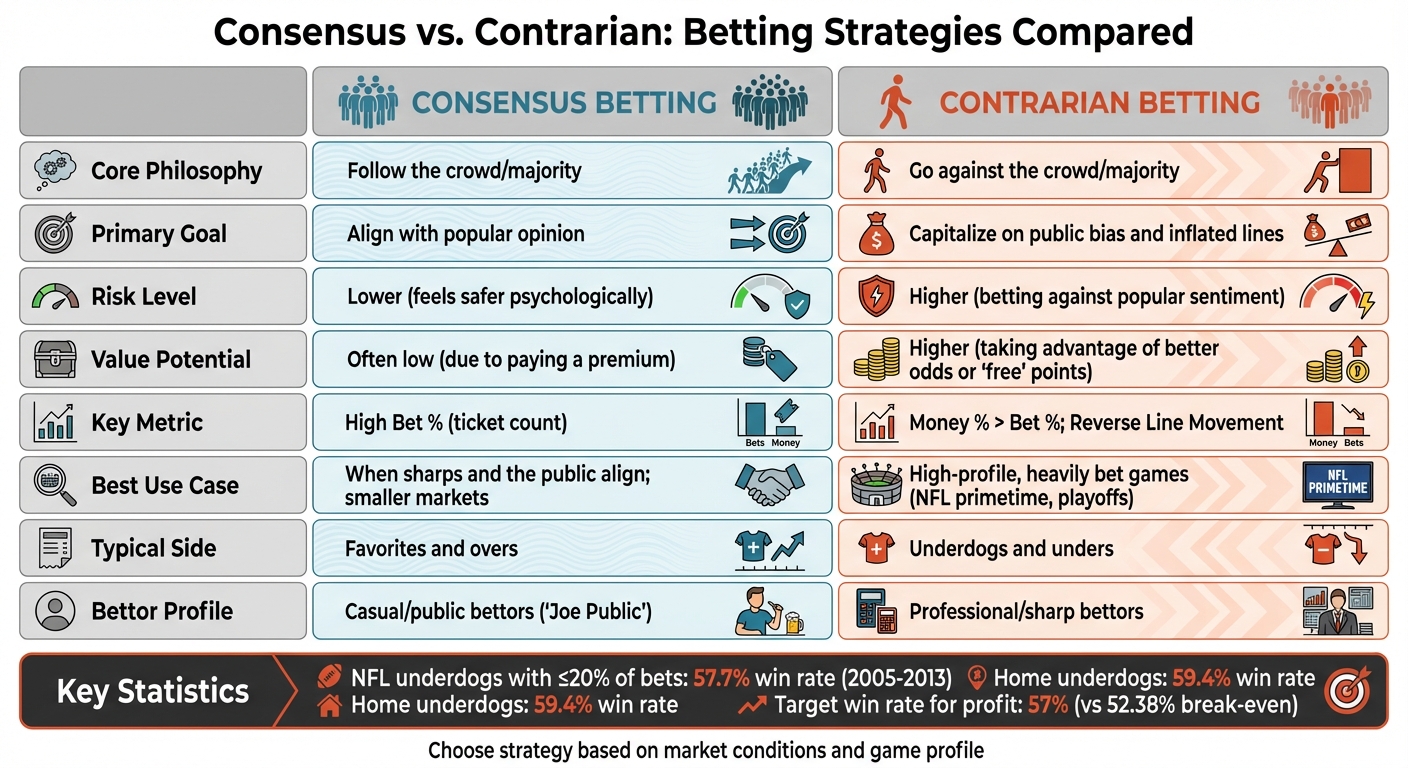
Consensus vs Contrarian Betting Strategies Comparison Chart
Betting Against The Public (feat. Kurt Long)
How Consensus Betting Works
Consensus betting relies on sportsbook data to gauge market sentiment. When the majority of bettors favor one side, it often signals something worth paying attention to.
Using Bet % and Money % Data
Two key metrics form the backbone of consensus betting: Bet % and Money %. Bet %, or ticket count, measures the total number of individual wagers placed on each side. This typically reflects where casual bettors are leaning. For instance, if 75% of bets are on the Lakers, it indicates a strong public preference.
Money %, on the other hand, tracks the total dollar amount wagered. This metric often highlights professional bettors, also known as sharps, who tend to place larger bets. A famous example is the August 2017 Floyd Mayweather Jr. vs. Conor McGregor boxing match. While most betting tickets favored McGregor due to his popularity, the majority of the money was on Mayweather. He ultimately won with a 10th-round TKO, showing the importance of following the money rather than the ticket count. A sharp signal occurs when there’s a significant gap between these metrics - like a team receiving 20% of the bets but 75% of the money. This often indicates professional backing.
Public vs. Sharp Money Influence
Understanding the difference between public and sharp money adds another layer of insight. Public money comes from casual bettors who typically place smaller wagers. Their decisions are often influenced by factors like team loyalty, media narratives, or recent performances. Popular teams like the Cowboys, Lakers, and Yankees frequently attract public money, as do favorites and "overs" in games.
Sharp money, however, comes from professional bettors or betting syndicates. These individuals make large wagers, often early in the week, to exploit perceived value or inefficiencies in the market. Their activity can significantly shift Money % data, even if Bet % remains skewed toward public wagers.
Benefits of Consensus Betting
For newer bettors, consensus betting offers some clear advantages. It simplifies decision-making by providing data-driven insights and can reduce the emotional impact of losses. By analyzing consensus data, you can identify sharp action - such as spotting a "money lean" where a team has a small percentage of tickets but a large share of the money. This helps pinpoint where professionals are focusing their bets.
Timing also matters. Placing bets closer to game time ensures the data reflects the maximum volume of both public and sharp money, offering a more accurate view of market sentiment. This approach allows bettors to make more informed decisions by leveraging consensus insights effectively.
How Contrarian Betting Works
Contrarian betting flips the script by going against the majority. The idea is simple: when most bettors favor one side, sportsbooks adjust the odds to protect themselves. This often inflates the price for the popular pick, creating hidden opportunities for those willing to bet on the less popular side.
Fading the Public
When 75%–80% of bets lean heavily toward one team, it’s a prime chance to fade the public. Sportsbooks are well aware that casual bettors tend to favor popular teams like the Dallas Cowboys, Los Angeles Lakers, or New York Yankees. Favorites and high-scoring "overs" also attract a lot of attention from these bettors. To balance their books, sportsbooks tweak the odds - making the popular side less appealing and boosting the value of the underdog.
"Sportsbooks aren't in the business of picking winners; they're in the business of balancing risk and making a profit." - Jimmy Boyd, Handicapper
Take the September 2023 college football matchup between Oregon and Colorado. Over 90% of bets poured in on Colorado, fueled by the hype surrounding Deion Sanders and "Coach Prime." Despite this, the point spread moved from Oregon -17 to -21, signaling sharp money backing Oregon. The result? Oregon crushed Colorado 42-6, easily covering the spread.
This type of imbalance often triggers reverse line movement, which is a critical indicator for spotting value.
Identifying Reverse Line Movement
Reverse Line Movement (RLM) happens when the betting line shifts in the opposite direction of public betting trends. For instance, if 80% of bets back a 6-point favorite, but the line drops to 4.5, it’s a clear sign that sportsbooks are adjusting for heavy professional action on the underdog.
Between 2005 and 2013, NFL underdogs receiving 20% or less of spread bets achieved a 57.7% win rate against the spread. For home underdogs, this figure climbed to 59.4%. Data also shows that when a team received 20% or fewer bets, the underdog’s line improved from the opening odds 55.4% of the time, compared to just 26.8% in other games.
It’s important to differentiate between RLM caused by sharp action and shifts due to legitimate news, like injuries or weather. If the line moves without any clear news, it’s likely driven by professional bettors. This matters because nearly 25% of NFL games are decided by a margin of 3 or 7 points, making even a small line adjustment crucial for finding value.
Benefits of Contrarian Betting
By taking advantage of line adjustments and reverse movements, contrarian bettors can exploit inefficiencies created by hype-driven betting. Instead of paying inflated prices like the majority, you align yourself with the sportsbooks, which consistently profit from public losses over time.
Contrarian betting is especially effective in high-profile games, like NFL primetime matchups or playoff contests, where casual money floods the market and distorts the lines. While it can feel uncomfortable to back unpopular picks, the long-term potential for profit is much higher than simply following the crowd. Professional bettors aim for a win rate of around 57%, well above the 52.38% needed to break even with standard -110 odds.
"The collective bias of public bettors can create inefficiencies in the betting market, presenting opportunities for sharp bettors who rely on data and analysis rather than public sentiment." - Sabrina Wang, InPlayLive
Consensus vs. Contrarian: Direct Comparison
Comparison Table
Both approaches serve different purposes in sports betting, each rooted in unique principles. The table below highlights these distinctions, emphasizing the importance of making informed, data-driven choices.
| Feature | Consensus Betting | Contrarian Betting |
|---|---|---|
| Core Philosophy | Follow the crowd/majority | Go against the crowd/majority |
| Primary Goal | Align with popular opinion | Capitalize on public bias and inflated lines |
| Risk Level | Lower (feels safer psychologically) | Higher (betting against popular sentiment) |
| Value Potential | Often low (due to paying a premium) | Higher (taking advantage of better odds or "free" points) |
| Key Metric | High Bet % (ticket count) | Money % > Bet %; Reverse Line Movement |
| Best Use Case | When sharps and the public align | High-profile, heavily bet games |
| Typical Side | Favorites and overs | Underdogs and unders |
| Bettor Profile | Casual/public bettors ("Joe Public") | Professional/sharp bettors |
When to Use Each Strategy
The key to success lies in knowing when to apply each method.
Go with consensus betting when sharp money aligns with public sentiment. If both the Bet % and Money % point in the same direction, it suggests professional bettors are backing the same side as the public. This scenario often occurs in smaller-market games or when major news, like an injury to a star player, causes significant line movements.
Opt for contrarian betting during marquee matchups that attract heavy public attention. Games like NFL primetime showdowns, playoff contests, or major college football events often see a flood of casual, emotionally driven bets. If 75% or more of wagers favor one side but the line shifts the opposite way, it's a strong signal to fade the public. These high-profile situations are where contrarian strategies can shine.
Avoid blindly betting against the public. Contrarian betting works best when line movements aren't triggered by legitimate factors like player injuries or weather conditions. In low-volume games, betting percentages can be misleading due to smaller sample sizes.
"Contrarian betting is about finding value, not simply contrarianism for its own sake." - Jimmy Boyd, Handicapper
With these strategies in mind, leveraging real-time data from platforms like WagerProof can help refine your approach and improve decision-making.
Using WagerProof Data to Optimize Both Strategies

WagerProof's advanced tools integrate real-time data to help refine your betting strategies and make more informed decisions.
Leveraging Public Bets and Money Lean Data
One of WagerProof's standout tools is the Public Money Splits, which tracks the difference between Ticket % (the number of bets placed) and Money % (the total cash wagered). This distinction is crucial because it highlights when sharp bettors - those with a deeper understanding of betting markets - are moving differently than casual bettors.
- For consensus bettors, when Ticket % aligns with Money % (e.g., 70% of tickets and 70% of money on the same team), it indicates agreement between both casual and professional bettors. This alignment often signals a side worth considering.
- For contrarian bettors, mismatched percentages can uncover value bets. For instance, if the public heavily favors one side, but sharp money trends in the opposite direction, WagerProof's data can instantly flag this divergence. This insight, known as reverse line movement, helps you spot opportunities to fade the public effectively.
Spotting Outliers and Value Bets
WagerProof's Edge Finder is another powerful tool, comparing predictions from 50 statistical models against live sportsbook lines. Using z-score standardization, it flags games where the market appears off. When a z-score exceeds 2.0, it signals a strong consensus among models that a line may offer value.
The AI Game Simulator adds another layer of precision by running thousands of simulations for each game. These simulations provide win probability ranges, helping you make decisions based on calibrated probabilities rather than raw accuracy. For example, one NBA study showed that selecting models based on calibration led to an average ROI of +34.69%, compared to -35.17% when relying on simple accuracy. This emphasis on transparent probability distributions ensures you're not relying on black-box predictions but rather data you can trust.
Additionally, WagerBot Chat connects you to live data sources, offering real-time insights into game conditions. You can ask about factors like wind speeds over 15 mph and their impact on passing games or how a last-minute player injury might shift win probabilities. These contextual details help both consensus and contrarian bettors adapt to evolving situations, giving you an edge over markets that may not have fully adjusted yet.
Transparency and Education for Smarter Betting
Unlike pick services that simply tell you what to bet, WagerProof shows you why a bet holds value. The platform backs up every recommendation with clear calculations, including z-scores, spread differentials, and simulation outputs.
This transparency is vital because NFL point spreads, for instance, account for about 86% of the variability in median outcomes. Even a small sportsbook bias - just one point off the true median - can create opportunities for positive expected profit. WagerProof's tools are designed to help you identify these subtle edges by surfacing the data professional bettors rely on.
The platform also provides automated alerts, notifying you of key market shifts. Whether it's a mismatch in prediction market spreads, sharp money moving against public sentiment, or weather and injury updates causing temporary inefficiencies, these alerts ensure you're always working with the most up-to-date information. Whether you're following the consensus or taking a contrarian approach, WagerProof gives you the same tools professionals use to make smarter bets.
Conclusion and Key Takeaways
Consensus and contrarian betting thrive under different circumstances. Consensus betting shines when multiple independent models align, revealing statistical advantages. This approach is particularly useful for point spreads and live betting, where synthesizing real-time data is crucial. On the other hand, contrarian betting leverages biases in high-profile games, taking advantage of inflated lines driven by emotion and public hype.
The key to success lies in knowing when to deploy each strategy. Use consensus betting in data-heavy situations, focusing on strong model agreement (z-scores above 2.0) to identify mispriced lines. Shift to contrarian betting during high-profile events like NFL primetime games, playoffs, or marquee matchups, where public sentiment often favors popular teams like the Cowboys or Lakers. Watch for reverse line movement as a key indicator: when over 75% of tickets are on one side, but the line moves the other way, it’s often a sign of sharp money acting on insights the public may have missed.
Choosing the Right Strategy
Start by assessing market conditions and aligning them with your betting goals. High-volume markets with heavy public action are ideal for contrarian plays, while consensus strategies work better in environments rich in data. Each method comes with its own risks: consensus betting can suffer from correlated model errors, while contrarian betting requires mental discipline and carries the danger of fading the public when they might actually be right.
Recent examples highlight the value of reverse line movement in spotting sharp action against public sentiment. Platforms like WagerProof enhance these strategies by offering real-time data, helping bettors act on the most relevant opportunities.
Maximizing Success with WagerProof
WagerProof equips bettors with professional tools to identify both consensus and contrarian opportunities. The Public Money Splits feature uncovers discrepancies between ticket percentages and money percentages, offering clear signals for contrarian value. Meanwhile, the Edge Finder tool scans forecasts from 50 statistical models against sportsbook lines, flagging games with high z-scores that may indicate market inefficiencies.
With automated alerts, WagerProof ensures you stay ahead of market shifts, whether you're leveraging model agreement or fading public sentiment. Plus, the exclusive Discord community and WagerBot Chat provide real-time insights on game-specific factors like weather or injuries. By using the right tools and data for each scenario, you can make smarter, more informed decisions in any betting market.
FAQs
What Bet % vs. Money % gap counts as a sharp signal?
A gap of 10% or more between the Money % and Ticket % is often viewed as a strong indicator of sharp betting activity. This happens when there's a noticeable difference between where the public is placing their bets and where the larger amounts of money are being wagered, typically pointing to professional bettors influencing the market.
How can I tell reverse line movement from injury or weather news?
Reverse line movement occurs when betting odds shift in the opposite direction of where the majority of bets are placed. This phenomenon often points to sharp bettors responding to factors like injury reports, weather updates, or other insider information not widely known. For instance, if a large percentage of bets are on one team, but the line moves in favor of their opponent, it might suggest that knowledgeable bettors are influencing the market. Tools such as WagerProof can be useful for monitoring these changes as they happen.
How do I choose between consensus and contrarian for one game?
When deciding between a consensus or contrarian betting strategy, it’s all about understanding public behavior and market dynamics. If the majority of bets and money are heavily skewed toward one side, a contrarian approach can take advantage of inflated lines influenced by public bias. On the other hand, if the consensus aligns with your personal analysis or models, siding with the crowd might be the smarter move. The key is to carefully assess market signals, identify any public biases, and weigh them against your own data before making a decision.
Related Blog Posts
Ready to bet smarter?
WagerProof uses real data and advanced analytics to help you make informed betting decisions. Get access to professional-grade predictions for NFL, College Football, and more.
Get Started Free