
Edge Decay in Prediction Markets
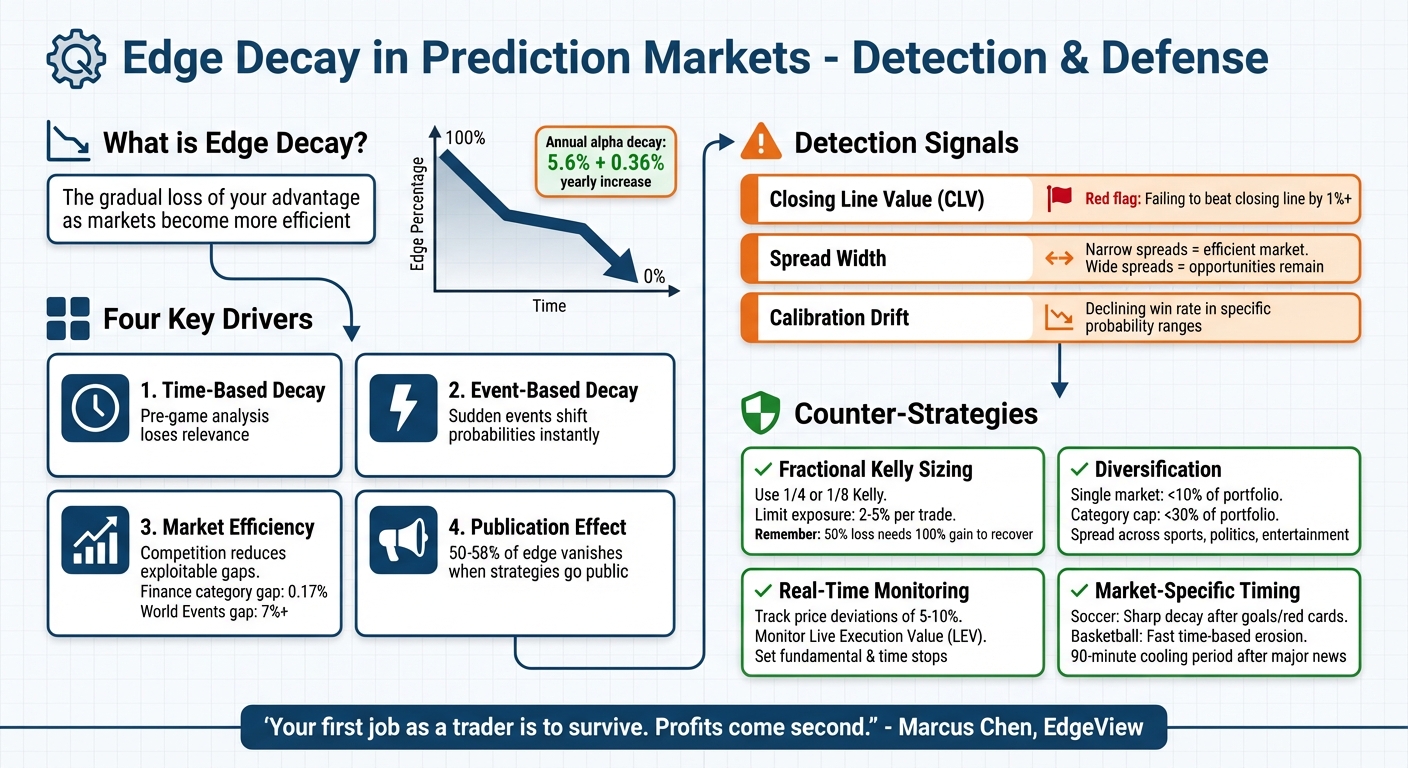
Edge decay refers to the gradual loss of your advantage in prediction markets as time passes, competition intensifies, and information becomes outdated. This concept is critical for bettors aiming to maintain profitability. Here's what you need to know:
-
What is Edge Decay?
Your "edge" is the difference between your probability estimate and the market's implied probability. Over time, this edge fades due to factors like market efficiency, new information, and unexpected events. -
Key Drivers of Edge Decay:
- Time-Based Decay: Pre-game analysis loses relevance as events unfold.
- Event-Based Decay: Sudden events (e.g., injuries, scores) can drastically shift probabilities.
- Market Efficiency: Increased competition and liquidity reduce exploitable inefficiencies.
- Publication Effect: Once strategies become public knowledge, their effectiveness diminishes.
-
Why It Matters:
- Shrinking edges mean lower profitability. A 4% edge requires far fewer bets to generate returns than a 1% edge.
- Misjudging edge decay can lead to losses, especially in fast-evolving markets like live betting.
-
How to Detect Edge Decay:
- Closing Line Value (CLV): If your bets fail to beat the closing line, your edge may be eroding.
- Spread Width: Narrow spreads indicate efficient markets, while wider spreads suggest lingering opportunities.
- Calibration Drift: A declining win rate in specific probability ranges signals a fading edge.
-
Counteracting Edge Decay:
- Use fractional Kelly sizing to manage risk.
- Diversify across markets (e.g., sports, politics) to reduce reliance on a single edge.
- Monitor real-time signals like price discrepancies and market shifts with tools like WagerProof.
Understanding edge decay is critical for long-term success in prediction markets. By recognizing its causes and implementing strategies to mitigate its impact, you can stay competitive even as markets evolve.
How to Detect and Combat Edge Decay in Prediction Markets
The Math Behind Edge Decay
How to Calculate Edge in Prediction Markets
To calculate your edge in prediction markets, subtract the market's implied probability from your own estimated probability. For example, if you believe a team has a 62% chance of winning, but the market prices them at 56%, you have a 6-point edge. But having an edge isn't enough - you need to determine if it justifies placing a bet. This is where expected value (EV) comes in:
EV = (True Probability × Profit if Won) - (True Failure Probability × Stake).
If the EV is positive, it suggests profitability over time. Accurate calculations are essential, especially as edge decay speeds up.
Another factor to consider is the vig (the bookmaker's margin), which typically ranges from 5% to 10%. For instance, in standard NFL spreads with -110 odds on both sides, the market hold is 104.8%. This means the total implied probabilities exceed 100% by 4.8%. To find the true probability, adjust for the vig using this formula:
True Probability = Implied Probability / Market Total %.
Once you know the true probability, you can use the Kelly Criterion to determine the ideal wager size:
f* = (b × p - q) / b,
where b is the decimal odds minus one, p is your true probability, and q is the probability of losing. However, since estimation errors can lead to significant losses, many experienced bettors opt for fractional Kelly, wagering 50% or 25% of the full Kelly stake to reduce volatility.
What Causes Edge to Erode
Edge erosion happens as markets become more efficient, liquidity increases, and competition pushes prices closer to the true probabilities. When betting volumes rise and information spreads, market prices tend to align with reality, shrinking your advantage. This effect is visible in market data: on Kalshi, the Finance category shows a maker-taker gap of just 0.17 percentage points, while in the World Events and Media categories, the gap exceeds 7 percentage points.
Edge decay occurs in two main ways: time-based and event-based. Time-based decay is a gradual reduction in edge as the clock ticks. Event-based decay, on the other hand, happens suddenly due to high-impact events like injuries, goals, or red cards. The Information Decay Model explains this by introducing the concept of a "half-life", where the predictive power of pre-game analysis drops to 50% compared to live data. For instance, in the NBA, the half-life might occur by the end of the first quarter, while in soccer, it could be around the 30-minute mark.
Sophisticated bettors may also use tools like Kullback-Leibler (KL) divergence to measure how small errors in probability estimates can impact long-term portfolio growth. The formula,
D(k/N ∥ p+ε) - D(k/N ∥ p) = [(p - k/N) / p(1-p)]ε,
helps quantify how even minor miscalculations can snowball into significant losses over time. Next, we’ll dive into specific signals that can help identify edge decay as it happens.
What Causes Edge Decay and How to Spot It
Main Drivers of Edge Decay
Edge decay happens when your initial advantage fades over time. One major cause is crowding - when too many traders target the same opportunity, the potential for profit diminishes quickly. This is because a fixed alpha (or edge) gets diluted as competition grows. As markets evolve, price adjustments occur, driven by both public information (like news and real-time sports data) and private insights. These adjustments gradually eliminate the mispricing that traders aim to exploit. For instance, in financial markets, the maker-taker gap can shrink to as little as 0.17 percentage points due to professional activity and fast information flow. On the other hand, in areas like world events or media, gaps can exceed 7 percentage points, allowing an edge to last longer.
The publication effect is another factor that speeds up edge decay. When market anomalies are published in academic papers or discussed in public forums, about 50% to 58% of the edge typically vanishes. Once a strategy is widely known, its competitive advantage diminishes. Additionally, algorithm-driven market makers further erode edges with their superior execution and efficiency. These factors not only reduce the edge itself but also force traders to rethink their strategies immediately.
Patterns That Signal Edge Decay
Different strategies lose their edge in distinct ways, but there are clear warning signs. One of the most telling is calibration drift. For instance, if your win rate in a specific probability range (like 60–65%) used to match your expectations but now consistently falls short, it’s a strong indication that your edge is slipping. Keeping track of these metrics on a monthly basis can help you spot such changes early.
Strategies based on mechanical systems, like momentum or reversal models, tend to lose their edge faster (mean R² = 0.37) because they’re easier to replicate and automate. In contrast, judgment-based approaches, such as value assessments or qualitative analysis, decay more slowly (mean R² = 0.04) since they require interpretation and are harder to copy. Watching for calibration drift can also reveal broader inefficiencies in the market, such as shrinking arbitrage opportunities.
Another red flag is arbitrage compression. Pay attention to how long price differences for the same event persist across platforms. Normally, semantically equivalent markets show price differences of around 2–4% on average. However, as platforms improve their "semantic alignment" and traders exploit these gaps faster, the discrepancies can disappear in seconds instead of minutes. This rapid closing of arbitrage opportunities is a clear sign that edge decay is taking place.
How to Detect Edge Decay in Real Time
Market Signals to Monitor
Real-time monitoring of market signals can help you identify edge decay before it impacts your profitability. One of the most reliable indicators is Closing Line Value (CLV) drift. If your bets consistently fail to beat the closing line by at least 1%, it could mean your edge is slipping away. Keeping a close eye on CLV drift allows you to decide when it’s time to reevaluate your strategy.
Another key signal is spread width. Narrow spreads often suggest that the market has efficiently processed all available information, while wider spreads may indicate uncertainty or lower liquidity, which could extend the life of your edge.
For live betting, Live Execution Value (LEV) is a critical benchmark. This involves measuring mid-odds three seconds after placing a bet. If you consistently outperform this benchmark, it confirms your edge is intact. However, watch for signs of overround sensitivity in your model. If your expected returns become increasingly tied to the bookmaker's margin over three consecutive days, it’s a red flag that your model may need recalibration.
These signals create a foundation for tools like WagerProof, which provide automated, real-time alerts to help you stay ahead.
Using WagerProof to Detect Edge Decay

Reacting quickly to edge decay is essential for staying profitable. WagerProof offers automated outlier detection, helping you spot spread mismatches across prediction markets in real time. By delivering immediate alerts on price discrepancies, it ensures you don’t miss out on valuable opportunities.
The platform also provides value bet signals, which compare public betting percentages against the distribution of money. For example, if 70% of bets are on one side but only 40% of the money is placed there, it can reveal where sharp money is moving.
WagerProof goes further by tracking events that can trigger sudden edge decay. These include moments like red cards or key injuries in soccer, or extended scoring runs in basketball. The platform flags these events so you can adjust your strategy before the market fully reacts. Since automated systems often cancel bets if data becomes outdated - exceeding 1,500 milliseconds during volatile periods - having real-time alerts gives you a crucial advantage.
How to Adapt to Edge Decay
Adjusting Bet Size and Hedging
When it comes to managing edge decay, professionals rely on calculated strategies rather than gut feelings. One of the key principles is capital preservation. Here’s why: recovering from a loss becomes exponentially harder as the percentage of the loss increases. For instance, a 50% loss requires a 100% gain just to break even, while a 90% loss demands a staggering 900% recovery. To manage this, many professionals use fractional Kelly sizing, such as 1/4 or 1/8 Kelly, to reduce variance and keep risks in check. Typically, they limit their exposure to just 2–5% of their bankroll on any single trade.
In addition to sizing, setting clear stop points is crucial. Fundamental stops - like exiting a trade when a major factor changes (e.g., a star player gets injured or unexpected news alters the landscape) - help prevent further losses. Time stops are another tool: if the expected outcome hasn’t materialized by a specific point in the game, it’s often better to cut losses and move on. These strategies work together to protect your capital.
For live betting, dynamic weighting can be a game-changer. This involves recalculating odds by blending pregame pricing with live market data using a weighted average: (Weight_PreGame × PreGame_Price) + (Weight_InPlay × Market_Live_Price). After major news events, taking a 90-minute cooling-off period can also help you avoid recency bias and rash decisions during market volatility.
Finally, spreading your bets across different markets is another way to manage edge decay effectively.
Spreading Bets Across Different Markets
Diversification isn’t just a buzzword - it’s a proven way to reduce risk. By spreading bets across unrelated markets like sports, politics, and even entertainment, you can minimize the impact of edge erosion in any single category. This approach is especially important because different markets decay at different rates, depending on their "metabolism."
Take sports markets as an example. Soccer markets often experience slower, time-based decay but see sharp drops in edge after significant events like goals or red cards. Basketball, on the other hand, is fast-paced, with constant scoring runs that can quickly erode any edge. Tennis markets are even more volatile, with swings driven by factors like service breaks or double faults.
To manage exposure, many professionals cap their allocation to a single market at less than 10% of their portfolio. They also limit total exposure to a specific category (e.g., political markets) to under 30%, reducing the risk of correlated losses. Cross-platform diversification can also pay off. For instance, in December 2025, arbitrageurs spotted price spreads of up to 14 cents (14%) between Polymarket and Kalshi on identical political event contracts, highlighting opportunities for savvy traders.
Using WagerProof for Strategy Adjustments
WagerProof offers tools designed to help you stay ahead of edge decay. The platform’s Edge Finder pulls data from over 50 sources and applies Bayesian modeling to deliver real-time signals. These alerts highlight price deviations of 5–10%, complete with direction, strength, and confidence scores, giving you actionable insights when market conditions shift.
When edge decay speeds up, WagerBot Chat provides AI-powered market analysis, backed by live professional data feeds. This tool not only delivers automated alerts but also allows you to backtest historical scenarios. By analyzing how similar edge decay patterns unfolded in the past, you can refine your approach for future events. Plus, WagerProof’s exclusive Discord community adds another layer of insight, offering real-time discussions with other professionals. Together, these features help you adapt quickly and confidently as markets evolve.
Key Takeaways
Main Points to Remember
In prediction markets, edge decay is an unavoidable reality. As inefficiencies are exploited, the advantages you hold naturally diminish. For example, in U.S. markets, annual alpha decay reaches 5.6%, with an additional yearly increase of 0.36%. This decay happens through time-based erosion, unexpected events, and biases like recency effects or the favorite–longshot bias, which often result in underdogs being overpriced.
The goal isn’t to completely avoid edge decay - that’s impossible. Instead, focus on identifying and adjusting to it. Regularly track metrics like Brier scores and win rates to spot when your signals lose their effectiveness. Protect your bankroll by using half-Kelly sizing (betting 50% of the full Kelly stake), as this approach minimizes risk. Remember, a 50% drawdown requires a 100% gain just to recover. Implement stop-loss protocols to exit a position when your initial thesis no longer holds or when outcomes deviate sharply from expectations.
"Your first job as a trader is to survive. Profits come second." – Marcus Chen, EdgeView
Diversification is another critical strategy. Spread your bets across uncorrelated markets, limiting single-market exposure to 10% of your portfolio and capping category exposure at 30% to manage risks tied to correlation. Different sports have varying decay rates, so tailoring your approach is essential. For instance, soccer experiences sharp decay after goals due to event shocks, while basketball’s fast pace leads to quicker time-based erosion.
These strategies lay the groundwork for tactical adjustments, especially when paired with advanced tools.
How WagerProof Helps You Maintain Your Edge
To combat edge decay effectively, leveraging the right tools makes all the difference. WagerProof’s Edge Finder aggregates data from over 50 sources and uses Bayesian modeling to alert you in real time when market prices deviate from fair value by 5–10%. These automated signals provide insights into the direction, strength, and confidence behind market movements.
Additionally, WagerBot Chat connects to live professional data feeds, offering AI-driven market analysis without misinformation. You can even backtest historical scenarios to observe how similar edge decay patterns unfolded, helping you refine your strategy for upcoming events. By detecting edge decay early, WagerProof enables you to adapt before it impacts your profitability.
Mastering edge decay and making timely adjustments are essential for staying profitable in fast-changing prediction markets. With the right strategies and tools, you can stay ahead of the curve.
How To Find An Edge, Scale It Successfully & Stay In Your Lane | Presented by Kalshi
FAQs
How fast does my edge decay in live markets?
In live markets, any advantage tends to fade fast - often within seconds or minutes. This happens because of factors like market volatility, shifts in liquidity, or sudden, event-driven changes. To make the most of these short-lived opportunities, traders need to move quickly and adjust to the ever-changing market landscape.
What’s the simplest way to know if I still have an edge?
To figure out if you still have an edge, compare your estimated probability to the market-implied probability. If your estimate points to a positive expected value, there's a good chance you have an edge. The process involves calculating the gap between your probability estimate and the market’s implied probability to determine if your prediction offers any value.
When should I stop betting a model that used to work?
When your model’s performance starts slipping - whether from edge decay or miscalibration - it’s time to hit pause. The telltale signs? Predictions that no longer match up with actual results and worsening metrics, like the Brier Score or Log Loss. As markets grow more efficient, the signals your model relies on can weaken, cutting into your ROI. Keep a close eye on these performance metrics and recalibrate as needed. If the model stops delivering a dependable edge, it might be time to either revise or temporarily shelve it.
Related Blog Posts
Ready to bet smarter?
WagerProof uses real data and advanced analytics to help you make informed betting decisions. Get access to professional-grade predictions for NFL, College Football, and more.
Get Started Free