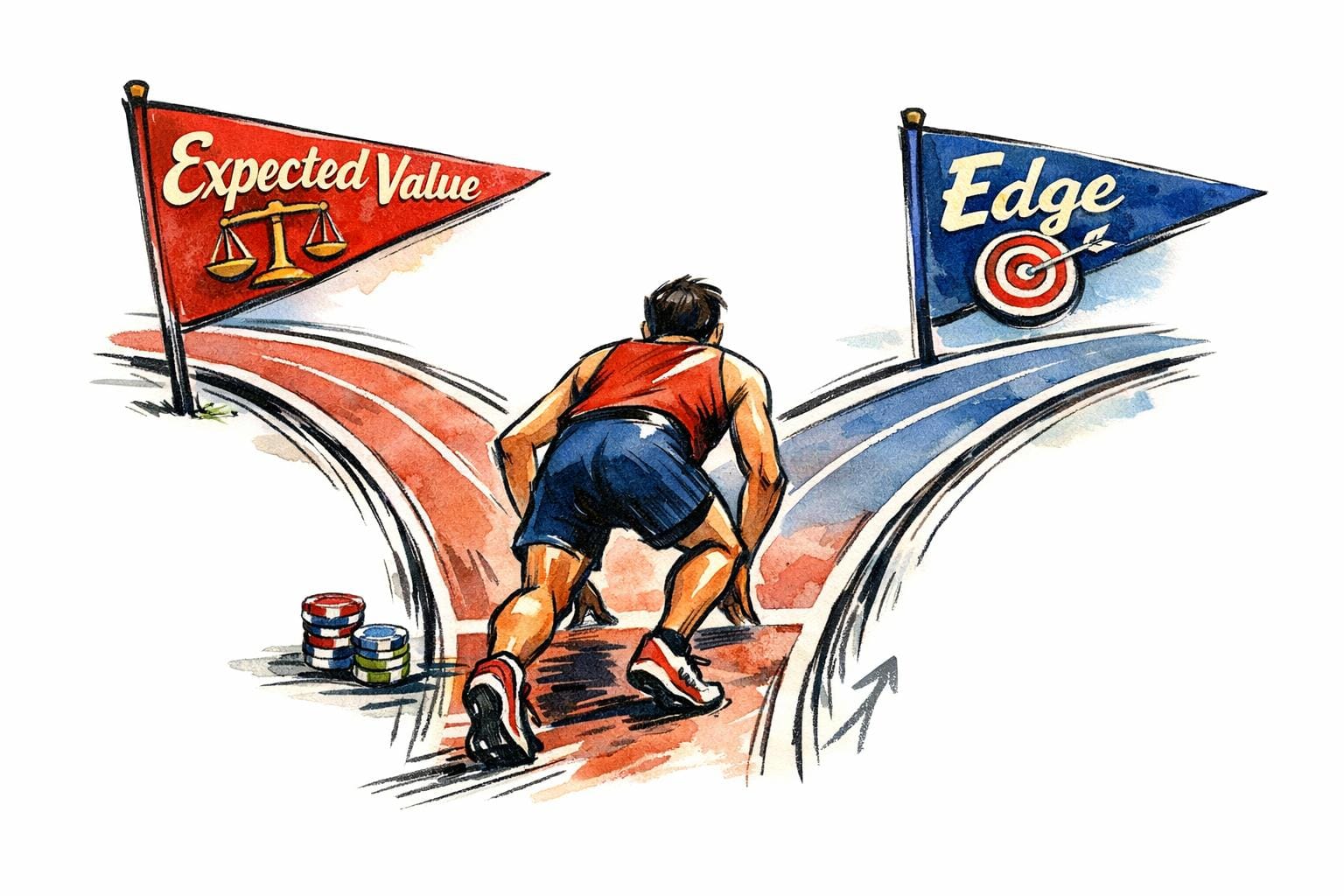
Expected Value vs. Edge: Key Differences
When betting, understanding Expected Value (EV) and Edge can make the difference between long-term profits and losses. Here's the core idea:
-
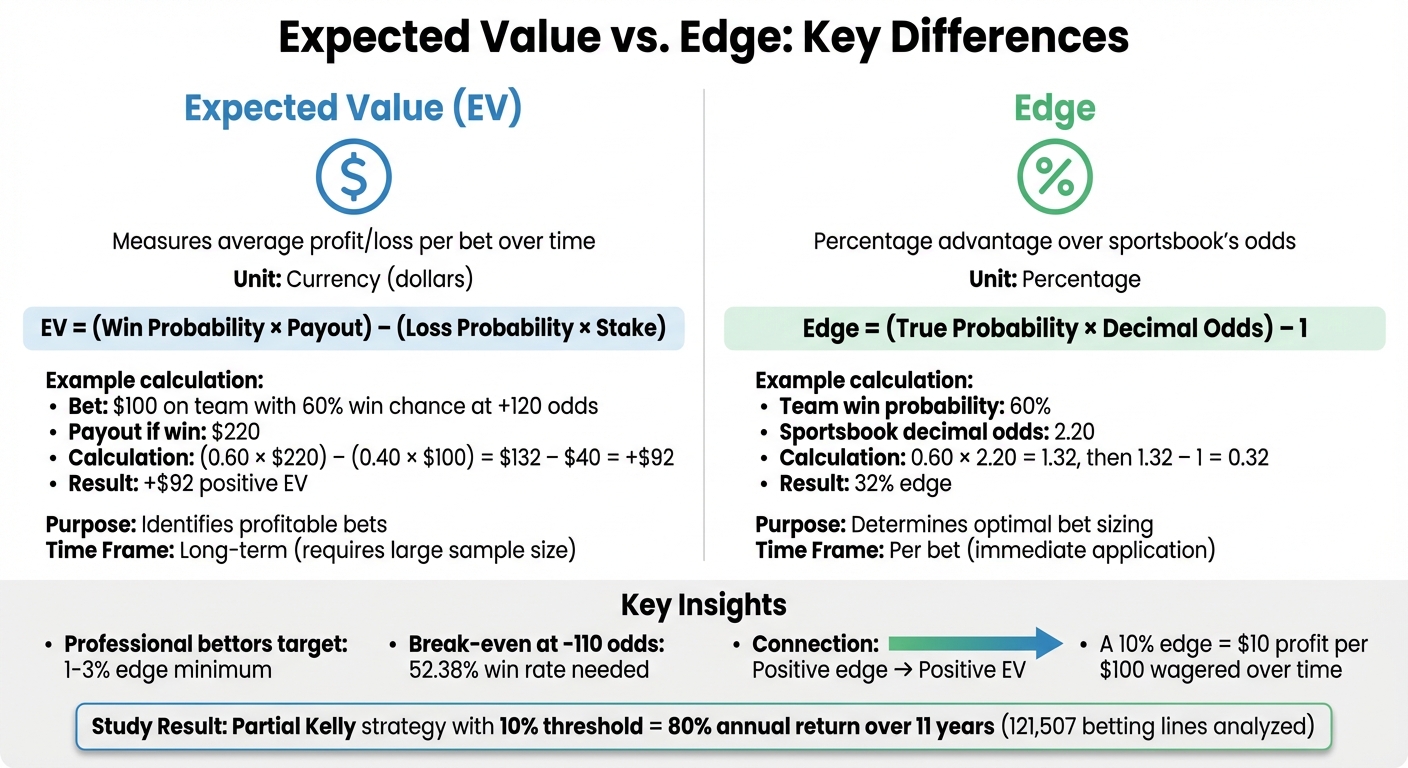
Expected Value (EV): Measures how much you can expect to win or lose on average per bet over time. Calculated in dollars, EV helps you decide if a bet is worth taking. Example formula:
EV = (Win Probability × Payout) – (Loss Probability × Stake) -
Edge: Shows your percentage advantage over the sportsbook's odds. It tells you how much better your estimated probabilities are compared to the sportsbook. Example formula:
Edge = (True Probability × Decimal Odds) – 1
Quick Comparison
| Feature | Expected Value (EV) | Edge |
|---|---|---|
| What it measures | Average profit/loss (in $) | Percentage advantage (%) |
| Formula | (Win % × Payout) – (Loss % × Stake) | (True Probability × Decimal Odds) – 1 |
| Purpose | Identifies profitable bets | Helps decide bet size |
| Time Frame | Long-term | Per bet |
Key takeaway: Positive EV means a bet is profitable in the long run, while Edge tells you how much of an advantage you have. Use both to make smarter betting decisions and manage risks effectively.
Expected Value vs Edge in Sports Betting: Key Differences and Formulas
Definitions: Expected Value and Edge
What is Expected Value (EV)?
Expected value (EV) is a way to measure how much you can expect to win or lose on average if you place the same bet multiple times. It’s a critical tool for determining whether a sportsbook's odds align with the actual likelihood of an event happening.
Here’s the formula for EV:
EV = (Win Probability × Payout) – (Loss Probability × Stake)
Let’s break it down with an example. Imagine you bet $100 on a team with a 60% chance of winning, and the odds are +120. If the team wins, your payout would be $220 (your $100 stake plus $120 profit). The EV calculation would look like this:
(0.60 × $220) – (0.40 × $100) = $132 – $40 = +$92
This means the bet has a positive EV of $92. A positive EV suggests that, in the long run, you’re expected to profit. On the other hand, a negative EV indicates a likely loss over time, often due to the sportsbook’s built-in margin. Professional bettors typically aim for an edge of 1% to 3% or more to account for uncertainties in their models.
What is Edge?
Edge refers to the percentage advantage you have when your assessment of an outcome's probability is better than what the sportsbook’s odds imply. In simple terms, if the true likelihood of an event happening is higher than what the odds suggest, you’ve found an edge.
The formula for edge is:
Edge = (True Probability × Decimal Odds) – 1
For example, if you believe a team has a 60% chance of winning and the sportsbook offers decimal odds of 2.20, the calculation would be:
0.60 × 2.20 = 1.32, and then 1.32 – 1 = 0.32 (or a 32% edge).
A 10% edge means that, over time, you can expect to earn $10 for every $100 wagered. To get an accurate edge calculation, it’s essential to remove the sportsbook’s margin - a process known as "de-viging" the odds.
How EV and Edge Connect
EV and edge are closely linked. While edge is expressed as a percentage, EV is shown in dollar terms. A positive edge naturally leads to a positive EV bet. The bigger your edge, the higher the EV.
"Expected value is the truth serum for your bets – it reveals whether you're making a savvy play or donating to the sportsbook's coffers."
- Jimmy Boyd, Boyd's Bets
This connection is fundamental to smart betting strategies. Professional bettors use their edge to determine how much to wager, often relying on the Kelly Criterion for bet sizing. One study of 121,507 betting lines found that using a Partial Kelly strategy with a 10% threshold delivered an 80% annual return over 11 years. However, even with a strong edge, there’s no escaping variance. A 60% win probability still means a 40% chance of losing any single bet.
Main Differences Between EV and Edge
Comparison Table: EV vs. Edge
Though edge and expected value (EV) often work hand-in-hand in a betting strategy, they focus on different aspects and serve distinct purposes. Edge measures your percentage advantage over the sportsbook, while EV estimates how much that advantage translates into actual dollars over time.
| Feature | Expected Value (EV) | Betting Edge |
|---|---|---|
| What it measures | Average profit or loss expected per bet over time | Percentage advantage over the sportsbook's price |
| Unit of Measurement | Currency (e.g., $) or units | Percentage (%) |
| Primary Formula | (Win Probability × Payout) – (Loss Probability × Stake) | (True Probability × Decimal Odds) – 1 |
| Strategic Use | Identifying whether a bet is worthwhile ("value") | Determining optimal bet sizing (e.g., via Kelly Criterion) |
| Time Frame | Long-term - requires a large sample size | Immediate, applied on a per-bet basis |
Here's how these concepts play out in practice: edge helps determine how much to wager. Pro bettors often use it within the Kelly Criterion, a method to scale bets based on their advantage. Meanwhile, EV tells you whether a bet is worth placing at all. If the EV is negative, you’re essentially giving money away to the sportsbook.
Understanding these differences is crucial, especially when considering how EV and edge interact over varying time frames.
Time Frames and Practical Applications
Looking at the table above, the roles of EV and edge become clearer when applied to real-world betting scenarios.
Edge is a short-term metric - it’s calculated for each individual bet and answers the question, "How much better is my price compared to the true value?" EV, on the other hand, is a long-term measure. It only becomes evident after placing hundreds or even thousands of bets. In the short term, variance can mask the true EV, even for bets with a significant edge. For example, a bet with a 10% edge might still experience losing streaks that make the numbers feel misleading.
This distinction has real implications for managing your bankroll. A bet could show a high positive EV in dollar terms but only a small percentage edge if your stake is large. On the flip side, even a slight edge of 1% to 3% can lead to meaningful gains over time if applied consistently. However, without identifying bets with both a positive edge and EV, even winning bettors can lose money in the long run. Balancing these metrics is key to a sustainable betting strategy.
Using EV and Edge in Your Betting Strategy
Finding Positive EV Bets
To spot positive Expected Value (EV) bets, start by converting betting odds into implied probabilities. For instance, standard -110 odds suggest a 52.38% win rate is needed to break even. Once you have the implied probability, strip out the sportsbook's vig (or margin) to uncover the true odds.
Sharp sportsbooks like Pinnacle and Circa are known for offering highly efficient lines. These can serve as reliable benchmarks to compare with your own probability estimates. If your calculated probability exceeds the market's de-vigged number, you’ve identified a positive EV opportunity.
"Being able to take American betting odds and convert them into implied probability is a key factor to assessing value in a particular betting market." - Nicole Russo, TheLines.com
Market inefficiencies are often more pronounced in areas like player props, smaller leagues, and live betting. These segments tend to react more slowly to new information compared to major events like NFL or NBA games. This delay creates opportunities for data-savvy bettors to capitalize on positive EV situations. Once you’ve identified such opportunities, the next challenge is turning your edge into consistent profits.
Using Edge for Consistent Profits
Sharp bettors often operate with slim margins - edges as small as 1% to 3% - but they apply these consistently across hundreds of bets. One of the most reliable indicators of long-term success is tracking Closing Line Value (CLV). If you’re consistently securing better odds than the final market price, it’s a strong sign of profitability, even if short-term results fluctuate.
A study of 121,507 betting lines revealed that using a Partial Kelly strategy with a 10% threshold resulted in an 80% annual return over 11 years. This demonstrates how compounding small edges over time can create significant gains. Even achieving a modest 53% win rate on standard -110 odds can turn consistent losses into steady profits.
Line shopping is another critical practice. By comparing odds across multiple sportsbooks, you can find discrepancies where one book may misprice a game or lag behind market trends. Tools like WagerProof can simplify this process by flagging mismatched spreads and uncovering hidden edges. Combining line shopping with disciplined betting strategies ensures you’re maximizing your advantage.
Once you’ve confirmed your edge, managing your bankroll effectively becomes the next essential step.
Bankroll Management and Risk Control
The Kelly Criterion offers a mathematical approach to bet sizing:
f = (bp - q) / b, where b is your decimal odds minus 1, p is your win probability, and q is your loss probability. This formula helps you optimize your stake size by balancing potential growth with the risk of ruin.
Most professional bettors prefer Fractional Kelly - betting only 25% to 50% of the full Kelly amount. This conservative approach accounts for potential errors in probability estimates and reduces the impact of variance. Even with a strong edge, variance is unavoidable. For example, a 60% win probability still leaves a 40% chance of losing, and losing streaks are a natural part of betting.
To minimize risk, avoid betting more than 5% of your bankroll on any single wager, regardless of how favorable the EV or edge appears. It’s also wise to set a stop-loss threshold - if your bankroll drops by 20%, pause and reassess your strategy. On no-vig platforms, the break-even point lowers from 52.4% to 50%, which explains why around 40% of users can potentially profit on peer-to-peer exchanges, compared to just 2% at traditional sportsbooks.
Effective bankroll management, combined with a disciplined approach, ensures that even small edges can lead to sustainable long-term success.
Positive EV Tutorial | How to Identify the Sharpest Bets
The Sportsbook's Edge: Overround and Hold
When evaluating bet value, it's crucial to understand how sportsbooks secure their profits. This built-in advantage, known as overround, is the sum of implied probabilities for all possible outcomes in a betting market. In a perfectly fair market, these probabilities would total 100%. Anything above that represents the sportsbook's margin, ensuring their profit.
For example, standard point spread odds of -110 on both sides result in a total implied probability of 104.8%. This means the sportsbook has a 4.8% hold. Before you can generate any profit - even if you've identified a mispriced line - you must first overcome this disadvantage. This built-in edge highlights why managing overround is so important for long-term success.
Not all markets are created equal. High-volume markets, like major football leagues such as the Premier League, typically have tighter overrounds, ranging from 102% to 104%. On the other hand, niche sports and lower leagues often see overrounds between 107% and 110%. Parlays, with their compounded margins, can exceed 115%, while novelty and political betting markets may reach as high as 125%.
Here’s a quick breakdown of how overround varies across markets:
| Market Type | Typical Overround | Difficulty Level |
|---|---|---|
| Major Football Leagues | 102% – 104% | Lower margin, highly efficient |
| Tennis (2-way) | 102% – 105% | Sharp money forces tight pricing |
| Basketball (NBA Spread) | 104% – 106% | Competitive major league pricing |
| Niche Sports / Lower Leagues | 107% – 110% | Less liquidity, higher margins |
| Parlays / Accumulators | 115%+ | Margins compound per leg |
| Novelty / Political Bets | 115% – 125% | Heavily padded casual markets |
To uncover true value, you can de-vig the odds - divide each implied probability by the market's total to strip out the sportsbook's margin. This helps reveal the fair price of a bet. When comparing markets with different overround levels, line shopping becomes essential. Securing odds in lower-margin markets can turn a marginal bet into a clear positive EV opportunity. On the flip side, avoid high-margin markets like exotic props or long-leg parlays, where excessive overround makes finding positive EV nearly impossible.
Conclusion
Grasping Expected Value (EV) and edge transforms sports betting from a game of chance into a calculated investment strategy. These concepts form the backbone of smart wagering and separate those who profit from those who simply fund the house.
The key shift is moving from "picking winners" to identifying and exploiting mispriced odds. As highlighted earlier, spotting these opportunities and managing variance effectively are critical to success. This approach allows you to fine-tune every bet with long-term gains in mind.
Patience and discipline are non-negotiable. Even with a solid 10% edge, poor bankroll management can lead to devastating losing streaks. Tools like fractional Kelly sizing and strict bankroll rules help mitigate these risks, ensuring that you stay in the game for the long haul.
Tracking your Closing Line Value (CLV) is another important step. It helps confirm whether your edge is genuine or just perceived. Focus on refining your process rather than obsessing over short-term results. Success lies in consistently making quality EV calculations, not in chasing immediate wins.
The numbers back this up. A study analyzing 121,507 betting lines showed that using a Partial Kelly strategy with a 10% threshold yielded an 80% annual return over 11 years. To replicate this success, strip out the vig, calculate your true edge, size your bets proportionally, and let the math guide your decisions. By mastering these principles and staying disciplined with your bet sizing, you can achieve sustained profitability in the long term.
FAQs
How do I convert American odds to implied probability?
To turn American odds into implied probability, use these formulas:
-
For positive odds (e.g., +X):
Implied probability = 100 / (X + 100) -
For negative odds (e.g., -X):
Implied probability = X / (X + 100)
Here’s an example to make it clearer:
- If the odds are +200, the implied probability is 33.33% (100 / 300).
- If the odds are -200, the implied probability is 66.67% (200 / 300).
This calculation helps you determine if the odds align with the probability you’ve estimated.
How do I de-vig odds to find the true probability?
To remove the bookmaker's margin (also known as the vig) from odds, you need to adjust the implied probabilities. Here's how it works:
- Convert the given odds into implied probabilities using the appropriate formulas for American odds.
- Add up all the implied probabilities. This total will usually exceed 100% because of the bookmaker's margin.
- Normalize these probabilities by dividing each implied probability by the total sum. This adjusts the values so they add up to 100%, effectively removing the vig.
The result is a set of "fair" probabilities, which reflect the true chances of each outcome. These adjusted probabilities are essential for identifying positive expected value (+EV) bets - situations where your own probability estimates suggest better odds than the bookmaker's fair odds.
How do I turn my edge into a bet size with Kelly?
To figure out your bet size using the Kelly criterion, start by determining your edge. This involves comparing your own probability of winning to the implied probability reflected in the odds. Once you have your edge, use the formula:
Kelly % = (bp - q) / b
Here’s what each part means:
- b: Decimal odds minus 1
- p: Your estimated probability of winning
- q: The probability of losing, or 1 - p
If you want to reduce risk and safeguard your bankroll, you can use a fractional Kelly approach, which involves betting a smaller percentage of the calculated amount. This helps balance potential returns with long-term stability.
Related Blog Posts
Ready to bet smarter?
WagerProof uses real data and advanced analytics to help you make informed betting decisions. Get access to professional-grade predictions for NFL, College Football, and more.
Get Started Free