How AI Detects Data Errors in Real-Time Betting
AI ensures accurate, real-time sports betting data by detecting and fixing errors instantly. Here's how it works:
- Error Types: Common issues include delayed feeds, incorrect odds, and mismatched data, all of which can mislead bettors.
- AI Techniques: Systems use anomaly detection, machine learning, and cross-checking to identify and address inconsistencies with 92%+ accuracy.
- Key Features: AI monitors data feeds, halts betting during delays, and compares odds across multiple sources to flag irregularities.
- Impact: This prevents costly mistakes, improves reliability, and helps bettors make informed decisions during live games.
Platforms like WagerProof leverage these tools to maintain data accuracy, spot unusual betting patterns, and provide users with actionable insights in real time.
What Are Data Errors in Real-Time Betting?
In real-time betting, data errors occur when there’s a mismatch between live game events and the information shown on a betting platform. These errors can mislead bettors by providing outdated or incorrect data. For instance, if a player scores a goal but the platform’s feed is delayed by more than 1,500 milliseconds, you might place a bet based on odds that no longer reflect the actual game situation. Common examples of such errors include delayed feeds, incorrect player stats, mismatched odds across platforms, and unusual betting patterns. Let’s break down the most frequent error types and their effects.
Common Data Error Types
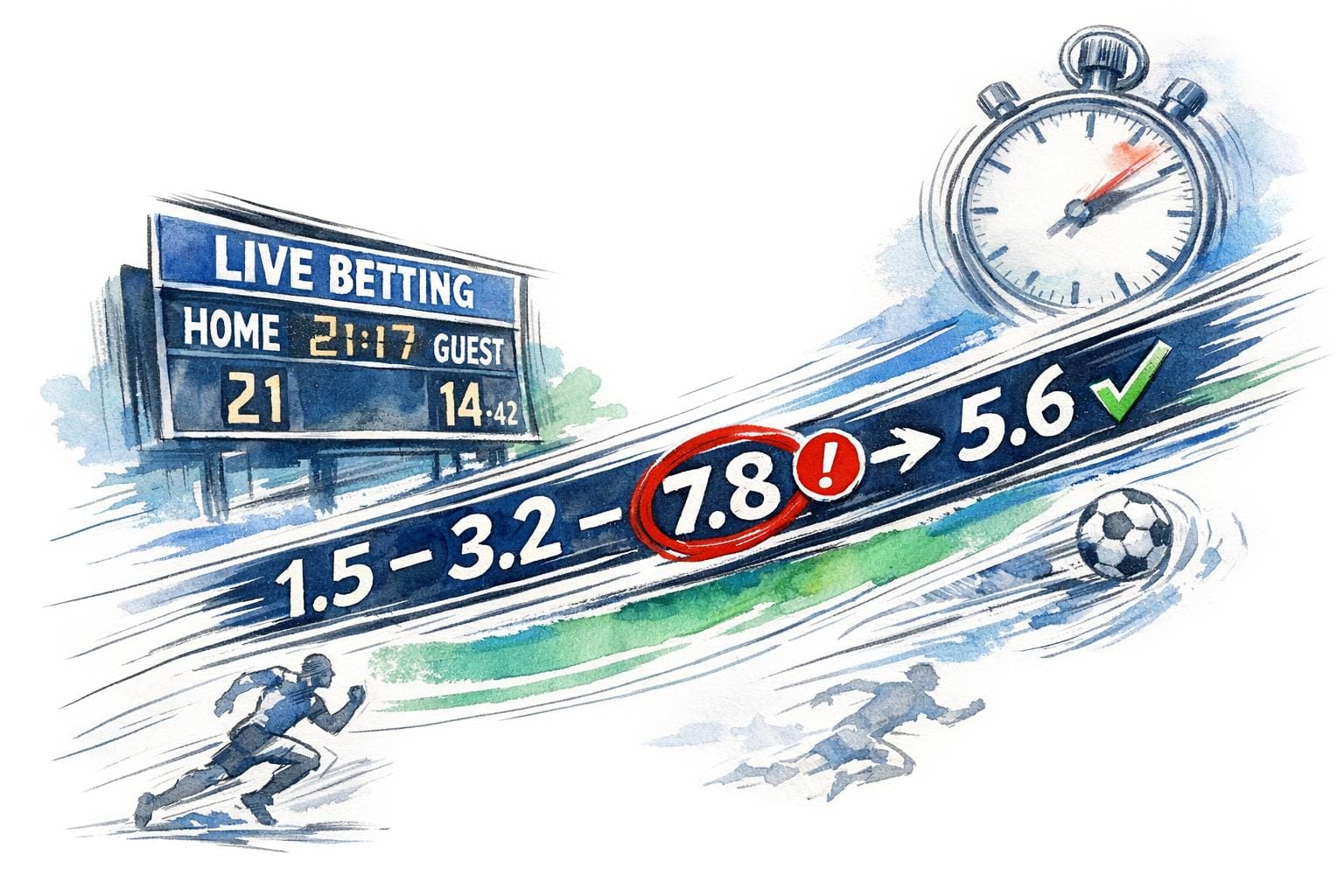
Latency and delayed feeds are some of the most frequent problems. If data delays exceed 1,500 milliseconds during crucial moments - like after a goal or penalty - the odds displayed may no longer align with the live game, creating what’s called a "market drift risk".
Erroneous odds happen when bookmakers fail to update prices accurately, often due to glitches in the data feed. For example, a 2024 study in the International Journal of Forecasting by Lawrence Clegg and John Cartlidge analyzed the "Hercog bet", a tennis wager that generated unusually high profits due to overly generous odds. When the error was corrected, the profits vanished, showing how a single inaccurate data point can mislead bettors into thinking there’s a market inefficiency.
False sentiment occurs when odds drop quickly without any real performance data - like Expected Goals (xG) or Expected Threat (xT) - to justify the change. On the other hand, static data refers to odds that remain stagnant during active gameplay, often due to low betting activity or frozen feeds.
What Happens When Data Errors Occur
The financial effects of data errors are real and often significant. Delayed feeds or incorrect stats can create arbitrage opportunities, leading bettors to place wagers based on outdated information.
Flawed data also undermines predictive accuracy. For instance, AI models can detect abnormal betting patterns with over 92% accuracy - but only when the data is reliable. A single incorrect figure can derail an entire betting strategy, exposing bettors to major financial risks.
Repeated errors can erode trust. When platforms consistently display wrong data, users may question not just the platform’s reliability but their own ability to make sound decisions. In cases of match-fixing, irregular betting patterns that don’t align with normal odds can indicate manipulation, further damaging confidence in the betting industry.
Here’s a quick summary of key error types, their causes, and their impacts:
| Error Type | Primary Cause | Impact on Bettor/Platform |
|---|---|---|
| Latency | Feed delay vs. bookie speed | Betting on outdated odds; increased risk |
| Mismatched Odds | Data feed inconsistencies | Arbitrage opportunities; unexpected profits/losses |
| Anomalies | Match-fixing/manipulation | Undermines sport integrity and fan trust |
| False Sentiment | Crowd noise/public hype | Odds changes unrelated to actual performance |
How AI Detects Data Errors
How AI Detects and Fixes Real-Time Betting Data Errors
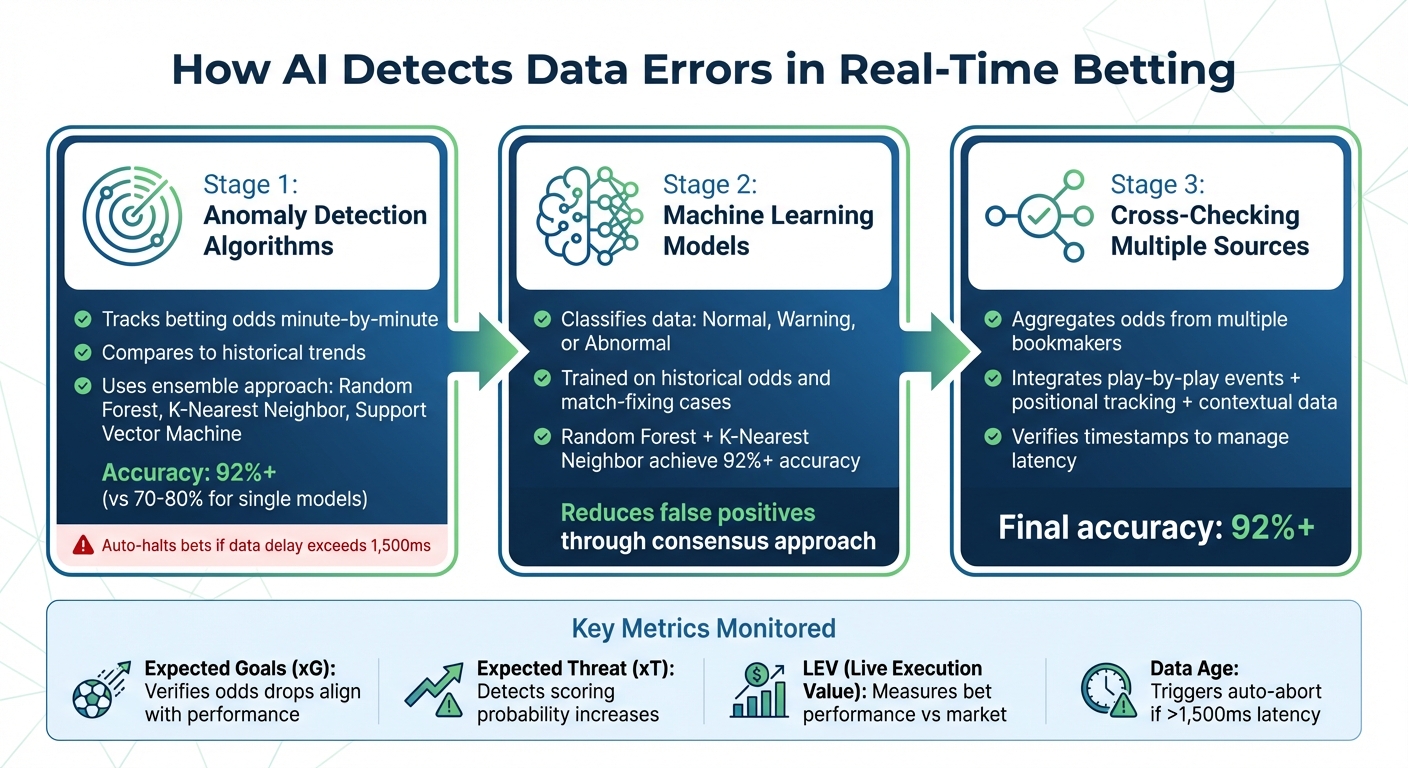
AI systems rely on a combination of anomaly detection, machine learning, and cross-checking across multiple data sources to identify and address errors in real-time. These techniques work together to monitor live data feeds, compare information from various sources, and flag irregularities within milliseconds.
Anomaly Detection Algorithms
Anomaly detection algorithms track betting odds minute by minute, analyzing fluctuations and comparing them to historical trends to identify patterns that stand out as unusual. By doing so, they can quickly differentiate between normal variations and potential errors.
Multiple algorithms work together to confirm anomalies. Systems like Random Forest, K-Nearest Neighbor, and Support Vector Machine analyze the same data point independently. If most models agree that something seems off, the system raises an alert. This ensemble approach has proven highly effective, with detection accuracy surpassing 92%, a significant improvement over earlier single-model methods that achieved only 70–80% accuracy.
Failsafes for latency are another crucial feature during volatile moments. If the age of a data feed exceeds 1,500 milliseconds during high-stakes periods, the system halts bets immediately to avoid acting on outdated information. Additionally, algorithms monitor metrics like overround sensitivity and Expected Calibration Error (ECE) to detect when predictions begin to drift away from market trends, triggering recalibration when necessary.
Once anomalies are flagged, they are passed along to machine learning models for further analysis and classification.
Machine Learning Models
Machine learning models build on the initial anomaly detection by classifying data into categories such as normal, warning, or abnormal. These models are trained using historical data on odds and documented cases of match-fixing. By analyzing patterns across thousands of matches, they can identify typical betting behaviors and spot irregularities.
Algorithms like Random Forest and K-Nearest Neighbor are particularly effective in this role, consistently achieving over 92% accuracy in distinguishing between legitimate and suspicious betting patterns. Ensemble models further enhance reliability by combining predictions from multiple algorithms, reducing false positives through a consensus-based approach.
"A highly accurate predictive model is useless as long as it coincides with the bookmaker's model."
This observation by Hubáček et al. highlights the importance of identifying discrepancies that indicate errors, rather than focusing solely on outcome predictions.
Cross-Checking Data from Multiple Sources
To ensure data accuracy, AI systems cross-check information from multiple sources. By aggregating live odds from various bookmakers, these systems establish a market-wide consensus. When a single source shows odds that deviate significantly from this consensus, it often points to a data error, feed delay, or localized issue.
Multi-modal data integration adds another layer of reliability. AI compares play-by-play event data - like shots, fouls, and corners - with positional tracking data and contextual details such as weather conditions and referee assignments. This ensures that betting odds align with the actual state of the game. For instance, if odds drop sharply without a corresponding change in performance metrics like Expected Goals (xG) or Expected Threat (xT), the system may flag this as a potential error or false sentiment.
Timestamp verification is also key in managing latency. By comparing the timestamps of incoming data feeds with model update times, systems can implement anti-latency measures. In practice, AI systems that use ensemble models to cross-check data from multiple bookmakers have achieved detection accuracies exceeding 92%.
| Metric | Description | Role in Error Detection |
|---|---|---|
| Expected Goals (xG) | Quality of scoring chances | Verifies if odds drops align with actual performance |
| Expected Threat (xT) | Positional danger level | Detects scoring probability increases before odds adjust |
| LEV (Live Execution Value) | Mid-odds recorded 3 seconds after execution | Measures if a bet outperforms market adjustments |
| Data Age | Latency of real-time feeds | Triggers auto-abort if latency exceeds 1,500ms |
How WagerProof Uses AI for Data Accuracy

WagerProof relies on advanced AI tools to ensure betting data remains accurate and reliable. By focusing on identifying mismatches, verifying statistics, and detecting irregularities in real time, the platform integrates these capabilities into its continuous monitoring systems, keeping data integrity at the forefront.
Finding Odds Mismatches
WagerProof’s Model Aggregator pulls forecasts from 50 different statistical models to establish a consensus. Using z-score standardization, it ranks games based on how closely these models agree. A higher absolute z-score often indicates a potential mispricing in a sportsbook’s line.
The Edge Finder tool takes this a step further by comparing the aggregated model spreads with live sportsbook odds. It flags discrepancies, or "spread-diffs", where predicted spreads differ significantly from actual spreads. When market odds deviate from model probabilities, the system triggers alerts for outliers, consensus gaps, or sudden shifts in the data.
Adding to this, WagerBot Chat connects directly to live professional data sources. This AI tool allows users to ask game-specific questions, validating model predictions against real-time market movements. Plus, it ensures accuracy by avoiding fabricated or "hallucinated" information.
Catching Stats Feed Errors
To preserve data integrity, WagerProof’s AI cross-references player stats across multiple data feeds and historical benchmarks. If a player’s performance metrics, like shooting percentages or scoring totals, deviate significantly from expected ranges or don’t align with play-by-play data, the system flags these anomalies immediately.
The Public Money Splits tool offers another layer of scrutiny by tracking the percentage of tickets versus the percentage of money wagered. This tool highlights gaps between sharp bettors and the general public, which can reveal unusual betting patterns or potential issues within stats feeds that may be influencing the market.
Spotting Unusual Betting Patterns
WagerProof’s AI Game Simulator runs thousands of simulations for each game to calculate win probabilities based on the latest data. When real-world betting activity deviates sharply from these simulations, the system raises alerts. Such anomalies could point to issues like feed delays, data errors, or even market manipulation.
By comparing live wagering data with expected patterns, WagerProof provides users with the transparency they need to make smarter betting decisions while avoiding costly mistakes.
| Tool | Primary Function | Visual Indicators |
|---|---|---|
| Edge Finder | Compares models to market odds | Outlier flags and consensus gaps |
| AI Game Simulator | Runs thousands of simulations/game | Win probability percentages |
| WagerBot Chat | Answers game-specific queries | Instant, data-backed insights |
| Public Money Splits | Tracks Ticket % vs. Money % | Highlights gaps in sharp vs. public bets |
Benefits of AI Error Detection in Real-Time Betting
AI's role in real-time betting goes beyond just preventing costly mistakes - it also improves transparency and helps bettors make smarter decisions.
Better Accuracy and Transparency
AI eliminates the uncertainty and bias that can come with human judgment. Unlike humans, who might need several seconds to react to a major event during a game, AI can update win probabilities in mere milliseconds. This speed ensures bettors get reliable, up-to-date information.
By analyzing advanced metrics like Expected Threat (xT), AI can identify genuine scoring opportunities instead of just focusing on possession stats. This deeper level of analysis helps bettors avoid being misled by surface-level numbers. Beyond improving accuracy, AI also speeds up the process of spotting and fixing errors, ensuring data remains trustworthy.
Faster Error Detection and Fixes
In live betting, where odds change constantly, speed is everything. AI systems monitor data 25 times per second, updating with sub-second latency. If something goes wrong - like a delay in stats or suspicious shifts in odds - AI immediately flags the issue.
For example, automated systems can pause betting if data delays exceed 1,500 milliseconds during high-stakes moments like a goal or red card. A real-world example of AI's effectiveness is Sportradar's Universal Fraud Detection System, which in 2023 monitored around 850,000 events across 70 sports. It flagged 1,329 suspicious matches in 105 countries and caught 73% of all suspicious cases - a 123% increase from 2022. This fast detection not only ensures fair play but also supports more accurate predictions.
Better Predictions and Betting Decisions
Quick error correction doesn’t just protect data - it lays the groundwork for better predictions. AI ensemble models, which use techniques like Random Forest and K-Nearest Neighbor, have achieved over 92% accuracy in spotting unusual betting patterns. Interestingly, models calibrated for profitability have shown an average ROI of +34.69%, while those focused solely on raw accuracy saw losses of 35.17%. With well-tuned models, bettors could grow their wealth by a third in just one season.
Companies like WagerProof take this a step further by cross-checking data from multiple sources. This method uncovers value bets and anomalies that might otherwise go unnoticed, giving bettors the insights they need to make confident, informed decisions - all while ensuring data stays accurate in real time.
Conclusion
AI is revolutionizing real-time betting by identifying and correcting data errors in just milliseconds, thanks to highly accurate models. These systems cut through market noise, detect unusual patterns, and ensure bettors receive the most reliable information right when they need it.
The most dependable platforms prioritize speed and transparency. AI verifies data by cross-checking multiple sources, minimizing costly mistakes. It helps bettors differentiate between calculated moves and emotional reactions, especially during high-stakes moments like goals or red cards. This level of precision plays a key role in maintaining the integrity of sports betting.
Platforms such as WagerProof take these advancements further by blending AI error detection with real-time data transparency. Instead of relying on vague predictions, users access professional-grade tools that highlight outliers, value bets, and mismatches in prediction markets. With live data at its core, WagerBot Chat links directly to these sources, while Real Human Editors validate insights - ensuring bettors have the information they need to make smarter, more strategic decisions. This seamless integration of AI for live data verification builds trust and elevates the betting experience.
FAQs
How does AI tell a real game event from a bad data feed?
AI pinpoints real game events by examining various data sources, detecting irregularities, and refining probabilities through approaches like Bayesian updating and reliability calibration. These methods help align data with actual outcomes, reducing real-time errors effectively.
What happens when a live feed is delayed during a key play?
When a live feed experiences a delay during a critical play, AI systems step in with predictive models and real-time data analysis to estimate the likely outcomes. This helps maintain the accuracy of betting odds, even when the live action isn't immediately available. Additionally, these systems keep an eye out for unusual patterns or outliers, which can signal potential errors or even fraudulent activity. This constant monitoring ensures that the data provided to users remains dependable.
How can bettors use AI alerts without chasing false signals?
To minimize the risk of acting on false signals, it’s crucial to fine-tune AI alerts. Techniques like Platt Scaling or Isotonic Regression can help by aligning predicted probabilities with actual outcomes. Another effective approach is combining multiple models to reach consensus predictions. This strategy helps reduce errors and boosts reliability.
It's also smart to implement risk controls. For instance, set clear signal thresholds and avoid overcommitting to marginal signals. Tools such as WagerProof can automate these processes, offering real-time insights with improved accuracy and fewer false positives.
Related Blog Posts
Ready to bet smarter?
WagerProof uses real data and advanced analytics to help you make informed betting decisions. Get access to professional-grade predictions for NFL, College Football, and more.
Get Started Free