How Injury Reports Impact Betting Odds
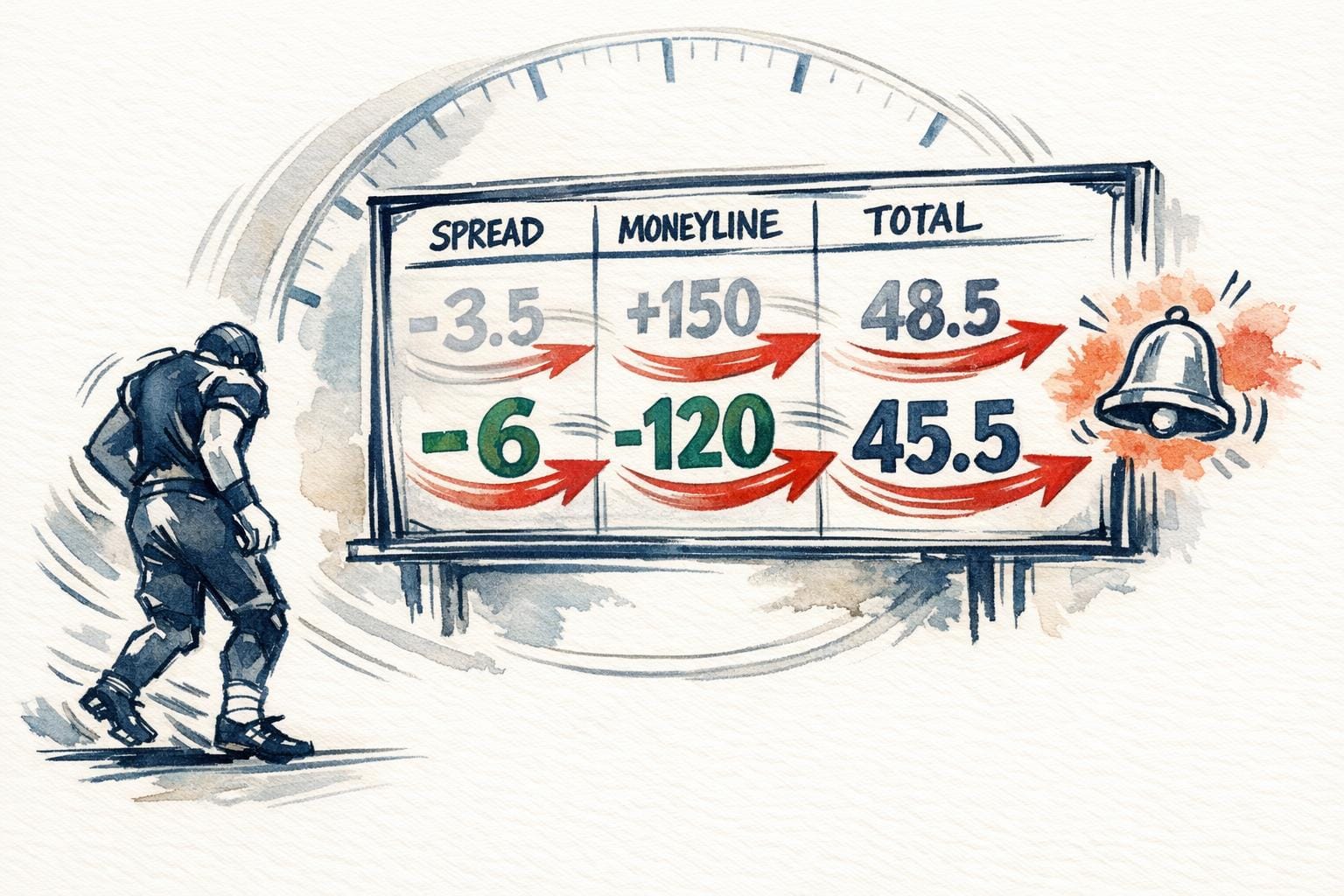
Injury reports can significantly shift betting odds by influencing point spreads, moneylines, and game totals. Here's the key takeaway: sportsbooks adjust odds almost instantly when injury updates surface, especially for star players or critical positions like quarterbacks in the NFL or high-usage players in the NBA. These shifts can range from 1 to 10 points depending on the sport, player, and team dynamics.
Key Points:
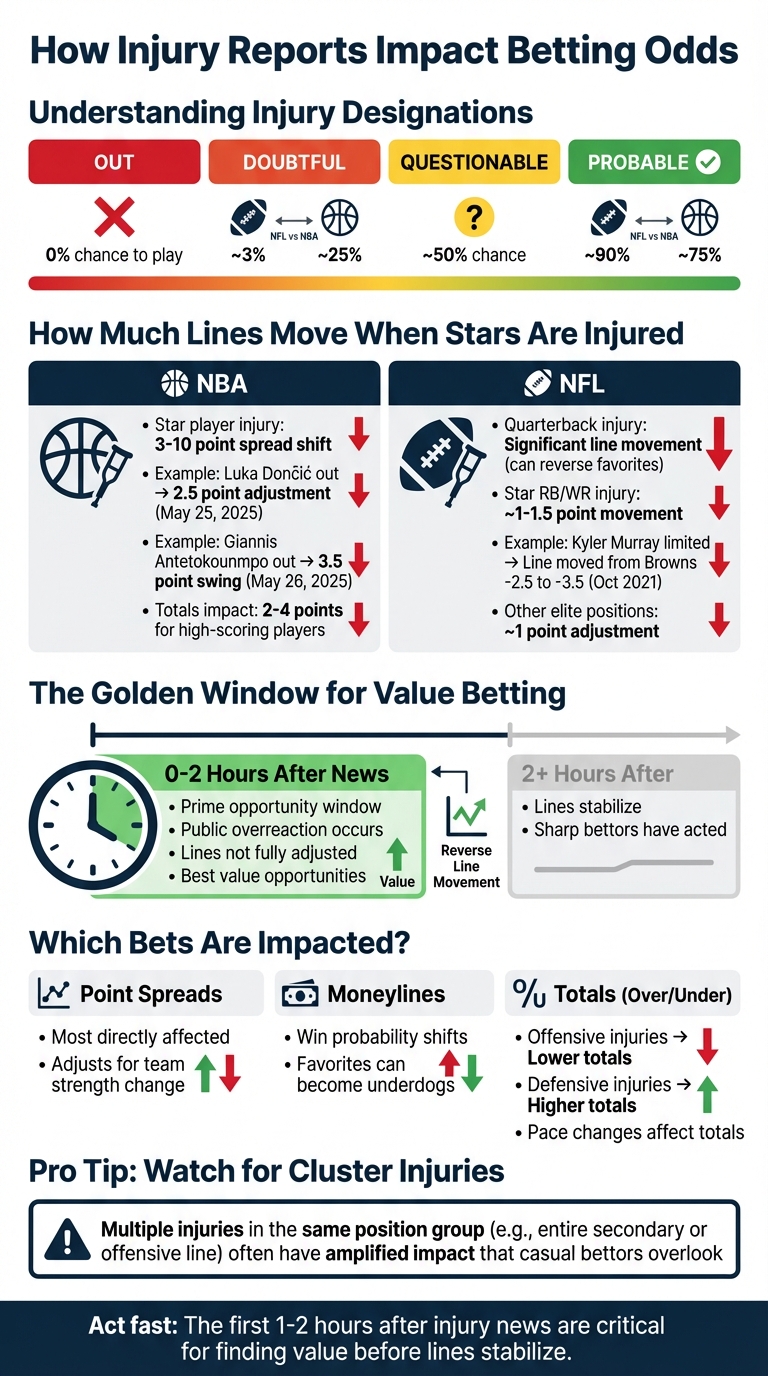
- Injury Classifications: Players are listed as Out (0%), Doubtful (~25% NBA, ~3% NFL), Questionable (~50%), or Probable (~75% NBA, ~90% NFL).
- Market Reactions: Star player injuries can shift NBA spreads by 3–10 points; NFL quarterback injuries can cause significant line movement too.
- Timing Matters: Early market reactions often overestimate the impact of injuries, creating opportunities for sharp bettors.
- Cluster Injuries: Multiple injuries in key positions can amplify adjustments, often overlooked by casual bettors.
- Bet Types Affected: Point spreads, moneylines, and totals all adjust based on injury reports.
For bettors, the first 1–2 hours after injury news breaks are critical for spotting value before lines stabilize. Tools like WagerProof can help you track updates and identify market inefficiencies. Understanding the true impact of injuries - and avoiding public overreactions - can give you an edge in sports betting.
How Injury Reports Impact Betting Odds Across Sports
How Injury Reports Change Betting Odds
How Oddsmakers React to Injury News
When injury updates hit the news, sportsbooks waste no time. They use advanced algorithms to crunch player stats and historical data, instantly tweaking probabilities and odds based on the new information.
The focus is often on high-profile positions, like NFL quarterbacks or NBA stars, since their absence can shake up a team's dynamics. But oddsmakers don’t ignore less glamorous roles. For instance, losing an offensive tackle or a defensive anchor can lead to significant adjustments, especially if the replacement player isn't up to par.
Factors That Determine Odds Changes
Not all injuries affect betting lines equally. In the NFL, a star quarterback missing a game can drastically shift the spread, while injuries to elite players in other positions might only move the line by about 1 point. In the NBA, losing a key player can cause spreads to swing anywhere from 3 to 10 points, depending on their importance to the team.
For basketball, sportsbooks also consider how a player's absence changes possession dynamics. If a high-usage player is out, they redistribute expected possessions among the remaining teammates. Teams with several scoring threats can absorb the impact better, but severe injuries often lead to a complete reassessment of a team’s power rating.
One commonly overlooked factor is cluster injuries. When multiple players in the same position group - like an entire secondary or offensive line - are sidelined, the collective impact can outweigh the loss of a single star. For savvy bettors, these scenarios can present opportunities to find value.
These variables often lead to quick market shifts, sometimes creating overreactions.
Timing and Market Overreactions
Sportsbooks typically adjust their lines within minutes of injury news breaking, with further fine-tuning as more details come to light. The betting public, however, has a tendency to overreact to big-name injuries, pushing the lines further than the numbers justify. This creates a brief window where the line may be inflated beyond the actual impact of the injury.
A key signal to watch for is reverse line movement (RLM). This happens when public bias drives heavy betting on one side, yet the line moves in favor of the injured team. Such shifts often indicate sharp bettors are taking the opposite side. Tools like WagerProof can help spot these discrepancies when market moves don’t align with statistical reality.
Sportsbooks also factor in public perception when setting odds. If they anticipate casual bettors will overreact to a star player’s absence, they might preemptively shift the line to protect their exposure. This creates opportunities for bettors who can distinguish between the actual statistical impact of an injury and the perceived value shift.
How Injuries Affect Different Bet Types
Point Spreads
Injuries can throw a wrench into the balance point spreads aim to create. Oddsmakers adjust spreads to account for a team's reduced strength when a key player is sidelined. The extent of the adjustment hinges on the player's importance and the quality of their replacement.
Basketball spreads tend to shift the most because smaller rosters amplify the influence of star players. For instance, in May 2025, Luka Dončić's absence led to a 2.5-point adjustment for the Lakers, while the Milwaukee Bucks saw a 3.5-point swing without Giannis Antetokounmpo.
In football, the impact is generally smaller unless a quarterback is involved. Losing a star running back or wide receiver might only move the spread by about 1 point - 1.5 points in rare cases. However, cluster injuries, where multiple players in the same position group are hurt, can magnify these adjustments.
It's also crucial to separate the initial overreaction from the eventual stabilized line after sharp bettors weigh in. When analyzing a spread shift, focus on the "replacement gap" - how much less effective the backup is compared to the starter.
Moneylines
Moneylines, which reflect a team's win probability, are directly affected by injuries. A slight favorite can quickly become an underdog once a key player's absence is confirmed. Sometimes, sportsbooks overcompensate for public overreaction, creating opportunities to find value on the injured team.
"The sportsbooks know how the public is going to react to a big injury. They instantly beat the public's predictable betting overreaction by jacking up the lines on that team's opponent. That crushes any value and puts the gamblers back at a disadvantage." - Robert Ferringo, Writer/Handicapper, DocSports
Historical examples highlight how injuries don't always spell doom. In the 1980s, when Joe Montana of the San Francisco 49ers was injured, the Vegas line barely moved - just 0.5 points - because his backup, Steve Young, was also elite. Similarly, during the 2014 season, the Ohio State Buckeyes lost their first- and second-string quarterbacks, forcing third-stringer Cardale Jones to step in. Despite the odds, Jones led the team to three consecutive wins and covers, including a dominating 59-0 victory over Wisconsin in the Big Ten Championship and a 42-20 triumph over Oregon in the National Championship.
These shifts also influence game totals, as injuries can alter scoring expectations.
Totals (Over/Under)
Game totals adjust depending on which players are missing and how their absence reshapes the game. Offensive injuries, like losing a star quarterback, usually push totals down due to reduced scoring potential. Conversely, defensive injuries - such as losing a key rim protector in basketball or critical secondary players in football - can lead to higher opponent scoring, pushing totals up.
But the effects aren't always straightforward. For example, in basketball, losing a primary ball-handler might slow the pace of the game, lowering the total. On the other hand, if the backup plays at a faster tempo, the total could rise despite the offensive downgrade. Similarly, losing a top rebounder might result in more second-chance points for opponents, driving the total higher.
"When a key skill player is out, I plug in 80% of his numbers contributed to the overall picture and team power rating for the game matchup. In other words, I deduct 20% off production numbers." - Tony George, Professional Handicapper
Cluster injuries also play a big role in totals. For instance, multiple injuries on the offensive line can reduce a team's ability to sustain drives, lowering the total. On the flip side, if several defensive backs are out, opponents might exploit the weakened secondary with deep passes, increasing the total. Unlike a single star's absence, these clustered impacts often fly under the radar, creating potential opportunities in the betting market.
Examples of Injury Reports Changing Odds
Case Study: NBA Star Injuries
Injuries to star players can shake up betting markets in an instant. Take May 25, 2025, for example: when Luka Dončić was ruled out, the Mavericks' game spread shifted from Lakers -8.5 to -6.0 - a 2.5-point adjustment. Similarly, on May 26, 2025, Giannis Antetokounmpo's injury caused the Bucks' spread to move from -5.5 to -2.0 - a 3.5-point swing.
The smaller rosters in basketball mean each player has a bigger influence on the odds. The best opportunities for value bets often appear in the first 1-2 hours after an injury announcement, before sportsbooks fully adjust their lines. Once this window closes, sharp bettors have already pushed the market toward a more accurate number.
For example, when a high-scoring player like Stephen Curry is ruled out, the over/under line can drop by 2-4 points, leaving little time for bettors to act.
The NFL sees similar betting market shifts when key players, especially quarterbacks, are sidelined.
Example: NFL Quarterback Injury
Just like in the NBA, injuries to key NFL players can dramatically alter betting lines. Quarterbacks, in particular, have an outsized impact. A great example comes from October 2021, during a game between the Arizona Cardinals and Cleveland Browns. Initially, the Browns opened as -3 home favorites at Pinnacle, but early betting on the unbeaten Cardinals pushed the line down to -2.5. Then came the turning point: Wednesday practice reports revealed that QB Kyler Murray was "limited" due to a shoulder injury, alongside other absences like Center Rodney Hudson and pass rusher Chandler Jones. This news reversed the market entirely, moving the line back to Browns -3.5 by Friday morning.
"There is not another position in major sports that is more impactful to the point spread line than the quarterback." - Steve Rieder, Professional Bettor
The size of the impact often depends on the quality of the replacement. For instance, when Jalen Hurts was ruled out of a Week 18 game in January 2023, the Philadelphia Eagles' betting lines shifted significantly due to the steep drop-off in talent between Hurts and his backup.
How to Use Injury Reports in Your Betting Strategy
Taking Advantage of Early Market Reactions
The first 1–2 hours after an injury announcement are crucial for finding value. During this time, sportsbooks are still adjusting their lines, while public bettors often overreact to the absence of a star player. This overreaction can push the lines too far in one direction, creating opportunities for sharp bettors to capitalize.
This speed advantage is especially pronounced in lower-profile leagues and games, where oddsmakers tend to react more slowly. Following team beat reporters on social media can give you a head start on injury news. For instance, when a backup player is promoted to the starting lineup, sportsbooks might initially set their prop lines based on the player’s limited bench stats instead of their expanded role. This creates a short window of opportunity before the market adjusts.
Keep an eye out for reverse line movement (RLM). If the majority of public bets favor the team benefiting from an injury, yet the spread moves in favor of the injured team, it’s a sign that professional bettors are fading the public’s overreaction.
Finally, use historical data to identify when these quick market shifts deviate from team performance norms. This can help you spot when the lines have overcorrected.
Using Historical Team Performance Data
Not all injuries are created equal, and the market adjusts based on the performance gap between the starter and backup - not just the star power of the injured player. Tools like WagerProof provide historical stats and team performance data, helping you analyze how teams perform without key players. This can reveal trends that the market might overlook.
Pay attention to coaching strategies. In basketball, for example, a player’s minutes often increase by 5–8 before sportsbooks adjust their prop lines. Some coaches adapt their game plans to hide weaknesses, while others stick to their usual systems regardless of personnel changes. Understanding these tendencies can give you a betting edge.
Cluster injuries - when multiple players in the same position are out - can also create undervalued markets. In these cases, the impact on deeper bench players and overall team performance is often underestimated by sportsbooks.
By combining team performance analysis with injury data, you can uncover valuable opportunities, particularly in prop and futures markets.
Finding Value in Prop Bets and Futures
Prop bets often lag behind game lines when it comes to adjusting for injuries. This is especially true when a backup player steps into a starting role. For example, when a high-usage player is sidelined, secondary playmakers often see an increase in opportunities, but sportsbooks may be slow to reflect this in the prop markets.
"The information edge in injury analysis comes from moving faster and thinking more systematically than the average bettor."
– Oliver Bennett, Expert
Pay special attention to backup centers filling in for starters. Rebounding props, in particular, are often undervalued because they’re initially based on the backup’s limited bench minutes. Similarly, the absence of an elite rim protector can make scoring props for opposing big men more appealing.
Defensive injuries can also create hidden value. When a key defender is out, opposing players often perform better due to weaker guarding. These adjustments tend to lag behind changes for offensive injuries, giving you an edge if you act quickly. Tools like WagerProof can help you identify these mismatches by flagging situations where prop lines don’t align with new playing time distributions or prediction market spreads.
The 4 Commandments of Injury News in Sports Betting
Conclusion
Injury reports play a crucial role in sports betting. But it’s not just about knowing who’s injured - it’s about understanding the bigger picture. Context, market reactions, and the potential value shifts are what really matter. As Robert Ferringo from DocSports aptly states:
"Injuries are one of the most important pieces of information that a bettor or sports handicapper can use to assess the value of a given game".
Smart bettors know how to tune out public overreactions. When a star player is sidelined and the betting line shifts dramatically, there’s often an opportunity to exploit. Watch for reverse line movement, monitor clusters of injuries within position groups, and analyze how backup players step into expanded roles - these insights can give you a serious edge.
Speed and strategic thinking are key when it comes to capitalizing on mispriced lines. Injury announcements can create golden opportunities, especially in prop markets where sportsbooks may lag in adjusting odds. Real-time tools like WagerProof can be game-changers, offering alerts, historical performance data, and sharp money indicators. Features like automated outlier detection let you act faster and smarter than casual bettors.
Ultimately, long-term success in sports betting isn’t about luck or gut feelings - it’s about staying informed and making educated decisions. By pairing injury analysis with advanced data tools, you can uncover value others overlook. Whether you’re targeting prop bets on backups, fading the public’s overreaction, or jumping on late-breaking news, being informed and decisive gives you the edge you need.
FAQs
How can I tell if an injury move is real or just public overreaction?
When trying to figure out if an injury-related odds move is valid or just hype, it’s all about analyzing the market and understanding the player's role. A sharp shift in odds usually points to a legitimate concern, while dramatic or overly fast moves might hint at an overreaction.
To stay ahead, keep an eye on real-time injury updates and compare them to how the market is reacting. This can help you spot value before the odds settle. Timing is everything here - acting promptly can give you an edge in making smarter bets.
What injuries change totals more than spreads?
Injuries to key players tend to impact totals (over/under) more than they do spreads. Why? Because injuries directly affect a team's scoring ability and defensive strength, both of which are critical to the total points in a game. Totals are especially sensitive to shifts in game dynamics caused by these absences, as they represent the combined score expected from both teams.
How can I use injury news to find better prop bets fast?
Stay informed by tracking injury reports from reliable sources, such as official team updates and verified social media accounts, particularly as game time approaches. Pay close attention to terms like "out" or "questionable," as these designations can heavily influence betting odds. Consider how an injury might alter team rotations or affect individual player performance. When you spot early line shifts, act fast to take advantage. Tools like WagerProof can be especially useful for spotting value bets before sportsbooks have a chance to adjust.
Related Blog Posts
Ready to bet smarter?
WagerProof uses real data and advanced analytics to help you make informed betting decisions. Get access to professional-grade predictions for NFL, College Football, and more.
Get Started Free