How Weather Impacts NFL Betting Lines
Weather has a clear effect on NFL betting, particularly on totals. Wind, rain, snow, and extreme temperatures can lower scoring, disrupt passing games, and impact kicking accuracy. Here’s what you need to know:
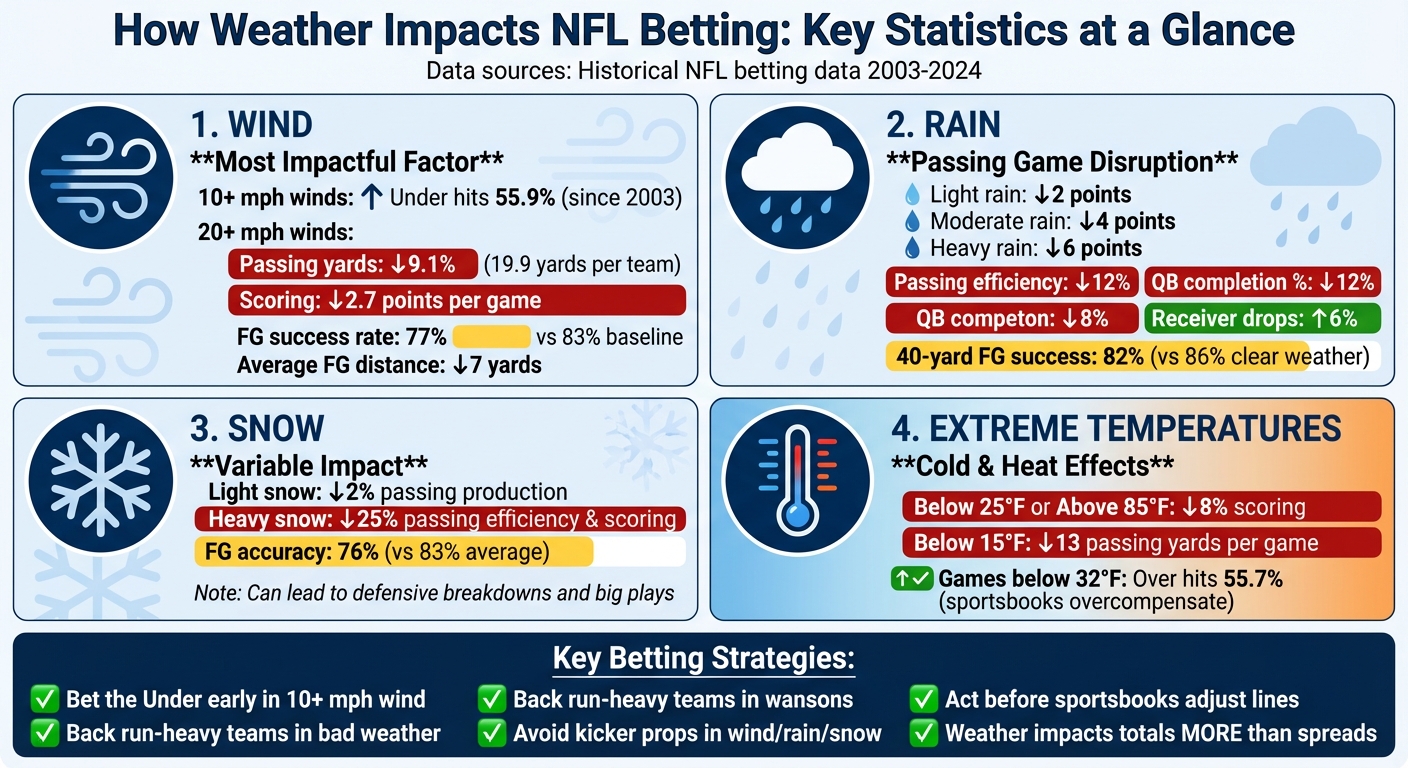
- Wind: The most impactful factor. Speeds over 10 mph reduce scoring, with winds above 20 mph causing a 9.1% drop in passing yards and a 2.7-point reduction per game. Field goal success also drops significantly.
- Rain: Passing efficiency decreases by 12%, and heavy rain can lower scoring by up to 6 points. Coaches often shorten field goal attempts.
- Snow: Heavy snow reduces scoring by up to 25% but can also lead to defensive breakdowns, allowing big plays.
- Extreme Temperatures: Below 25°F or above 85°F, scoring drops by 8%. Cold weather affects passing, kicking, and ball handling.
Key strategies for bettors:
- Bet the Under early in bad weather (wind over 10 mph games hit the Under 55.9% since 2003).
- Focus on run-heavy teams in wind or rain.
- Avoid kicker props in tough weather conditions.
- Watch for line movements and act before sportsbooks adjust.
Weather impacts totals more than spreads, creating opportunities for sharp bettors. Tools like WagerProof help track forecasts, line movements, and historical trends to find value in weather-affected games.
How Weather Conditions Impact NFL Game Scoring and Betting Lines
The Impact of Weather on Football Betting Strategies
Wind: The Biggest Factor in NFL Betting Lines
When it comes to NFL betting, wind is the most dependable weather factor to consider, with a wealth of historical data from outdoor games backing its impact. On average, outdoor NFL games experience wind speeds of around 7 mph. But when winds exceed 10 mph, the effects on both passing and kicking become noticeably measurable.
The 20 mph mark is where things get serious. While passing stats show a steady decline between 10-20 mph, winds above 20 mph cause a dramatic drop - about 1.5 to 2 times worse than in the 15-20 mph range. At this threshold, scoring takes a significant hit, with passing yards dropping by 19.9 yards per team (a 9.1% decrease). This is why sharp bettors pay close attention to this threshold - it’s a clear signal of suppressed scoring potential. The impact is felt not just in scoring but also in passing and kicking performance, as outlined below.
How Wind Speed Affects Passing
Windy conditions wreak havoc on quarterbacks, especially with lateral throws. Instead of simple underthrows or overthrows, wind tends to push the ball ahead of or behind receivers, making precision much harder. At wind speeds of 10+ mph, quarterbacks experience a 1.8% drop in completion percentage and lose 0.30 yards per attempt. Over a standard 36-pass game, this translates to roughly 10.8 fewer yards.
Teams accustomed to playing in domes face even bigger challenges outdoors. Just 10 mph winds can lead to a 6% decline in passing yards for these teams. To adapt, coaches often pivot to shorter, quicker passes or lean more heavily on the run game. And while passing suffers, kickers face their own set of challenges.
Wind's Effect on Field Goals and Kicking
High winds create a double-edged problem for kickers: accuracy plummets, and coaches tend to shorten their acceptable field goal range. When winds hit 15-20 mph, field goal success rates drop to about 80%. Once winds exceed 20 mph, success rates dip further to 77%, and the average attempt distance decreases by approximately 7 yards. What’s striking is that, even with shorter attempts (which should theoretically boost success rates to nearly 89%), actual conversion rates remain significantly lower due to the wind’s interference.
| Wind Speed | FG Success Rate | Average Distance Impact |
|---|---|---|
| 0–7 mph | 83% | Baseline metrics |
| 10–15 mph | 83% | Slightly shorter attempts |
| 15–20 mph | 80% | Shorter attempts |
| 20+ mph | 77% | 7 yards shorter on average |
How to Bet on Windy Games
The smartest move? Bet the Under early. Since 2003, games with winds of at least 10 mph and temperatures above 33°F have hit the Under at a 57% rate (456-351-8 record). Timing is everything, as Nate Rubin from Sharp Football Analysis explains:
If you can move fast, you can get better odds before NFL betting apps adjust their lines to account for the weather forecast.
Consider Week 8 of the 2021 season as an example. Forecasted winds of 19-28 mph caused significant line shifts. The Titans vs. Bengals total dropped from 55 to 50.5, while the Raiders vs. Browns total plunged from 55.5 to 48. Bettors who acted quickly on early weather reports secured much better value than those who waited.
Another strategy is to back run-heavy teams in windy conditions. Teams with strong ground games can stick to their usual approach, while pass-heavy offenses struggle to adapt. A great example is the 2013 game between Philadelphia and Detroit:
LeSean McCoy rushed for 217 yards as heavy wind and precipitation rendered the passing game ineffective.
In extreme wind conditions (20+ mph), rushing yards typically increase by 10.2%, as teams abandon the aerial attack.
Rain's Effect on NFL Betting Lines
Rain has a noticeable influence on NFL games, reshaping how teams execute their game plans. These conditions often lead to lower-scoring games, which tend to favor teams with a strong running game over those that rely heavily on passing.
Light Rain vs. Heavy Rain
The intensity of the rain directly impacts scoring. Light rain usually decreases total points by about 2, while moderate rain lowers it by around 4 points. Heavy rain can lead to a more significant drop of roughly 6 points. Across all rain conditions, passing efficiency takes a hit, with production dropping by about 12%. While light rain might allow teams to maintain a slightly higher play count, heavy rain often turns games into a grind, with slippery conditions making intricate blocking schemes nearly impossible. These challenges ripple through the game, affecting both scoring and field goal success.
How Rain Affects Scoring and Totals
Rain doesn’t just make the field slippery - it also disrupts the passing game. Quarterbacks’ completion percentages drop by 12%, and receivers are more prone to dropping passes, with a 6% increase in drops. Field goal success also declines. While kickers typically convert 40-yard attempts at 86% in clear weather, that percentage dips to about 82% in rain. Coaches often respond by shortening their field goal attempts, further limiting scoring opportunities.
| Rain Intensity | Average Scoring Reduction | Passing Efficiency Impact |
|---|---|---|
| Light Rain | -2 Points | -12% |
| Moderate Rain | -4 Points | -12% |
| Heavy Rain | -6 Points | -12% |
Betting Adjustments for Rain Forecasts
When rain is in the forecast, it’s smart to adjust your betting strategy. Heavy rain, in particular, often makes betting the Under a favorable choice. As highlighted by RotoGrinders:
Heavy rain can reduce the total points scored in a game by up to 6 points, making it a good opportunity to bet on the under against the spread.
For player props, consider fading quarterback passing yards and wide receiver receptions due to the 12% drop in passing efficiency. On the flip side, betting the Over on running back rushing attempts can be a solid move, as teams tend to lean more heavily on the ground game in rainy conditions. Similarly, kicker props are worth fading since long field goal attempts become less likely.
Timing matters - place your bets as soon as a reliable weather forecast becomes available, before sportsbooks have a chance to adjust their lines. Keep in mind that rain is often accompanied by wind, which can compound its effects, further reducing scoring and offensive efficiency.
Snow and Extreme Cold: Special Betting Challenges
Snow and freezing temperatures bring unique twists to NFL betting. While wind and rain often lead to lower-scoring games, snow and extreme cold can create unexpected situations, sometimes even boosting offensive production. Slippery turf, for instance, can cause defensive breakdowns, flipping the script on what many expect to be a low-scoring affair.
How Snow Affects Offense and Defense
Light snow tends to have a minor impact, trimming passing production by just about 2%. Heavy snow, however, is a different story - it can cut passing efficiency by as much as 25% and reduce overall scoring by roughly the same margin. But snow doesn’t always favor defenses. The slippery conditions can make it harder for defensive backs to stay with receivers, often leading to big plays downfield. A prime example? The Patriots once racked up 59 points against the Titans during a snowstorm, proving that snowy conditions don’t always mean fewer points on the board.
Tackling efficiency also takes a hit when the field gets slick. Defensive linemen often lose their footing, giving quarterbacks more time to make plays. Kicking suffers as well - field goal accuracy dips to 76% in snowy games, compared to the league average of 83%. This forces coaches to adjust, often shortening their field goal range and opting for fourth-down attempts instead of long kicks.
Extreme Cold and Player Performance
When temperatures drop below 25°F, passing production decreases by around 8%. In even colder conditions - below 15°F - teams typically lose about 13 passing yards per game. Quarterbacks struggle to grip the ball, and receivers face challenges securing catches. The colder air also makes the football denser, reducing both kicking distance and hang time.
That said, cold weather doesn’t always lead to defensive slugfests. In January 2022, the Buffalo Bills scored 47 points against the Patriots in 11°F weather, proving that elite offenses can still thrive in the cold. The real trouble comes when frigid temperatures combine with strong winds. For example, when it’s below 20°F and winds exceed 15–20 mph, both passing and kicking become significantly harder. These conditions amplify the challenges already posed by wind and rain, further complicating betting decisions.
Betting on Snow and Cold Games
Snow and cold demand a different approach to betting. Don’t automatically assume the Under is the right play in these conditions. Since 2003, games played in temperatures below 32°F have hit the Over 55.7% of the time, as sportsbooks often overcompensate by lowering the total too much.
For player props, heavy snow can be a signal to bet the Under on quarterback passing yards, given the 25% drop in passing efficiency. Meanwhile, consider the Over on running back carries, as teams often shift to a ground-heavy approach. Avoid kicker props altogether - coaches are less likely to attempt long field goals in these conditions.
Another angle to explore is mismatches between warm-weather teams - like Miami, Arizona, and Las Vegas - and cold-weather franchises such as Green Bay, Buffalo, and Chicago. Teams used to harsh winter conditions often have a noticeable edge, which the betting market might undervalue. Take the January 2024 game between Miami and Kansas City, for example. Played in a brutal –27°F wind chill, the warm-weather Dolphins struggled mightily, highlighting the advantage cold-weather teams can have in these situations.
Using WagerProof Tools for Weather-Affected Games

When it comes to betting on weather-impacted NFL games, WagerProof offers tools that take the guesswork out of the equation. By automating critical analyses, the platform helps you stay ahead of the curve. From tracking forecasts and historical trends to monitoring line movements, WagerProof identifies weather-related betting opportunities in real time. Plus, its tools send instant alerts, so you can act before the market adjusts.
Finding Weather-Related Line Mismatches
The Edge Finder is designed to spot mismatches between implied probabilities and actual odds, especially when sportsbooks haven't fully accounted for weather conditions. It digs deeper than surface-level data, flagging scenarios like a cold-weather team hosting a warm-weather opponent in freezing temperatures. For example, if a forecast changes from light winds to gusts over 20 mph on a Saturday morning, public betting might push the Over before sportsbooks have time to adjust the totals. By analyzing a wealth of data - like weather conditions, team travel schedules, and past performance - the Edge Finder highlights games where the market has mispriced the odds.
Analyzing Historical Weather Data
With WagerProof's Historical Analytics, you can dive into how teams and players have performed under similar weather conditions in the past. Using WagerBot Chat, you can quickly get data-backed answers to specific questions, such as, "How does the Bills' passing efficiency change in winds over 20 mph?". This feature saves you from manual research and ensures your decisions are based on real trends, like how strong winds can disrupt passing and scoring.
The AI Game Simulator takes it a step further by running thousands of simulations for each game. It incorporates historical matchups, current stats, and weather variables like heavy snow or extreme cold. For instance, if a game is expected to have 25 mph winds, the simulator can predict how similar conditions have influenced scoring and field goal attempts in the past. This helps you gauge potential outcomes with precision.
WagerBot Chat and Automated Alerts
Acting as your personal betting assistant, WagerBot Chat provides real-time insights as weather updates roll in before kickoff. You can ask it to analyze your bet against the closing total or explore scenarios like why a high-scoring team might struggle in poor footing conditions.
Meanwhile, automated alerts ensure you never miss a moment when the odds shift in your favor. You can set custom thresholds - like a minimum edge percentage - and receive notifications the instant weather-related line changes create value. These alerts are especially handy when forecasts change rapidly, giving you the chance to act before sportsbooks adjust. And with WagerProof's transparent multi-model consensus approach, you'll always understand the math behind each recommendation instead of relying on a "black box" system. These tools make it easier to seize opportunities created by weather-related line shifts before the market catches on.
How to Adjust NFL Bets Based on Weather
Adjusting your NFL bets to account for weather conditions can give you a serious edge. Here's how to do it step by step.
Step 1: Check Weather Forecasts Early
Start monitoring the weather about 6–7 days before kickoff. Early forecasts might not be perfect, but they can help you spot opportunities before sportsbooks make adjustments. For instance, if a Saturday forecast predicts light winds but shifts to gusts over 20 mph, you might want to lock in your bet before the lines change. On game day, revisit the forecast for the latest updates. Once you've secured favorable lines, focus on how those lines are moving across different sportsbooks.
Step 2: Track Line Movements Across Sportsbooks
Keep an eye on totals and spreads throughout the week. When bad weather is expected, sportsbooks often lower totals slightly ahead of the market, staying about half a point to a point lower. Pay attention to reverse line movement - when totals drop even though the majority of bets are on the Over. This usually indicates sharp bettors are influencing the line based on weather conditions. Once you've identified these trends, use them to refine your betting strategy.
Step 3: Compare Team Performance in Weather Conditions
Weather impacts some teams more than others, so dig into historical data. Teams that rely heavily on passing, like the New Orleans Saints, often struggle in high winds. On the other hand, teams accustomed to cold weather, such as the Green Bay Packers, tend to perform better in freezing temperatures compared to their warm-weather opponents. Use this information to evaluate how a team's offensive style aligns with the forecasted conditions.
Step 4: Bet Against Public Overs in Bad Weather
Bad weather often leads to lower scoring, creating opportunities to bet on the Under. Since 2003, games with wind speeds of 10 mph or higher have seen the Under hit 55.9% of the time. When winds exceed 20 mph, scoring drops by an average of 2.7 points. If heavy rain or strong winds are in the forecast, public Over bets can inflate totals, giving you value on the Under. This contrarian strategy takes advantage of market tendencies before sportsbooks adjust their lines.
Conclusion
Weather has a clear and measurable impact on NFL betting lines, particularly on game totals. For instance, wind speeds exceeding 10 mph have historically pushed the Under to hit at a 55.9% rate since 2003. Heavy snow can reduce scoring by up to 25%, while extreme temperatures (below 25°F or above 85°F) lead to an 8% drop in points. Rain, on the other hand, affects passing efficiency by about 12%, though its influence on totals is less pronounced compared to wind.
One crucial takeaway? Weather influences totals far more than spreads. As David Solar from Sports Insights explains:
The total is impacted by inclement weather far more than the point spread.
This creates a consistent market inefficiency that sharp bettors can take advantage of. Identifying these trends is essential for staying ahead in a competitive betting landscape.
WagerProof simplifies this process with real-time weather-driven insights. The platform tracks wind speeds, precipitation, and temperature changes throughout the week, sending automated alerts when weather conditions shift lines in your favor. With tools like WagerBot Chat, you can access live professional data instantly, while the Edge Finder pinpoints mismatches between sportsbook lines and prediction markets. Historical analytics also offer a detailed look at how specific teams perform under different weather conditions.
FAQs
How does weather affect NFL betting strategies?
Weather plays a big role in shaping NFL betting lines, and understanding its impact can give bettors an advantage. For instance, strong winds exceeding 15 mph can disrupt passing and kicking games, while heavy rain or snow tends to lower scoring and lead to more turnovers. When temperatures drop below 25°F, handling the ball becomes trickier, often resulting in fewer points on the board.
To stay ahead, adjust your expectations for game totals and player props based on the forecast. Outdoor games in challenging weather conditions often lead to fewer points, making the under a more appealing choice. For player props, windy games might highlight QB rushing yards or shorter passes, while bitter cold could affect receiving yards and increase the likelihood of fumbles. By factoring in these elements and comparing them to sportsbook odds, you can spot valuable opportunities before the market fully adjusts.
How does extreme weather impact NFL betting, and what strategies should I use?
Extreme weather - like strong winds, heavy rain, snow, or freezing temperatures - can have a big impact on NFL betting lines, including spreads, totals, and player props. If you're looking to make smarter bets during these conditions, here are some strategies to keep in mind:
- Lean toward the under on totals: Bad weather often leads to lower-scoring games. High winds (over 15 mph), heavy rain, or freezing temperatures (below 32°F) can disrupt passing efficiency and make ball-handling tricky, which typically results in fewer points on the board.
- Prioritize run-heavy teams: Teams with strong rushing attacks or experience playing in cold weather tend to handle harsh conditions better. Rain, snow, and wind can throw off passing and kicking, but a solid ground game remains reliable.
- Adapt player props: Windy games can mean fewer deep throws from quarterbacks and less accuracy from kickers. This creates opportunities to bet on lower passing yards, fewer completions, or reduced field-goal attempts.
Tools like WagerProof can help you stay ahead by offering real-time weather-adjusted data and alerts for unusual betting lines. By incorporating weather insights into your strategy, you can turn unpredictable conditions into a betting advantage.
How does weather affect the performance of NFL teams from different climates?
Weather plays a crucial role in how NFL teams perform, particularly when they’re facing conditions they’re not used to. Teams from warmer areas, like Florida or Arizona, often struggle when temperatures drop. Freezing weather can make it tough for quarterbacks to grip the ball, lower catch rates for receivers, and increase the likelihood of fumbles. Meanwhile, teams based in colder regions, such as Green Bay or Buffalo, are better equipped to handle these challenges and might even gain a tactical edge. On the flip side, teams from cooler climates often face difficulties in extreme heat, tiring more quickly or mismanaging hydration, while warm-weather teams are more accustomed to such conditions.
Wind and precipitation add another layer of complexity. Strong winds can severely impact pass-heavy offenses, leading to lower completion rates and fewer yards per attempt. Rain or snow not only increases the risk of turnovers but also makes kicking far less reliable. These weather-related factors are often overlooked in betting lines, creating opportunities for sharp bettors to identify value.
If you’re looking to dig deeper into these dynamics, WagerProof offers tools like real-time weather updates and historical stats. These resources can help you pinpoint mismatches between a team’s usual climate and the game-day forecast, giving you a smarter way to spot betting opportunities.
Related Blog Posts
Ready to bet smarter?
WagerProof uses real data and advanced analytics to help you make informed betting decisions. Get access to professional-grade predictions for NFL, College Football, and more.
Get Started Free