Implied Probability vs. True Probability
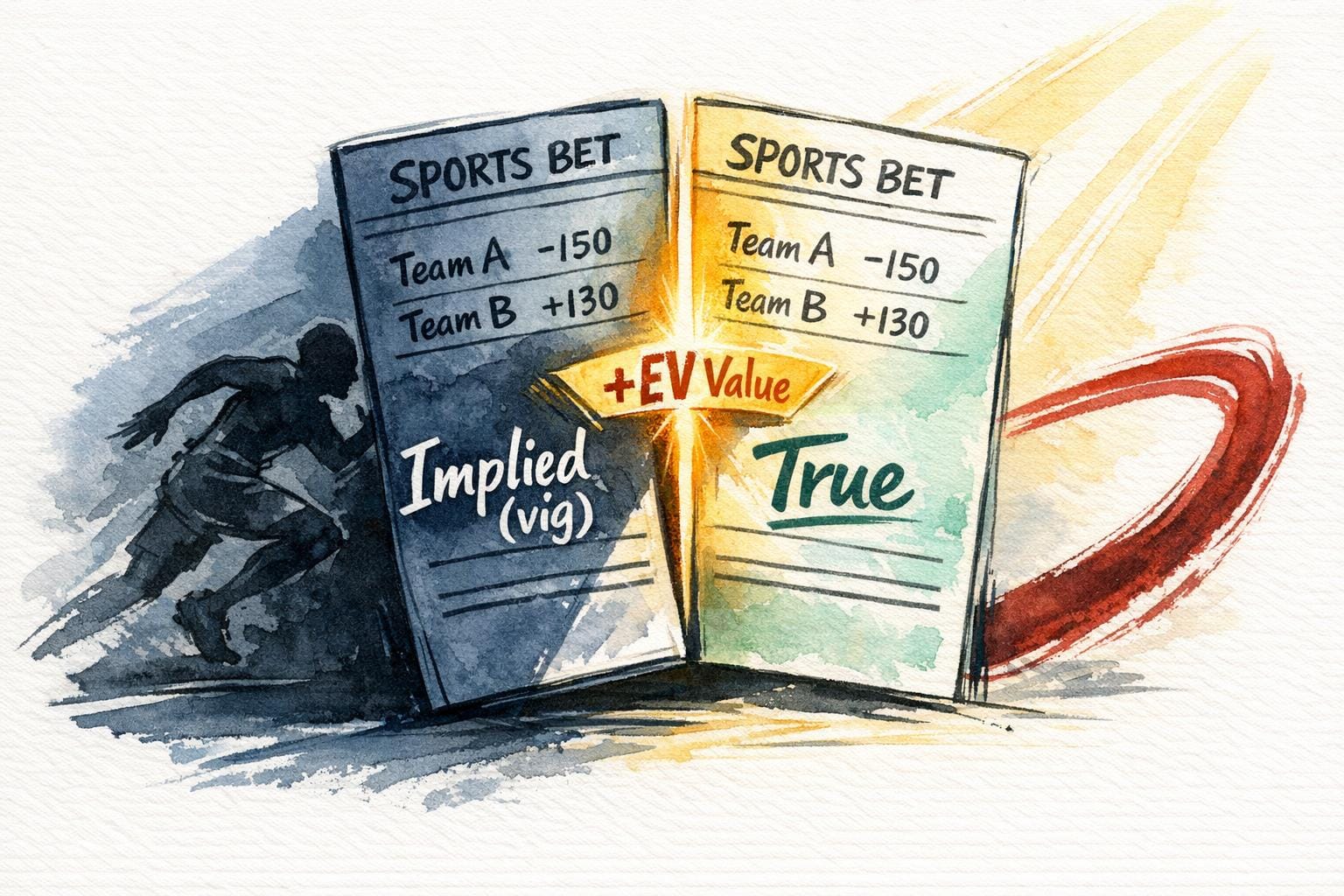
Betting success hinges on understanding two key concepts: implied probability and true probability. Implied probability reflects the likelihood of an event based on sportsbook odds, including their profit margin (vig). True probability, however, is the event's actual statistical chance, free from the sportsbook's markup. The gap between these two is where bettors can find value.
Key Points:
- Implied Probability: The breakeven percentage derived from odds (e.g., -110 odds = 52.38% implied probability).
- True Probability: The real chance of an event occurring, calculated using data and models, without the vig.
- Vig's Impact: Sportsbooks inflate implied probabilities, exceeding 100% market totals, to secure profits.
- Value Betting: Happens when your true probability estimate exceeds the implied probability, creating a positive expected value (EV).
For example, a -110 bet implies a 52.38% win rate to break even. If your analysis shows a 55% chance, that's a value bet with positive EV. Tools like statistical models or AI platforms can help identify these opportunities, ensuring calculated and informed decisions.
Mathematically Sound Sports Betting
What Is Implied Probability?
Implied probability translates betting odds into the win percentage needed to break even, factoring in the sportsbook's built-in vig. For instance, odds of -110 mean you need to win 52.38% of your bets to avoid long-term losses.
It’s important to note that implied probability doesn’t represent the actual likelihood of an event happening. Instead, it reflects the break-even point for a bet. When a sportsbook sets odds at -110, they’re essentially setting the percentage of wins required to break even over time.
"If you do not understand implied probability, you are not investing; you are gambling." – EdgeSlip
Bettors often use implied probability as a tool to identify value bets. If their own estimate of an event's true probability is higher than the implied probability from the odds, they may have found a value bet - a situation where the odds underestimate the actual chances of success.
How to Calculate Implied Probability
The calculation of implied probability depends on the format of the odds. Here are the formulas and examples for converting various odds formats into implied probability:
| Odds Format | Formula | Example |
|---|---|---|
| American (Negative) | Absolute Value of Odds / (Absolute Value of Odds + 100) | -150: 150 / (150 + 100) = 60.0% |
| American (Positive) | 100 / (Odds + 100) | +200: 100 / (200 + 100) = 33.3% |
| Decimal | 1 / Decimal Odds | 2.50: 1 / 2.50 = 40.0% |
| Fractional | Denominator / (Denominator + Numerator) | 5/2: 2 / (2 + 5) = 28.6% |
For quick reference, here are some common break-even benchmarks:
| American Odds | Decimal Odds | Implied Probability |
|---|---|---|
| -500 | 1.20 | 83.33% |
| -200 | 1.50 | 66.67% |
| -110 | 1.91 | 52.38% |
| +100 | 2.00 | 50.00% |
| +150 | 2.50 | 40.00% |
| +500 | 6.00 | 16.67% |
For example, if you bet on a team with -120 odds, the implied probability is about 54.5%. This means you need to win more than 54.5% of your bets to break even in the long run.
Next, let’s see how the sportsbook’s vig impacts these probabilities.
How Vig Affects Implied Probability
The vig, or the sportsbook’s "cut", inflates implied probabilities by pushing the total market percentage above 100%. For example, in an NFL spread market where both sides are priced at -110, the combined implied probability is approximately 104.76%. That extra 4.76% - known as the overround - represents the sportsbook’s expected profit margin.
This inflation means that implied probability always overestimates the true likelihood of an event. In futures markets, like betting on the "Super Bowl Winner", the total implied probability can soar to 125% or more, highlighting the premium bettors pay.
To find a more accurate market price, bettors often "devig" the odds by adjusting the implied probabilities so they add up to 100%. This can be done by dividing each outcome’s implied probability by the total market percentage. For example, in October 2022, the Philadelphia Eagles were listed at -460, which translates to an 82.14% implied probability, while the Pittsburgh Steelers were at +370, equating to 21.27%. Together, these implied probabilities totaled 103.41%, reflecting a vig of 3.41%. After adjusting, the Eagles’ probability dropped to 79.43%, and the Steelers’ to 20.57%.
Recognizing how vig affects implied probability is essential for spotting genuine value in betting opportunities. Accurately adjusting for this distortion allows for a clearer comparison between implied and true probabilities in betting strategies.
What Is True Probability?
True probability refers to the actual, unbiased likelihood of an event happening - free from any bookmaker margins or fees. It reflects fair odds that exclude the house edge.
Unlike implied probability, which factors in the bookmaker's margin and represents a breakeven point, true probability is purely a statistical measure of what is expected to occur. Essentially, it answers the question: "If this event were repeated 100 times under identical conditions, how often would this specific outcome happen?"
"The sportsbook isn't predicting who will win. They're predicting what the public will bet. And when their implied probability doesn't match actual probability, that gap is where money gets made." – HotTakes
The key difference lies in the math: true probabilities in any betting scenario must always total exactly 100%, whereas implied probabilities exceed 100% due to the bookmaker's overround. This distinction is crucial because value bets arise only when your calculated true probability exceeds the implied probability offered by the sportsbook.
Professional bettors rely on probabilities rather than certainties. Instead of saying, "Team A will win", they think in terms like, "Team A has a 65% chance of winning under these conditions". This mindset is what separates strategic betting from simple gambling.
How to Estimate True Probability
One of the simplest ways to estimate true probability is by removing the vig (the bookmaker's margin) from market odds. Using the Multiplicative Method, you take the implied probabilities for all outcomes and divide each by the total market percentage. For example, if the implied probabilities for two outcomes add up to 104.76%, divide each by 1.0476.
Efficient betting lines from sportsbooks like Pinnacle are often used as benchmarks for true probability. These markets reflect the opinions of professional bettors and generally feature lower margins compared to recreational sportsbooks.
Statistical models also offer powerful tools for estimating true probabilities. Examples include:
- Poisson distributions for predicting goal totals.
- Elo ratings and Power Rankings for assessing team strength.
- Monte Carlo simulations for estimating win frequencies.
Start by looking at base rates, which are historical frequencies of similar events. For instance, how often do NFL home favorites with a 7+ point spread cover? Then, adjust for situational factors like travel schedules, rest days, injuries, or weather conditions. The goal is to quantify these variables. For example, instead of simply noting "star player injured", determine how much their absence impacts the win probability based on historical data.
Mastering this process is essential for identifying value bets by comparing your estimated true probability to the sportsbook's implied odds.
Implied Probability vs. True Probability
Implied Probability vs True Probability in Sports Betting
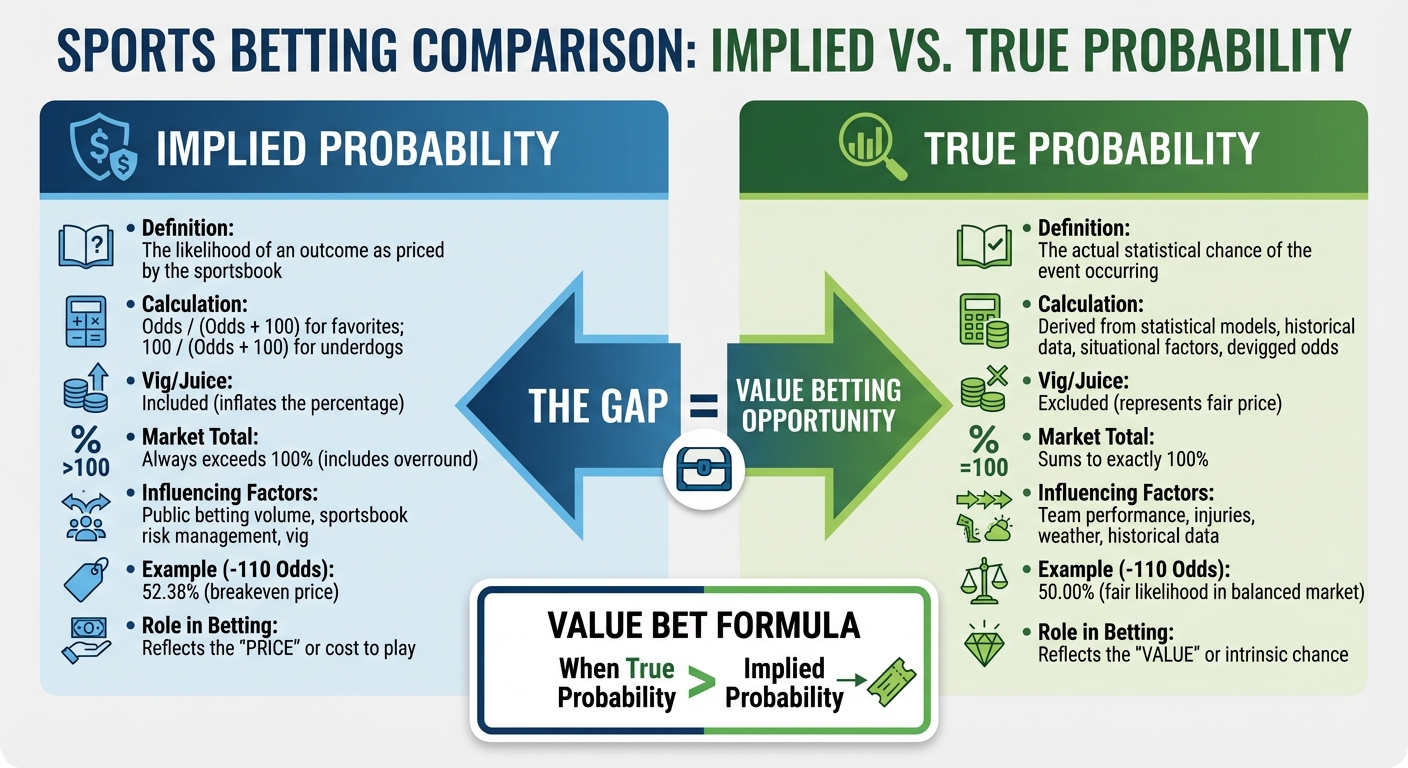
At its core, the distinction between implied probability and true probability boils down to price versus value. Implied probability reflects the breakeven point embedded within the odds, while true probability represents the actual statistical chance of an event occurring. Understanding the gap between what you're paying for and the real worth of a bet is key to making smarter wagering decisions.
This gap exists because of something called the "vig" or "juice." Sportsbooks intentionally inflate implied probabilities to ensure a profit margin. For example, in a standard NFL spread market with -110 odds on both sides, the total market probability adds up to 104.76% - a figure that exceeds the mathematically accurate 100%. That extra 4.76%? That’s the sportsbook’s edge, and it’s the hurdle every bettor faces.
Implied probability isn’t just shaped by the actual likelihood of an event; it’s also influenced by public betting trends and a sportsbook’s risk management strategies. True probability, by contrast, comes from statistical analysis, historical trends, situational factors, and adjusted (or "devigged") market odds.
Professional bettors focus on the gap between these numbers. They avoid bets where the true probability they’ve calculated falls below the implied probability, even if they believe the team might win. This approach reflects gradient thinking - evaluating value rather than simply predicting winners. It’s not about who wins; it’s about whether the win probability justifies the price being offered.
Let’s break down these concepts further with a side-by-side comparison:
Comparison Table: Implied vs. True Probability
| Feature | Implied Probability | True Probability |
|---|---|---|
| Definition | The likelihood of an outcome as priced by the sportsbook. | The actual statistical chance of the event occurring. |
| Calculation | Odds / (Odds + 100) for favorites; 100 / (Odds + 100) for underdogs. | Derived from statistical models, historical data, situational factors, and devigged odds. |
| Vig/Juice | Included, which inflates the percentage. | Excluded, representing the fair price. |
| Market Total | Always exceeds 100% (includes the overround). | Sums to exactly 100%. |
| Influencing Factors | Public betting volume, sportsbook risk management, and the vig. | Team performance, injuries, weather, and historical data. |
| Example (-110 Odds) | 52.38% (breakeven price). | 50.00% (fair likelihood in a balanced market). |
| Role in Betting | Reflects the "price" or cost to play. | Reflects the "value" or intrinsic chance. |
How to Use Both Probabilities in Betting Decisions
To make smart betting decisions, you need to understand how to spot value by comparing true probability with implied probability. When your estimated true probability is higher than the implied probability, you've uncovered an edge. This edge signals a value bet, which translates into a positive expected value (EV) - a key indicator for profitable wagers.
Take this example: a sportsbook offers -110 odds on an NFL spread, which corresponds to an implied probability of about 52.38%. If your analysis shows the team has a 55% chance to cover, you’ve found a 2.62% edge. That edge represents an opportunity, as it translates into a positive EV, guiding how much to bet.
Finding Value Bets with Positive EV
Expected value (EV) is the foundation of value betting. Here's how it's calculated:
EV = (True Probability × Potential Profit) – (Loss Probability × Stake)
Let’s break it down with an example. On a $100 bet at -110 odds, if your model estimates the true win probability at 55%, the EV calculation looks like this:
EV = (0.55 × $90.91) – (0.45 × $100) = $5
This $5 represents your positive edge. The process is straightforward: calculate the difference between your estimated true probability and the implied probability. If the result is positive, you’ve found a value bet. Even professional bettors often operate with win rates of 53–54%, rarely exceeding 55% over time, but those small edges add up.
Once you’ve identified a positive EV, you can use the Kelly Criterion to determine the optimal size of your wager. The formula is:
f* = (bp – q) / b
Where b is the decimal odds minus 1, p is your true probability, and q is the loss probability.
How WagerProof Helps Find Value

Finding accurate true probabilities requires more than intuition - it demands sharp data, solid statistical models, and real-time analysis of factors like injuries, weather, line movements, and public betting trends. That’s where WagerProof comes in.
WagerProof’s AI research agents work around the clock, analyzing matchups and generating picks tailored to your betting strategy. These agents simplify the process by automatically identifying value bets. They flag mismatches between market spreads and sportsbook odds, saving you from manually "devigging" odds to spot mispricing.
For real-time insights, WagerBot Chat provides professional-grade data at your fingertips. Ask something like, “What’s the value on tonight’s Lakers game?” and you’ll get a detailed analysis. This includes weather conditions, injury updates, betting odds, model predictions, and the calculated edge - all wrapped up in a clear recommendation. It even suggests the optimal bet size based on your bankroll.
This system not only highlights actionable opportunities but also helps you understand the math behind positive EV bets. By combining this knowledge with quality data, you can make smarter, more consistent betting decisions over time.
Conclusion
Grasping the difference between implied probability and true probability is key to making informed sports betting decisions. Implied probability represents the odds offered by sportsbooks, which include their built-in profit margin. On the other hand, true probability reflects the actual statistical chances of an outcome. The gap between these two probabilities is where savvy bettors can spot opportunities for value.
Sportsbooks typically inflate their odds beyond a fair 100% probability due to the overround. As EdgeSlip succinctly put it, "If you do not understand implied probability, you are not investing; you are gambling". By removing the overround (a process known as devigging), you can uncover fair market odds and compare them to true probabilities to identify potential value bets.
To take advantage of these opportunities, having the right tools makes all the difference. WagerProof simplifies the process by using AI to analyze odds and flag discrepancies. It alerts you when sportsbook lines deviate from prediction market spreads. Additionally, WagerBot Chat allows you to ask plain-English questions and receive detailed breakdowns that incorporate factors like injury updates, weather conditions, model forecasts, and the calculated edge - all in one clear recommendation.
The goal is straightforward: objective, data-backed analysis. Professional bettors rely on percentages, skipping bets where the implied probability outweighs their estimate of true probability. This disciplined approach separates calculated betting from mere speculation - and WagerProof gives you the tools to bet with confidence.
FAQs
How do I devig odds to get a fair probability?
To calculate fair probabilities and remove the sportsbook's margin (also known as the vig), follow these steps:
- Convert the odds into implied probabilities: This step translates the odds into percentages that represent the likelihood of each outcome.
- Sum the implied probabilities: The total will exceed 100% because of the sportsbook's built-in margin.
- Normalize the probabilities: Divide each implied probability by the total sum, then multiply by 100%. This adjusts the probabilities so they add up to exactly 100%, removing the sportsbook's margin.
- Convert the normalized probabilities back to odds: This final step gives you the fair odds, reflecting the true probabilities without the vig.
By doing this, you uncover the real probabilities, making it easier to spot fair bets and potential value opportunities.
How can I estimate true probability without a complex model?
To approximate true probabilities without diving into complex models, begin by converting the given odds into implied probabilities. Once you have that, account for the sportsbook's margin (also called the vig) by subtracting the overround. This straightforward method gives you a clearer estimate of true probabilities without relying on advanced tools or calculations.
How big should my edge be before I place a bet?
When placing bets, your edge needs to be big enough to secure a positive expected value (EV). In simple terms, this means the probability you estimate as accurate should be higher than the implied probability reflected in the odds. While the required edge size can vary depending on the context, a bigger edge generally boosts your odds of staying profitable over the long run. Take the time to assess these factors thoroughly to make more informed betting choices.
Related Blog Posts
Ready to bet smarter?
WagerProof uses real data and advanced analytics to help you make informed betting decisions. Get access to professional-grade predictions for NFL, College Football, and more.
Get Started Free