Injury Reports vs. Line Movements
When betting, you need to know how injury reports and line movements work together. Injury reports explain why a team’s performance might change, while line movements show how much the betting market reacts to that news. Here’s what matters:
- Quarterbacks drive the biggest line changes: A star QB being ruled out can shift a line by 6–7 points, while other positions usually move it by just 1–1.5 points.
- Public bettors overreact: Casual fans often exaggerate the impact of injuries, especially to big-name players. Sharp bettors look deeper, considering team depth and replacements.
- Timing is key: Early-week injury updates create opportunities before the market adjusts. Last-minute news often leads to public overreactions, which sharps exploit.
- Reverse line movement (RLM): When a line moves against public betting trends, it often signals sharp money and valuable betting opportunities.
The best approach? Combine injury updates with market reactions to spot mispriced lines. For example, if a non-QB injury causes a 3-point shift, it’s likely an overreaction. Tools like WagerProof can help track these trends in real-time, giving you an edge.
The 4 Commandments of Injury News in Sports Betting
How Injury Reports Affect Betting Markets
How Different Player Injuries Impact NFL Betting Lines
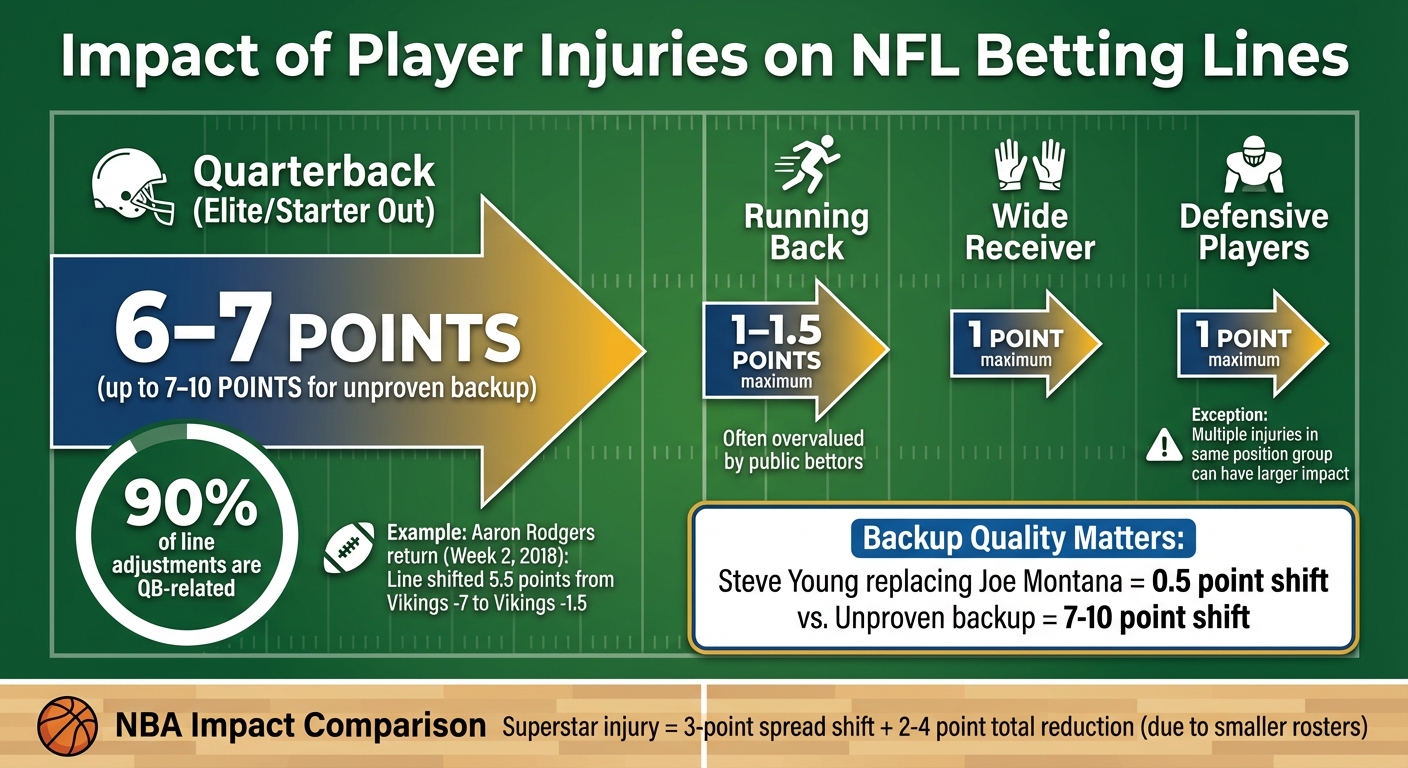
Injury reports do more than just list who's in or out - they reveal how the market values a player's replacement. The real focus isn't just on the injured player's skill but on the gap in performance between the starter and the backup. For instance, if a team has a solid backup like Steve Young stepping in for Joe Montana, the betting line might only shift by half a point. But if an unproven backup replaces a top-tier quarterback, the spread could move by as much as 7 to 10 points. This difference highlights why some injuries lead to bigger market reactions than others.
Different Injuries Create Different Market Reactions
Quarterbacks dominate the conversation when it comes to injury-related betting adjustments in the NFL. In fact, about 90% of these adjustments are tied to quarterbacks. A clear example of this was in September 2018, when Aaron Rodgers was confirmed to start for the Green Bay Packers in Week 2. The line against the Minnesota Vikings shifted dramatically - 5.5 points, from Vikings -7 to Vikings -1.5. On the other hand, injuries to running backs, wide receivers, or defensive players typically move the line by no more than 1 point.
"For the most part, quarterbacks are 90 percent of the reason a line is adjusted."
– Andy Iskoe, Professional Handicapper, The Logical Approach
In basketball, the impact of injuries can be even more pronounced due to smaller rosters. Losing a superstar might shift the point spread by about 3 points and lower the game's total by 2 to 4 points. Additionally, injuries that cluster within a specific position group - like an offensive line or secondary - can have a ripple effect. For example, in October 2021, the Cleveland Browns saw their line against the Arizona Cardinals drop from -3 to -2.5 after multiple injuries in the secondary weakened the team's defensive efficiency. When several players in one unit are sidelined, the overall performance can take a significant hit.
When Injury News Breaks Matters
Timing is everything when it comes to injury news and its effect on betting markets. Early-week practice reports give bettors a chance to act before the market fully adjusts. In the NFL, Wednesday's practice participation - marked as "Full", "Limited", or "Non-participant" - often serves as the first meaningful clue about a player's availability, giving sharp bettors an edge.
The final injury updates, released 15–30 minutes before kickoff, can cause sudden shifts in the odds. These last-minute updates often lead to public overreactions, creating opportunities for sharp bettors to "buy back" undervalued teams. This dynamic between the timing of injury news and market volatility underscores how crucial it is to combine injury reports with line movement analysis to spot potential pricing errors.
What Line Movements Tell You
Line movements provide a real-time snapshot of how the betting market reacts to new information, like injury updates or other key developments. They reflect the collective actions of professional bettors, casual fans, and sportsbooks, offering clues about where value might lie and where public perception may be skewed.
When a betting line shifts, it’s not just random. It often indicates how seriously sportsbooks and sharp bettors are taking the latest news. Understanding the "why" behind these movements helps separate meaningful insights from the noise of public betting.
Not all bets are created equal. A few sharp bettors placing large wagers can move a line far more than thousands of casual fans betting small amounts. Sportsbooks adjust quickly to sharp action because they know these bettors are well-informed and have a history of success. If sharp money heavily favors one side, sportsbooks will tweak the line - even if it means creating potential liability.
Professional Bettors vs. Public Bettors
The behavior of professional bettors (often called sharps) and casual fans differs dramatically, and these differences are what drive distinct patterns in line movements. Sharp bettors act early, seizing on inefficiencies as soon as lines are posted or news breaks. Casual fans, on the other hand, tend to bet later, often influenced by media hype or popular teams.
Reverse line movement (RLM) is one key signal of sharp action. For example, in NFL Week 12, the Green Bay Packers opened as -4.5 favorites. Despite over 75% of public bets backing the Packers, the line dropped to Packers -3 by kickoff. This shift suggested sharp bettors were heavily favoring the Minnesota Vikings, who ultimately covered the spread.
"Sharp money can move lines even when it creates a liability issue for a book because sportsbooks value the opinions of certain professional bettors."
– Tony Farmer & Andrew Dixon
To identify sharp action, look at betting splits - the percentage of bets versus the percentage of money. If a team has, say, 30% of the bets but 60% of the money, it’s a strong indicator that sharps are backing that side. Timing also matters: sharp action often drives early-week volatility, while late-week movement is more likely driven by casual bettors.
| Feature | Professional (Sharp) Bettors | Public (Casual) Bettors |
|---|---|---|
| Bet Timing | Early or right after news breaks | Late, usually on game day |
| Bet Size | Large, high-limit wagers | Small, recreational bets |
| Market Impact | Causes "Steam Moves" and RLM | Creates movement to balance sportsbook liability |
| Focus | Exploiting inefficiencies and news | Betting on favorites, popular teams, or media narratives |
These distinctions highlight why sharp bettors often shape the market, while casual bettors follow trends.
Using Line Movements to Verify Injury Impact
Line movements don’t just confirm injury news - they can also challenge it, revealing how the market values certain players or situations.
Take the Cleveland Browns in October 2021 as an example. They opened as -3 favorites against the Arizona Cardinals, but after injuries hit their secondary, the line dropped to -2.5. Later in the week, practice reports revealed key defensive players were returning, and the line moved past the critical number of 3 to Browns -3.5. This shift showed the market valued those defensive players more than the initial injury reports suggested.
Steam moves - rapid, simultaneous adjustments across several sportsbooks - are another key indicator. These moves often signal sharp action or breaking news. If you see a steam move without any obvious injury update, it’s a sign that professionals might have inside information or advanced analysis. On the flip side, if an injury report drops and the line barely moves, the market may be signaling that the player’s absence isn’t as impactful as casual bettors might assume.
High-profile players, like running backs or wide receivers, are often overvalued by public bettors. These injuries rarely move lines by more than 1 point, but the public tends to overreact, creating opportunities for sharps to exploit temporary mispricing.
"Watching line movements is like getting a peek at the market's heartbeat – it tells you what other bettors (and the bookies) are thinking."
– Jimmy Boyd, SportsCapping
Another subtle but important indicator is vigorish (juice) movement. If a sportsbook adjusts the juice - for example, shifting from -110 to -120 on one side - it’s often a precursor to a full point spread change. This is the sportsbook’s way of discouraging action on one side before making a more significant adjustment. Spotting these changes early gives you a chance to act before the line moves further.
How to Use Injury Reports and Line Movements Together
The real advantage comes from combining injury reports with market reactions. When these two sources don't align, it could signal a pricing error. The goal is to spot situations where the line movement doesn't match the expected impact of an injury - whether due to market overreaction or a lag in adjustment.
Finding Pricing Errors by Comparing Both Data Sources
Start by assessing whether the line movement aligns with the injury's expected influence. For example, elite quarterbacks typically cause a line shift of 6–7 points, while star running backs, wide receivers, or defenders usually move the line by just 1 to 1.5 points. If a non-quarterback injury causes a shift of 3 points or more, it's likely an overreaction from the public - opening up a chance to bet on the injured team.
"There are more actionable opportunities to fade the overreaction than there are to actually play against the injury."
– Steve Rieder, Betting Analyst
On the other hand, if multiple players from the same position group are sidelined and the line hasn't shifted enough, the market might be undervaluing the combined impact.
Timing is everything. Jump on early betting opportunities when injury news breaks, before sportsbooks have fully adjusted. Alternatively, you can wait for the public to overreact - especially in the 15–30 minutes before kickoff when final inactive lists are announced - and take advantage of inflated lines. Professional bettors often aim to beat the closing line 75–80% of the time using these strategies, compared to 60–70% for casual bettors.
Replacement value is another critical factor. Analyze the backup's historical performance. If a team has strong depth and the line moves significantly, the market might be underestimating the replacement. Conversely, if the backup is untested and the line barely moves, the market might be undervaluing the starter's absence.
| Scenario | Market Signal | Betting Opportunity |
|---|---|---|
| Star QB ruled out, line moves 3 points | Underreaction (expected 6–7 points) | Bet against the injured team |
| Star RB ruled out, line moves 3 points | Overreaction (expected 1–1.5 points) | Fade the public, bet on injured team |
| 3+ O-Line injuries, line moves 1 point | Market undervaluing cluster impact | Bet against the injured team |
| Reverse line movement despite injury | Sharp money backing injured team | Follow the sharp action |
Blending these insights with advanced tools can sharpen your betting strategy even further.
Using WagerProof for Real-Time Data Analysis
WagerProof simplifies the process by combining injury reports, line movements, public betting percentages, and prediction markets into a single, easy-to-use platform. This eliminates the hassle of jumping between different sources. The platform flags outliers - like when spreads from prediction markets don't align with sportsbook lines - helping you spot value bets before the market adjusts.
The Edge Finder tool provides real-time tracking of line movements across both sharp and public sportsbooks. It highlights instances where professional money is moving against the public. For example, if 70% of bets are on one team but the line shifts in favor of the other team, WagerProof identifies this reverse line movement immediately, pointing to sharp action. You can also analyze public money lean - comparing the percentage of bets to the percentage of money - to pinpoint when large, informed wagers are influencing the line despite lower overall bet volume.
With WagerBot Chat, you can ask about specific injury scenarios and receive instant, data-backed analysis. Whether you're curious about a player's historical impact on spreads, want to compare current line movements to past situations, or need to evaluate replacement value, WagerBot provides real-time answers. Backed by statistical models, the platform helps you determine whether a line movement is justified based on historical performance, giving you an extra layer of confidence beyond just observing the numbers.
Conclusion
Injury reports tell us who’s sidelined, while line movements reflect how the market reacts. Together, they uncover gaps in pricing that bettors can exploit.
The real trick? Staying consistent. By tracking these patterns over time, you can learn to separate the noise - like public hype around star players - from the real signals, such as sharp money influencing the odds. Take the NFL, for example: betting against popular narratives resulted in a 64% cover rate (30–17 record). This shows that sticking to disciplined, data-driven analysis beats emotional decision-making. One clear indicator of sharp money at play is reverse line movement, which can be a goldmine for those paying attention.
Don’t get distracted by every injury update. Instead, focus on clusters of injuries or unexpected line shifts. When a line moves significantly beyond what you’d expect, it often signals a chance to capitalize on the market’s overreaction.
Adding real-time data into the mix sharpens your edge even more. Most major odds adjustments happen 15–30 minutes before kickoff, as final injury updates roll in. Tools like WagerProof simplify this process by combining injury news and line movement data, flagging outliers and reverse line movements automatically. This allows you to act quickly, often before the market fully adjusts. Ultimately, it’s this kind of consistent, data-driven approach - not gut instincts - that separates long-term winners from everyone else.
FAQs
How do I know if an injury is already priced into the line?
When trying to figure out if an injury is factored into the betting line, pay attention to line movements after injury news breaks. A big shift in the line typically means the injury has already been considered. On the other hand, if the line barely moves, it might indicate the injury hasn't been fully accounted for yet.
By keeping an eye on injury reports alongside line changes, you can make smarter and more informed betting choices.
What is reverse line movement, and why does it matter?
Reverse line movement occurs when the betting line moves in the opposite direction of where most public bets are placed. This usually signals that sharp bettors - those considered more experienced or informed - are wagering on the less popular side. For bettors, this can highlight opportunities, as it often reflects where the "smart money" is going. Understanding this can give you an edge over the general public, who tend to follow the line's initial trajectory.
When is the best time to bet after injury news breaks?
When injury news breaks, the smartest move is to place your bet immediately. Quick action gives you the chance to take advantage of any overreaction in the market before sportsbooks have time to adjust their odds. Waiting too long? That could mean missing out on better lines as the market settles.
Related Blog Posts
Ready to bet smarter?
WagerProof uses real data and advanced analytics to help you make informed betting decisions. Get access to professional-grade predictions for NFL, College Football, and more.
Get Started Free