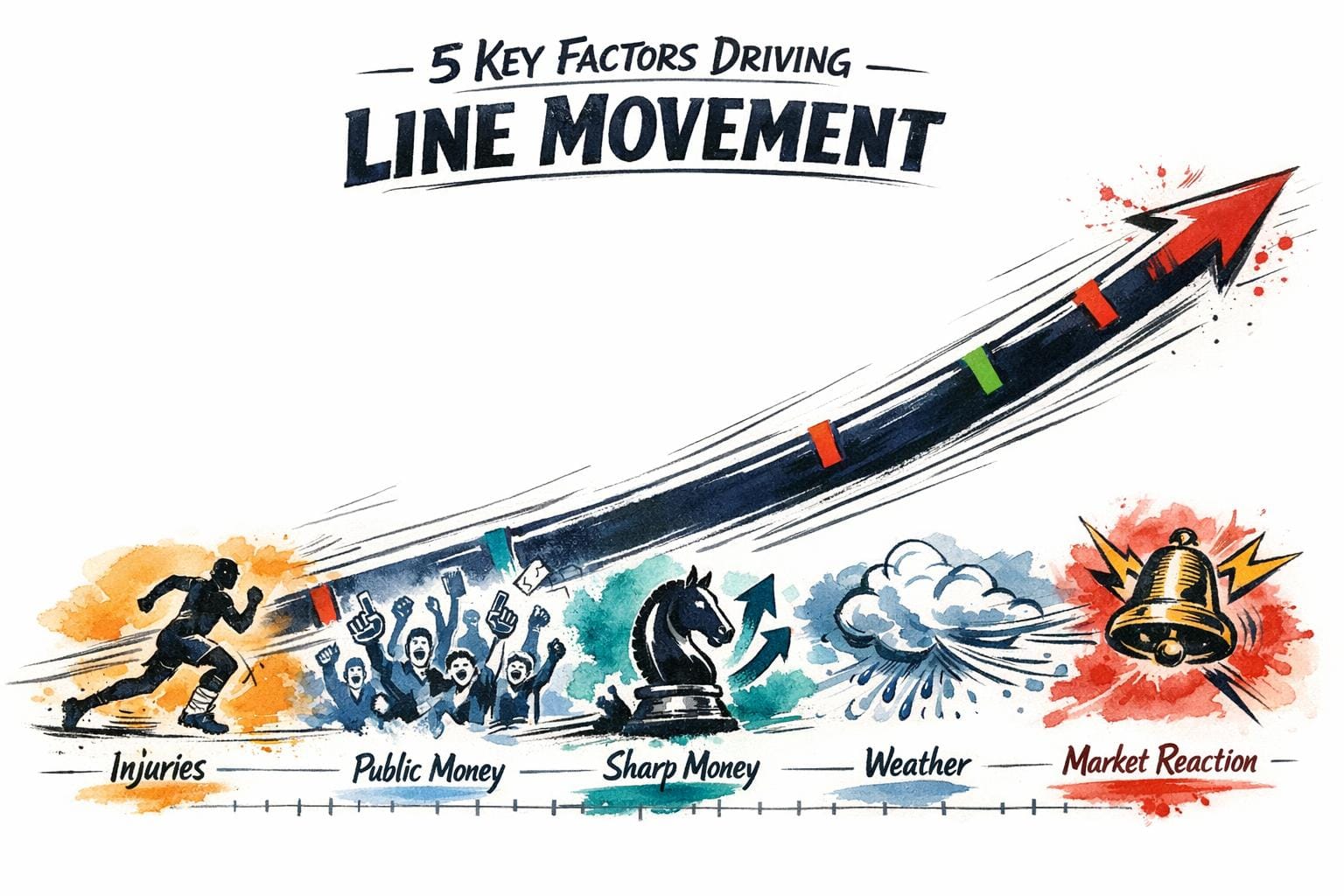
5 Key Factors Driving Line Movement
In sports betting, line movement shows how odds or point spreads shift from the opening line to the closing line. These changes happen because of factors like injuries, public betting trends, sharp bettors’ activity, weather, and sportsbooks adjusting to competitors. Understanding these shifts can help you spot opportunities for better odds and smarter bets.
Here’s a quick breakdown of the key drivers:
- Injuries/Roster Changes: Star player injuries or lineup changes can cause big shifts. For example, losing a top NFL quarterback might move the spread by 7+ points.
- Public Betting Trends: Heavy public money on one side often causes sportsbooks to adjust lines to balance their risk.
- Sharp Action: Professional bettors’ large, well-timed wagers influence lines more than casual bets.
- Weather Conditions: Wind, rain, and temperature impact outdoor sports, especially totals betting.
- Market Reactions: Sportsbooks mimic each other to align odds and avoid being exploited by sharp bettors.
Using tools like WagerProof can help track these movements in real time, giving you insights into why lines change and where value might exist.
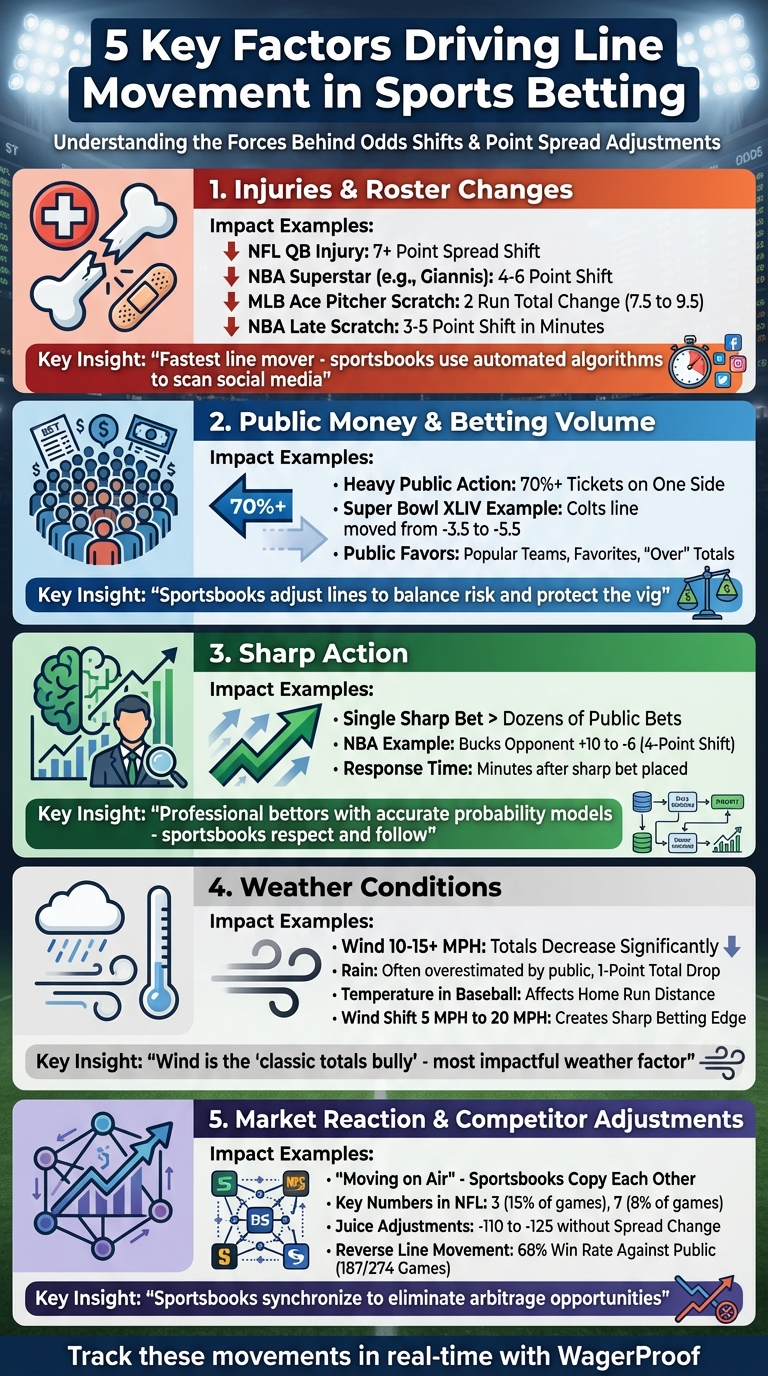
5 Key Factors Driving Sports Betting Line Movement
How to Track Line Movement to Find +EV Bets | Sports Betting Strategy Explained
1. Injuries and Roster Changes
Injuries can shake up betting lines faster than almost anything else. The moment a star player gets hurt, sportsbooks rush to adjust their odds before savvy bettors can take advantage of outdated numbers. To stay ahead, sportsbooks rely on automated algorithms that scan social media and news outlets for terms like "out", "torn", or "indefinitely." When major news hits, they often "circle" the game - temporarily pulling it off the board to reassess the situation.
The impact of an injury depends on the sport and the player's role. In the NFL, losing a top-tier quarterback can shift the point spread by 7 or more. For example, when the Kansas City Chiefs announced Patrick Mahomes wouldn’t play, the line quickly moved several points in favor of the opposing team. In the NBA, a superstar like Giannis Antetokounmpo can affect the spread by 4 to 6 points, potentially turning a heavy favorite into a near toss-up. In MLB, when Shohei Ohtani of the Los Angeles Angels was scratched from a start due to illness, the line shifted from -170 to a pick'em (-110).
"In the world of sports betting, information is the most valuable currency... nothing moves a betting line faster or more drastically than injury news." - Steven Petrella, Commercial Content Director, Action Network
Roster changes beyond injuries also cause major ripples. Suspensions, load management, and even tactical decisions can all move the needle. In the NBA, resting a star player for health reasons - commonly referred to as a "late scratch" - can shift the spread by 3 to 5 points in a matter of minutes. In the NFL, replacing a struggling veteran quarterback with a rookie can cause a 3- to 7-point swing. In baseball, when a starting ace is replaced by a bullpen game, the over/under total can jump by 2 runs almost instantly, such as from 7.5 to 9.5.
Sharp bettors often follow local reporters on social media to catch injury news before it becomes official. They also look for opportunities to exploit market overreactions. For instance, when the public overestimates the impact of a star player’s absence, the line might move too far, creating value for the supposedly weakened team. Sometimes, teams even perform better without a high-usage but inefficient player, benefiting from improved ball movement and effort - this is known as the "Addition by Subtraction" effect.
Next, we’ll dive into how public betting volume influences line movement.
2. Public Money and Betting Volume
In the world of sports betting, injuries and roster changes can quickly alter betting lines, but the influence of public wagers is just as significant. Public money refers to bets made by casual fans, often swayed by media buzz or their loyalty to popular teams. These bettors tend to favor well-known teams like the Dallas Cowboys or Los Angeles Lakers, and they often bet on favorites or the "Over" in totals markets, as these options feel more exciting and intuitive.
To keep track of betting trends, sportsbooks monitor two main metrics: the number of bets (tickets) and the total money wagered (wagering volume). When more than 70% of tickets are placed on one side, it's considered heavy public action. To manage this imbalance, sportsbooks adjust the lines to make the less popular side more appealing. This encourages bets on the other side, helping the sportsbook balance its risk and ensure it collects the commission - or "vig" - regardless of the game's outcome.
"The main goal for oddsmakers is to garner as much action on both sides. That way, the sportsbook will make money regardless of the outcome, based on the commission they charge." - Luke Miller, Featured Writer, BettingPros
Interestingly, modern sportsbooks often focus more on minimizing losses from sharp bettors than perfectly balancing public bets. Sometimes, they’ll tolerate uneven public wagers if their pricing models suggest the risk is manageable. A well-known example of this occurred during Super Bowl XLIV in February 2010. The Indianapolis Colts opened as -3.5 favorites against the New Orleans Saints, but a surge of public money on the Colts pushed the line to -5.5 by kickoff as sportsbooks sought to limit their liability.
Another key concept is reverse line movement, which signals the influence of sharp money. This happens when most tickets are on one side, but the line moves in the opposite direction. It suggests that a smaller group of professional bettors has placed large wagers on the less popular side. Watching the gap between ticket percentages and money percentages can help bettors spot these situations and uncover potential value in betting against the public.
3. Sharp Action
Sharp action stands apart from public betting, which typically comes from casual fans placing numerous smaller bets. Sharps, or professional bettors, earn the respect of sportsbooks because their wagers are based on a more accurate evaluation of probabilities. When a sharp bettor places a wager, sportsbooks often adjust their lines within minutes to reflect this informed perspective.
Sportsbooks identify sharp action by monitoring customers who consistently turn a profit and analyzing the ratio of bets to the total money wagered. A large number of small bets usually signals public action, while a few substantial wagers hint at sharp activity. Interestingly, a single significant sharp bet can lead to a more drastic line adjustment than dozens of smaller public bets.
Sharps employ different strategies when timing their bets. Some act quickly after lines open to take advantage of initial inaccuracies, while others wait until just before the game starts to exploit lines inflated by heavy public betting. A great example of this occurred during an April 2025 NBA game. Sharp bettors wagered early on the Milwaukee Bucks' opponent at +10, speculating that Giannis Antetokounmpo might sit out. Once his rest was confirmed two hours before the game, sportsbooks adjusted the line to Bucks -6 - a dramatic 4-point shift that rewarded the early sharp bettors.
To respond to sharp action, sportsbooks may adjust the point spread immediately, change the juice (e.g., from -110 to -120), or even temporarily freeze the line to reassess the odds. They also rely on "on-air" adjustments, mirroring changes made by leading market-setting sportsbooks, and may limit the maximum bet amounts for accounts flagged as sharp. Up next, we’ll look at how weather conditions can also play a role in line movement.
4. Weather Conditions
Weather has a big impact on line movement, especially in outdoor sports like football and baseball. Among all weather factors, wind is the most impactful. It's often referred to as the "classic totals bully" because it disrupts long passes and forces teams to lean on safer, run-focused strategies. When wind speeds exceed 10–15 mph, sportsbooks typically lower totals to account for fewer scoring chances. Other factors, like rain, can also influence betting lines, though sometimes the market reacts more strongly than necessary.
Rain is often overestimated by casual bettors. The mere mention of rain tends to push many toward the "Under", even though rain alone rarely has a major effect unless paired with strong winds or poor field conditions. For example, a sudden rainstorm before an NFL game might cause the total to drop by a full point. Savvy bettors, however, prioritize wind speed over rainfall when assessing its true impact.
Baseball presents its own weather dynamics. Temperature changes can affect how far fly balls travel - warmer weather tends to increase home runs, while cooler temperatures have the opposite effect. A sudden wind shift, such as going from 5 mph to 20 mph, can make opening lines seem outdated, giving sharp bettors an edge. Player props are especially sensitive to weather changes and often take longer to adjust, creating opportunities for those who follow real-time forecasts closely.
Take February 2026 as an example, just before Super Bowl LX at Levi's Stadium. Forecasts predicted daytime highs in the upper 60s, dropping to the low 50s by kickoff, with light winds of 5–7 mph. Analysts determined that these conditions were unlikely to affect the point spread much. Instead, they focused on how morning fog and lingering moisture might influence early-game timing and footing. This subtle shift led to more interest in "under" totals and specific player props rather than changes to the spread.
5. Market Reaction and Competitor Adjustments
Sportsbooks keep a close eye on each other, reacting swiftly to any major line adjustments. This practice, often referred to as "moving on air", is a risk management strategy designed to keep odds aligned across the market. As sports handicapper Jimmy Boyd explains:
"In the modern era, bookmakers watch each other closely... odds makers copying odds makers."
Beyond factors like injury updates or sharp betting activity, competitor behavior plays a significant role in line movement. If a sportsbook's odds fall out of sync with the broader market, it risks being targeted by sharp bettors looking to exploit outdated lines. To counter this, sportsbooks often adjust preemptively, creating a ripple effect. Typically, a major Las Vegas book or a high-volume online platform leads the market, prompting others to follow suit. This synchronization helps eliminate gaps that could be exploited and ensures market stability.
When a respected betting syndicate makes a decisive move, it can cause rapid line shifts across several sportsbooks at once. Bettors who notice a delay in updates at one sportsbook can sometimes take advantage of better odds before the adjustment catches up.
To manage risks like "middling", sportsbooks often tweak the juice instead of changing the spread. For example, a spread might remain at -6, but the juice could increase from -110 to -125, making that bet more expensive. This tactic becomes especially relevant around key numbers, such as 3 or 7 in football. These margins are particularly significant because 3-point outcomes occur in roughly 15% of games, while 7-point outcomes happen about 8% of the time.
For bettors, the most effective way to navigate these market dynamics is through line shopping. Maintaining accounts with multiple sportsbooks allows you to spot delays in line updates, providing opportunities to secure better odds. This strategy is especially useful when paired with public money trends. For instance, a study tracking 274 reverse line movement games revealed that the public money side lost in 187 cases - about 68% of the time.
To stay ahead, consider using tools like WagerProof to track these shifts in real time. It’s a powerful way to stay informed and make smarter betting decisions.
Using WagerProof to Track Line Movement

Manually tracking line movements across multiple sportsbooks can be a real headache - not to mention the risk of missing crucial shifts. WagerProof simplifies this by consolidating real-time line data, giving you instant access to the factors driving these changes.
One standout feature is its public bets and money lean data, which highlight betting imbalances in real time. For instance, imagine 75% of bets are on the Packers at -4.5, but the line suddenly drops to -3. This suggests sharp action on the other side of the matchup. This phenomenon, known as reverse line movement - when the line moves against public bets - is a key indicator of sharp betting activity. WagerProof makes it easy to spot these shifts and connect them to live professional actions, enabling deeper analysis.
Another game-changing tool is WagerBot Chat, which integrates live professional data. You can simply ask, "Why did the Cowboys line move from -140 to -125?" and get a detailed breakdown that includes factors like injuries, weather conditions, and model projections. For example, if a star NBA player’s status changes, the system can quickly detect a 3- to 5-point spread adjustment and provide the context behind it.
WagerProof also employs AI research agents that work around the clock, monitoring markets across leagues like the NFL, NBA, Premier League, and Bundesliga. These agents can detect both rapid "steam moves" and more subtle "silent drops" in odds, sending you real-time alerts so you can act before the value disappears. For example, if a Bundesliga match shows 55% of bets but 70% of the money on Dortmund, leading to a spread shift from -1.5 to -2.0, the system flags this as sharp betting influence. This kind of intel helps you capitalize on line movements effectively.
And the best part? WagerProof offers all of this for just $0.63 per day, giving you access to the same real-time insights that sharp bettors depend on. It’s a small investment for staying ahead of the curve and spotting value at the right moment.
Conclusion
Grasping line movement isn't just about watching numbers tick up or down - it’s about understanding the why behind those changes. Factors like injuries, public money, sharp action, weather conditions, and market adjustments all play a role in shaping odds. Each of these elements contributes to the bigger picture, emphasizing the importance of tools that can keep up with fast-moving markets.
The closing line is considered the most accurate reflection of true probability because it incorporates all these variables. Consistently beating this line is what separates successful bettors from the rest.
"Consistently getting numbers better than the close is the mark of a winning bettor." - LoserWins
Given the speed of these changes, relying solely on manual tracking can mean missing out on key opportunities. That's where tools like WagerProof come in handy. By combining real-time odds, public betting data, and sharp action indicators, it equips you with the insights needed to identify reverse line movement, steam moves, and value bets - all before the market locks you out.
FAQs
What does line movement actually tell me?
Line movement represents how odds or point spreads change over time, often influenced by factors like betting trends, player injuries, or weather conditions. It provides insight into how sportsbooks adjust to market activity and where money is being placed. By keeping an eye on these shifts, you can identify opportunities to gain an edge - whether that means placing a bet early to avoid less favorable changes or holding off for a better line that boosts potential profit. Grasping the nuances of line movement can lead to more strategic and informed betting decisions.
How can I spot reverse line movement quickly?
To spot reverse line movement quickly, keep an eye on betting lines and compare them with public betting percentages. The key is to find situations where the line moves in the opposite direction of the majority of bets. For instance, if 75% of bets are on Team A, but the line shifts to favor Team B, it’s often a sign that sharp money is affecting the odds. Using tools that display real-time line movements and public betting data can help you track these changes more efficiently.
When should I bet - early or right before kickoff?
The timing of your bet hinges on your approach and how the lines move. Placing your bet early can lock in better odds before adjustments occur due to factors like sharp bettors, injuries, or public betting trends. On the other hand, waiting until closer to kickoff allows you to take advantage of updated information, such as injury updates or weather conditions. If you anticipate the odds shifting against you, betting early might be the smarter move. However, if you want to use the latest data to find opportunities, betting later could provide an edge.
Related Blog Posts
Ready to bet smarter?
WagerProof uses real data and advanced analytics to help you make informed betting decisions. Get access to professional-grade predictions for NFL, College Football, and more.
Get Started Free