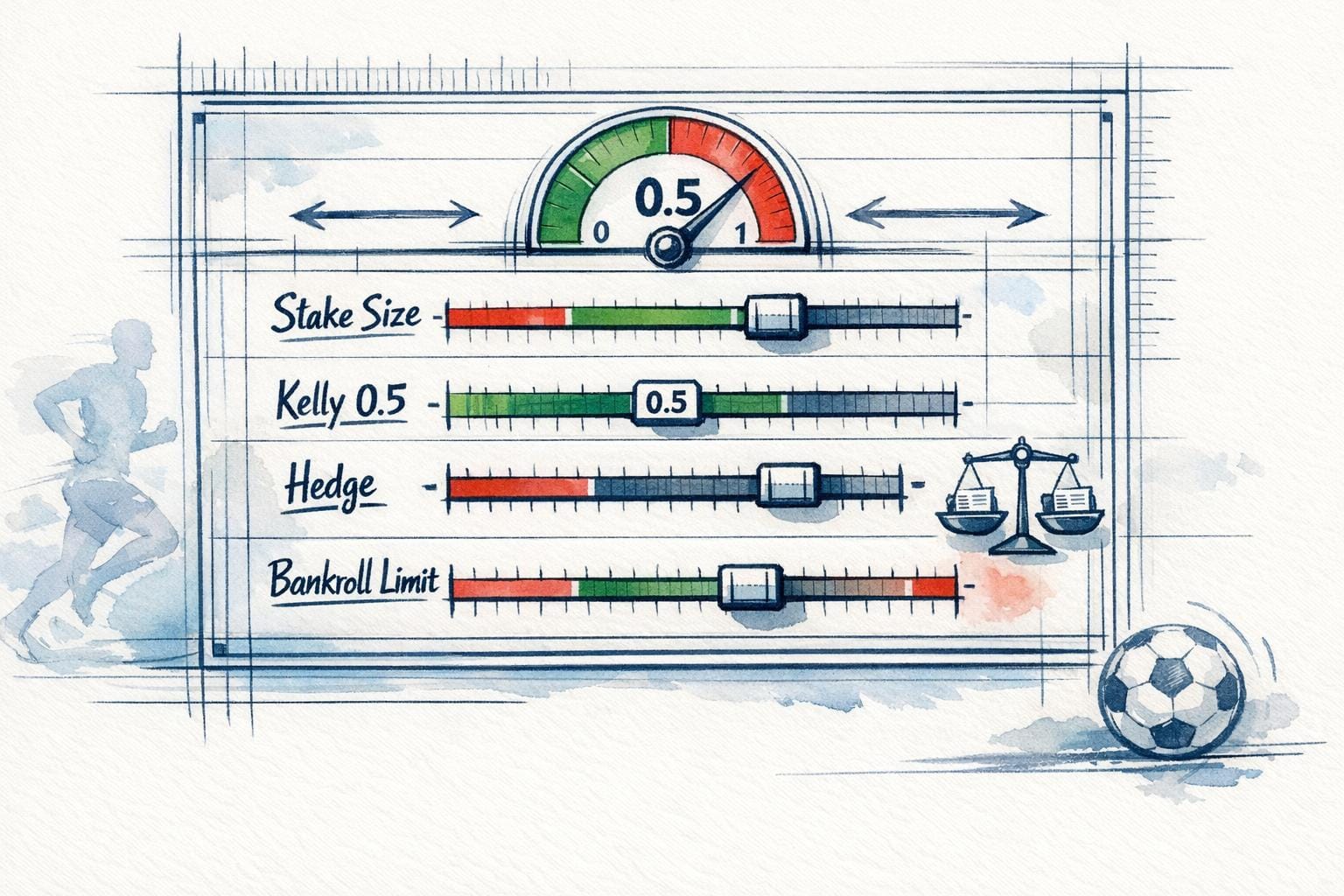
Live Betting Stake Adjustments: Pro Tips
Live betting moves fast, and adjusting your stakes during the game can make or break your bankroll. The key is to avoid emotional decisions and focus on strategy. Here’s what you need to know:
- Stick to small stakes: Limit in-play bets to 0.5% of your bankroll and cap total session exposure at 6%.
- Time your bets wisely: Place bets during natural pauses like halftime or timeouts to avoid reacting impulsively.
- Watch for overreactions: Odds often swing drastically after big moments like goals or injuries - wait a few seconds for the market to stabilize.
- Prepare pre-game: Set clear risk limits, identify potential momentum shifts, and rely on tools like WagerProof for data-driven insights.
- Use fractional Kelly: To calculate optimal stakes, apply a conservative version of the Kelly Criterion to reduce risk in high-volatility situations.
- Avoid common mistakes: Don’t chase losses, increase bets after wins, or bet during chaotic game moments.
With discipline, preparation, and a clear approach to stake adjustments, you can navigate the unpredictable world of live betting effectively.
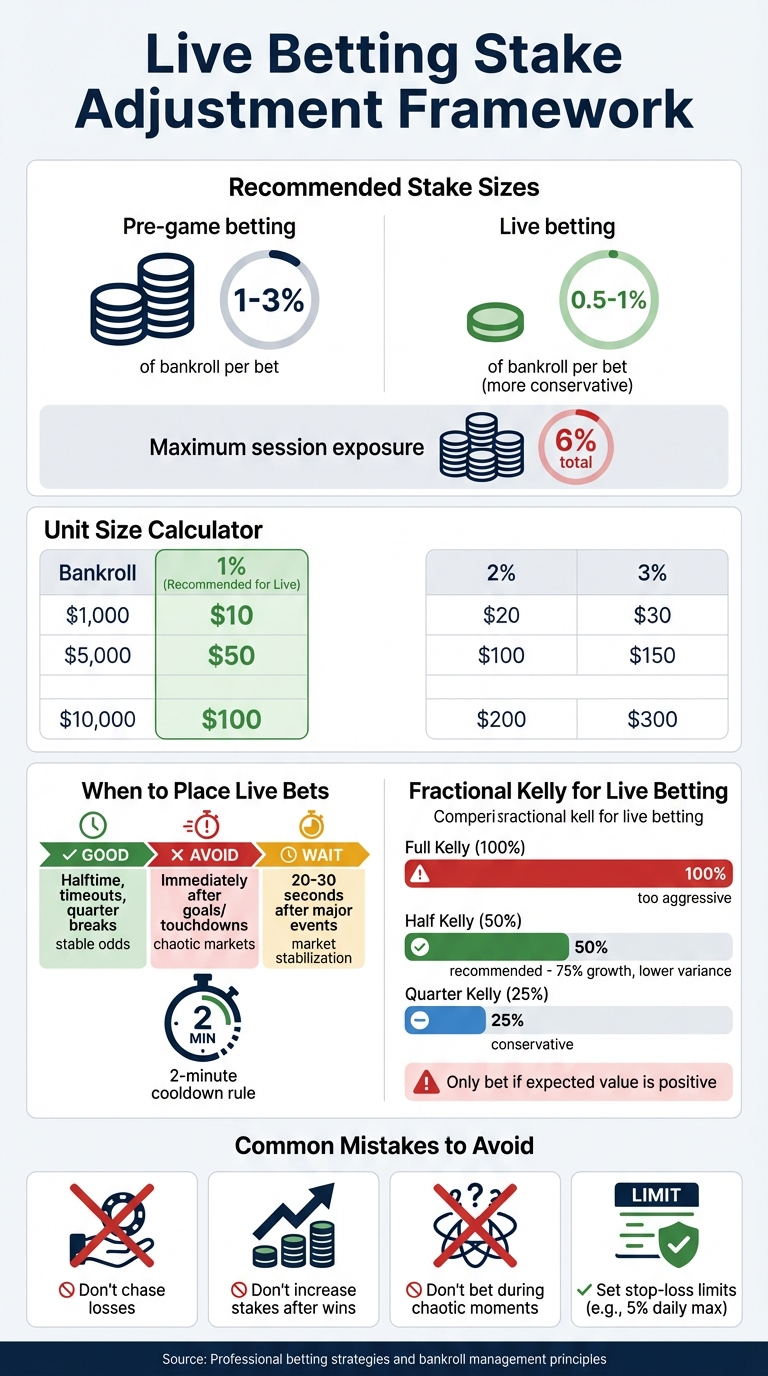
Live Betting Stake Adjustment Framework: Bankroll Percentages and Risk Management
The 1 Minute Live Betting Strategy (That Actually Works)
To execute this strategy effectively, you need access to top real-time sports data platforms that provide the low-latency updates required for 1-minute windows.
Pre-Game Preparation: Building Your Framework
Live betting moves fast, so your pre-game plan has to be solid. Before the game starts, you need to decide how much you're willing to risk, when you'll make adjustments, and what data you'll rely on. Without this groundwork, you're betting on impulse instead of strategy.
Setting Your Bankroll and Unit Sizes
Your bankroll should be money set aside specifically for betting - completely separate from your rent, savings, or daily expenses. Keeping these funds separate ensures you avoid emotional decisions tied to your personal finances.
Most seasoned bettors risk only 1% to 3% of their total bankroll per bet. For live betting, stick closer to the 1% range since in-play markets are more unpredictable, and you'll likely place multiple bets during a game. Many experienced bettors reduce their live betting unit size to half or even a third of their pre-match unit to handle the fast pace.
For beginners, flat betting - risking the same amount on every bet - is ideal. It keeps things simple and stress-free. As you gain experience, you might shift to percentage staking, where your unit size adjusts with your bankroll. For instance, if your $1,000 bankroll grows to $1,500, your 1% unit increases from $10 to $15.
Here’s a quick reference for typical bankroll levels:
| Bankroll | 1% Unit | 2% Unit | 3% Unit |
|---|---|---|---|
| $1,000 | $10 | $20 | $30 |
| $5,000 | $50 | $100 | $150 |
| $10,000 | $100 | $200 | $300 |
Set a stop-loss limit - for example, a 5% maximum daily loss - to avoid chasing losses during a bad streak. If you hit that limit, it’s time to take a break.
Identifying When to Adjust Stakes
With your framework in place, decide in advance when and how you'll adjust your stakes during the game. Clarity here is crucial.
Look for momentum versus scoreboard mismatches - situations where a team is controlling the game but isn’t leading on the scoreboard. These can hint that the odds haven't caught up with the action on the field. Similarly, key events like player injuries, foul trouble, or red cards should prompt you to reassess your bets.
Timing is just as important as the event itself. Use natural pauses like halftime or timeouts to adjust your stakes when you’re less likely to act on emotion. Avoid betting during chaotic moments, such as the final minutes of a soccer match, when fatigue and desperation can cause erratic odds swings.
A good rule of thumb? Use a "two-minute cooldown" after major events like a goal or touchdown before placing a live bet. This gives the market time to stabilize and helps you avoid emotional reactions to sudden odds changes.
Using WagerProof for Pre-Game Analysis

WagerProof equips you with the data you need before the action starts. Its prediction markets, public betting data, and models highlight games where live odds are likely to shift, giving you a head start.
Begin by comparing prediction market spreads to sportsbook lines. When there’s a mismatch, WagerProof flags potential value bets that might emerge during the game. The platform also tracks public betting trends, showing where the majority of bets are going versus where sharp money is landing. This insight helps you anticipate odds movements after key in-game moments.
With WagerBot Chat, you can access live data and ask specific questions about trends, team performance in certain scenarios, or statistical advantages - without the inaccuracies of generic AI tools. Use it during your pre-game preparation to refine your strategies and identify triggers for adjusting stakes.
Lastly, join the WagerProof Discord community to see how other bettors are planning for the same games. Expert picks with detailed explanations are shared, helping you understand why certain adjustments might be necessary during live play. This collaborative insight ensures you’re ready for whatever happens on the field.
A solid pre-game strategy, backed by data and clear triggers, positions you to make smarter decisions as the game unfolds.
How to Adjust Stakes During Live Games
When the game begins, your pre-game strategy collides with reality, and it's crucial to adapt to what unfolds rather than sticking rigidly to your initial plan. While your pre-game analysis provides a foundation, live adjustments rely on interpreting market behavior, calculating bet sizes accurately, and knowing when to safeguard your position.
Spotting Market Overreactions
Big moments in a game often cause sportsbooks and casual bettors to overreact. Events like goals, red cards, or injuries can lead to dramatic odds shifts that don't always reflect the true impact on win probability. This is where the "discard window" strategy comes into play: wait 5–10 seconds after a major event to allow the market to stabilize before making a move. This prevents you from reacting to temporary noise. For instance, if a soccer team concedes a goal but has been dominating possession and creating more opportunities, the odds might swing excessively in favor of the opposing team, ignoring the underlying dynamics.
To evaluate whether you're taking advantage of these overreactions, track your Live Execution Value (LEV). This involves comparing the odds at which you placed your bet to the market's mid-odds three seconds later. If your odds consistently beat the market's settled price, you're successfully exploiting inefficiencies rather than chasing bad lines.
However, timing is everything. If data delays exceed 1.5 seconds during volatile moments, it's best to skip the bet. At that point, you're likely chasing outdated quotes instead of locking in real value.
Applying the Kelly Criterion for Bet Sizing
Once you've identified a market inefficiency, the next step is determining how much to stake. The Kelly Criterion offers a formula for calculating the optimal stake based on your edge. The formula is: f* = (b × p - q) / b, where f* is the fraction of your bankroll to bet, b is your net odds (decimal odds minus 1), p is your estimated win probability, and q is 1 minus p.
Before staking, ensure the bet has positive expected value. This means your win probability multiplied by the decimal odds must exceed 1. If the Kelly formula gives a negative result, it's a clear signal to pass on the bet.
Full Kelly is too aggressive for live betting. The high volatility and potential for small errors in your probability estimates can lead to overexposure. Instead, use Half Kelly (50% of the calculated stake) or Quarter Kelly (25%) to reduce risk. Half Kelly, for example, captures about 75% of the growth rate while significantly lowering variance.
To stay disciplined, set strict limits on your stakes. Many experienced bettors cap individual live bets at 0.5% of their bankroll and limit total session exposure to 6% to avoid overextending during unpredictable shifts.
When the game takes an unexpected turn, hedging becomes a valuable tool for managing risk.
Hedging to Secure Profit or Reduce Loss
Hedging involves placing a bet opposite your original position to either lock in profit or minimize potential losses. This strategy is particularly effective when in-game events - like injuries, red cards, or momentum shifts - significantly alter win probabilities.
As with other live betting strategies, timing is critical. Use the discard window to let the market stabilize before executing a hedge. If the odds on your original bet have shortened considerably, you can "lay off" at favorable terms to secure a profit.
To calculate the hedge stake, use this formula: Hedge Stake = (Desired Net Result + Current Liability) / Hedge Odds. For example, if you bet $200 on a team at +800 (9.00 decimal) and their odds shorten to +200 (3.00 decimal), placing a $200 hedge at -200 (1.50 decimal) would guarantee a net profit of about $300, no matter the outcome.
| Hedge Type | When to Use | Outcome |
|---|---|---|
| Partial Hedge | Odds shorten significantly but you want upside | Locks in some profit while keeping some exposure |
| Full Hedge | You want to eliminate all risk | Guarantees a fixed return with no further upside |
| Live/In-Play Hedge | Injuries or momentum shifts change probabilities | Reduces volatility but requires quick execution |
Common Mistakes to Avoid
Even seasoned bettors can stumble into common traps when adjusting stakes during live games. The fast pace of live betting, combined with emotional highs and lows, often leads to decisions driven by instinct rather than strategy. Recognizing these pitfalls and putting safeguards in place is crucial for protecting your bankroll and staying profitable over time.
Maintaining Discipline During Live Action
Live betting often creates a sense of urgency that can derail even the most prepared bettor. Features like countdown timers, "last chance" prompts, and trending bets are designed to encourage impulsive decisions. These triggers, coupled with emotional surges, can cloud your judgment. If you feel pressured, consider enforcing a "two-bet pause" to regain focus before placing another wager.
This scenario ties into the Yerkes-Dodson Law, which suggests that excessive stress can lead to poor decisions and riskier bets. To counteract this, take a moment before any live wager to verify the odds, compare markets, and clearly articulate your reasoning. If you can’t summarize your logic in two sentences, skip the bet.
Adding friction to your betting process can also help curb impulsive decisions. Disable one-tap deposits and set daily time limits to prevent quickly reloading your account during a game. These small steps create a buffer, giving you time to evaluate whether you're acting on emotion or following a sound plan.
Finally, consider implementing a "Pause Rule." After a bad beat or a string of losses, step away from betting for a short period. This cool-off period helps you reset mentally and avoid chasing losses.
Handling Variance and Protecting Your Bankroll
Variance is an unavoidable part of betting. Even professionals with a 55% win rate experience losing streaks. For instance, at standard -110 odds, a bettor might see a standard deviation of about 5 units per 100 bets. This means that even with a small edge, you could still face stretches where you're down by 10 units or more.
Preserving your bankroll is essential, especially because of recovery asymmetry. Losing 50% of your bankroll requires a 100% return just to break even. To manage this, base your unit size on your current bankroll rather than your starting amount.
Live betting is typically more volatile than pre-game wagering, so it’s wise to reduce your unit sizes. Many professionals limit individual live bets to 0.5% of their bankroll and use Fractional Kelly strategies - betting only a fraction (e.g., 25%) of the full Kelly recommendation - to minimize variance and account for uncertainty. Additionally, set clear drawdown limits: for example, halve your Kelly fraction if your bankroll drops by 15%, and stop betting entirely if it falls by 25% to reassess your strategy.
| Losing Streak | 2% Stake (Conservative) | 5% Stake (Aggressive) |
|---|---|---|
| Start | $1,000 | $1,000 |
| 1 Loss | $980 | $950 |
| 5 Losses | $904 | $774 |
| 10 Losses | $817 | $599 |
Source:
While these safeguards help manage the numbers, controlling your mindset is just as important.
Preventing Overconfidence and Loss Chasing
Live betting feedback can distort your confidence, leading to poor decisions. A few quick wins might inflate your sense of control, tempting you to place larger bets on favorites or risky parlays. On the flip side, chasing losses often stems from the sunk cost fallacy - the mistaken belief that past losses are debts you need to recover, which can lead to reckless wagers.
Behavioral economics research shows that losses feel about twice as painful as wins feel rewarding. This loss aversion can push you to make defensive bets that stray from your long-term strategy, especially when live betting tempts you to recover losses quickly.
To combat these tendencies, set firm rules for yourself. For instance, end your session after two consecutive in-play losses. Avoid increasing your stakes immediately after a win; only adjust your unit sizes upward after a significant bankroll increase, such as 25% or 50%. Most importantly, make changes to your strategy or selection criteria only after analyzing a meaningful sample size - like every 100 bets - rather than during the heat of live betting. This structured approach replaces vague notions of discipline with clear, actionable boundaries, making it easier to stay on track and avoid impulsive decisions.
Conclusion and Key Takeaways
Summary of Main Strategies
Succeeding in live betting demands preparation, sharp decision-making, and disciplined bankroll management. As Andrew Edwards from Macau Sporting Club aptly notes:
"Managing sports betting bankroll correctly matters more than picking winners".
Key strategies include using fractional Kelly (0.25–0.50) to handle volatility during live games. Place bets during natural pauses - like timeouts, halftime, or quarter breaks - when odds stabilize, and the risk of broadcast delays is lower. After significant plays, wait 20–30 seconds for the market to settle before acting. To safeguard your bankroll, cap individual live bets at 0.5% and keep your total session exposure under 6%. Even seasoned bettors face losing streaks, so a well-thought-out staking strategy is essential to manage both ups and downs.
These principles set the stage for incorporating advanced data tools into your betting approach.
Using WagerProof to Improve Your Betting
Data-driven tools like WagerProof can eliminate guesswork and reduce emotional bias. WagerProof offers real-time sports data, prediction markets, and statistical models in one clear interface, helping you identify outliers and value bets when market spreads are off or when it's best to avoid certain games. By using WagerProof's live data feeds, you can confirm game states before placing bets, ensuring the sportsbook's data aligns with your broadcast stream.
To measure your efficiency, track your Live Execution Value (LEV) by comparing mid-odds three seconds after placing a bet to see if you're consistently outpacing market adjustments. With expert insights from Real Human Editors and WagerBot Chat - an AI tool connected to live professional data - you gain the transparency and guidance needed to fine-tune your staking strategy over time. These resources can help you bet smarter and more strategically.
FAQs
How do I estimate win probability fast enough for live betting?
To estimate win probability during live betting, rely on real-time models that adjust dynamically based on live odds, play-by-play updates, and the overall game context. According to WagerProof, predictive models such as Bayesian or recurrent models can fine-tune these estimates effectively. Regular calibration is key to maintaining accuracy. This method delivers quick and reliable probabilities that mirror the game's current situation, offering a useful advantage in live betting.
When should I hedge instead of letting a bet ride?
Hedging comes into play when the odds or game dynamics take a turn, making your original bet less likely to succeed. By placing a counter bet, you can either cut potential losses or secure some profit, regardless of the outcome. However, if your initial bet still looks solid and the circumstances haven’t shifted much, it’s usually smarter to stick with it. Hedging is particularly useful in live betting to keep risks under control.
How can I tell if my live bets are getting good prices over time?
To determine if your live bets are priced well, keep an eye on market shifts and compare the odds offered with your own probability estimates. Tools such as WagerProof can help pinpoint value bets by spotting differences in prediction market spreads. Additionally, tracking metrics like ROI, expected value, and whether odds shift in your favor over time can provide insight into whether your bets are strategically sound.
Related Blog Posts
Ready to bet smarter?
WagerProof uses real data and advanced analytics to help you make informed betting decisions. Get access to professional-grade predictions for NFL, College Football, and more.
Get Started Free