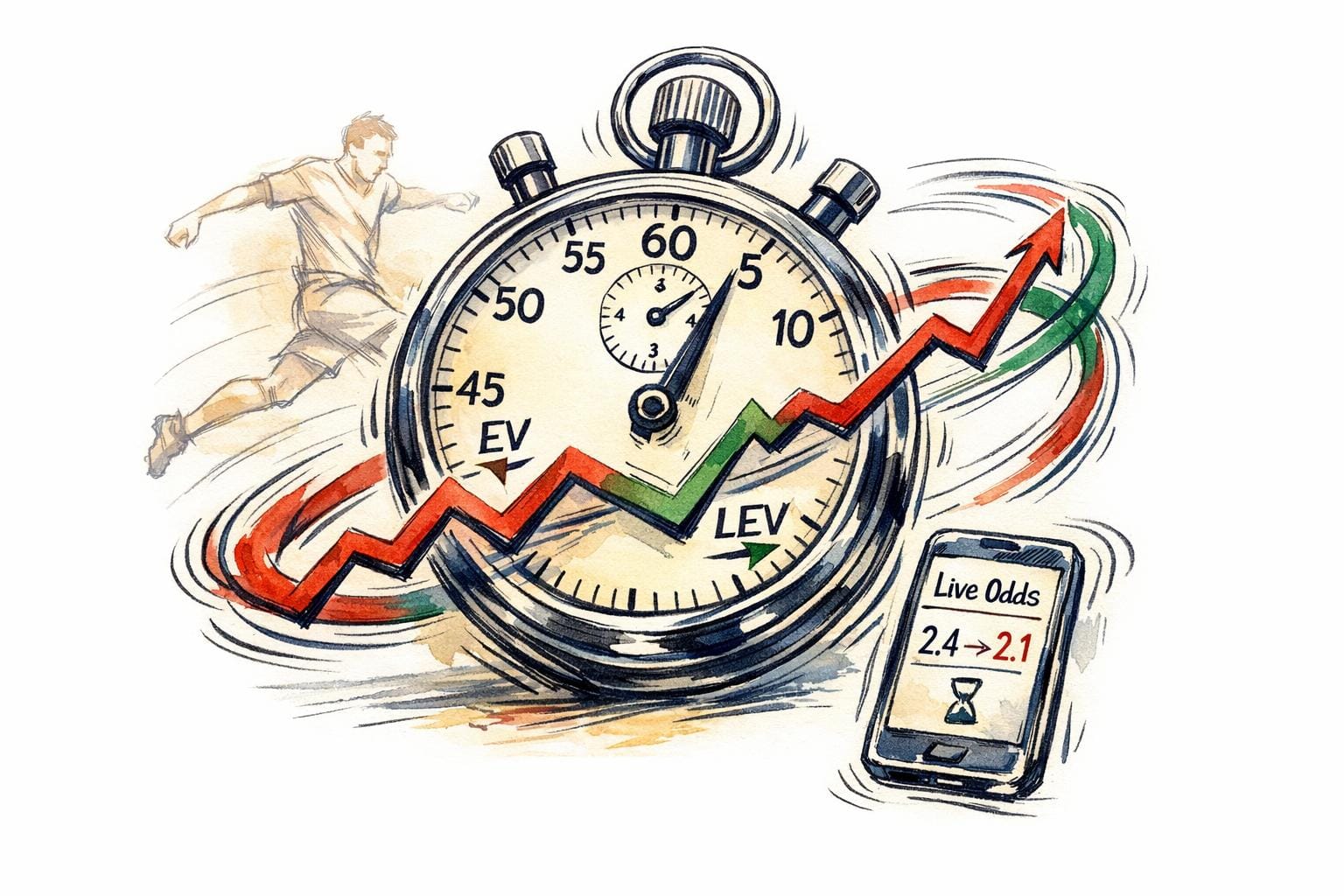
Live Betting Timing vs. Market Movement
In live sports betting, success hinges on two key factors: timing and market movement. Timing involves acting quickly during brief windows, often just 0.5 to 3.5 seconds, before sportsbooks adjust odds after an event. Market movement, on the other hand, refers to how odds shift due to new information or betting trends. Both require sharp decision-making and the ability to interpret data in real time.
Key Takeaways:
- Timing: Exploit short delays in odds updates caused by events like goals, injuries, or red cards.
- Market Movement: Understand why odds shift - sharp money (professional bettors) vs. public money (casual bettors).
- Tools: Platforms like WagerProof help identify value bets and discrepancies in real-time.
- Strategies: Pre-plan responses to in-game events and avoid betting on outdated information.
- Risk Management: Use metrics like expected value (EV) and Live Execution Value (LEV) to evaluate bets.
Combining quick reactions with market analysis gives bettors an edge, but staying disciplined and informed is critical to long-term success.
Live Betting Tips Most People Overlook
1. Live Betting Timing
In live betting, timing is everything. The small window between an event happening and the sportsbook updating its odds is where opportunities - and risks - lie. These windows are incredibly brief: a counterattack might give you just 0.5 to 1.2 seconds, yellow cards allow 1.0 to 1.8 seconds, and minor injuries offer slightly more at 2.5 to 3.5 seconds before odds shift. For events like VAR reviews, you may have a little over 3 seconds to make your decision.
Understanding these fleeting moments is essential to grasp how live betting dynamics influence market outcomes.
Impact on Odds
Even a short delay can make a big difference financially. Picture this: if the odds drop from 2.00 to 1.80, the implied probability jumps from 50% to 55.6%, cutting into your potential return. Professional bettors use metrics like Live Execution Value (LEV) to measure how well they capitalize on these shifts. LEV compares the odds you locked in against the mid-odds a few seconds later. Beating this adjustment consistently means you're capturing extra value, while being late forces you to pay a premium for information already baked into the market.
The problem? Information becomes outdated quickly. Pre-game analysis loses much of its relevance as live data takes over. This is especially true in fast-paced sports like basketball and tennis, where every possession or point can shift probabilities. In slower-scoring sports like soccer or hockey, pre-game insights might hold their value a bit longer, but a single goal or event can still cause a sharp, immediate shift. Knowing how quickly your chosen sport's dynamics change - its "metabolism" - can help you decide when to rely on pre-game research and when to pivot to live data.
Reaction Speed and Value Identification
Timing isn't just about speed - it’s about making informed decisions quickly. Research from July 2023 by Jay Simon at American University analyzed 3,681 MLB games and found that sportsbooks often overreact to events, leading to negatively autocorrelated odds changes. In plain terms, the market sometimes swings too far in one direction before correcting itself, creating opportunities for sharp bettors to exploit.
To stay ahead, plan your moves before the game even starts. Establish "if-then" scenarios for potential in-game events - this helps you react faster and eliminates emotional decision-making. For example, decide in advance how you’ll respond to a red card or a key player substitution. Using platforms with features like one-click betting and high refresh rates can also ensure you’re working with up-to-date odds.
Additionally, professional-grade AI models often include a failsafe mechanism, such as a 1,500ms cutoff, to cancel bets if data becomes outdated during volatile moments like goals or red cards. Betting on stale information is a quick way to lose your edge. Tools like WagerProof can help by highlighting real-time value bets and outliers, allowing you to act both faster and smarter.
2. Market Movement
While timing is all about when you place your bet, market movement focuses on understanding why odds shift and what drives those changes. By grasping the forces behind these shifts, you can separate genuine opportunities from misleading signals. Let’s dive into how these movements affect odds and how you can make fast, informed betting decisions.
Impact on Odds
Sportsbooks don’t just predict outcomes - they aim to balance their books to ensure profit, no matter the result. When odds suddenly drop, it’s usually because something has changed: new information has surfaced, or a large amount of money has been wagered on one side, forcing the bookmaker to adjust. But here’s the thing - markets often overreact. Research analyzing 3,681 MLB games revealed that betting lines tend to swing too far in one direction before correcting themselves, a phenomenon known as negative autocorrelation. This creates opportunities for savvy bettors to exploit these overreactions.
"Betting lines tend to overreact, exhibiting significant negatively autocorrelated changes that could be exploited by sophisticated bettors." - Jay Simon, Kogod School of Business
What’s driving the movement is more important than the movement itself. Early market shifts - typically 24 to 72 hours before kickoff - are often triggered by sharp money, which comes from professional bettors using data-driven models. On the other hand, public money, driven by emotion and last-minute hype, floods in closer to game time, pushing lines away from their true value. Late drops frequently reflect fear of missing out (FOMO) rather than analytical insights. This interplay between sharp and public money mirrors the timing dynamics discussed earlier, reinforcing how crucial it is to understand the underlying drivers.
Reaction Speed and Value Identification
When odds move, your first step is to figure out why. Cross-check performance stats (like expected goals or tempo), AI predictions, and adjustments across multiple bookmakers. If all three align, the movement is likely based on solid data.
One effective method is value sniping - using odds comparison tools to spot bookmakers that haven’t yet adjusted their lines after a sharp move. This works especially well in high-liquidity leagues like the Premier League, where large betting volumes slow down market adjustments. In contrast, low-liquidity leagues often see extreme reactions to small sharp bets, creating larger opportunities. Tools like WagerProof can help by flagging these discrepancies, giving you a head start before the market catches up.
Another strategy is leveraging value echoes. Movement in one market often signals an upcoming shift in a related market. For instance, if "Both Teams to Score" odds drop sharply, it might indicate that "Over 2.5 Goals" odds are about to follow suit. Spotting these correlations allows you to act quickly, reinforcing the importance of combining timing with market movement insights.
Risk Management
Finding value is only half the battle - you also need to manage your risk effectively. Use the expected value (EV) formula to guide your decisions: EV = (Your Probability × Odds) – 1. If the result is greater than zero after an odds drop, there’s still value. If not, it’s best to move on. Generally, a 7% to 10% shift in odds signals a sharp move worth investigating.
It’s also crucial to distinguish between high-impact events (like a red card or goal) and minor fluctuations (such as missed shots or turnovers). In sports like soccer, where a single event can dramatically shift the market, event-based changes dominate. Meanwhile, in faster-paced sports like basketball, time-based changes happen more gradually, requiring you to update your analysis every few minutes.
A study of 1,004 English Premier League matches (August 2009 to May 2014) revealed that markets often underestimate a longshot team’s win probability after they score late goals. This reverse favorite-longshot bias led to gross returns of approximately 50% for bettors who identified the mispricing. Markets are particularly inefficient during high-volatility moments, such as the 20 seconds following major news events.
Finally, avoid quote-chasing during high-volatility phases. If the data you’re relying on is more than 1,500 milliseconds old - especially right after a goal - automated systems recommend skipping the bet to avoid acting on stale lines.
Pros and Cons
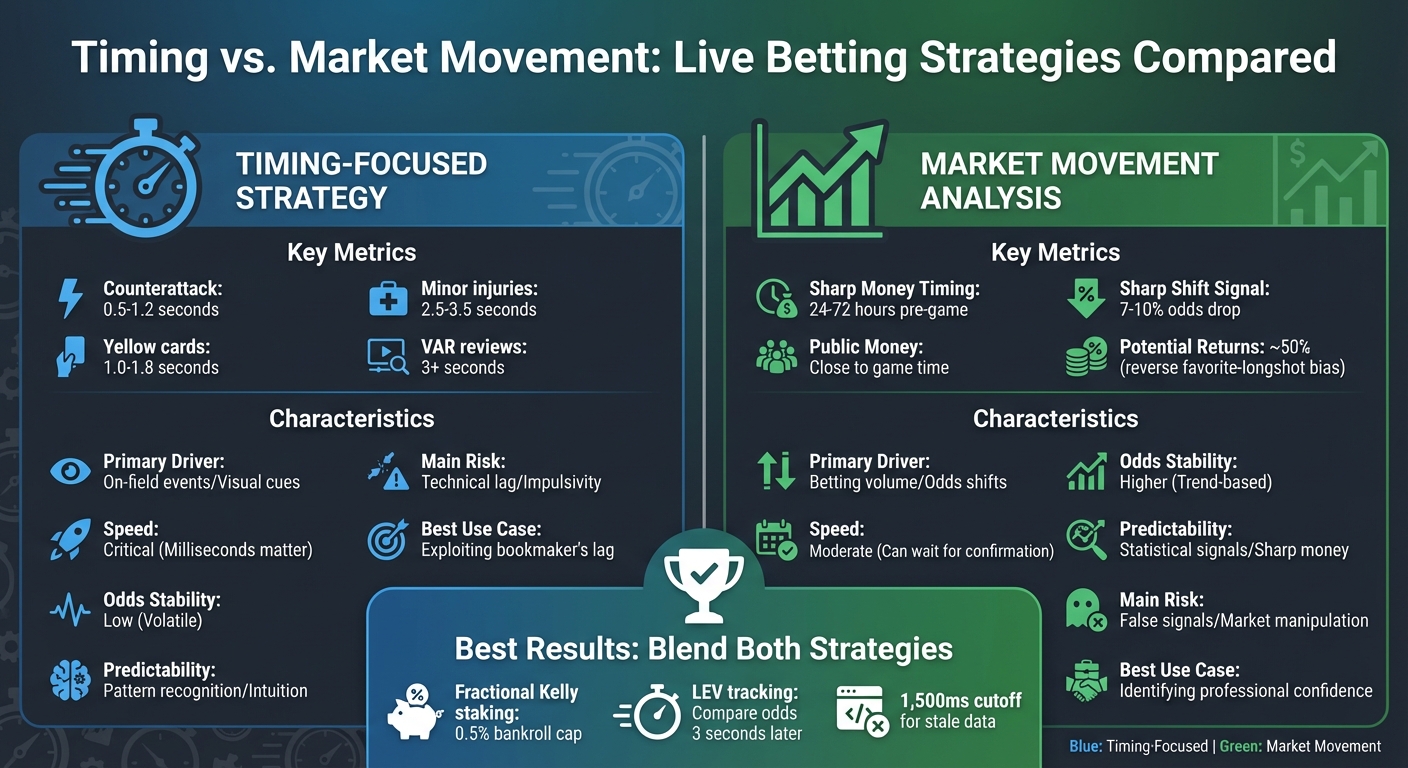
Live Betting Timing Windows vs Market Movement Strategies Comparison
Let's break down the strengths and challenges of timing strategies and market movement analysis in live betting. Each approach has its perks and pitfalls, so your choice depends on what suits your style and goals.
Timing strategies thrive on exploiting the tiny window - often just 0.5 to 3.5 seconds - between an on-field event and the bookmaker's odds adjustment. For instance, spotting a player limping or a red card before the odds catch up can give you a serious edge. But this method isn't for the faint of heart. It requires specialized tools like low-latency platforms and one-click execution to minimize slippage, where odds change mid-bet. The biggest challenge? Avoiding impulsive bets under pressure, which can quickly derail your strategy.
On the flip side, market movement analysis taps into crowd behavior and sharp money signals - bets made by professionals with inside knowledge or strong confidence. This approach can also uncover "value echoes", where shifts in one market (like Both Teams to Score) hint at changes in another (such as Over 2.5 Goals). However, it's not foolproof. You may encounter "false drops", where bettors manipulate volume to mislead others, or late market swings driven by public sentiment rather than analytical insights.
Here’s a quick comparison of the two approaches:
| Feature | Timing-Focused Strategy | Market Movement Analysis |
|---|---|---|
| Primary Driver | On-field events/Visual cues | Betting volume/Odds shifts |
| Speed | Critical (Milliseconds matter) | Moderate (Can wait for confirmation) |
| Odds Stability | Low (Volatile) | Higher (Trend-based) |
| Predictability | Pattern recognition/Intuition | Statistical signals/Sharp money |
| Main Risk | Technical lag/Impulsivity | False signals/Market manipulation |
| Best Use Case | Exploiting the bookmaker's lag | Identifying professional confidence |
For example, research on MLB betting lines shows markets often overreact, creating opportunities for savvy bettors to capitalize on negative autocorrelation. Similarly, exploiting the "reverse favorite-longshot bias" on betting exchanges has been shown to yield potential gross returns of about 50%. Keep an eye out for price drops of 7–10%, as these often indicate a "sharp shift" driven by professional activity.
If you're looking for tools to simplify this process, platforms like WagerProof can help. They highlight discrepancies, surface value bets, and send alerts when prediction market spreads don't align - making it easier to spot games worth fading or backing.
Conclusion
The best live bettors don’t settle for just one strategy - they blend timing and market analysis for a more comprehensive edge. By taking advantage of decision windows (those crucial 0.5 to 3.5 seconds before bookmakers adjust odds) and keeping a close eye on sharp money signals, you create a two-pronged approach that uncovers value from multiple angles. This method combines real-time timing plays with data, AI predictions, and broader market signals to confirm your bets.
Understanding how information decays is another critical piece of the puzzle. Pre-game models lose their accuracy as games progress, especially in sports like basketball, where predictive power can drop sharply by the end of the first quarter. As this happens, your live observations become even more valuable. Filtering out low-impact events (like missed shots or turnovers) and focusing on high-impact signals (such as star player injuries or red cards) allows you to make smarter, more adaptive bets as the game evolves.
Managing the volatility of live betting is just as important. Fractional Kelly staking, with bets capped at 0.5% of your bankroll, helps reduce the risks of extended losing streaks. To measure your edge, track your Live Execution Value (LEV) by comparing the odds you bet at with the mid-odds three seconds later. This ensures your strategy holds up under real-time conditions.
Leveraging platforms designed for live betting can amplify these strategies. Tools like WagerProof highlight outliers and value bets as they happen. Whether you’re capitalizing on a VAR review delay or spotting sharp money movements days before kickoff, having tools that clearly explain why a bet has value can make all the difference.
Speed and validation are the ultimate combination. Exploit bookmaker delays with precise timing, then back up your decision with market movement signals. This integrated approach reduces errors and consistently outperforms the algorithms. Success in live betting comes from mastering both timing and market analysis together.
FAQs
How can I react faster when placing live bets?
To keep up with the fast pace of live betting, it’s crucial to stay alert to key moments in the game - things like goals, injuries, or sudden momentum shifts. These events often lead to quick changes in the odds, and acting within those brief windows before adjustments are made can give you a real advantage.
A good strategy is to practice spotting these opportunities and placing bets during calmer moments, like timeouts or breaks between quarters. Using tools that provide real-time updates and track market movements can also make a big difference. For example, platforms like WagerProof help uncover hidden opportunities by highlighting outliers, mismatches in prediction markets, and other valuable insights, allowing you to make smarter, faster bets.
What causes odds to change during live betting?
Odds in live betting change rapidly as the game unfolds, responding to real-time events like score changes, momentum shifts, player injuries, or other crucial developments. Sportsbooks adjust these odds almost instantly to reflect updated probabilities and manage their risk.
Betting activity also plays a big role in how odds move. If a large number of bets come in on one side, sportsbooks may tweak the odds to attract action on the other side and keep things balanced. To make smarter live bets, it’s important to stay alert and act quickly as these shifts occur.
How can I reduce risk when placing live sports bets?
To reduce risk in live sports betting, timing is everything. Keep a close eye on how the market is shifting and use real-time data like public money trends and line movements to spot potential value bets. This approach can also help you steer clear of sudden, unpredictable market changes.
Tools like WagerProof can be a game-changer. They help you identify outliers, send alerts about mismatched spreads, and highlight key signals to refine your decisions. By analyzing live odds and gauging market confidence, you can aim for bets that strike a better balance between risk and reward.
It’s also crucial to stay flexible during the game. By using real-time models and adjusting your strategies as new information comes in, you can manage risk more effectively and improve your overall betting outcomes.
Related Blog Posts
Ready to bet smarter?
WagerProof uses real data and advanced analytics to help you make informed betting decisions. Get access to professional-grade predictions for NFL, College Football, and more.
Get Started Free