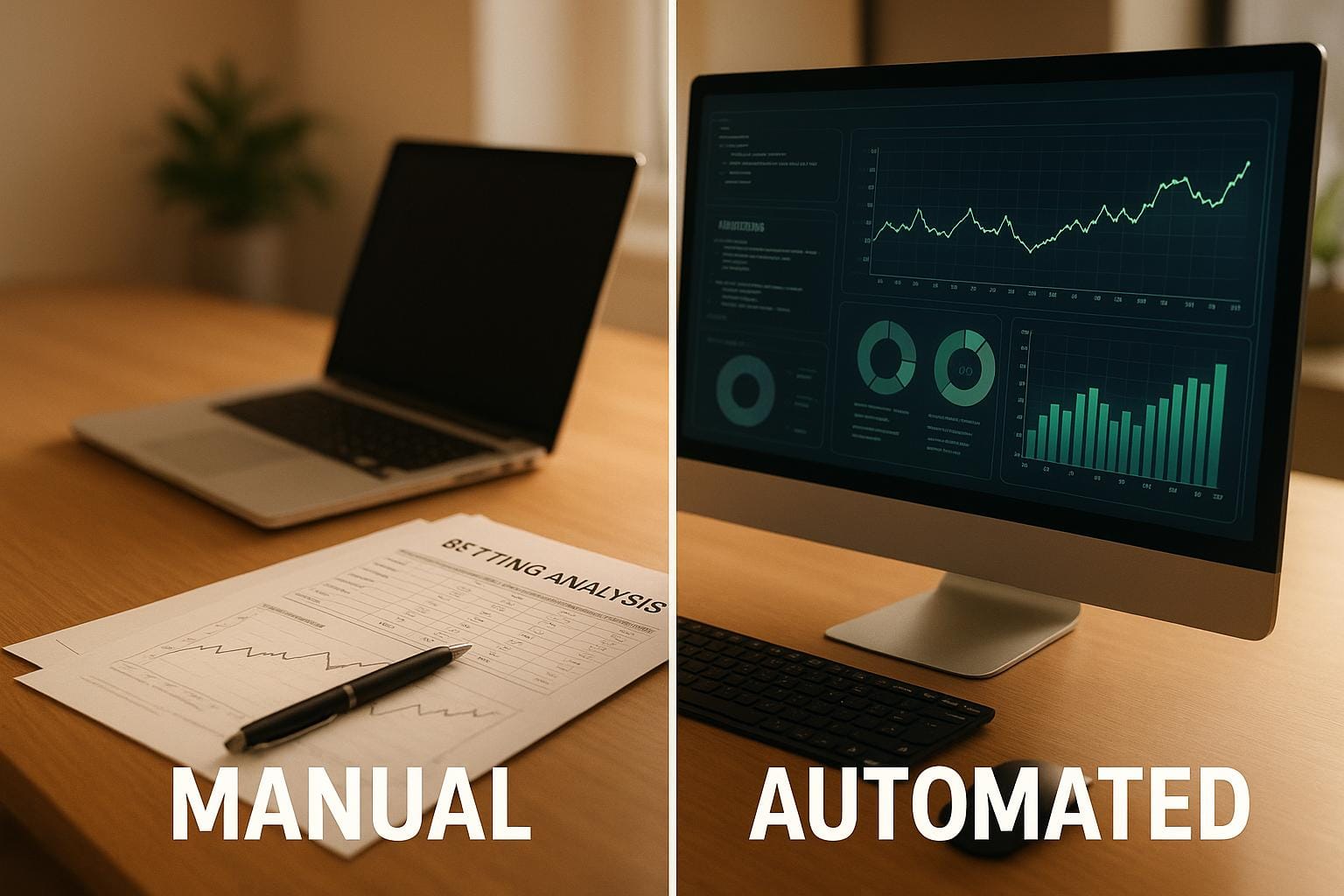
Manual vs Automated Betting Analysis Tools
When it comes to sports betting, you have two primary paths: manual analysis or automated tools. Manual analysis involves doing your own research - comparing odds, tracking stats, and using personal strategies. Automated tools, on the other hand, use AI and algorithms to process large amounts of data quickly, offering predictions and insights.
Here’s a quick breakdown:
- Manual Analysis: Gives you full control and is budget-friendly but requires significant time and effort. Mistakes and scalability can be challenges.
- Automated Tools: Save time, handle large data sets, and reduce errors but can be costly and may lack transparency.
Best Approach? A hybrid strategy often works well - use automation for efficiency and manual research for validation.
The Best +EV Betting Tools of 2025
Quick Comparison
| Factor | Manual Analysis | Automated Tools |
|---|---|---|
| Time Investment | High | Low |
| Cost | Low (free tools like spreadsheets) | High (monthly subscriptions) |
| Accuracy | Depends on skill | Relies on algorithm quality |
| Scalability | Limited | High |
| Customization | Full control | Limited to platform features |
| Best For | Niche, low-volume betting | High-volume, time-sensitive betting |
Read on for a deeper dive into the pros, cons, and when to use each method.
Manual Betting Analysis Tools
What Is Manual Betting Analysis
Manual betting analysis involves conducting your own research and using basic tools to evaluate betting opportunities. This method gives you full control over how you gather and analyze data, often using custom tracking systems to guide your decisions.
A typical process includes visiting multiple sportsbooks and sports websites to compare odds, check team stats, monitor player injuries, and review historical matchups. Many bettors rely on simple formulas in spreadsheets to calculate metrics like expected value, win rates, and return on investment (ROI). While this hands-on approach requires effort, it offers distinct advantages that can directly influence your betting performance.
Benefits of Manual Tools
One of the biggest advantages of manual tools is their flexibility. You can fully customize your system to focus on the metrics that matter most to you, whether that’s over/under totals, point spreads, or moneyline bets. This level of personalization allows you to track patterns and trends that align with your betting strategy.
Another plus? They’re incredibly affordable. Tools like Google Sheets are free, and even premium spreadsheet software usually involves a one-time purchase rather than recurring subscription fees. Manual systems also let you quickly adapt to new data or statistics without waiting for updates from external platforms.
Despite these benefits, manual tools aren’t without their challenges.
Drawbacks of Manual Tools
The biggest downside to manual analysis is the time commitment. Researching a single game can take anywhere from 30 minutes to several hours, depending on the depth of your analysis. This time-intensive process can lead to delays, especially in fast-moving betting markets where odds may shift before you’ve finished your research.
Mistakes are another concern. Manual data entry is prone to human error, and even a small typo - like entering the wrong odds or stats - can lead to incorrect calculations and poor decisions. Additionally, manual tools are limited in their ability to process large amounts of data. While you might track 10-15 key metrics effectively, analyzing hundreds of variables at once is nearly impossible, which means you could miss critical patterns or correlations.
Scalability is another challenge. While managing analysis for 5-10 games per week might be manageable, scaling up to 50 or more games becomes overwhelming. Manual systems simply aren’t built for high-volume betting strategies.
Lastly, real-time analysis is a struggle. By the time you’ve completed your research, odds may have shifted, making it harder to capitalize on profitable opportunities or forcing you to settle for less favorable lines.
These limitations highlight why many bettors eventually explore automated solutions, which will be covered in the next section.
Automated Betting Analysis Tools
What Is Automated Betting Analysis
Automated betting analysis leverages AI-powered software to gather, process, and evaluate live data from sportsbooks and sports databases. These tools pull in a wealth of information, including odds, player statistics, weather conditions, and historical performance data, all in real time.
Using advanced algorithms, these platforms can analyze thousands of data points at once. They track injury updates, calculate expected values, and even provide real-time alerts based on user-defined preferences such as favorite sports, specific bet types, or minimum edge percentages. Dashboards display opportunities where factors like implied probability differ from actual odds, highlighting potential value bets.
Some systems go a step further by employing machine learning to detect market trends and predict outcomes based on historical patterns. Whether it's comparing odds across multiple sportsbooks or calculating intricate metrics like implied probabilities, these tools handle the heavy lifting, offering bettors a data-driven edge.
Benefits of Automated Tools
Automated betting tools come with several standout advantages that can enhance both efficiency and accuracy.
For one, these platforms work at lightning speed. In live betting, where odds can change in moments, automated systems process data almost instantly, ensuring you never miss a fleeting opportunity.
Their ability to scale is another game-changer. Automated tools can analyze a massive number of games across various sports simultaneously, something that would be nearly impossible to do manually. This is especially useful during high-activity periods like March Madness or NFL Sundays when the volume of games and bets is overwhelming.
The sheer data-crunching power of these platforms is invaluable. They consider variables that might be too complex or time-consuming for manual analysis - everything from team travel schedules and referee tendencies to weather conditions and historical matchups. All of this is synthesized into actionable betting recommendations.
Another major plus is error reduction. Automated systems minimize human mistakes, like miscalculating odds or overlooking key updates such as player injuries. Plus, they stick to pre-set criteria, reducing the risk of emotional decision-making.
Finally, real-time monitoring gives you a competitive edge. These tools can alert you immediately when favorable odds emerge or when market movements suggest value opportunities, allowing you to act quickly and capitalize on inefficiencies.
Drawbacks of Automated Tools
While automated systems offer many advantages, they’re not without their challenges.
For starters, subscription costs can be steep. Many high-end platforms require monthly fees, which may not be justifiable for casual bettors who aren’t betting at high volumes or generating consistent profits.
There’s also the risk of technical hiccups. Server outages, interrupted data feeds, or software bugs can disrupt access to these tools, especially during critical betting windows.
Another concern is the lack of transparency with some platforms. Many operate as "black boxes", meaning users don’t always get insight into how their recommendations are generated. This can make it hard to trust or fully understand the reasoning behind certain suggestions.
The learning curve is another hurdle. While these tools aim to simplify betting, they often require time to set up, configure, and learn how to interpret the metrics and alerts they provide.
Over-reliance can also be a problem. Depending entirely on automated recommendations without developing your own analytical skills leaves you vulnerable if the system’s performance dips or if you encounter scenarios outside the tool’s capabilities.
Lastly, market saturation is a real issue. When many users act on the same automated recommendations, the profitability of those opportunities can quickly diminish as odds adjust to the influx of action.
Manual vs Automated: Direct Comparison
Understanding the differences between manual and automated betting analysis can help you align your approach with your betting style and goals. Now that we've broken down each method individually, let’s compare them side by side to see how they measure up across key factors that matter most to bettors.
Feature Comparison Table
| Factor | Manual Analysis | Automated Tools |
|---|---|---|
| Time Investment | High – requires significant research time for each bet | Low – analysis is completed quickly |
| Upfront Cost | Minimal to moderate – basic data subscriptions may suffice | Higher – monthly fees for platforms with advanced features |
| Learning Curve | Steep – expertise takes time to develop | Moderate – users typically adapt more quickly |
| Customization | Full control over methods and strategies | Limited to the platform’s built-in functionality |
| Accuracy | Depends on individual skill and experience | Consistently objective but reliant on algorithm quality |
| Speed | Slower – may miss time-sensitive opportunities | Fast – delivers real-time alerts and processes data rapidly |
| Scalability | Limited – analyzing multiple events manually is challenging | High – can handle a large volume of events efficiently |
| Market Coverage | Often focused on familiar sports or leagues | Broad – covers a wide range of sports and markets |
| Emotional Control | Prone to personal bias and gut decisions | Data-driven and objective |
| Best For | Niche betting with unique insights | High-volume betting and efficiency-focused scenarios |
This table highlights some important distinctions. Manual analysis demands more time and effort but allows for deep dives into specific events or markets. Automated tools, on the other hand, excel in speed and scalability, making them ideal for bettors who need to process large amounts of data quickly.
When to Use Each Method
Each method shines under different circumstances, depending on your goals and resources.
Manual analysis is perfect for niche markets where a detailed understanding of specific factors, like team dynamics or coaching styles, can provide a competitive edge. For example, college basketball conference tournaments often benefit from this hands-on approach. It’s also a good fit for casual bettors who enjoy the process of research and place wagers less frequently.
Automated tools, however, are a game-changer for high-volume or time-sensitive scenarios. If you’re placing multiple bets daily or engaging in live betting, these tools can quickly identify value opportunities that manual analysis might miss. Their ability to process data in real time is especially useful when speed is critical.
Many bettors find success by combining both methods. For instance, you can use automated systems to analyze a broad range of events and then apply manual research to focus on specific opportunities. Budget is another factor to consider - manual approaches are more budget-friendly, while automation requires a larger financial commitment but can save significant time.
Ultimately, the choice comes down to how much time you’re willing to dedicate to research versus how much you value rapid, data-driven insights. Both methods have their strengths, and the best approach might be a blend of the two.
WagerProof's Automated Analysis Platform

WagerProof takes automated betting analysis to the next level by addressing one of the industry's biggest challenges: transparency. While automated tools offer undeniable advantages, WagerProof stands out by pairing powerful automation with a clear and open methodology, making advanced analysis accessible to all types of bettors.
WagerProof Core Features
WagerProof's platform is built around four key tools, each designed to provide bettors with detailed insights:
- Edge Finder: This tool highlights betting opportunities supported by quantifiable data and explains the math behind every recommendation, helping users make informed decisions.
- AI Game Simulator: Using up-to-date team stats, player performance data, and historical matchups, this simulator runs scenarios to predict a range of possible outcomes, giving a deeper understanding of potential results.
- WagerBot Chat: Acting as a personal betting assistant, this feature offers clear, data-driven answers to questions about games, players, or strategies.
- Real-Time Statistics and Trends: Stay informed with constantly updated data that reflects the latest developments.
How WagerProof Solves Automation Problems
One common criticism of automated tools is their "black box" nature - leaving users unsure of how predictions are made. WagerProof tackles this issue head-on by using a multi-model consensus approach. This method not only strengthens prediction accuracy but also ensures transparency by revealing the underlying data and models. Importantly, WagerProof offers its analysis as recommendations, not directives, giving users the final say in their decisions.
WagerProof Pricing Options
WagerProof offers flexible pricing plans to suit different needs:
- Free Plan: Perfect for newcomers, this plan includes a demo of the Edge Finder and access to basic statistics and trends, allowing users to explore the platform without spending a dime.
- Premium Plan: Unlock the full range of features, including the complete Edge Finder, AI Game Simulator, WagerBot Chat, historical analytics, and tools for optimizing teaser bets. Premium users also gain access to a private Discord community for strategy discussions.
- Enterprise Plan: Designed for professional bettors, syndicates, or organizations, this plan includes advanced analytics, custom integrations, and dedicated support to meet high-level needs.
How to Choose the Right Method
When deciding on the best approach, your experience, time, budget, betting volume, learning style, and risk tolerance all come into play. Here's how these factors can guide your choice:
Experience level makes a difference. If you're just starting out with sports betting, automated tools can be a great way to ease into the process. They handle the heavy lifting - complex calculations and data analysis - while you get familiar with the basics. On the other hand, seasoned bettors often prefer a hybrid method, combining automated tools for initial data filtering with their own manual analysis to fine-tune decisions on high-value bets.
Time is a major consideration. Manual analysis takes a lot of effort, especially if you're betting on multiple games daily. If you’re short on time, automated tools are practically a necessity. But if you only place a few well-researched bets each week, manual analysis might fit your schedule just fine.
Budget constraints matter, too. Manual analysis doesn’t require much in terms of upfront costs, while automated platforms often involve recurring subscriptions. Many of these tools offer free trials, so you can test them out before committing. Ultimately, weigh the cost of these tools against the potential improvement in your betting outcomes.
Betting volume and stakes play a role. High-volume bettors placing dozens of wagers weekly will likely need automated tools to maintain consistency and efficiency. On the flip side, if you’re a casual bettor making fewer, smaller wagers, manual analysis might be all you need. A hybrid approach can also work well here, especially for those who want the benefits of automation without losing the personal touch.
Learning style is another factor. Some people enjoy diving deep into manual analysis, finding it rewarding to uncover patterns and insights on their own. Others prefer the clarity and simplicity of automated tools, which often make complex betting concepts easier to grasp.
Risk tolerance should guide your choice. Manual analysis gives you full control but leaves you vulnerable to personal biases and errors. Automated tools minimize human error but require trust in algorithms you may not fully understand. Many experienced bettors find balance by using a hybrid method, combining the strengths of both approaches.
For most bettors, a hybrid strategy strikes the ideal balance. For instance, you might use tools like WagerProof's Edge Finder to quickly spot promising bets, then dive into manual research to validate your choices. This method saves time while still allowing for a personal touch in decision-making.
Start small and scale up. Begin with free tools or basic manual techniques to get a feel for what works best for you. As you gain experience and see positive results, you can invest in more advanced tools or strategies. This gradual approach helps you minimize risk while honing your betting skills.
Whichever method you choose - manual, automated, or a mix of both - consistency is key. Stick to a system that aligns with your goals and resources, and you'll be better positioned for data-driven betting success.
Conclusion
Deciding between manual and automated betting analysis tools depends on your specific goals and circumstances. Manual analysis offers complete control and allows for tailored strategies but demands significant time and carries the risk of human error. On the other hand, automated tools provide speed and consistent data insights, typically costing anywhere from $10–$30 up to $299 per month.
It's important to note that neither method guarantees success. AI tools often achieve prediction accuracy rates between 50% and 60%, and even the most advanced systems can encounter losing streaks. For example, one automated system with a 53.75% strike rate still ended up with a net loss.
For many serious bettors, a hybrid approach works best. Combining automated tools for initial screening with manual validation can help you leverage the efficiency of technology while retaining the human touch for critical decisions. This approach allows you to evaluate more opportunities without sacrificing control.
Your strategy should align with your betting habits and experience. High-frequency bettors often benefit from automation, while casual bettors may find manual analysis both practical and cost-efficient. Start with what you’re comfortable with and refine your approach over time.
Also, think about data ownership and security. Automated tools store your data externally, while manual methods keep it entirely in your hands.
Begin with the resources you have and scale up as you achieve success. Experiment with free tools or basic manual techniques to build a foundation, then gradually invest in more advanced options when you see positive results. The key is consistency - choose a system that fits your goals, time, and budget, and stick with it for long-term success.
FAQs
What’s the best way to combine manual and automated betting analysis?
To achieve optimal outcomes, blend automated tools with manual analysis. Automation excels at handling large datasets, identifying patterns, and uncovering opportunities in record time. However, it’s your expertise and judgment that bring context to the numbers - addressing unexpected shifts, team dynamics, or other elements that algorithms might miss.
This combination lets you harness the efficiency of technology while ensuring your decisions align with the complexities of real-world situations.
What should I consider when deciding between manual and automated betting analysis tools?
When deciding between manual and automated betting analysis tools, it’s important to weigh factors like your goals, time availability, and comfort level with technology. If speed and the ability to handle large data sets are priorities - especially for high-volume or professional betting - automated tools might be your best bet. They’re designed to process information quickly and efficiently, making them ideal for those who need to analyze vast amounts of data.
On the flip side, manual tools give you more control and flexibility. They’re a solid option for casual bettors or anyone who enjoys a more hands-on, personalized approach to developing strategies.
Consider other aspects too, such as your bankroll size, technical skills, and whether you value customization or scalability. While automated tools can save time and minimize errors, manual methods let you fine-tune your strategies to align with your preferences. The right choice ultimately comes down to your specific needs and how you prefer to manage your betting decisions.
Are automated betting tools worth the cost compared to their impact on results?
Automated betting tools come with an initial investment and recurring costs, but they offer some clear advantages. They stand out for their speed, precision, and ability to eliminate emotional decision-making, making it easier to stick to consistent, data-driven strategies.
That said, while these tools may enhance short-term results, long-term success hinges on the strength of your strategy and its ability to adjust to shifting market dynamics. Before diving in, it's crucial to evaluate whether the cost aligns with your betting goals and available resources.
Related Blog Posts
Ready to bet smarter?
WagerProof uses real data and advanced analytics to help you make informed betting decisions. Get access to professional-grade predictions for NFL, College Football, and more.
Get Started Free