
Neural Networks vs. Traditional Models in Betting
Neural networks and statistical models each have their strengths in sports betting. Statistical models are simple, transparent, and ideal for stable environments like football leagues. They rely on historical data and use methods like Poisson distributions or Elo ratings, achieving 52–58% accuracy. Neural networks, on the other hand, analyze massive datasets (e.g., player biometrics, live tracking) and handle complex patterns, boosting accuracy to 65–75% in some cases. They also adjust predictions in real-time, outperforming statistical models in unpredictable scenarios like live betting. However, they require more data, computational power, and come with a "black box" issue, meaning their logic isn't always clear.
Quick Comparison
| Feature | Statistical Models | Neural Networks |
|---|---|---|
| Accuracy | 52–58% | 65–75% |
| Data Needs | Thousands of points | Millions of points |
| Transparency | High (clear logic) | Low ("black box") |
| Best Use Case | Stable, predictable leagues | Complex, chaotic scenarios |
| Cost | Low | High (computing power) |
For beginners, statistical models offer simplicity and ease of use. For experienced bettors, neural networks provide better performance in complex situations but require advanced tools and data.
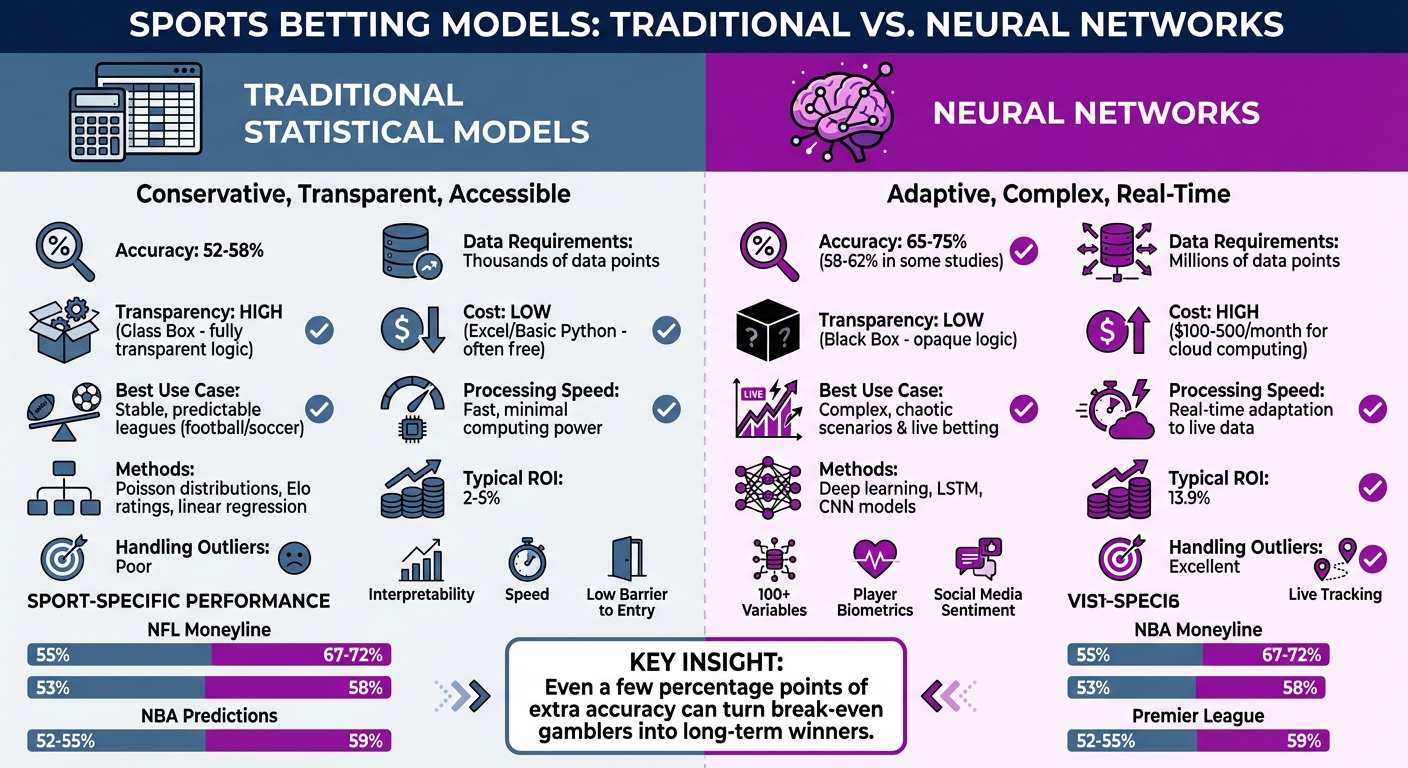
Neural Networks vs Traditional Statistical Models in Sports Betting: Accuracy, Cost, and Performance Comparison
I Trained AI to Predict Sports
Traditional Statistical Models Explained
Traditional statistical models use historical game data to create probabilistic forecasts through mathematical frameworks like linear regression, Poisson distributions, and Elo ratings. These methods have been a cornerstone of sports betting, offering a structured way to predict outcomes.
How Traditional Models Work
At their core, these models analyze past performance to forecast future results. They rely on game statistics, team records, rankings, and factors like home-field advantage to calculate probabilities for specific outcomes. For instance, a Poisson model calculates scoreline probabilities using the average goals scored and conceded by a team.
Unlike newer approaches, traditional models handle smaller, structured datasets - usually involving thousands of data points rather than millions. Even a basic Poisson model can be built using simple tools like Excel or Python. Professional bookmakers, such as Pinnacle Sports, often use refined versions of these models to set odds, reportedly achieving long-term profit margins of 2–5% over casual bettors.
One defining feature of traditional models is their transparency. Every prediction is traceable back to specific metrics, such as expected goals (xG) or recent team performance. For example, a 60% win probability can be directly linked to these underlying statistics. This clarity appeals to bettors who value understanding the reasoning behind predictions. However, as we’ll explore, this transparency also highlights some limitations.
Strengths and Weaknesses of Traditional Models
The simplicity and transparency of traditional models are among their greatest strengths. Often referred to as "glass box" systems, these models allow users to see and understand every step of the calculation. They perform well in stable, predictable environments like major football leagues, where historical data is consistent and plentiful. For example, a study of over 1,000 Premier League matches (2010–2020) showed that Poisson-based models achieved 52–55% accuracy in moneyline predictions.
However, their straightforward nature also limits their effectiveness. Accuracy rates for traditional models in major sports leagues generally plateau at 52–58%, which often isn’t enough to consistently beat bookmaker margins. They also struggle to account for unpredictable factors like injuries, weather changes, or red cards. Human analysts using these models can typically process only 10–15 key variables at a time, leaving out the complex interactions among hundreds of potential factors. When outcomes hinge on interconnected and chaotic variables, these models reach their limits. Emerging neural network approaches aim to address these challenges.
| Feature | Traditional Statistical Models |
|---|---|
| Core Logic | Linear Regression, Poisson, Elo |
| Accuracy Range | 52–58% |
| Data Requirements | Thousands of points |
| Interpretability | High (Fully transparent) |
| Best Use Case | Stable leagues, pre-match baselines |
Neural Networks in Sports Betting
Neural networks are reshaping the way sports betting predictions are made, stepping in where traditional statistical methods fall short. These AI-driven systems mimic the way human brains process information, using layers of interconnected nodes to learn from massive datasets.
How Neural Networks Work
At their core, neural networks operate by passing raw data through an input layer, identifying patterns in hidden layers using a process called backpropagation, and then delivering predictions through an output layer. They are trained on vast amounts of historical game data, fine-tuning their internal "weights" to reduce errors in their predictions.
What makes these systems stand out is their ability to process over 100 variables for a single match while adapting to real-time data. They pull insights from sources like live tracking stats, player biometrics, and even social media sentiment, uncovering patterns that might escape human analysts. For instance, a neural network might identify that a combination of specific weather conditions and midfield control levels significantly impacts scoring trends.
This ability to analyze and adapt to intricate data gives neural networks an edge in understanding the complexities that traditional models often miss.
What Makes Neural Networks Different
One of the standout features of neural networks is their ability to handle non-linear relationships. Sports are full of unpredictable, chaotic events, and these systems excel at identifying patterns in such complexity - patterns that traditional models often overlook.
"Neural networks thrive on the nonlinearity of sports - capturing black swan events traditional stats miss, like a goalkeeper's off-day form".
Unlike traditional methods that rely on static, pre-match data, neural networks continuously adapt to live game updates. They’ve been trained on countless chaotic scenarios, enabling them to make sense of unexpected changes as they happen. This adaptability aligns perfectly with the demands of modern sports betting, where precision and real-time analysis are crucial.
Data Usage: Traditional Models vs. Neural Networks
The way traditional models and neural networks handle data is vastly different. Traditional models perform well with thousands of structured data points, like box scores and historical averages. Neural networks, however, demand millions of data points to train their intricate, multi-layered systems effectively. This isn't just about scale - it's a fundamental shift in how predictions are built.
Data Requirements
Traditional statistical models rely on clean, well-organized datasets. They use linear assumptions, such as Poisson distributions or Elo ratings, to analyze structured data like team win percentages, average points scored, and historical matchups. This structured approach makes their predictions easier to interpret and understand.
Neural networks operate on a completely different level. They can analyze over 100 variables per match at once, pulling from unconventional sources that traditional models often ignore. These include player biometrics, social media sentiment, live tracking data, and even fatigue metrics. For instance, while a traditional model might focus on a team’s average possession percentage, a neural network could uncover how specific temperature ranges impact performance against certain defensive styles - patterns that linear models can't detect. This ability to process diverse and complex inputs contributes to the higher accuracy neural networks often achieve compared to traditional models.
"Traditional models excel in stable environments like football leagues, where data is abundant and patterns linear... [but] they falter with non-linear chaos." - Dr. Joseph Buchdahl, Author
This expansive data processing capability also gives neural networks the edge when it comes to updating predictions in real time.
Real-Time Data Processing
The differences become even more evident in live betting scenarios. Traditional models are built for speed, processing data quickly with minimal computing power. This makes them ideal for straightforward, in-game situations. However, they struggle to adapt when unexpected events occur - like a red card, a VAR decision, or a star player’s sudden injury.
Neural networks shine in these unpredictable moments. They continuously update predictions as new data streams in, factoring in sudden changes like injuries or shifts in momentum. For example, in NBA betting, LSTM neural networks achieved 58% accuracy compared to 53% for traditional logistic regression models. By adapting to real-time complexity, neural networks outperform traditional models, which require stable conditions to deliver their best results.
Accuracy Comparison: Neural Networks vs. Traditional Models
When it comes to predicting sports outcomes, the data paints a compelling picture. Neural networks consistently outperform traditional models in most major sports, though the extent of their superiority can vary based on the sport and betting context. These differences highlight which approach might align better with your betting strategy.
Accuracy Metrics
The performance gap between neural networks and traditional models becomes striking when you dive into the numbers. For NFL predictions, machine learning models have shown an accuracy range of 67% to 72%, compared to just 55% for traditional statistical models. This difference can be a game-changer for bettors.
"Even a few percentage points of extra accuracy can turn break-even gamblers into long-term winners." - WSC Sports
However, raw accuracy isn’t the only factor that matters. Well-calibrated predictions are crucial for consistent profitability. In March 2023, researchers from the University of Bath compared NBA betting models over several seasons, focusing on accuracy-driven versus calibration-driven approaches. The calibration-focused model delivered a +34.69% ROI, while the accuracy-focused model suffered a –35.17% loss. In optimal conditions, the calibration approach reached a +36.93% ROI, far surpassing the +5.56% ROI achieved by the accuracy-driven model.
Another key metric is Closing Line Value (CLV), which measures how well a model beats the final market price before a game begins. Top AI models consistently outperformed the closing line by 3% to 7%. For instance, during the 2023 NFL season, DraftKings' AI-driven neural networks beat Las Vegas closing lines by 4.5% on point spreads.
| Metric | Traditional Models | Neural Networks |
|---|---|---|
| NFL Moneyline Accuracy | 55% | 67–72% |
| NBA Prediction Accuracy | 53% | 58% |
| Premier League Accuracy | 52–55% | 59% |
| Typical ROI | 2–5% | 13.9% |
| Handling Outliers | Poor | Excellent |
These advantages in accuracy and ROI vary depending on the sport, as explored below.
Performance Across Different Sports
In soccer, traditional Poisson-based models achieve 52% to 55% accuracy for Premier League matches. By comparison, convolutional neural networks (CNNs) push that number to around 59%. When focusing on Over/Under goals betting, neural networks have delivered a +7.8% ROI versus the +3.2% ROI achieved by traditional models.
Basketball follows a similar trend. LSTM neural networks reached 58% accuracy in NBA predictions, outperforming logistic regression models, which achieved 53%. The key advantage lies in neural networks’ ability to process complex, interconnected variables and detect non-linear patterns that traditional linear models often miss.
That said, traditional models still have their strengths. They excel in stable environments with abundant data and linear patterns. Dr. Joseph Buchdahl, author of Squares & Sharps, Suckers & Sharks, explains:
"Traditional models excel in stable environments like football leagues, where data is abundant and patterns linear. They've powered consistent profits for pros since the 1990s."
Additionally, their simpler design allows for quick updates, making them particularly useful in live betting scenarios within predictable leagues.
Pros and Cons of Each Approach
Choosing between neural networks and traditional models involves weighing their strengths and weaknesses. These differences play a big role in determining betting accuracy and strategy.
Neural Network Advantages
Neural networks shine when it comes to spotting intricate, non-linear patterns that traditional models often miss. For example, they can detect subtle trends like a basketball team's shooting percentage improving when a particular player reaches a set number of assists in the first half. They can process enormous amounts of data at once - everything from player biometrics to social media sentiment and live tracking data. Plus, they help eliminate common cognitive biases, such as confirmation bias, recency bias, and the gambler's fallacy.
"Neural networks thrive on the nonlinearity of sports - capturing black swan events traditional stats miss, like a goalkeeper's off-day form."
- Ian Goodfellow, AI Pioneer
Another major advantage is their ability to adapt in real time. They can quickly adjust to unexpected events, like last-minute injuries, something static, pre-game-focused traditional models struggle with.
Traditional Model Advantages
Traditional models offer clarity and speed. Their logic is straightforward and easy to interpret, which makes it clear why a particular prediction was made. This transparency helps bettors refine their strategies with confidence. Traditional models also perform well in stable environments with plenty of data and linear patterns, making them a reliable choice for professional bettors since the 1990s.
Cost is another plus for traditional models. Basic setups, like those using Excel or simple Python scripts, are often free. In contrast, training neural networks on platforms like AWS can cost anywhere from $100 to $500 per month. Traditional models also work effectively with smaller datasets - thousands of data points instead of the millions required for neural networks - making them more accessible for bettors without extensive resources. Additionally, their quick update capability is a strong advantage in live betting scenarios within predictable leagues.
Limitations of Both Approaches
Despite their strengths, both approaches come with challenges. Neural networks suffer from the "black box" issue, where they might generate a winning prediction without explaining the reasoning behind it. This lack of transparency can complicate regulatory compliance and erode bettor trust. They also demand significant computational power and vast amounts of data to perform well.
Traditional models, on the other hand, struggle with unpredictable or chaotic events like sudden injuries, weather changes, or red cards. These scenarios often lead to underfitting, where the model fails to capture the complexity of the situation.
Both approaches share a common pitfall: poor-quality or incomplete input data leads to unreliable outputs, often described as "garbage in, garbage out". To address these limitations, the industry is moving toward hybrid models that combine the strengths of traditional statistical methods with neural networks.
| Feature | Traditional Models | Neural Networks |
|---|---|---|
| Transparency | High (Interpretable logic) | Low ("Black Box" nature) |
| Data Requirement | Thousands of data points | Millions of data points |
| Compute Cost | Low (Excel/Basic Python) | High (Cloud GPUs/AWS) |
| Best For | Stable environments, quick updates | Complex patterns, outlier detection |
| Risk | Underfitting (misses complexity) | Overfitting (memorizes noise) |
Performance in Actual Betting Scenarios
Sports Betting Case Studies
Real-world examples highlight how neural networks outperform traditional models in various betting situations. For instance, during the 2023 NFL season, DraftKings' AI, powered by neural networks, surpassed traditional Vegas closing lines by 4.5% on point spreads. This advantage came from the AI's ability to process complex data like player tracking and weather conditions - factors that conventional models often overlook.
In European football, the results are even more striking. A study covering La Liga matches from 2015 to 2023 revealed that a CNN-based model achieved a +15% ROI over 500 bets, compared to a +4% ROI from a traditional Poisson-based model. However, league predictability plays a significant role. Research published in the Journal of Sport Industry & Blockchain Technology showed that AI models reached 66.7% accuracy in the German Bundesliga but struggled in the English Premier League, with accuracy dropping to 16.7% due to the league's unpredictable nature. These differences emphasize how varying conditions can impact live betting strategies.
Tournament betting scenarios offer another angle. During Euro 2020, MIT researchers developed a CNN-based model that correctly predicted 67% of knockout stage upsets, far outperforming traditional Elo ratings, which managed just 51%. The neural network excelled at identifying unexpected outcomes - such as those influenced by player fatigue or sudden tactical changes - making it particularly effective in high-stakes, volatile situations.
Hybrid approaches also provide valuable insights. For example, in December 2024, StatPair tested predictions on 100 Premier League matches. The AI outperformed the human analyst in total wins, securing 58 games compared to the analyst's 39. However, the human expert achieved a higher ROI of +12.4%, compared to the AI's +8.7%, by tweaking the algorithm during low-stakes, end-of-season games. This case demonstrates how combining AI's statistical precision with human judgment can sometimes yield better results in specific contexts.
How WagerProof Uses Neural Networks

WagerProof takes the capabilities of neural networks and applies them in exciting ways to refine betting accuracy and provide users with smarter tools.
AI Research Agents
The AI research agents at WagerProof are powered by neural networks that continuously analyze betting data. These agents work autonomously, diving into matchups, historical statistics, and trends to generate betting picks without needing human input. You can fine-tune your agent with more than 50 adjustable parameters, tailoring it to your risk appetite, preferred sports, and betting style.
Thanks to their neural network foundation, these agents can detect patterns that traditional models, like Poisson or Elo, often miss. This means they can spot rare but impactful events that might influence game outcomes - something conventional approaches struggle to do. By leveraging deep learning, WagerProof's agents go beyond surface-level trends, uncovering subtle yet significant insights that can tip the scales in your favor.
What's more, the performance of every agent is publicly tracked, with results that are fully verifiable. This commitment to transparency ensures you can trust the system, unlike opaque "black-box" models that hide their inner workings.
To complement these agents, WagerProof offers WagerBot Chat for real-time data-driven betting advice.
WagerBot Chat and Real-Time Analysis
WagerBot Chat connects neural networks directly to live, professional-grade data sources, avoiding the inaccuracies that often plague generic AI chatbots. You can ask straightforward questions - like, "Should I bet the over in tonight's Lakers game?" - and get detailed, multi-step analyses. These responses integrate factors like weather conditions, injury updates, odds shifts, and predictive models.
The neural network processes this information in real time, ensuring its recommendations are always based on the latest data. Unlike traditional systems that rely on manual updates, WagerBot adapts throughout the day, keeping up with rapidly changing conditions.
Transparency and Value Betting
WagerProof's neural networks are designed to uncover outliers and value bets that might otherwise slip through the cracks. When market spreads deviate from statistical norms, the system flags these opportunities, helping you identify hidden value. During major tournaments, this approach has been shown to boost ROI by 12% compared to older, more rigid methods.
What sets WagerProof apart is its commitment to transparency. Instead of simply giving you a pick, the platform breaks down the data points and factors that influenced its analysis. This allows you to see exactly where the edge lies, showcasing the predictive strength of neural networks while also helping you sharpen your own betting strategies. Over time, this emphasis on clarity enables you to develop a deeper understanding of value betting, making you less reliant on the system and more confident in your skills.
Conclusion: Choosing the Right Model
When deciding which model to use, it all comes down to your betting experience and what you're aiming to achieve. Traditional models are straightforward and offer 52–55% accuracy in moneyline predictions. They're great for beginners because they're easy to interpret and can be tested with simple tools like Excel. Resources like Football-Data.co.uk provide free historical data, making it accessible to start experimenting. On the other hand, neural networks push accuracy to 58–62% by identifying complex, non-linear patterns. However, they require more advanced skills and tools like TensorFlow or PyTorch, along with the ability to handle large datasets.
For experienced bettors, a hybrid strategy can be a game-changer. By incorporating traditional Elo scores into a neural network, you can improve prediction accuracy by 5–10%. This approach combines the clarity of traditional methods with the advanced capabilities of neural networks, offering the best of both worlds.
Platforms like WagerProof make neural networks more accessible by handling the technical heavy lifting for you. Their AI research agents process massive amounts of data, while WagerBot Chat simplifies the insights into easy-to-understand language. With features like outlier detection, value bet identification, and multi-factor analysis, you get powerful tools with clear explanations of how predictions are made.
Whether you stick with traditional methods or embrace neural networks, choose an approach that matches your expertise and refine it by finding a betting edge through real-world application.
FAQs
Do I need millions of data points to use neural networks for betting?
Neural networks don't always need massive datasets to perform effectively. In fact, data quality and proper calibration often outweigh the importance of sheer quantity. Research indicates that well-optimized models, even with moderate amounts of data, can achieve impressive ROI. Fine-tuning elements like learning rate and model depth frequently leads to better outcomes than simply collecting millions of data points.
Why can a more accurate model still lose money?
Accuracy in sports betting doesn’t automatically translate to profits. Losses can still pile up due to issues like unfavorable odds, misplaced confidence, or incorrect probability estimates. Even with impressive accuracy, ignoring value bets or being overly confident can hurt your return on investment (ROI). To achieve profitability, it’s essential to focus on proper calibration - betting only when you have a clear advantage. This becomes especially critical when you consider that breaking even at standard -110 odds requires an accuracy rate of just over 52.4%.
When should I use a hybrid model instead of just one approach?
A hybrid model can be incredibly useful when your goal is to boost prediction accuracy, cut down on errors, and build more reliable strategies in sports betting. By blending techniques like neural networks, statistical models, and time series analysis, you get the best of each method. This combination helps offset individual weaknesses, improves calibration, and uncovers better value bets.
This approach works particularly well with dynamic sports data. It can adapt to both pre-game conditions and live trends, giving you a more well-rounded and effective betting strategy.
Related Blog Posts
Ready to bet smarter?
WagerProof uses real data and advanced analytics to help you make informed betting decisions. Get access to professional-grade predictions for NFL, College Football, and more.
Get Started Free