How Player Injuries Shift Live Betting Odds
When a player gets injured during a game, sportsbooks adjust betting odds almost instantly. Injuries can shift point spreads, moneylines, and totals based on the player's value and their backup's potential. For example, an NBA star's absence can move the spread by 4–8 points, while role players may shift it by 0.5–2 points. Bettors often face two challenges: overreacting to star player injuries and underestimating the impact of role players. The best opportunities arise within 1–2 hours after injury news, as initial market reactions are often exaggerated. Tools like WagerProof or real-time injury updates can help bettors act quickly and spot value before odds stabilize. Timing, discipline, and understanding player impact are key to betting smarter on injury-driven odds.
How Player Injuries Impact NBA and NFL Betting Odds by Position and Role
How Player Injuries Change Different Types of Live Betting Odds
Changes to Point Spreads and Alternate Spreads
Point spreads can shift dramatically depending on the sport and the importance of the injured player. In basketball, where rosters are smaller, the impact is often more pronounced. The key factor driving these changes is the performance gap between the injured starter and their replacement.
Steve Rieder, an NFL handicapper, highlights this concept:
To determine how the line should adjust due to an injury at any position in any sport, you need to take a look at the impact between the starter and the replacement.
In football, for instance, injuries to non-quarterback positions usually affect the spread by less than a point, even when elite players are involved. The exception? When multiple injuries hit the same position group - like an entire offensive line or secondary - magnifying the overall impact beyond what the market initially accounts for.
Sportsbooks often overreact when news of an injury breaks, leading to exaggerated line movements. As more details become available, these lines tend to stabilize. This creates opportunities for sharp bettors who can quickly determine if the adjustment has been overdone. Vernon Croy, a handicapper at Doc's Sports, explains:
More times than not, the books will overadjust the line leaving an opportunity for us to come back on the other side.
These initial shifts in point spreads often set the tone for adjustments in other markets, like moneylines and totals, as oddsmakers recalibrate based on the injury's real impact.
Changes to Moneylines and Win Probabilities
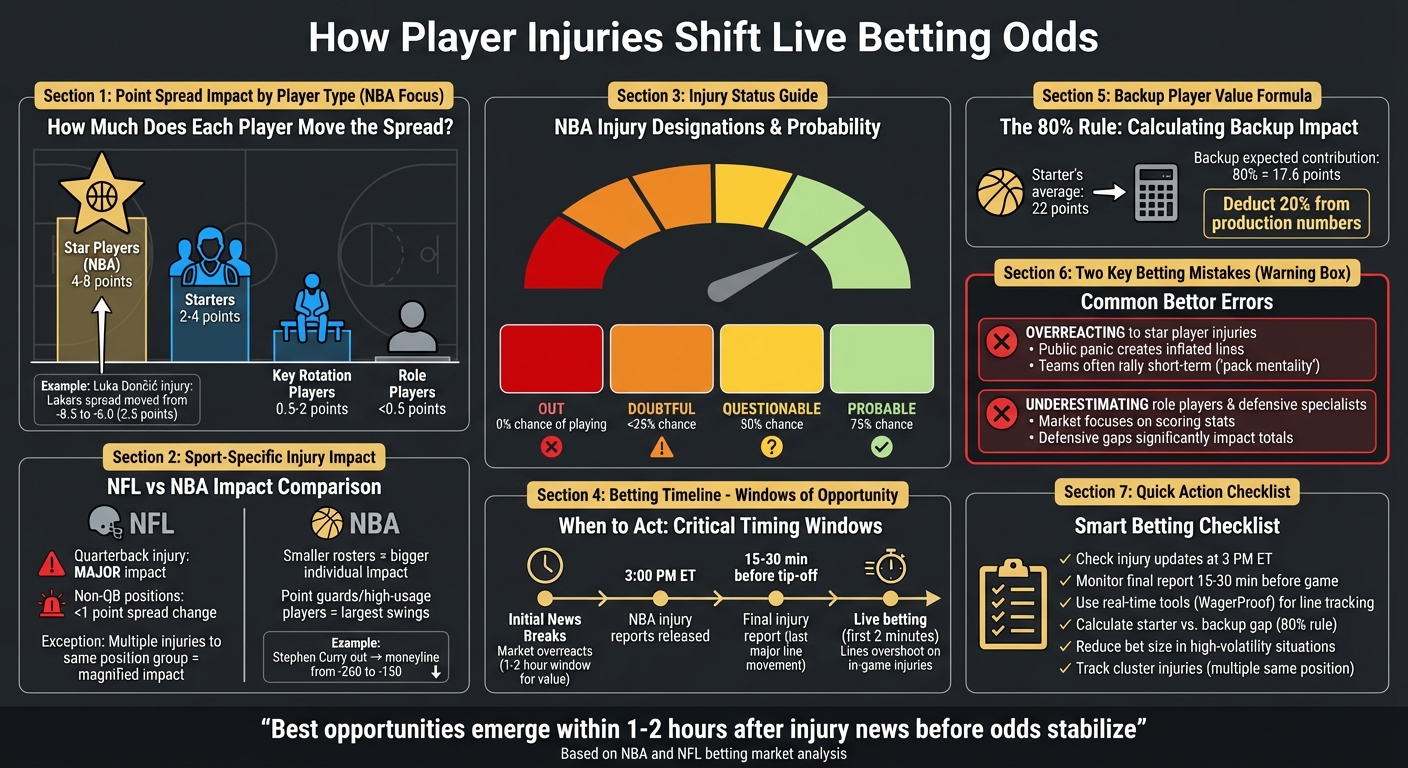
Moneyline shifts are all about how player injuries alter a team's chances of winning. High-usage players - like NBA point guards or NFL quarterbacks - tend to cause the biggest swings. These players not only contribute directly to scoring but also control the game's tempo and execution. A clear example is when Luka Dončić was injured in May 2025, causing the spread to shift from Lakers -8.5 to Lakers -6.0, reflecting a 2.5-point adjustment.
Public perception can also amplify moneyline movements. For instance, if Stephen Curry is ruled out, casual bettors flock to bet against the Warriors, pushing the moneyline from -260 to -150. This shift doesn’t always align with the actual statistical impact. Oddsmakers account for how a team has performed in similar situations - such as games without the injured player - to refine their adjustments.
The nature of the injury plays a critical role, too. Minor injuries with "questionable" tags might cause slight fluctuations, while season-ending injuries lead to major, lasting changes across all markets. The NBA categorizes player statuses as Out (0%), Doubtful (<25%), Questionable (50%), and Probable (75%), which helps guide these market reactions.
Changes to Totals and Game Pace
Player injuries don’t just influence spreads and moneylines - they also reshape totals and game tempo. The type of player injured determines whether totals rise or fall. For example, if a team's primary scorer or playmaker is sidelined, NBA totals often drop by 2–4 points, reflecting reduced offensive efficiency and tempo. On the other hand, losing a key defensive player can increase totals, as it makes it easier for opponents to score. Simply put, missing defensive players tend to favor the over, while missing scorers lean toward the under.
Game pace is another critical factor. Backup players often operate at a different tempo than the starters they replace, which can throw off pre-game projections. Tony George, a handicapper at Doc's Sports, describes his approach:
When a key skill player is out, I plug in 80% of his numbers... I deduct 20% off production numbers. That means his backup... will not have the same impact on the overall picture as the starter does.
Interestingly, teams sometimes experience a short-term boost in performance immediately after a star player is injured. This "pack mentality" sees remaining players step up their defensive effort, which can create value on the under if the market hasn’t fully accounted for this temporary intensity.
Why Markets Misprice Injury Impacts
Overreaction to Star Players
When a star player gets injured, the betting public often hits the panic button. Sportsbooks are quick to respond by inflating the opponent's lines, frequently overshooting the actual impact of the injury.
Robert Ferringo, a handicapper from DocSports, explains the phenomenon:
The general public almost always overreacts to injury information, especially when it involves a high-profile or star player.
Sportsbooks count on this predictable overreaction, adjusting lines before casual bettors can pile on, which often eliminates any real value for those bets. What many bettors miss is that teams can sometimes rally in the short term when a star player is sidelined. Doug Upstone, another handicapper from DocSports, points out:
Most teams will take it upon themselves to collectively up their level of play, compensate for the missing star, and play better than anticipated. The big key is not to overreact to a player's injury in a single contest.
This collective effort can lead to unexpected overperformance, especially in the immediate aftermath of the injury announcement. Interestingly, the best opportunities for value often emerge within the first 1–2 hours after the news breaks, before the betting market has a chance to stabilize.
Undervaluing Role Players and Defensive Specialists
While star players dominate headlines, injuries to role players often fly under the radar. These players might not be household names, but their absence can disrupt team chemistry and rotation depth in ways that are hard to quantify.
Defensive specialists, in particular, are frequently undervalued. For example, when a rim protector or elite perimeter defender is sidelined, the market tends to adjust far less than it would for a high-scoring guard. However, the defensive gap can significantly impact the game, often resulting in higher opponent scoring and inflated totals. The public's focus on flashy stats like points and assists means they often overlook how critical a defensive anchor can be.
Role players also bring unique skills - whether it’s three-point shooting, rebounding, or guarding specific threats - that are not easily replaced. When they’re out, starters have to shoulder a heavier load, which can lead to fatigue and a drop in performance as the game progresses. This "resource strain" frequently goes unnoticed by the market because algorithms struggle to measure factors like matchup flexibility and system fit.
Timing and Information Gaps
Injury timing plays a major role in how markets misprice odds. Adjustments typically happen in two phases: an immediate, often volatile reaction, followed by a more calculated shift as more details come to light.
Live betting lines are especially prone to overreactions in the first few minutes after an in-game injury update. As Hoop Heads Pod explains:
Live line shifts often overshoot in the first two minutes after an update. If the injury is minor, you can find fade opportunities, betting against the market's knee-jerk reaction.
The final injury report, released 15–30 minutes before tip-off, often sparks the last significant odds movement before the game. Players listed as "Questionable" (indicating a 50% chance of playing) create additional volatility, keeping odds in flux right up to game time.
Another challenge for markets is handling "cluster injuries", where multiple players from the same position group are affected. Steve Rieder, an NFL specialist with Betting Predators, notes:
When there are multiple areas of concern [bulk injuries], the task becomes much more daunting. When bulk injuries occur, the market place usually does not account for it.
These cluster injuries often create ripple effects that are more impactful than a single high-profile injury. However, markets tend to focus on individual stars, overlooking the broader consequences. For savvy bettors, tools like WagerProof can be invaluable for identifying these mispriced odds in real time.
Data-Driven Strategies for Betting on Injury-Driven Odds
Measuring Player Value and Team Impact
Understanding a player's impact on their team is crucial for betting on injury-driven odds. One way to gauge this is by observing market movements. For example, if a line shifts from –15 to –7, it suggests an 8-point adjustment due to the absence of key players. In the NBA, star players typically influence the spread by 4–8 points, starters by 2–4 points, and key rotation players by 0.5–2 points.
The real edge comes from analyzing the performance gap between a starter and their backup. Tony George, a seasoned handicapper, shares his approach:
When a key skill player is out, I plug in 80% of his numbers contributed to the overall picture and team power rating for the game matchup. In other words, I deduct 20% off production numbers.
- Tony George, Doc's Sports
For instance, if a starter averages 22 points, their replacement is expected to contribute around 17 points. In the NFL, George uses a similar model for linemen, where losing a center or left tackle typically results in a 1-point deduction from the team's power rating. Beyond stats, it's also important to evaluate the backup’s plus/minus ratings and how they fit within the coach's system alongside the remaining starters. This kind of analysis sets the stage for leveraging real-time tools to exploit market inefficiencies.
Using Real-Time Tools to Track Injuries and Line Movements
Timing is everything when betting on injuries. The best opportunities often arise within the first 1–2 hours after an injury is announced, before the market fully adjusts. To make the most of this window, you need tools that provide instant updates and track line movements across multiple sportsbooks.
Platforms like WagerProof offer real-time sports data, highlighting outliers and value bets. These tools send alerts when spreads deviate from historical trends, allowing you to act quickly before the odds stabilize. Additionally, setting up notifications from team beat reporters on X (formerly Twitter) can give you a heads-up on player injuries - like spotting a limp during warmups - before the official reports are released.
The NBA now requires pre-game and interval injury updates every 15 minutes. The final injury report, typically released 15–30 minutes before tip-off, often sparks the last major line movement. Monitoring odds screens can help you track how much the market adjusts for specific injuries. For example, in March 2025, the OKC Thunder’s line dropped from –15 to –2 after their entire starting lineup was ruled out. Analysis revealed that Shai Gilgeous-Alexander accounted for a 5-point adjustment, Jalen Williams for 3 points, Chet Holmgren for 2 points, Lou Dort for 1 point, and Isaiah Hartenstein for 1.5 points. These insights can serve as the foundation for a structured betting strategy.
Creating a Rule-Based Approach to Injury Scenarios
High-profile injuries often lead to emotional betting decisions. A rule-based approach can help you avoid impulsive reactions and identify when the market has overreacted or undervalued an injury. For example, you might establish benchmarks for player impact - 4–8 points for stars, 2–4 points for starters, and 0.5–2 points for rotation players - and make additional adjustments for cluster injuries.
Develop a timing checklist for injury reports: check updates when they first come out (often around 3 PM ET for NBA games), 15–30 minutes before tip-off, and during live betting within the first two minutes of an in-game injury. During this initial window, live lines often overcompensate, creating opportunities to fade the overreaction if the injury is minor. Also, consider the "pack mentality" effect, where teams tend to rally in the short term after losing a star player.
Finally, log spread adjustments over time to uncover betting trends and patterns.
Risk Management in Injury-Driven Live Betting
Adjusting Bet Sizes in High-Volatility Situations
When injury news breaks and the betting market becomes unpredictable, it’s wise to adjust your wager sizes. As expert handicapper Raphael Esparza puts it, sometimes the smartest move is no bet at all.
If you decide to bet, consider scaling down your usual stake. For instance, if your standard wager is $100 per game, lowering it to $30 or $50 during periods of uncertainty - like when a star player’s status is unclear - can help minimize potential losses. Hedging your bets is another way to safeguard against dramatic market swings.
The position of the injured player also plays a huge role in your strategy. In the NFL, a quarterback injury often calls for a significant shift in approach, as it can drastically affect the game. On the other hand, injuries to non-quarterback positions typically move the betting line by less than one point.
These strategies are all about staying disciplined and keeping emotions out of your betting decisions.
Avoiding Emotional Reactions to High-Profile Injuries
Handling injury news with a cool head is essential for effective risk management. Instead of reacting to the hype, focus on the actual impact of the injury. The real question isn’t "How good is the injured player?" but "How much of a downgrade is the backup?" For example, when Joe Montana was sidelined and Steve Young stepped in, the betting line barely shifted because the performance gap was minimal.
Doug Upstone, a professional handicapper, offers this advice:
The big key is not to overreact to a player's injury in a single contest.
Teams often rally in the short term when a star player is out, as other players step up to fill the void. This phenomenon can make the immediate aftermath of an injury less predictable than it seems.
Tracking and Evaluating Injury-Based Betting Strategies
To sharpen your betting approach, keep a detailed record of your injury-related wagers. Track factors like the injured player, changes in the betting line, and the outcomes of your bets. Over time, this data can reveal patterns in how the market reacts - and overreacts - to injuries.
Take inspiration from Steve Rieder, whose disciplined tracking of these variables has led to consistent profits.
Tools like WagerProof can be invaluable for this process. They provide real-time insights into line movements and help you spot when spreads deviate from historical norms. By logging your bets and analyzing backup performance, replacement value, and market trends, you can refine your strategy and steer clear of costly errors.
How Do Injuries Affect Your Live Betting Strategy?
Conclusion: Using Injury Data and Tools to Bet Smarter
Shifts in betting odds due to injuries can open up real opportunities - if approached with a mix of discipline and solid data. Instead of simply reacting to news about star players, dive deeper. Pay attention to how backups perform, analyze usage rates, and study how the market has historically responded in similar situations.
Timing is everything. Real-time tools can help you spot value before sportsbooks adjust. For example, in the NBA, the window of opportunity after injury news breaks is typically just 1–2 hours. During this time, the absence of a star player can swing point spreads by 4–8 points. Tools like WagerProof are designed to identify outliers, track line movements, and alert you to mismatched prediction spreads - giving you a critical edge during this short window.
To take your strategy to the next level, focus on tracking detailed line movements and using real-time alerts. These tools can help you identify instances where the market overreacts, particularly when the public places too much weight on a star player’s absence while ignoring the team’s overall depth. As professional handicapper Robert Ferringo from DocSports explains:
The general public almost always overreacts to injury information, especially when it involves a high-profile or star player.
FAQs
How can bettors take advantage of market overreactions to player injuries?
When a star player gets injured, sportsbooks often experience a surge in public bets, leading to sudden and sometimes exaggerated shifts in the odds. For savvy bettors, this creates a window of opportunity - if they can move fast before the market evens out.
Stay on top of live injury updates and evaluate how much the injured player truly impacts the team. Look beyond the headlines - compare the odds movement against the player's actual contribution and the backup's past performance. If the adjustment feels overblown, placing your bet early can secure better odds before sportsbooks recalibrate.
Tools like WagerProof - which offers live injury updates and detailed stats - can be a game-changer in spotting these chances. Timing is everything here; acting within minutes of breaking news can give you a significant advantage.
Why are role players and defensive specialists often overlooked in live betting odds?
Role players and defensive specialists often fly under the radar when it comes to betting odds. Sportsbooks tend to focus on star players and those with flashy stats, leading to line adjustments that heavily reflect their presence - or absence. On the other hand, the impact of losing a defensive cornerstone or a dependable bench player is trickier to measure and usually gets overlooked.
For savvy bettors, this presents a chance to find value. Teams with solid depth or standout defensive contributors may actually have a better shot at winning than the odds suggest. Tools like WagerProof can be a game-changer here, offering real-time injury updates, detailed player performance data, and insights into team depth. With this information, you can identify when the market undervalues the absence of a role player and make smarter, more informed bets.
How can I effectively track betting line changes caused by player injuries?
Tracking how betting lines shift after player injuries involves combining up-to-the-minute updates with sharp analysis. Start by using platforms that deliver instant injury news and watch how sportsbooks adjust their odds right after the announcement. These early shifts often present chances to act before the market settles.
To gauge whether the odds adjustment makes sense, compare the injured player’s stats to their replacement’s performance. It’s also helpful to look at the team’s past games without the injured player to uncover patterns. Tools that track public betting trends can reveal when the market might be overreacting to the injury news. And, of course, always double-check injury updates from trustworthy sources before making any bets.
Related Blog Posts
Ready to bet smarter?
WagerProof uses real data and advanced analytics to help you make informed betting decisions. Get access to professional-grade predictions for NFL, College Football, and more.
Get Started Free