How Prediction Markets Reflect Coaching Adjustments
When a team changes its coach mid-season, betting markets react quickly. Prediction markets and sportsbooks adjust their odds differently, creating opportunities for bettors who understand these shifts. Here's what you need to know:
- Prediction markets adjust faster, often within hours, reflecting collective sentiment. They focus on tactical changes and short-term performance boosts but can be volatile and fragmented.
- Sportsbooks prioritize risk management, adjusting lines within minutes. They factor in tactical styles but may overreact to public sentiment, creating misaligned spreads.
Key insights:
- Teams often perform better than expected immediately after a coaching change, but this effect fades after a few games.
- Tools like WagerProof help spot mismatches between prediction markets and sportsbooks, highlighting betting opportunities.
1. Prediction Markets
Prediction markets react swiftly when coaching changes make headlines. Prices adjust, and implied probabilities shift within minutes or hours of the announcement. The first game following a coaching change often sees a spike in market volatility as projections are thrown into question.
These markets consider specific tactical factors. For example, if a newly appointed coach is known for favoring a conservative defensive strategy, totals (over/under) lines tend to drop. Take November 2022 in the Bundesliga: home win odds fell by an average of 0.08 points during the first weekend after coaching changes. Teams replacing their coach during a slump also saw a 15% average increase in points per match over the next five games.
That said, the initial boost doesn’t last for most teams. Only about 40% manage to sustain the early momentum beyond the first few games. In fact, a study analyzing 240 midseason coaching changes across Europe found that early performance exceeded market expectations in just 35% of cases. This short-lived effect creates a window for sharp bettors to capitalize on the gap between media narratives and actual on-field adjustments. The same trend can be observed in other leagues, including the NBA.
In the NBA, research indicates that teams with replacement coaches are often undervalued during periods of high uncertainty. While closing lines tend to incorporate all relevant market data, opening lines after a coaching change often reflect biases. This leaves room for savvy bettors to identify opportunities. Tools like WagerProof help pinpoint such outliers, alerting bettors when prediction market spreads deviate from expected patterns.
2. Sportsbooks
When coaching news breaks, sportsbooks react swiftly - often within minutes - by adjusting odds and updating fixtures as soon as a coaching change is confirmed. This quick response helps oddsmakers protect themselves from sharp bettors who try to capitalize on fresh information before it becomes widely known. Essentially, sportsbooks aim to incorporate tactical changes into the odds as soon as possible.
These adjustments aren’t random. Bookmakers factor in a coach's tactical approach when setting new lines. For instance, if a coach known for conservative strategies takes over, over/under lines may drop. On the other hand, if a "motivator" replaces a rigid manager, spreads often tighten, reflecting the market's expectation of a psychological boost for the team.
Mid-season coaching changes bring an element of unpredictability, leading to understated betting lines for the incoming coach. This creates a brief window of opportunity for value bets before the market fully adjusts. Studies indicate that during these uncertain periods, betting lines tend to undervalue the replacement coach's team. However, odds movements aren’t always purely about probability. Sometimes, sportsbooks shift lines to limit their risk when too much public money flows toward the "new coach" narrative. Tools like WagerProof can help identify these misaligned spreads, highlighting genuine opportunities for bettors.
Pros and Cons
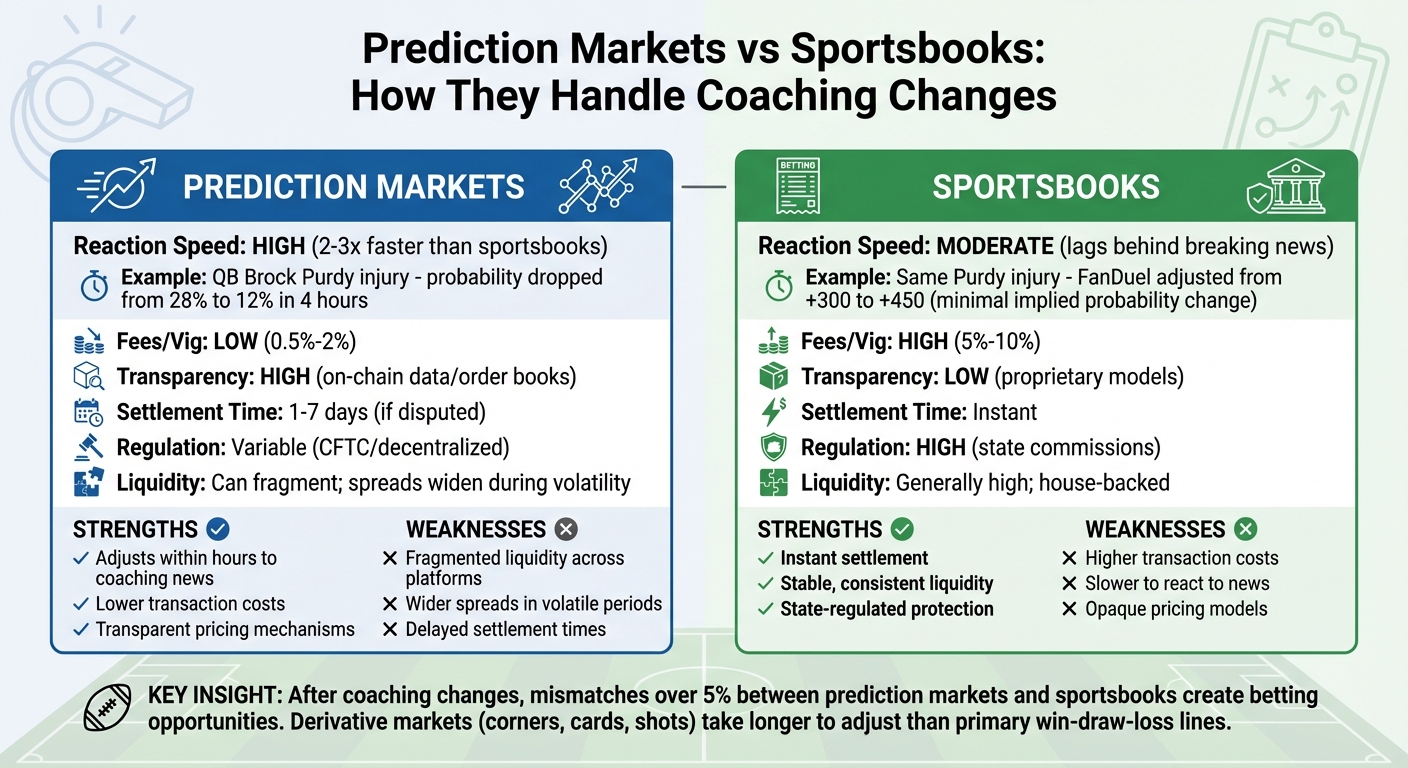
Prediction Markets vs Sportsbooks: Key Differences for Coaching Changes
This section dives into the strengths and weaknesses of prediction markets and sportsbooks, particularly when it comes to tracking coaching adjustments. Each has its own distinct approach and benefits.
Prediction Markets
Prediction markets are known for their speed and transparency. They respond 2–3 times faster than sportsbooks to breaking news, such as injuries or tactical changes. For instance, when a January 2024 injury report dropped QB Brock Purdy's Super Bowl MVP probability from 28% to 12% within four hours, prediction markets quickly reflected this change. In contrast, FanDuel only adjusted his odds from +300 to +450, barely altering the implied probability.
Another advantage is their lower fees, typically ranging from 0.5% to 2%, compared to the 5%–10% vig charged by sportsbooks. However, prediction markets are not without flaws. Liquidity can become fragmented across platforms, spreads can widen during volatile periods, and settlement times may extend from 1 to 7 days if disputes arise.
As NFL Executive Vice President Jeff Miller pointed out, "Those guardrails do not exist in prediction markets".
Sportsbooks
Sportsbooks, on the other hand, offer stability and instant settlement. Operating under strict state regulations, they maintain consistent liquidity and provide fixed odds backed by the house. When coaching changes occur, sportsbooks adjust their lines within minutes.
However, this stability comes at a cost. Sportsbooks often use opaque models, and their high vig can eat into potential returns. Additionally, their risk management approach means that lines may not always align perfectly with actual probability shifts.
| Feature | Prediction Markets | Sportsbooks |
|---|---|---|
| Reaction Speed | High (2–3x faster) | Moderate (lags behind news) |
| Fees/Vig | Low (0.5%–2%) | High (5%–10%) |
| Transparency | High (on-chain data/order books) | Low (proprietary models) |
| Settlement Time | 1–7 days (if disputed) | Instant |
| Regulation | Variable (CFTC/decentralized) | High (state commissions) |
| Liquidity | Can fragment; spreads widen | Generally high; house-backed |
Bridging the Gap
Platforms like WagerProof are stepping in to bridge the differences between these two systems. By identifying mismatches between prediction market spreads and sportsbook lines, these platforms create opportunities for strategic decisions. This approach combines the rapid adjustments of prediction markets with the stability and regulation of sportsbooks, offering a more balanced way to navigate the betting landscape.
Conclusion
Coaching changes can shake up betting lines almost immediately. Prediction markets tend to react 2–3 times faster to news, while sportsbooks offer a more stable, state-regulated platform for bettors to work with. Both systems come with their own challenges - prediction markets may face issues like fragmented liquidity and wider spreads during volatile periods, while sportsbooks often have higher vig and may lag slightly in updating odds.
When a coaching change happens, it’s wise to observe the initial adjustment period. Let the early fluctuations stabilize before committing to long-term bets.
Keep an eye out for mismatches of over 5% between prediction markets and sportsbook odds, which are often noticeable after a coaching change. Pay special attention to derivative markets - such as corners, cards, and shot statistics - as they usually take longer to adjust to a new coach’s tactical style compared to primary win-draw-loss lines.
Tools like WagerProof can help by flagging these mismatches automatically, combining the fast reactions of prediction markets with the steadiness of sportsbooks. Instead of blindly chasing picks, leveraging real-time data allows you to understand why the odds are shifting and identify where the true opportunities lie. These insights tie together previous findings, offering a practical framework for making smarter betting decisions.
FAQs
How do prediction markets and sportsbooks respond to coaching changes?
When it comes to coaching changes, prediction markets and sportsbooks handle the news in distinct ways, especially in terms of timing and strategy. Sportsbooks are quick to react - sometimes altering their odds within minutes. These adjustments are driven by fresh information, public sentiment, and strategies to manage risk. Essentially, they reflect how both bettors and oddsmakers respond in the immediate aftermath of coaching announcements.
Prediction markets, however, take a slower, more analytical route. They lean on collective expectations and sophisticated models to evaluate the broader, long-term effects of a coaching change. While sportsbooks prioritize speed, prediction markets aim to capture a deeper, evolving perspective on how such changes shape team performance and influence betting trends. Together, these two approaches paint a more complete picture of how coaching decisions ripple through the sports world.
What opportunities do bettors have right after a coaching change?
When a team undergoes a coaching change, it often shakes things up in ways that betting markets struggle to keep pace with. This short-term turbulence can lead to mispriced odds and opportunities for bettors who know where to look. For a brief period, the market may not fully account for how the new coach might influence team performance.
To get ahead, focus on key details like the incoming coach’s past achievements, how the team has been trending recently, and how the market is reacting to the change. Pay close attention to odds or spreads that seem out of sync with the potential impact of the new leadership. These moments of adjustment can offer a chance to spot value bets before the market stabilizes.
How does WagerProof help spot differences between prediction markets and sportsbook odds?
WagerProof offers bettors a way to spot differences between prediction markets and sportsbook odds using real-time, clear data. By comparing prediction market spreads against historical stats, public betting trends, and statistical models, it identifies mismatches that could signal value bets or inefficiencies in the market.
By highlighting outliers and showing when market prices stray from expected probabilities, WagerProof empowers users to make smarter, data-backed betting choices. This approach can reveal situations where prediction markets might either overrate or underrate the chances of a particular outcome.
Related Blog Posts
Ready to bet smarter?
WagerProof uses real data and advanced analytics to help you make informed betting decisions. Get access to professional-grade predictions for NFL, College Football, and more.
Get Started Free