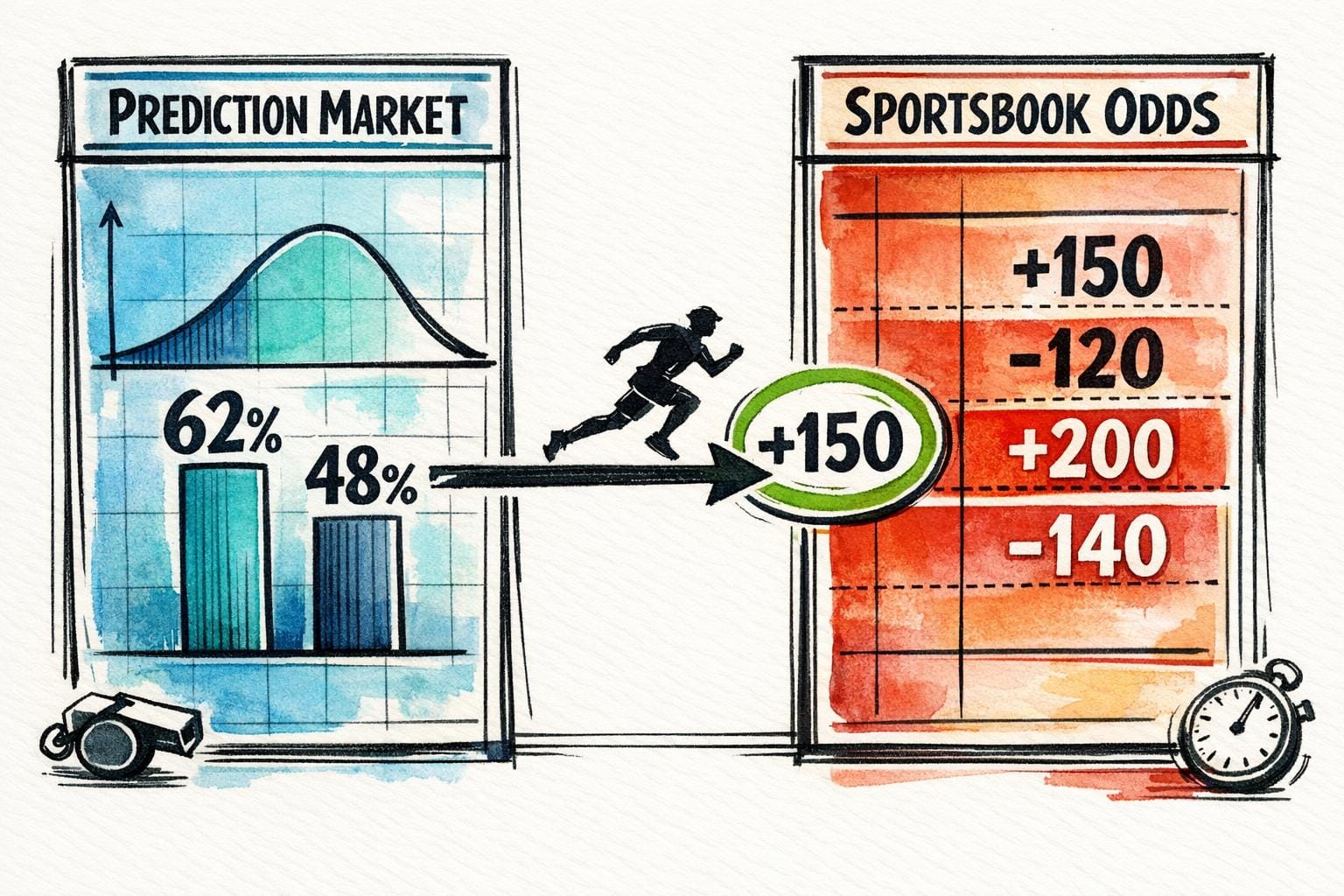
Prediction Markets vs. Sportsbook Odds
Prediction markets and sportsbook odds both provide ways to estimate the likelihood of events, but they operate very differently:
- Sportsbook odds: You bet against the bookmaker. Odds include a profit margin (vig), making it harder to profit long-term. Odds are fixed once you place your bet.
- Prediction markets: Peer-to-peer trading where prices reflect the market’s collective probability. Fees are explicit, and you can trade or exit positions before the event concludes.
Key Takeaways:
- Sportsbooks: Focus on entertainment, with odds adjusted for profit and risk management. Examples include moneyline, point spreads, and totals.
- Prediction markets: Function like stock exchanges, with prices driven by supply and demand. They are often more reflective of true probabilities but charge fees on trades or winnings.
- Accuracy: Both methods are highly accurate, but prediction markets may better reflect real probabilities due to their peer-driven nature.
- Opportunities: Comparing sportsbook odds to prediction market prices can reveal mismatches that signal potential value.
Using both approaches together can improve betting strategies by identifying pricing inefficiencies and managing risks effectively.
Are Prediction Markets Rigged? A Pro Bettor’s Honest Take | Presented by Kalshi
What Are Prediction Markets?
Prediction markets function as financial exchanges where participants trade contracts based on the outcomes of future events. These could range from sports results to political elections or economic trends. Unlike traditional betting, where you wager against a bookmaker, prediction markets operate in a peer-to-peer format, with the platform serving only as a facilitator.
Each contract is binary - either "Yes" or "No" - and is priced between $0.01 and $0.99. The price reflects the market's collective estimate of the likelihood of the event occurring. For instance, a contract priced at $0.65 suggests a 65% chance of the event happening. If the event occurs, the contract settles at $1.00; if not, it settles at $0.00. Traders can choose to exit their positions before the event concludes, allowing them to secure profits or limit losses.
"The price is determined purely by supply and demand, and it represents the market's consensus on the probability of the event occurring." – Gambling Insider
How Prediction Markets Work
In these markets, purchasing a contract is akin to buying shares in a specific outcome. For example, if you spend $100 on contracts priced at $0.34 each, you would acquire approximately 294 shares. If the outcome is successful, each share pays $1.00, resulting in a return of about $294.
Prices fluctuate as traders react to breaking news, injuries, or other relevant developments. Since you're trading against other participants, those who can spot mispriced contracts and act on them profit, which in turn helps align the market price more closely with the actual probability. In high-liquidity markets, such as major political events, trading volumes can exceed $500,000 at the best bid/ask levels, ensuring minimal price slippage.
Key Features of Prediction Markets
- Market-Driven Pricing: Prices are determined entirely by market activity, not by oddsmakers or risk managers. If traders believe a price undervalues the likelihood of an outcome, their collective buying pushes the price higher, reflecting a new consensus.
- Collective Intelligence: Prediction markets bring together a wide range of participants, including analysts, institutional investors, and experts. Research from the University of Pennsylvania and Iowa Electronic Markets shows that these markets outperform traditional forecasting methods by 8–12%. Markets with over 1,000 daily contracts achieve calibration accuracy rates of 88–92%, meaning the prices closely represent actual probabilities.
- Diverse Applications: Prediction markets go beyond sports. Platforms like Kalshi (a federally regulated market) and Polymarket (a decentralized platform) offer contracts on topics like economic indicators, regulatory decisions, and even cultural events. For instance, Kalshi's "Pro Football Champion" market has facilitated over $34 million in trades, while Polymarket has recorded more than $2 billion in total volume. These platforms also tend to have lower and more transparent fees compared to traditional sportsbooks. Kalshi charges an effective fee of about 3.5% on mid-priced contracts, while Polymarket applies a 2% protocol fee on winnings.
What Are Sportsbook Odds?
Unlike prediction markets, sportsbook odds are designed to ensure consistent profit for bookmakers rather than purely reflect the probability of an event.
Sportsbook odds represent the betting lines set by bookmakers for various sports outcomes. When you place a bet at a sportsbook, you’re essentially wagering against the bookmaker itself. This differs from prediction markets, where participants trade bets with each other. The odds you see reflect the likelihood of an event, but they’re adjusted to include the bookmaker’s profit margin. Importantly, once you place your bet, the odds for your wager remain fixed, even if the line shifts later. For instance, if you bet on the Kansas City Chiefs at –150 and the odds change to –180 an hour later, your bet still holds at –150.
Bookmakers aim to balance bets on both sides of a wager to ensure profit using the "vig" (short for vigorish), also known as "juice" or "overround." This margin is baked into the odds, so you won’t see a separate fee on your bet slip.
"The bookmaker is not trying to gamble; they are trying to guarantee a profit." – Gambling Insider
For example, in a standard sportsbook market offering –110/–110 odds, the house edge is typically 4.8%. The implied probabilities of both outcomes add up to more than 100%, with the excess representing the bookmaker’s margin.
Types of Sportsbook Odds
Sportsbooks provide various betting options to cater to different preferences and strategies:
- Moneyline bets: These are straightforward wagers on which team will win. A –150 favorite means you need to bet $150 to win $100, while a +130 underdog pays $130 on a $100 bet.
- Point spreads: These level the playing field by assigning a point handicap. For example, if the New England Patriots are –3.5 against the Miami Dolphins, they must win by more than 3.5 points for your bet to win. Both sides of the spread usually have –110 odds, meaning you’d wager $110 to win $100.
- Totals (over/under): Here, you bet on whether the combined score of both teams will go over or under a set number. If the total is 48.5, you’re wagering on whether the final combined score will be 49 or higher (over) or 48 or lower (under).
- Futures bets: These are long-term wagers on events like a season or tournament outcome. For example, betting on a Super Bowl champion at +500 odds.
How Sportsbooks Set Odds
Bookmakers use a combination of statistical models, injury reports, and historical data to set opening lines. These lines aren’t static - they shift based on public betting trends and the sportsbook’s need to manage liability. If too much money is bet on one side, the bookmaker adjusts the line to encourage action on the other side, helping to balance their risk and maintain profits.
For instance, in January 2026, FanDuel set the moneyline for a Buffalo Bills vs. Denver Broncos playoff game at –100 for the Bills (50% implied probability) and –118 for the Broncos (54.1% implied probability). The combined implied probability of 104.1% revealed a 4.1% margin built into the odds. In a hypothetical scenario, if DraftKings took $1 million in bets on each side at –110, they would pay out approximately $1,818,180 to the winning side while retaining $181,820 - a 9.1% profit margin, regardless of the game’s outcome.
"Sportsbook margin (5–10% implicit) means bettors must win at better than −110 odds to achieve positive expected value." – Lines.com
This setup highlights how sportsbooks adjust odds not to reflect "true" probabilities but to account for risk and profit. For a 50/50 event with –110 odds, you’d need to win about 52.4% of the time just to break even.
These adjustments underline how sportsbooks maintain their edge throughout the betting process.
Main Differences Between Prediction Markets and Sportsbook Odds
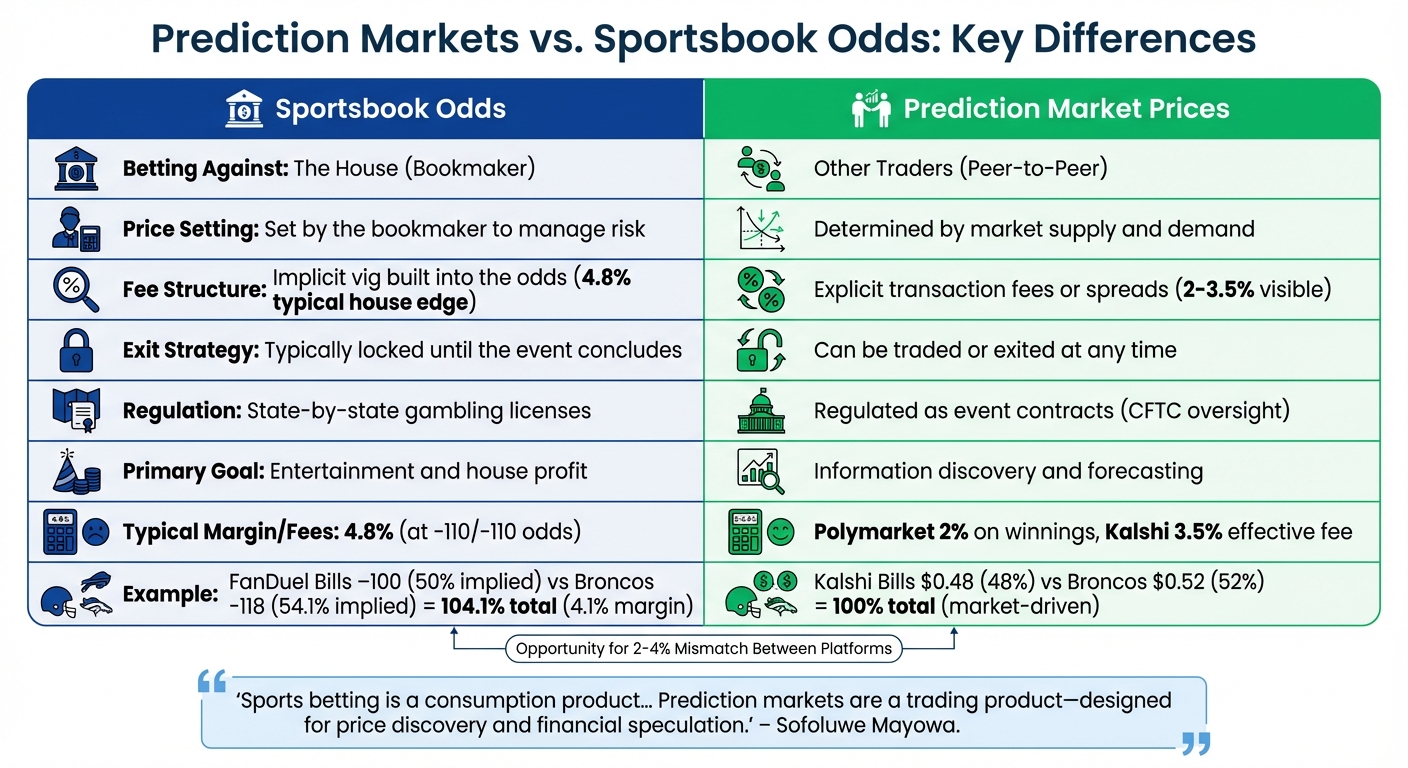
Prediction Markets vs Sportsbook Odds: Key Differences Comparison
Sportsbooks and prediction markets operate on fundamentally different principles. In sportsbooks, you're betting against the bookmaker, whose odds include a built-in profit margin. On the other hand, prediction markets are peer-to-peer systems where prices are determined purely by supply and demand dynamics among participants. While sportsbooks adjust odds to manage risk and ensure profits, prediction markets allow participants to freely trade, letting the market dictate the prices.
Side-by-Side Comparison Table
| Feature | Sportsbook Odds | Prediction Market Prices |
|---|---|---|
| Betting Against | The House (Bookmaker) | Other Traders (Peer-to-Peer) |
| Price Setting | Set by the bookmaker to manage risk | Determined by market supply and demand |
| Fee Structure | Implicit vig built into the odds | Explicit transaction fees or spreads |
| Exit Strategy | Typically locked until the event concludes | Can be traded or exited at any time |
| Regulation | State-by-state gambling licenses | Regulated as event contracts (CFTC oversight) |
| Primary Goal | Entertainment and house profit | Information discovery and forecasting |
"Sports betting is a consumption product... Prediction markets are a trading product - designed for price discovery and financial speculation." – Sofoluwe Mayowa, Gambling Writer
These structural differences also influence how probabilities are represented and communicated in each system.
How Probabilities Differ
Prediction market prices directly reflect probabilities. For instance, a contract trading at $0.70 implies a 70% likelihood of that outcome, as winning contracts settle at $1.00. In contrast, sportsbook odds require conversion to uncover their implied probabilities. These implied probabilities often exceed 100% when combined, due to the bookmaker's profit margin. While prediction markets charge explicit fees (around 2% on winnings), their prices transparently represent the market's consensus probability.
Which One Predicts Outcomes Better?
What the Data Shows
When it comes to predicting sports outcomes, both prediction markets and sportsbook odds deliver impressive accuracy. A study of 5,478 European soccer matches revealed that these two methods perform equally well in forecasting and consistently outshine individual expert tipsters. Sports betting markets, in particular, demonstrate strong calibration across major leagues. For instance, an analysis of MLB, NFL, NBA, NHL, and NCAA data from 2016 to 2020 showed that when the market assigns a 40% probability to an event, it occurs roughly 40% of the time over large datasets.
"Prediction markets and betting odds perform equally well in terms of forecasting accuracy, but both methods strongly outperform tipsters." – Martin Spann and Bernd Skiera, Journal of Forecasting
This level of reliability is key for identifying moments when discrepancies between predicted probabilities and sportsbook lines create betting opportunities.
When Differences Signal Value
Using this accuracy as a foundation, price differences between prediction markets and sportsbooks can highlight potential value, especially after accounting for fees. For example, let’s say a sportsbook prices an outcome at –150, implying about a 60% probability after adjusting for the vig. If a prediction market prices the same outcome at $0.55 (55% probability), that 5% gap could signal value - assuming the difference is large enough to cover associated fees.
To evaluate, adjust the sportsbook odds to remove the house edge and compare them to the true implied probabilities. For instance, if the sportsbook's adjusted line suggests a 58% probability and the prediction market reflects 55%, the 3% gap might offer a betting edge - provided transaction costs don’t erode the margin.
The type of market also plays a role in spotting discrepancies. Data from 72.1 million trades on Kalshi revealed that financial prediction markets are highly efficient, with a maker-taker gap of just 0.17%. In contrast, entertainment and world event markets can show gaps of over 7%, often due to emotional betting. Sports markets generally fall somewhere in between, with inefficiencies most pronounced in lower-volume games or prop bets where crowd sentiment can skew the odds.
Common Misconceptions About Betting Odds
Misconception 1: Prediction Markets Are Always Better
Some bettors assume prediction markets always offer better odds, but that's not the case - especially for more complex bets like player props, spreads, or live in-game wagers.
Sportsbooks bring certain advantages that prediction markets can't match. For example, they often have higher betting limits, offer promotional bonuses, and cater to casual bettors with a broader range of betting options. Additionally, low-liquidity prediction markets can experience significant price slippage. A single $1,000 bet in such markets might shift the price by 5–15 cents, quickly negating any potential pricing advantage. Ultimately, these platforms serve different purposes, and neither is universally better.
Misconception 2: Odds Show True Probabilities
Sportsbook odds aren't designed to represent the "true" probability of an event. Instead, they function as risk-management tools, balancing the books while including a profit margin known as the vig.
"Betting odds do not represent the 'true' probability of an event. They represent the probability adjusted for the bookmaker's risk and profit margin." – Sofoluwe Mayowa, Gambling Writer
Prediction markets, driven purely by supply and demand, tend to reflect probabilities more closely. However, they also include fees - Polymarket charges a 2% protocol fee on winnings, and Kalshi takes about 7% of profits from winning trades. Neither platform offers raw, unadjusted probabilities, making it important to consider these costs when interpreting odds.
Misconception 3: All Differences Mean Betting Edges
When you notice discrepancies between sportsbook odds and prediction markets, it doesn't automatically mean there's a profitable opportunity. These differences often stem from factors like fee structures, liquidity, or how quickly each platform reacts to news.
To identify a real edge, you need to "de-vig" the sportsbook odds to uncover the underlying probability, then compare that to the prediction market price after accounting for all fees. If the gap is smaller than the combined costs of the sportsbook's vig and the prediction market's fees, there's no edge to exploit. Understanding this is key to spotting genuine betting opportunities, which we'll explore further in the next section.
How to Use Both for Better Betting Results
Tracking Mismatches and Line Movement
You can combine prediction markets and sportsbook odds to uncover real-time pricing mismatches. Start by selecting an event, converting sportsbook odds and prediction market prices into implied probabilities, and then comparing the two.
Take this example: In January 2026, FanDuel listed the Buffalo Bills' moneyline at -100 (50% implied probability) against the Denver Broncos at -118 (54.1% implied). Meanwhile, Kalshi's decentralized market priced the Bills at $0.48 (48% probability) and the Broncos at $0.52 (52% probability). This created a 2–4% mismatch between the sportsbook and the decentralized market, highlighting a potential value opportunity. Additionally, tracking line movements can offer insight into public betting trends or early responses to breaking news, like injuries or weather updates. These shifts often indicate where informed bettors are placing their money.
Hedging and Spreading Risk
These discrepancies aren't just about spotting value - they can also help you manage risk more effectively.
Prediction markets allow for two-way trading, something sportsbooks don’t offer. This means you can exit positions early, either locking in profits or minimizing losses. This flexibility makes prediction markets a great tool for hedging futures bets or adjusting your strategy as new information comes in.
For instance, if you placed a sportsbook bet on a team and their win probability improves mid-season, you could sell a "Yes" contract in the prediction market to secure your gains.
Using WagerProof Tools

To simplify these strategies, advanced tools like WagerProof can make the process easier and more efficient.
WagerProof provides a transparent interface that integrates these strategies seamlessly. It offers real-time alerts when prediction market spreads differ significantly from sportsbook odds - taking fees into account - so you can identify true value bets. WagerBot Chat goes a step further, analyzing live data like weather, odds, injury updates, and model predictions to deliver clear, step-by-step recommendations.
Unlike traditional pick sites that provide unexplained predictions, WagerProof focuses on data transparency and actionable insights. The platform highlights fade signals and hidden edges, helping you make smarter, more confident betting decisions. It’s accessible on the web, iOS, and Android, and includes an exclusive Discord community for ongoing support.
This integrated approach combines the strengths of traditional sportsbook odds with market-driven insights, giving you a more informed and effective betting strategy.
Conclusion
Prediction markets and sportsbook odds each bring unique strengths to the table, offering a dynamic framework for more informed betting decisions. Sportsbooks shine in areas like player props, point spreads, and live betting options, while prediction markets stand out with their lower fees and quicker market adjustments. The real advantage lies in comparing the two - if a sportsbook sets odds with a 50% implied probability while a prediction market prices the same outcome at 48%, that 2–4% difference could indicate a valuable opportunity.
These distinctions aren't just theoretical - they directly impact your profitability. Studies reveal that prediction markets outperform traditional forecasts by 8–12%. Additionally, when you factor in sportsbook vig (usually around 4.8%) compared to prediction market fees (as low as 2%), the savings and improved risk management from two-way trading become clear.
To capitalize on these advantages, tools that merge these insights are essential. WagerProof is designed to do just that, offering real-time alerts and in-depth analytics by combining prediction market data with sportsbook odds. For example, real-time alerts flag differences between prediction market spreads and sportsbook odds, while WagerBot Chat analyzes live factors like weather, injuries, and model predictions to provide actionable, step-by-step recommendations. Every edge is backed by transparent data and calculations.
The platform’s Model Aggregator combines forecasts from over 50 statistical models, minimizing bias and uncovering mispricings that single models might miss. Features like public money splits reveal where sharp bettors are challenging the consensus, and z-score rankings highlight the most promising opportunities. Accessible on web, iOS, and Android, WagerProof also offers an exclusive Discord community for continuous support.
FAQs
How do I remove the vig from sportsbook odds?
To calculate no-vig odds (odds without the bookmaker's margin), follow these steps:
- Convert Odds to Implied Probabilities: Use the appropriate formula based on the odds format - American, decimal, or fractional. This step translates the odds into percentages that reflect the likelihood of each outcome.
- Normalize the Probabilities: Add up the implied probabilities for all outcomes. Then, divide each individual probability by the total sum. This adjusts the probabilities so they total 100%, removing the bookmaker's margin.
- Reconvert Probabilities to Odds: Once adjusted, convert these normalized probabilities back into the original odds format. The result is the fair odds that exclude the sportsbook's built-in "vig" or juice.
This process helps reveal the true, unbiased odds for a given event.
When do prediction market fees erase an edge?
Prediction market fees can wipe out any advantage if they eat into the profitability of trades too much. This is especially true for low-probability contracts, where high fees can transform what seemed like favorable odds into losing propositions. The issue is even more pronounced in markets with tight spreads or limited liquidity, as fees take up a larger portion of the overall transaction costs. When the fees exceed the potential profit margin, any edge a trader might have is effectively nullified.
How can I hedge a sportsbook bet in a prediction market?
Hedging a sportsbook bet in a prediction market involves leveraging the distinct mechanics of each platform. Sportsbooks operate with fixed odds, while prediction markets are driven by crowd-based pricing that fluctuates with market sentiment. To hedge effectively, you would place a counter-bet in the prediction market to either reduce potential losses or secure a guaranteed profit.
However, this process isn’t without its challenges. Differences in rules between the platforms, varying levels of liquidity, and fluctuating pricing can all impact the success of your hedge. Paying close attention to these factors is essential to manage risk and make the hedge as efficient as possible.
Related Blog Posts
Ready to bet smarter?
WagerProof uses real data and advanced analytics to help you make informed betting decisions. Get access to professional-grade predictions for NFL, College Football, and more.
Get Started Free