Public Money vs. Player Psychology in Betting
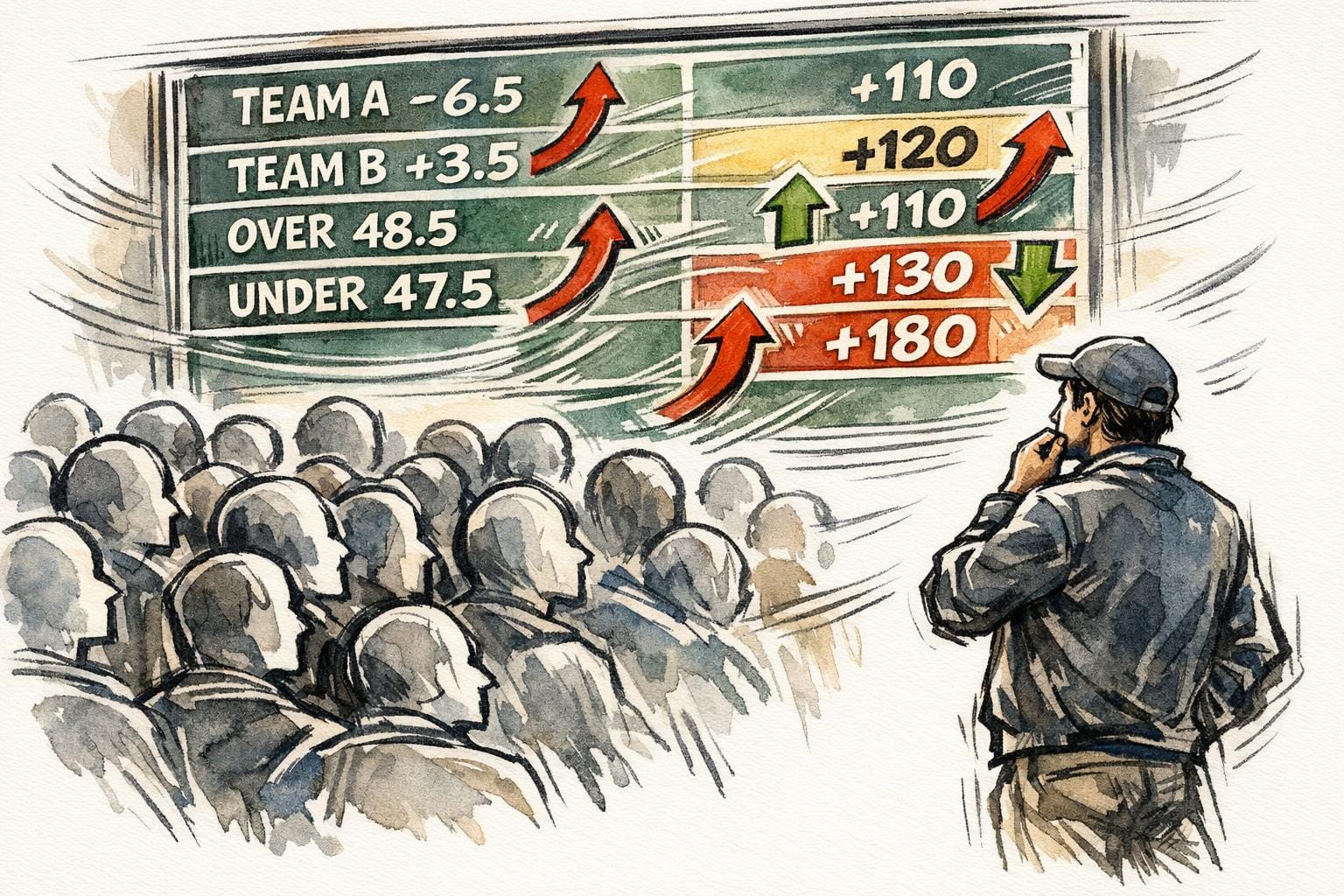
Betting success often comes down to understanding two key factors: public money and player psychology. Public money refers to casual bettors who follow emotions and trends, while player psychology involves analyzing mental and emotional factors affecting athletes. Sportsbooks adjust odds based on these patterns, creating opportunities for savvy bettors to find inefficiencies.
Key Takeaways:
- Public money skews odds due to emotional betting on favorites, overs, or big-name teams. This creates value for those who bet against the majority.
- Player psychology highlights how emotional narratives (e.g., star player hype or "must-win" situations) can inflate odds beyond their true probabilities.
- Tools like betting splits and line movement tracking can help identify where sharp bettors (professionals) are placing their money.
- Combining public money trends with deeper psychological analysis can reveal smarter bets.
Pro Tip: Look for mismatches between public sentiment and sharp money. For example, if 80% of bets favor Team A, but most of the money is on Team B, professionals may see value in the underdog.
Balancing these insights with data-driven tools like WagerProof can simplify the process, helping you spot value bets and avoid emotional traps.
STOP Using Public Betting Percentages...
1. Public Money
Public money refers to wagers placed by casual bettors who often rely on gut feelings, team loyalty, or media buzz. These recreational bettors dominate the volume of bets placed, and their behavior tends to follow patterns that sportsbooks are well-equipped to anticipate.
Impact on Odds
Bookmakers craft betting lines not only based on probabilities but also by factoring in public betting tendencies. For instance, when a significant number of bettors back high-profile teams like the Dallas Cowboys or Los Angeles Lakers, sportsbooks may adjust the line to make betting on these favorites more expensive. This practice, known as "shading", creates opportunities for value that are influenced purely by public demand.
"Public sentiment - not raw probability - starts to bend the numbers." - Betting Barometer
This dynamic showcases how public biases can influence market odds, often skewing them away from pure statistical probability.
Predictability
One of the defining traits of public betting behavior is its consistency. Casual bettors typically lean toward favorites, overs, and well-known teams, often ignoring value plays. They're also susceptible to recency bias - if a star quarterback has a standout game, the public often overestimates their chances of delivering a repeat performance. This tendency forms the basis of the "fade the public" strategy, particularly when over 70% of bets are on one side.
A real-world example highlights this: In a January 2025 NFL game between the Cleveland Browns and the Baltimore Ravens, only 7% of public tickets backed the Browns on the moneyline. However, those 7% accounted for 49% of the total money wagered. This discrepancy indicated that professional bettors were targeting the less popular side while public money poured in on the favorite.
Betting Strategy
To effectively leverage insights about public money, it's important to track both the timing of bets and the gaps between the number of wagers and the total money involved. Public bets tend to spike closer to game time, especially during primetime events like Sunday or Monday Night Football. If you're planning to bet on a popular favorite, placing your wager early can help you lock in a better price before public money inflates the odds.
Keep an eye on "Reverse Line Movement" (RLM), which occurs when a significant majority (e.g., 80%) of bets favor one side, but the line shifts in the opposite direction. This often signals the influence of professional bettors. Additionally, using betting split tools to identify games where the money percentage significantly outpaces the bet percentage (by 15% or more) can reveal where sharp money is being placed.
"The public loses. Not every time, but over the long haul being on the same side as the majority of bettors isn't a sound strategy." - Action Network Staff
2. Player Psychology
Player psychology delves into the mental and emotional factors that influence how athletes perform under pressure. Unlike public betting trends, which are often driven by casual sentiment, player psychology zeroes in on individual traits and situational pressures that can make outcomes harder - or easier - to predict.
Impact on Odds
Psychological narratives often skew betting odds beyond what the statistics would suggest. For example, when a team is labeled as "desperate" or in a "must-win" situation, sportsbooks adjust the odds to account for the flood of emotional bets from the public. However, desperation rarely translates into a measurable increase in a team’s chances of winning. Similarly, when a star athlete delivers an impressive performance or hits a hot streak, bettors tend to overvalue that recent success due to recency bias, which pushes the odds away from their fair value.
"The battle between public emotion and measured analysis shapes every betting market." - Betting Barometer
This phenomenon creates what’s called an "overlay" - a situation where odds are inflated due to psychological factors rather than concrete data. A classic example is the 1990 heavyweight title fight between Mike Tyson and Buster Douglas. Tyson entered as a 42-to-1 favorite due to overwhelming public hype, but Douglas pulled off a shocking upset. Those who questioned the narrative and bet against the public sentiment reaped significant rewards. Such distortions highlight how psychological factors can create opportunities for sharper analysis of individual performance metrics.
Predictability
Player psychology uncovers variables that basic statistics often overlook. Consider a quarterback’s completion percentage under pressure or a team’s head-to-head record against a particular opponent. These factors can reveal psychological edges that the public frequently misses. For instance, a team with superior stats might consistently underperform against a specific rival, opening the door for strategic bets.
Media influence amplifies these effects. Viral stories and trending news cycles can create exaggerated hype around certain players, making their success seem more inevitable than it really is. By blending these psychological insights with data-driven analysis, bettors can identify when emotional narratives are driving inefficiencies in the market.
Betting Strategy
Recognizing psychological cues can sharpen your betting strategy. Instead of relying solely on basic stats, focus on situational metrics. For example, in soccer, analyze "Expected Goals" (xG), or in basketball, look at "Player Efficiency Rating" (PER) to gauge whether a player’s recent performance is likely to regress to the mean. Emotional public sentiment often causes lines to move excessively, creating value for those willing to bet against the narrative.
Timing is also key. Sharp bettors watch line movements as game time approaches, when public sentiment and psychological narratives are at their peak. If you notice the public backing a team or player based on emotion rather than data, it might be an ideal moment to take a contrarian position. Converting odds to implied probability (e.g., +150 equals 40%) and comparing them to your own data-driven estimates can help pinpoint mismatches.
"Long-term success is achieved not by outsmarting the bookies, but by avoiding the emotional traps that trip up the crowd." - Betting Barometer
When combined with real-time data and analytical tools, these psychological insights become powerful tools for identifying and exploiting market inefficiencies.
Pros and Cons
Public Money vs Player Psychology Betting Strategies Comparison
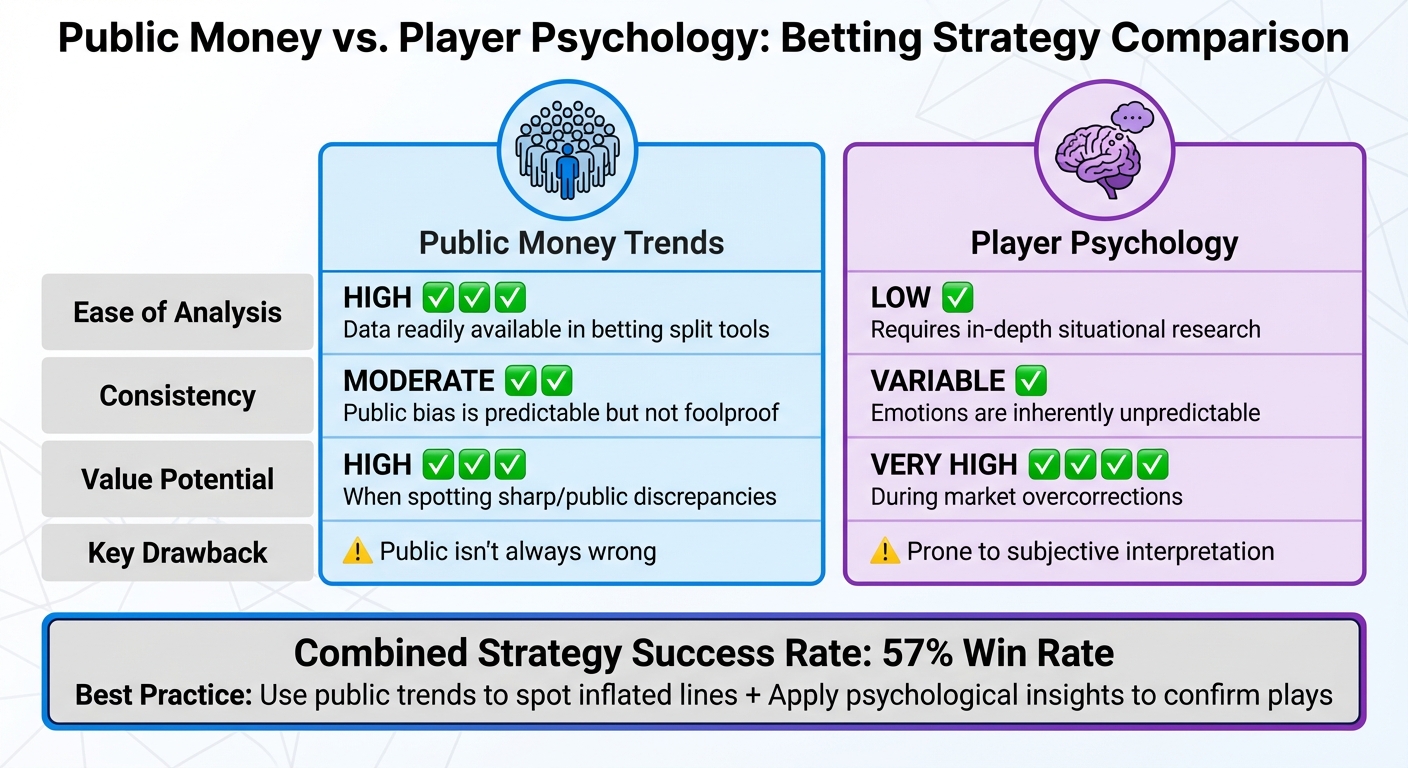
Each method offers its own strengths and weaknesses. Public money trends are simpler to analyze since they provide clear data on bet and money percentages. This transparency can help identify discrepancies that point to sharp action. However, it’s worth noting that the public isn’t always wrong, and betting splits don’t guarantee success. Relying solely on these trends means you’re depending on market inefficiencies created by others rather than building your own unique advantage.
On the other hand, player psychology brings a different layer of complexity. It involves digging deeper - analyzing media narratives, evaluating situational factors like "flat spots", and accounting for emotional biases. This approach can uncover valuable opportunities, especially when the public overreacts to a star player’s recent hot streak. But, it’s also prone to subjective misjudgments, which can make it less reliable.
| Factor | Public Money Trends | Player Psychology |
|---|---|---|
| Ease of Analysis | High; data readily available in betting split tools | Low; requires in-depth situational research |
| Consistency | Moderate; public bias is predictable but not foolproof | Variable; emotions are inherently unpredictable |
| Value Potential | High when spotting sharp/public discrepancies | Very high during market overcorrections |
| Key Drawback | Public isn’t always wrong | Prone to subjective interpretation |
This comparison highlights why blending both methods can create a well-rounded betting strategy. Savvy bettors use public trends to spot inflated lines and apply psychological insights to confirm their plays. Those who successfully combine these approaches tend to win about 57% of their wagers.
"If you can spot sharp action early and avoid falling into public traps, you'll position yourself on the winning side more often." - Dave, Strategy Expert at Predictem
Finding Value Bets with WagerProof Tools

WagerProof takes the guesswork out of betting by offering tools that pinpoint value gaps where public sentiment clashes with objective probabilities. By analyzing these discrepancies, the platform helps identify opportunities where emotion-driven narratives inflate odds, creating potential value for savvy bettors.
The Edge Finder compares sportsbook odds with AI-generated probabilities, giving you a clearer picture of where the numbers don't add up. Meanwhile, the AI Game Simulator runs thousands of simulations, using current team stats and historical trends to establish a more accurate baseline. For example, if a team's odds are overly boosted due to a recent winning streak or strong home-field support, these tools can highlight where the public has overreacted. Together, they cut through market noise and provide a more reliable perspective. The Multi-Model Consensus tool adds another layer by flagging bets where multiple analytical models are in agreement, helping to filter out hype and focus on actionable insights.
Another feature is public bets and money lean data, which reveals where professional bettors (the "sharps") and casual bettors diverge. For instance, if a large percentage of bets favor one team but the majority of money is placed on the other, it could indicate sharp action going against the public. Real-time alerts also track Reverse Line Movement, where odds shift away from the team drawing most of the public bets - another signal of sharp money in play.
For instant validation, WagerBot Chat is your go-to tool. You can ask questions like, “How does Team X perform on short rest?” or “What’s their record as a home underdog after a blowout loss?” This feature connects you to live data, offering context that helps you decide whether the public is overreacting - and if that overreaction creates a betting opportunity.
Additionally, fade alerts automatically flag games where a team has less than 40% of total bets. These are prime spots for contrarian betting, where the majority opinion might have skewed the odds too far in one direction. By combining these tools, WagerProof helps you uncover value bets when public bias misaligns with sharp money. With real-time, data-driven alerts, you’re better equipped to make smarter, more informed contrarian bets.
Conclusion
Success in betting lies in striking a balance between understanding public sentiment and analyzing player behavior. Public money often highlights how emotion and hype can skew betting lines, creating opportunities for those who can recognize when these shifts stray from true value. By combining this with a grasp of player psychology, you can spot moments where emotional overreactions open doors for smarter wagers.
"The goal in sports betting isn't about winning every single wager – it's about consistently identifying edges and managing your bankroll wisely over time." - WagerProof
Over time, following the majority rarely leads to consistent wins. To outsmart the market, focus on finding discrepancies - like when a small percentage of public bets accounts for a large share of the total money wagered. This often signals sharp action backing an underdog or alternative outcome.
WagerProof provides tools designed to simplify this process. With features like the Edge Finder, AI Game Simulator, and real-time public money tracking, its platform helps you quickly identify market inefficiencies without the need for hours of manual research.
For the best results, pair these automated insights with situational analysis. Consider factors like injuries, weather, and team dynamics to confirm where value bets exist. This combination of technology for efficiency and human judgment for nuance is a game-changer. It’s what separates bettors who profit consistently from those who chase losses. You can access WagerProof’s tools on the web, iOS, or Android to start finding those opportunities where public sentiment and sharp money diverge.
FAQs
How can I tell if public betting trends are affecting the odds?
When you examine betting splits, you can often tell when public betting trends are affecting the odds. One clear sign is reverse line movement - this happens when a large chunk of bets (say, over 60%) is on one side, but the line shifts in the opposite direction. Another important clue is a difference between the percentage of bets and the percentage of money (handle). For instance, if the majority of tickets are on one side but most of the money is backing the other, it could mean sharp bettors are taking a contrary position.
Spotting these patterns can help you identify value bets and steer clear of odds that are distorted by heavy public action.
How does player psychology influence value betting?
Player psychology is a powerful factor in spotting value bets, as emotions and biases often distort betting markets. For instance, when the public gets carried away by recent performances, the popularity of certain teams, or media-driven hype, odds can drift away from the actual probabilities.
By recognizing these psychological tendencies, sharp bettors can identify mispriced lines - situations where the odds don't accurately represent the true chances of an outcome. This knowledge allows them to capitalize on market inefficiencies and make more strategic, well-informed bets.
How does WagerProof help identify value bets and market inefficiencies?
WagerProof gives you instant access to crucial betting data, making it easier to identify market gaps and potential value bets. By examining bet percentages (number of tickets) and money splits for each game, you can pinpoint mismatches - like when most bets are on one team, but the bulk of the money is on another. This scenario often hints at sharp bettors siding with the less popular choice.
The platform also tracks reverse line movement, which occurs when odds move against public betting trends - usually a sign of professional bettors influencing the market. With automated alerts flagging these anomalies, WagerProof transforms raw data into useful insights, helping you place smarter, more informed bets.
Related Blog Posts
Ready to bet smarter?
WagerProof uses real data and advanced analytics to help you make informed betting decisions. Get access to professional-grade predictions for NFL, College Football, and more.
Get Started Free