How Public Trends Impact Betting Lines
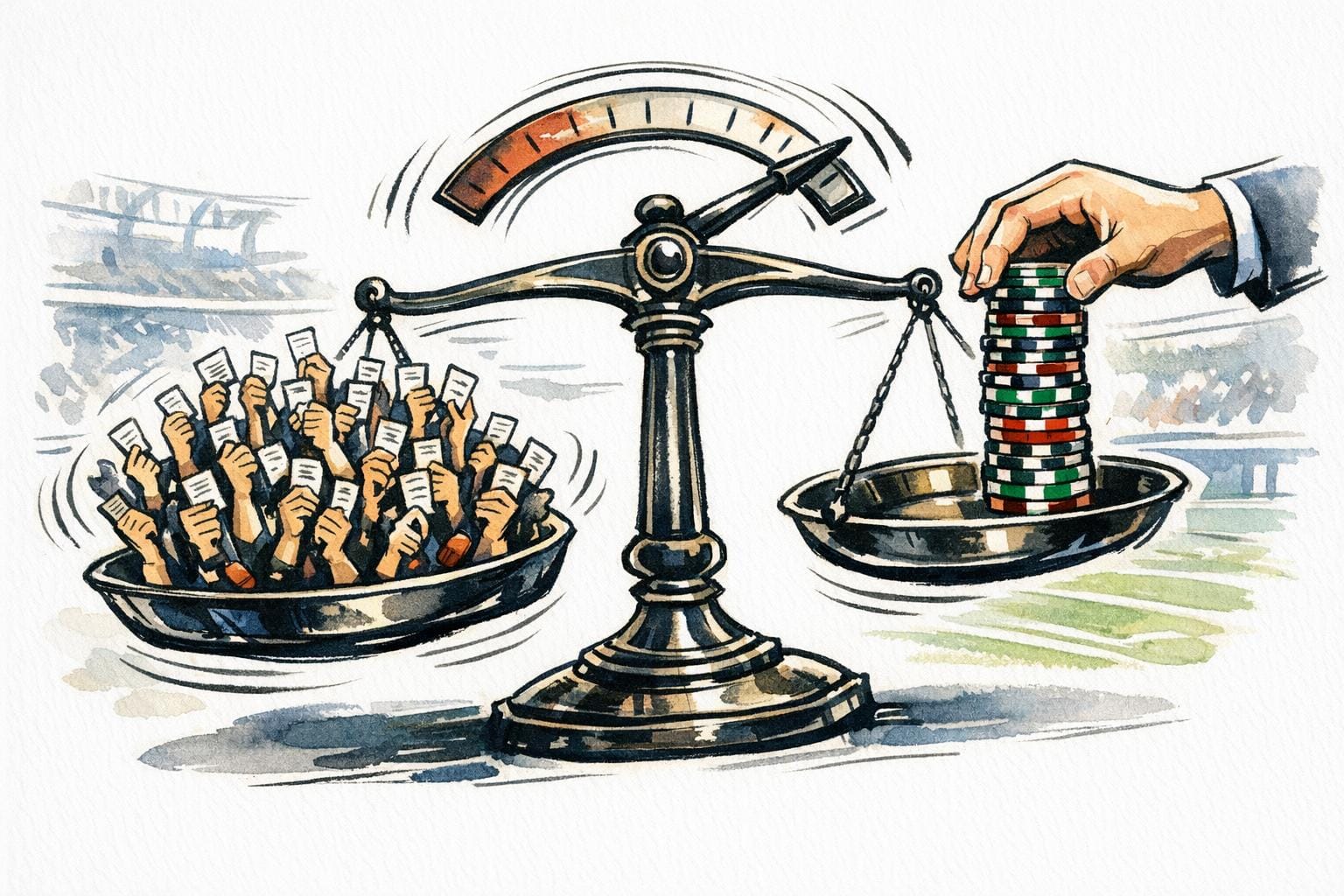
When the public heavily bets on popular teams like the Cowboys or Lakers, sportsbooks adjust lines to manage risk and protect profits. These shifts create opportunities for sharp bettors who exploit inflated odds caused by public bias. Key takeaways:
- Public Money vs. Sharp Money: Casual bettors (public money) place smaller, emotion-driven bets, favoring favorites and overs. Sharp bettors use data and models to spot value, often betting early.
- Line Movement: Sportsbooks shift lines based on betting volume to balance risk. Popular teams often see inflated spreads, creating value for underdogs.
- Timing Bets: Bet early for favorites and late for underdogs to capitalize on public-driven line changes.
- Underdog Edge: Teams with less than 30% of public bets have consistently covered spreads at higher rates (53.7% in NFL games over five seasons).
Using tools like WagerProof, you can track public betting trends, spot sharp money, and identify value bets by combining public patterns with statistical analysis. This strategy helps you make smarter, data-driven betting decisions.
How to Read Line Movement & Public Betting Percentage
To track these shifts effectively, you can use real-time sports data platforms to monitor live market changes.
How Public Money Moves Betting Lines
Public Money vs Sharp Money: Key Differences in Sports Betting
How Line Movement Works
Sportsbooks adjust betting lines for one main reason: to manage financial risk. When too much money is wagered on one side, the sportsbook risks significant losses if that side wins. To counter this, they shift the line to make the other side more appealing, encouraging bets that help balance the action.
This adjustment isn't about predicting the outcome - it's purely a risk-management strategy. For example, if 80% of the money is on the Cowboys at -7, the sportsbook might move the line to -7.5 or -8. The goal? To entice more bets on the other side and even out the exposure.
Another common tactic is "shading the line." Sportsbooks often inflate spreads on popular teams like the Cowboys, Lakers, or Yankees because they know casual bettors will back these teams regardless of the odds. For instance, if the true line should be -6.5, they might set it at -7.5, creating value for sharp bettors who recognize the inflated number.
To further manage lopsided bets, sportsbooks may adjust the spread or tweak the juice (the cost of placing a bet). For example, instead of moving a line from -7 to -7.5, they might keep it at -7 but increase the juice from -110 to -115 or -120. This discourages additional bets on the heavily favored side without altering the spread itself.
Next, let’s dive into how the influence of public and sharp money shapes these line movements.
Public Money vs. Sharp Money
Understanding how lines are adjusted also means recognizing the distinction between public and sharp bettors. While both groups influence line movement, their approaches and impact differ significantly.
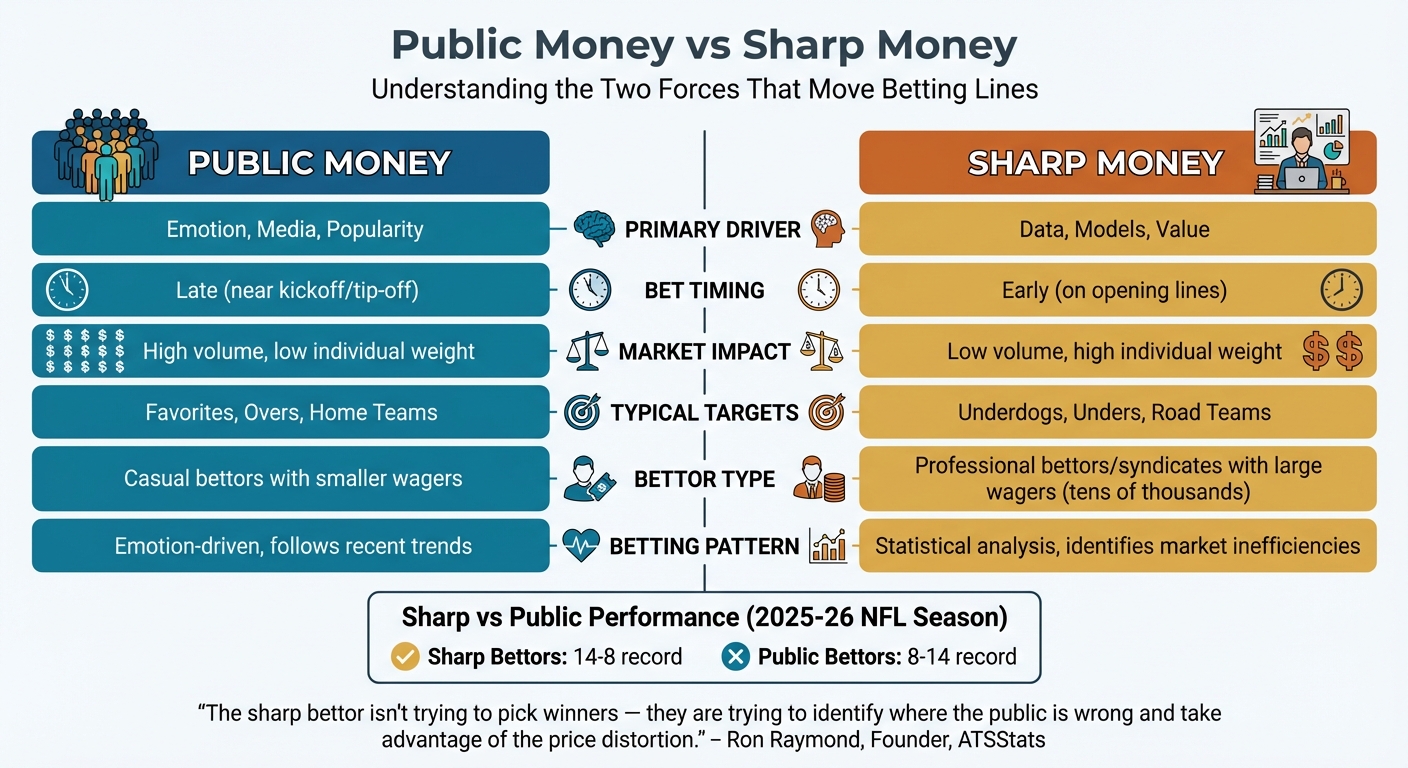
Public money comes from casual bettors - those placing smaller wagers, often driven by emotion, recent trends, or media narratives. These bettors tend to favor favorites, overs, and well-known teams. Their action usually ramps up closer to game time, flooding sportsbooks with high-volume, low-stakes bets.
Sharp money, however, is the domain of professional bettors or syndicates who place large wagers, sometimes in the tens of thousands. These bettors rely on statistical analysis, injury reports, and market inefficiencies to find value. They typically act early, targeting opening lines before sportsbooks can make adjustments. A few sharp bets can move a line more dramatically than thousands of smaller public wagers.
"The sharp bettor isn't trying to pick winners - they are trying to identify where the public is wrong and take advantage of the price distortion." - Ron Raymond, Founder, ATSStats
Sportsbooks pay far more attention to sharp money than public bets. When professionals or syndicates target one side, books react quickly, even if it creates an imbalance in the number of tickets. This is why you may see reverse line movement (RLM): when 75% of bets are on the favorite, but the line shifts in favor of the underdog. This reflects sharp action rather than public sentiment.
Here’s a quick comparison of public and sharp money:
| Feature | Public Money | Sharp Money |
|---|---|---|
| Primary Driver | Emotion, Media, Popularity | Data, Models, Value |
| Bet Timing | Late (near kickoff/tip-off) | Early (on opening lines) |
| Market Impact | High volume, low individual weight | Low volume, high individual weight |
| Typical Targets | Favorites, Overs, Home Teams | Underdogs, Unders, Road Teams |
Recognizing these differences is key. When a line moves against the majority of bets, it’s often a sign of sharp money at play - and that’s a signal worth noting.
Using Public Bias to Time Your Bets
Finding Overvalued Favorites
Certain teams consistently draw more public attention - and money - due to their popularity, regardless of how well they're performing. Franchises like the Dallas Cowboys, Los Angeles Dodgers, and New York Yankees are prime examples. These teams tend to attract heavy betting action simply because of their "brand name" status. Sportsbooks adjust for this by shading the lines, making these favorites more expensive to bet on since casual bettors are often willing to pay the premium.
Here’s where it gets interesting: teams receiving less than 30% of public bets have covered the spread at a 53.7% rate over the past five NFL seasons. This trend becomes even more pronounced in primetime games. For instance, when 70% or more of public bets back the "Over" in NFL primetime matchups, the "Under" has hit at a 54.1% rate.
Another common public bias? Overreacting to star player injuries. When a key player is sidelined, the betting line often moves more than the actual statistical impact justifies. Savvy bettors take advantage by "buying on bad news" once the line becomes artificially inflated.
These patterns reveal how sportsbooks adjust lines and highlight opportunities for bettors to capitalize on public tendencies.
When to Place Your Bets
Timing is everything when it comes to exploiting public biases. If you're betting on favorites, placing your wager early can help you lock in better odds before public money starts driving the price up. On the other hand, if you're backing underdogs, waiting until public action inflates the line can provide more value.
Take this example from May 2024: the Denver Nuggets opened as -5.5 favorites, but as 78% of public bets poured in, the line shifted to -6.5. The Minnesota Timberwolves ended up winning 106-99, proving the value of waiting for the public to push the line too far. Similarly, in September 2024, the Dodgers faced the Diamondbacks with 81% of bets driving the moneyline from -165 to -175. Arizona won 5-3, rewarding those who waited for the inflated odds.
High-profile events like Sunday Night Football often see exaggerated line movements as public money floods in closer to kickoff. However, before jumping on a line shift, always consider the context. Changes could stem from late-breaking injury news or weather updates rather than sharp betting action.
Using Data to Track Public Trends
Monitoring Public Betting Percentages
Tracking public betting patterns can uncover opportunities where the market may be out of balance. The trick lies in analyzing the gap between ticket percentage (the number of bets placed on each side) and money percentage (the total amount of money wagered). When these figures differ significantly, it often points to sharp money going against the majority.
For instance, if a team attracts just 30% of the bets but accounts for 60% of the total money, it’s a clear indicator of sharp action. This means professional bettors are making larger, calculated wagers on that side, while recreational bettors are spreading smaller bets on the other. Such disparities can signal where the value lies.
Early line movements during the week often reflect sharp bettors acting quickly on opening odds. On the other hand, late shifts - especially just before game time - are usually driven by public sentiment and media narratives . To stay ahead, having real-time access to this data is essential, and tools like WagerProof make this possible.
Using WagerProof for Real-Time Data

To make the most of public betting trends, you need up-to-the-minute insights. WagerProof simplifies this process by offering all the key data in one place. The Public Money Splits tool shows live ticket and money percentages, making it easy to spot when sharp money diverges from public betting patterns.
The platform’s Edge Finder tool compares statistical model predictions with current market odds, flagging mismatches and gaps that could indicate value opportunities. When the sportsbook lines don’t align with prediction models, you’ll get instant alerts.
Additionally, the WagerBot Chat feature allows you to ask game-specific questions in plain language. It provides accurate, data-driven responses based on live odds, injury updates, weather forecasts, and statistical models - avoiding the pitfalls of generic AI tools. The AI Game Simulator rounds it out by running thousands of simulations to calculate win probabilities, helping you assess whether public betting has skewed a line beyond its true value. With these tools, you can make more informed decisions in real time.
Combining Public Trends with Statistical Analysis
Why Public Trends Aren't Enough Alone
While real-time public betting data can provide useful insights, it's far from a complete strategy on its own. Public betting trends are often seen as a "weak data point". Why? Because they usually come from a single recreational sportsbook, like DraftKings or BetMGM. This means you're likely missing out on the bigger picture, such as high-stakes wagers placed at sharp books or the massive volume tied up in parlays and Same Game Parlays.
Sportsbooks are well aware of public betting habits and adjust - or "shade" - their lines to counteract one-sided action. So, when you see a heavily favored side, the line may already reflect public bias. Simply fading the public without factoring in objective analysis can lead to losses, as the odds have likely been adjusted to account for this behavior.
Take the 2025–26 NFL season as an example. Sharp bettors achieved a 14–8 record in "Sharp vs. Public" matchups, while public bettors ended with an 8–14 record. This success wasn’t just about observing betting percentages; it came from combining public trends with statistical models to uncover true value.
Creating a Complete Betting Approach
To build a well-rounded betting strategy, you need to integrate both public trends and statistical models. The process can start with a solid statistical model to identify a value bet. Then, use public trends to time your wager strategically. For instance, if your model indicates value on an underdog, you might wait for public action to inflate the favorite's line, allowing you to lock in a better price.
As we discussed in the "Finding Overvalued Favorites" section, teams with minimal public support have historically covered the spread at a higher rate. However, this edge only holds when you confirm value through other factors like injury reports, weather conditions, historical matchups, and predictive models.
This combined approach ensures your decisions are grounded in multiple data sources rather than relying on guesswork. WagerProof's Edge Finder is a great example of a tool that helps bridge this gap. It compares statistical model predictions with current market odds, flagging discrepancies that might signal value. Meanwhile, the AI Game Simulator runs thousands of simulations to calculate win probabilities, helping you determine if public betting has pushed a line beyond its actual value. By using these tools alongside real-time public money splits, you can make smarter, more informed bets that capitalize on market inefficiencies and timing advantages. This is the foundation of a truly effective betting strategy.
Conclusion: Better Betting Through Public Trend Analysis
Tapping into public betting trends can provide a real advantage in the sports betting world. For instance, teams attracting less than 30% of total bets have historically covered the spread at rates between 54% and 56% in NFL and NCAA football games. These situations highlight how public money can distort betting lines, creating opportunities for savvy bettors to find value.
Early in the week, lines are less influenced by public sentiment, making this a prime time to spot favorable bets. On the flip side, as the week progresses, late public bets often inflate favorites, giving underdog bettors better odds closer to game time. Keeping an eye on steam moves - those sudden, consistent line shifts across multiple sportsbooks - can also signal sharp action. When you see these moves, leveraging data tools to back up your decisions can make all the difference.
As discussed earlier, sharp bettors consistently outperform the public by combining public betting trends with other critical factors like statistical models, injury updates, and market analysis. Tools like WagerProof simplify this process by flagging outliers, identifying value bets, and providing actionable insights - whether it’s spotting mismatched spreads, fading certain games, or uncovering hidden edges.
The most successful strategies bring together multiple data sources. For example, WagerBot Chat allows you to ask straightforward questions and receive in-depth analysis, combining weather updates, odds, injury reports, and predictive models into a single, actionable recommendation. By tracking public betting percentages to identify overhyped favorites and validating your picks with statistical models, you can make smarter wagers. This blend of public trend analysis and data-driven insights is what sets consistent winners apart from the rest.
FAQs
How can I tell if a line move is sharp money or injury news?
When professional bettors, often referred to as sharps, place large, well-informed wagers, it can lead to a shift in betting odds that goes against public opinion. This phenomenon is called reverse line movement. In contrast, sudden and noticeable line changes caused by injury news are directly tied to updates about players' availability or condition. To tell these scenarios apart, pay attention to factors like timing, public betting percentages, and how the market reacts overall.
What’s the best way to use ticket vs. money percentages?
To make the most of ticket vs. money percentages, focus on situations where the Money % is at least 10% higher than the Ticket %. This often indicates sharp bettors placing larger, more informed wagers. Keep an eye on real-time changes and watch for reverse line movement - when betting lines shift in the opposite direction of public trends. These shifts often reveal the influence of sharp money. Using tools designed to track these patterns can help you identify valuable opportunities and better time your bets.
When should I bet early vs. wait until game time?
The timing of your bet plays a crucial role and largely depends on your approach. Placing your bet early can help you lock in better odds before sharp bettors or fresh updates - like injury reports or other factors - cause the line to shift. On the other hand, waiting until closer to game time gives you the advantage of factoring in last-minute news, such as unexpected injuries, weather changes, or how the public is betting. Both strategies have their perks: bet early to stay ahead of line movement, or wait to make a more informed decision based on the latest developments.
Related Blog Posts
Ready to bet smarter?
WagerProof uses real data and advanced analytics to help you make informed betting decisions. Get access to professional-grade predictions for NFL, College Football, and more.
Get Started Free