Reading Betting Splits: Sharp vs Public Trends
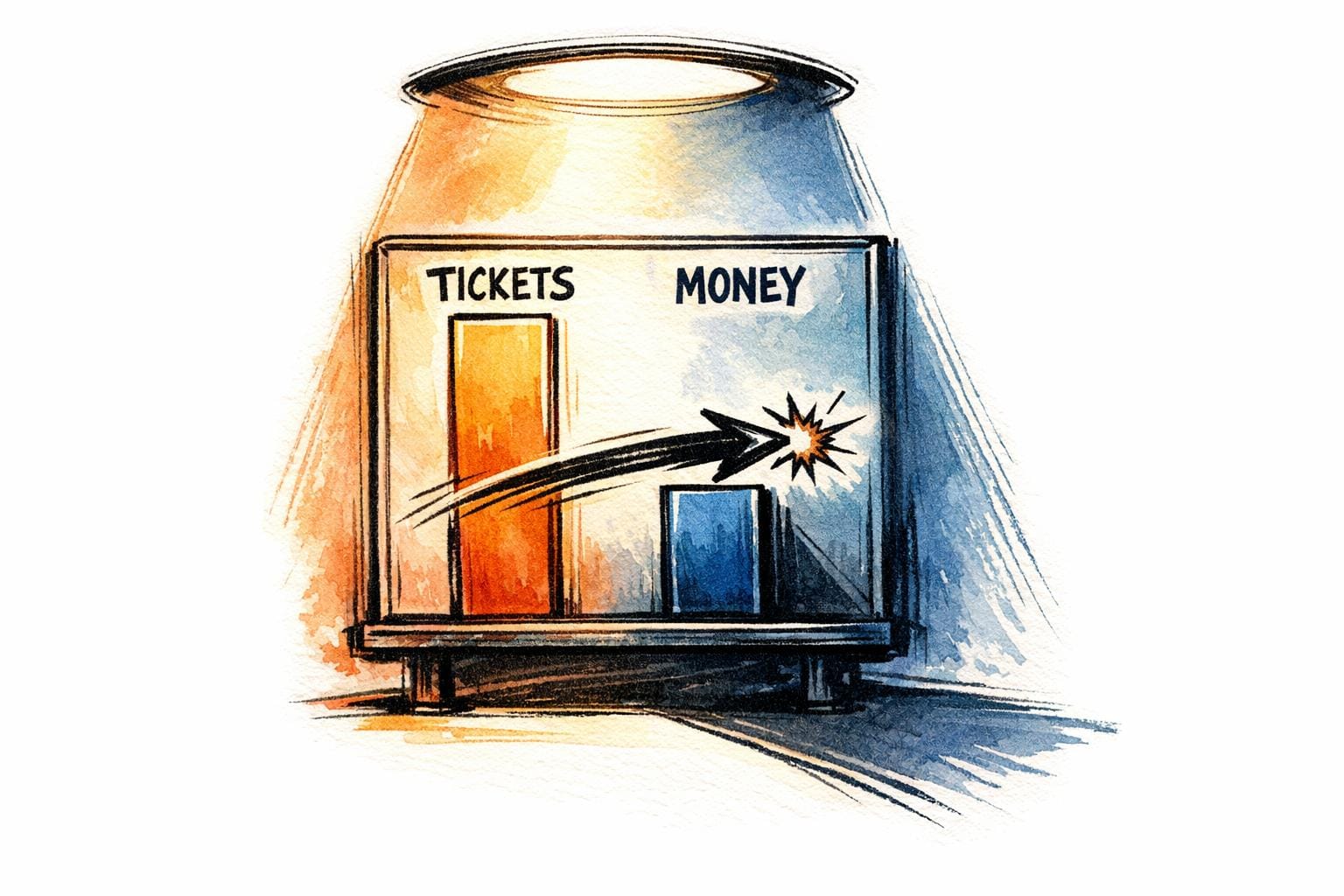
Betting splits reveal how bets and money are distributed across wagers, helping identify trends between public bettors (casual, smaller bets) and sharp bettors (professionals, larger bets). Here's what you need to know:
- Ticket Percentage: Tracks the number of individual bets (public sentiment).
- Money Percentage: Tracks total dollars wagered (sharp conviction).
- Key Insight: A gap between these percentages (the "Delta") often signals sharp activity, like when fewer bets but more money back an underdog.
Sharp Bettors vs Public Bettors:
- Sharps bet early, use data models, and focus on value.
- Public bettors bet emotionally, favor popular teams, and bet closer to game time.
Sharp Money Indicators:
- Reverse Line Movement: Line shifts opposite to public betting trends.
- Steam Moves: Sudden line shifts across sportsbooks.
- Bet-Money Percentage Gaps: Large differences between ticket and money percentages.
- Timing Patterns: Sharps act early or during high-limit windows.
Tools like WagerProof can help analyze these patterns using real-time alerts, AI insights, and advanced betting data. Understanding these trends can help you make informed betting decisions.
What Does Fading the Public and Chasing Steam or Sharp Money Mean? | Sports Betting 102
Sharp Bettors vs Public Bettors
Sharp vs Public Bettors: Key Differences in Sports Betting Strategy
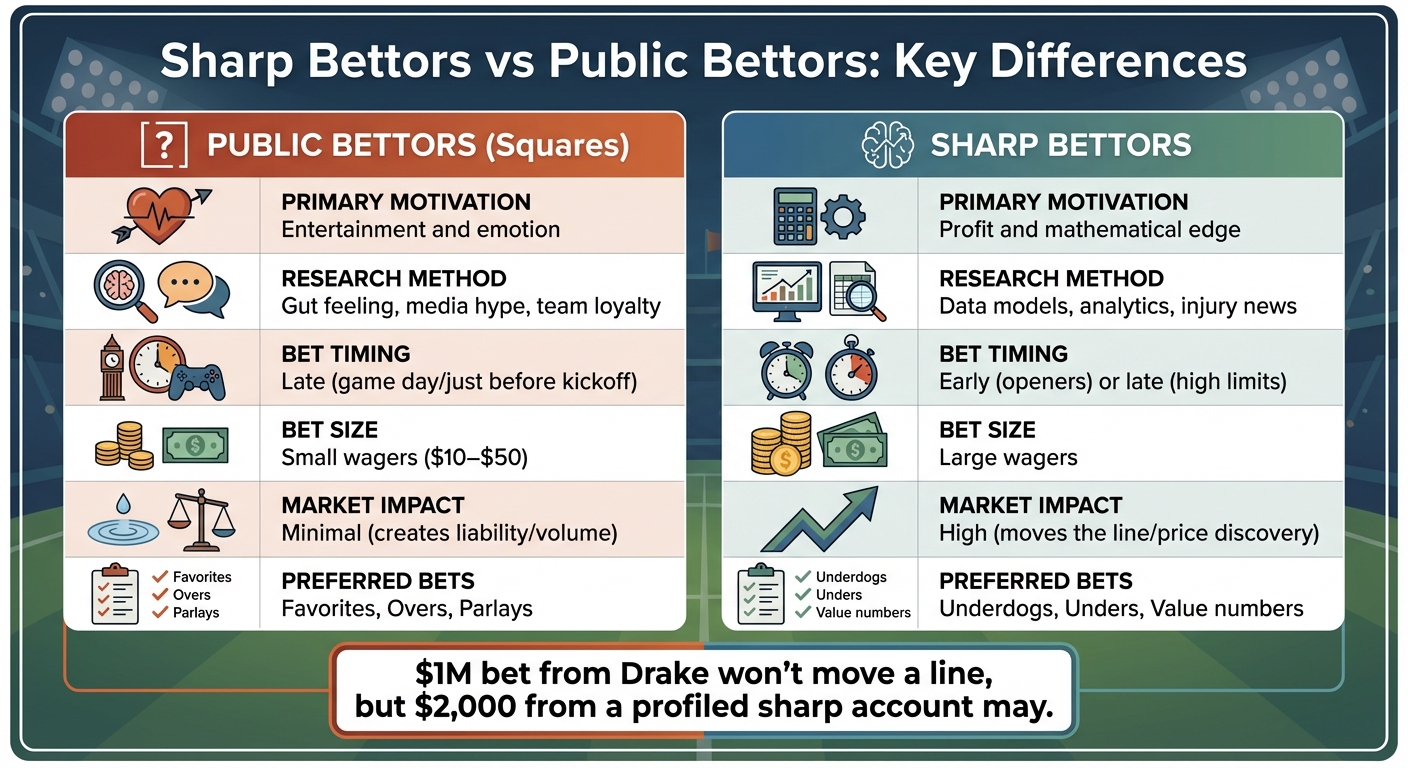
Understanding the difference between sharp and public bettors is essential for interpreting betting patterns. These two groups approach sports betting with entirely different strategies, and their behaviors shape the betting splits data. Recognizing these differences can help you identify sharp money indicators.
How Sharp Bettors Operate
Sharp bettors view sports betting as an investment. They rely on data models and analytics to identify mispriced lines. Their focus is on finding value - situations where the odds don't accurately reflect the true probability of an outcome.
One of their key metrics is Closing Line Value (CLV), which shows whether they secured a better line than the final closing number. Timing is critical for sharp bettors. They strategically place bets to exploit inefficiencies and often make decisions based on limits and line movement. This calculated approach is evident in betting splits, where the money percentage often differs from the ticket percentage. Sharps aim for a long-term win rate of about 55%, which allows them to profit even after factoring in the sportsbook's edge.
"$1M bet from Drake won't move a line, but $2,000 from a profiled sharp account may." – Betting Analyst
This quote highlights a key reality: sportsbooks value sharp action far more than public money. A small bet from a known professional can trigger immediate line adjustments, while even massive celebrity wagers may not affect the market. Sportsbooks treat sharp bets as critical information, using them to refine their lines.
How Public Bettors Operate
Public bettors, on the other hand, are often influenced by emotion and media narratives. They tend to favor "overs", popular teams like the Cowboys or Lakers, and betting on favorites. Most recreational bettors place small wagers, typically between $10 and $50.
Public bettors usually place their bets late, often on game day, when the market is most liquid. They favor parlays and bets that align with popular opinion. While sportsbooks are happy to accept public money due to the house edge gradually eroding these bankrolls, they act quickly when they spot sharp action.
Sharp vs Public Bettors: Comparison Table
Here’s a quick breakdown of the key differences between sharp and public bettors:
| Feature | Public Bettors (Squares) | Sharp Bettors |
|---|---|---|
| Primary Motivation | Entertainment and emotion | Profit and mathematical edge |
| Research Method | Gut feeling, media hype, team loyalty | Data models, analytics, injury news |
| Bet Timing | Late (game day/just before kickoff) | Early (openers) or late (high limits) |
| Bet Size | Small wagers ($10–$50) | Large wagers |
| Market Impact | Minimal (creates liability/volume) | High (moves the line/price discovery) |
| Preferred Bets | Favorites, Overs, Parlays | Underdogs, Unders, Value numbers |
The takeaway here is that sportsbooks treat money differently depending on its source. Sharp money helps them fine-tune their lines, while public money is welcomed because the house edge ensures profitability over time. These contrasting behaviors are the foundation for spotting sharp money in market movements.
How to Spot Sharp Money in Betting Splits
When professionals influence betting markets, there are four key signs to look for: reverse line movement, steam moves, bet-to-money percentage gaps, and timing patterns. These clues can help identify sharp action.
Reverse Line Movement
Reverse Line Movement (RLM) occurs when a betting line shifts in the opposite direction of public betting trends. For example, if 80% of bets favor a team at -7, but the line moves to -6.5, this suggests sharp money is driving the change. Sportsbooks often respect sharp bettors enough to adjust lines against public sentiment, even if it increases their liability.
Sometimes, sportsbooks will hold a line steady despite overwhelming public action. For instance, if 90% of bets are on the Over at 55.5, but the total doesn’t budge, it shows the book is "taking a stand" with sharp money on the Under. This tactic highlights where the bookmakers align their risk, often siding with professional bettors.
Steam Moves
Steam moves are sudden, simultaneous line shifts across multiple sportsbooks, typically involving at least five major books. These moves often happen when professional syndicates make large bets or when new information impacts the market.
"Steam moves happen when multiple sportsbooks move at once in one direction. That usually means a group of sharps hit the same side across books during a high-limit window." – Lesly Shone, AI Model Builder
A true steam move is most reliable when it occurs at respected high-limit books like Pinnacle or Circa. If only one sportsbook adjusts its line while others hold steady, it’s more likely a localized reaction to liability rather than sharp action.
Bet vs. Money Percentage Gaps
The difference between the percentage of tickets (bets) and the percentage of money wagered - often called the "delta" - is a strong indicator of sharp betting. When a team gets less than 40% of bets but more than 60% of the money, it’s a classic sign of sharp action.
- Small gaps (8–10%) can hint at potential value.
- Larger gaps (15–20%) strongly suggest sharp confidence.
However, validation is essential. If a sharp side doesn’t cause a line adjustment, the signal might just be noise.
| Scenario | Data Example | Interpretation |
|---|---|---|
| Alignment | 75% Tickets / 78% Money | No Edge: Public and sharps agree; line is efficient. |
| Public Overload | 80% Tickets / 55% Money | Fade Opportunity: Public is overconfident; sharps disagree. |
| Sharp Split | 35% Tickets / 65% Money | High Value: Pros back an unpopular side with large bets. |
These scenarios illustrate when sharp bettors diverge from public sentiment, offering actionable insights.
Bet Timing Patterns
Sharp bettors typically act early in the week to exploit softer opening lines or breaking news. Public betting, by contrast, often peaks closer to game time. That said, major steam moves often occur late when sportsbooks increase betting limits.
For NFL games, early-week splits (like on Tuesday) often lack significance due to low liquidity. By Sunday morning, when limits are higher, the market reflects sharper liability. In the NBA, splits can shift dramatically if a star player’s status changes shortly before tip-off.
Chasing steam moves after the line has shifted is rarely profitable. For example, if a spread moves two points following sharp action, betting at the adjusted line often leads to poor Closing Line Value (CLV). Instead, focus on early moves at market-leading sportsbooks and look for retail lines that haven’t yet caught up.
How to Read Betting Splits: Step-by-Step
Understanding betting splits is all about separating public opinion from professional betting patterns. Here's a straightforward guide to help you analyze betting splits effectively and apply them during your evaluations.
Step 1: Check Bet Percentages
Start by looking at the Ticket Percentage, which reflects the public's betting preferences. This shows the proportion of total bets placed on a particular side. For instance, if 80% of tickets are on the Kansas City Chiefs at -7, it’s clear that casual bettors are heavily backing the Chiefs. However, this metric alone doesn't tell you where the larger, more strategic wagers - often from professional bettors - are going.
Step 2: Compare Bet and Money Percentages
Next, compare the Ticket Percentage with the Money Percentage to spot sharp betting activity. The Money Percentage indicates the total dollar amount wagered on a side. Since professional bettors tend to place larger bets, a higher Money Percentage compared to Ticket Percentage often signals sharp action.
Pay attention to the delta (the difference between these percentages). A gap of more than 10% is a strong indicator of sharp interest. For example:
- A "Sharp Split" occurs when a team has less than 40% of tickets but more than 60% of the money.
- Conversely, if a team has 80% of tickets but only 55% of the money, this suggests "Joe Overload" - a situation where public enthusiasm is high, but professionals aren't backing it proportionally. This could be a good opportunity to fade the public.
Step 3: Monitor Line Movement
Line movement can confirm sharp betting trends. If 70% of bets are on a favorite, but the line moves toward the underdog, this is known as Reverse Line Movement (RLM). It’s a clear signal that sportsbooks are reacting to sharp money rather than public volume.
Sharp line movements are most reliable when they occur at market-making sportsbooks like Pinnacle or Circa, as these books are known for reflecting professional action. On the other hand, adjustments at retail sportsbooks like DraftKings or FanDuel might primarily aim to balance public betting risk.
Step 4: Find Underdog Value
Sharp bettors often target underdogs, especially when the Ticket Percentage is below 40%, the Money Percentage is above 60%, and the line moves in favor of the underdog due to reverse line movement. These scenarios often highlight high-value opportunities.
The table below breaks down common betting split scenarios and what they reveal:
Betting Splits Analysis: Example Table
| Bet Type | Public Bet % | Money % | Key Insight |
|---|---|---|---|
| Alignment | 75% | 78% | No Edge: Public and sharps agree; the line is efficient. |
| Public Overload | 80% | 55% | Fade Opportunity: Public enthusiasm without big-money backing. |
| Sharp Split | 35% | 65% | High Value: Sharp bettors favor the unpopular side. |
| Reverse Line Movement | 70% (Team A) | 40% (Team A) | Sharp Action: Line shifts toward Team B despite Team A's popularity. |
Using WagerProof for Betting Splits Analysis
WagerProof brings together live betting data, AI-driven insights, and instant alerts in one easy-to-navigate platform.
Real-Time Betting Splits and Money Leans
The Edge Finder tool in WagerProof scans multiple sportsbooks to find pricing gaps and lines that haven’t caught up with market trends. It uses sharp benchmarks like Pinnacle and Circa to highlight "stale" lines at retail books. For instance, if these market leaders adjust their odds but other books lag behind, you’ve got a chance to act before the market corrects itself.
WagerProof also identifies patterns such as reverse line movement, steam moves, and bet-to-dollar imbalances. Take this scenario: a team has only 30% of the bets but accounts for 60% of the money. This bet-to-dollar ratio often signals sharp action, and WagerProof flags it in real time, giving you a starting point for deeper analysis using its AI tools.
AI-Powered Analysis with WagerBot Chat
Once you receive real-time alerts, WagerProof’s advanced AI tools step in to refine your strategy. WagerBot Chat connects you to professional betting data, steering clear of the inaccuracies found in generic AI systems. You can ask direct questions like, “How do home underdogs perform against the spread in the NBA?” and get a detailed response that integrates factors like injuries, weather, odds, and model predictions.
If you notice an unusual line move, WagerBot can help you figure out whether it’s due to sharp syndicate activity or a late public betting surge. It works alongside the Edge Finder to explain alerts, such as reverse line movement or steam moves, ensuring you can confirm whether these patterns align with profitable trends. To complement this, tools like the Model Aggregator and AI Game Simulator further pinpoint betting opportunities.
Outlier Detection and Value Bets
The Model Aggregator in WagerProof gathers predictions from 50 statistical models to identify consensus picks and outliers. Using z-score standardization, it ranks games - any z-score above 2.0 indicates a strong consensus that a sportsbook line is off. Meanwhile, the AI Game Simulator runs thousands of simulations per game, calculating win probabilities to help you verify whether the range of outcomes supports the identified value.
Conclusion
By diving into the mechanics of betting splits and the contrasting behaviors of sharp and public bettors, you’re now better equipped to make decisions rooted in data rather than guesswork. One of the key takeaways is understanding the Delta - the difference between Ticket Percentage and Money Percentage. This gap often highlights where sharp money is being placed, providing a valuable clue worth further investigation.
AI-powered tools have made this process more efficient than ever. Tools like WagerProof's Edge Finder, AI Game Simulator, and WagerBot Chat help identify these patterns in real time, offering insights before market adjustments occur.
Professional bettors, or sharps, take a long-term approach rather than chasing quick wins. They use strategies like fractional Kelly sizing (typically 0.25 to 0.5 Kelly) to determine bet sizes, balancing perceived edges with bankroll protection against variance. Additionally, they track Closing Line Value (CLV) to ensure they’re consistently securing better odds than the final market price.
Sharps also tend to act early, placing small bets to influence lines in their favor. On the other hand, when sportsbooks hold firm on a line despite heavy public action, it’s often a sign they’re comfortable taking the less popular side. These subtle market movements distinguish casual betting from professional-level analysis.
To gain an edge, focus on monitoring market-maker books, analyzing the Delta in betting splits, and leveraging AI tools like those from WagerProof. The data is there - your success lies in how you interpret it.
FAQs
What’s the quickest way to confirm a “sharp split” is real?
The quickest way to confirm a sharp split is by identifying reverse line movement. This happens when the betting line moves in the opposite direction of the public betting trend. It’s a strong sign that professional bettors, or sharps, are impacting the market - even when most bets are backing the other side.
Why can the line move against the side getting most of the bets?
When the line moves against the side with the majority of bets, it’s often due to sharp money - bets placed by professional gamblers who rely on data and expertise. Sportsbooks give more importance to these informed wagers because they’re typically backed by solid analysis. As a result, the line can shift in favor of the opposing side, even if the general public overwhelmingly bets on one team. This highlights how sharp, high-stakes betting can outweigh the sheer number of public wagers.
When are betting splits most reliable during the week?
Betting splits tend to be more reliable earlier in the week, typically on Tuesday or Wednesday. At this stage, they often showcase the activity of sharper bettors, providing a clearer picture of market trends. As the week progresses, public betting behavior starts to have a greater impact on the splits, making them less reflective of sharp action.
Related Blog Posts
Ready to bet smarter?
WagerProof uses real data and advanced analytics to help you make informed betting decisions. Get access to professional-grade predictions for NFL, College Football, and more.
Get Started Free