Reverse Line Movement: Betting Volume Explained
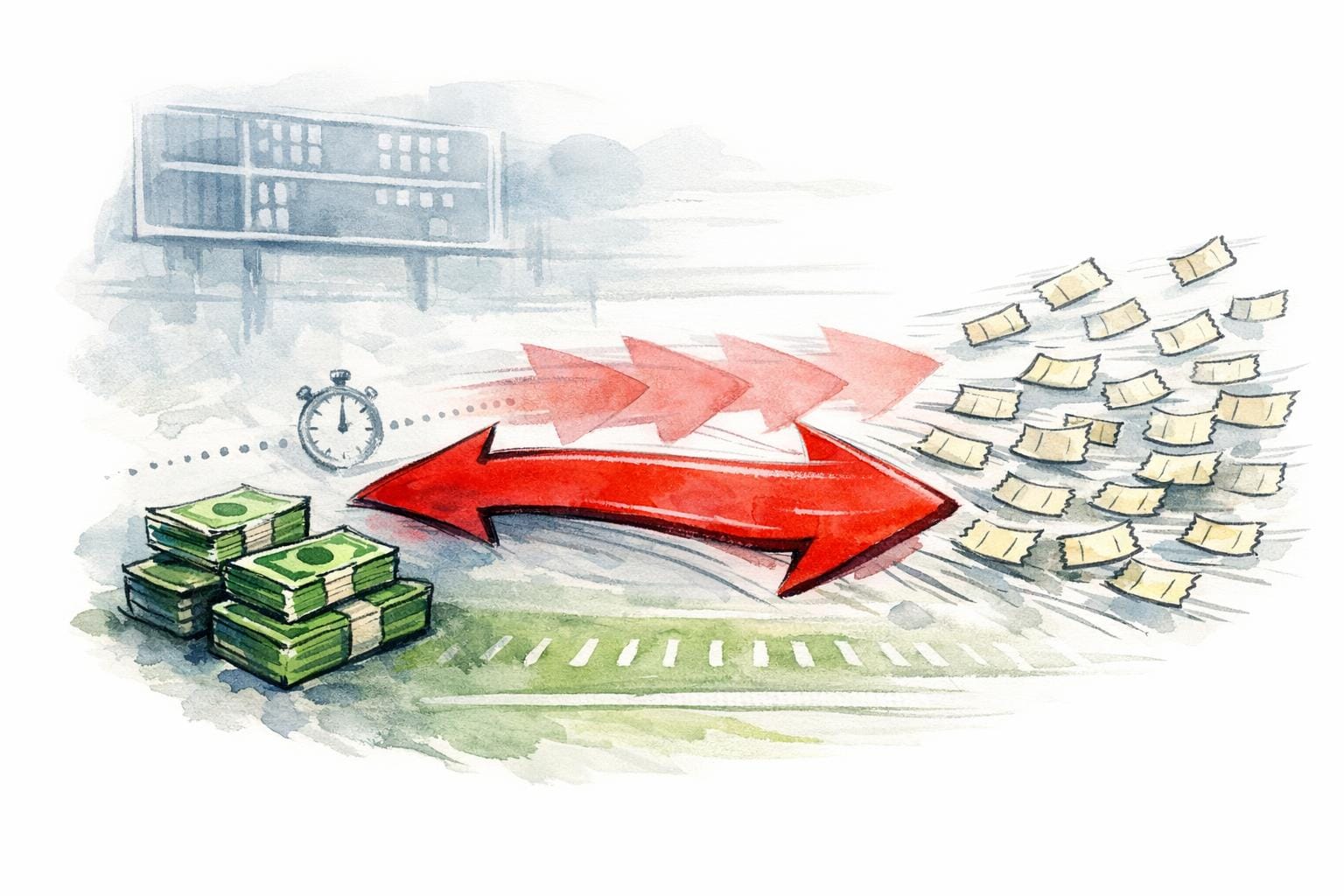
Reverse Line Movement (RLM) happens when betting lines shift in the opposite direction of where most bets are placed. This usually signals sharp money - large, informed bets by professional bettors - impacting the market. Sportsbooks adjust lines based on sharp action rather than public betting trends to manage risk.
Key Points:
- What is RLM? When the betting line moves against public bets, often due to sharp money.
- Why does it happen? Sharp bettors place large wagers on the less popular side, prompting sportsbooks to recalibrate odds.
- How to spot it? Look for games where the ticket percentage (number of bets) and money percentage (total dollars wagered) diverge significantly.
- Example: In a game where 70% of bets favor one team, but the line moves in favor of the other, sharp money is likely influencing the market.
Quick Tip:
Use tools like WagerProof to track live betting data and identify sharp action. Focus on games with at least a 20% gap between bet dollars and tickets to align with professional insights.
RLM offers a way to understand professional betting patterns and make more informed decisions.
What Reverse Line Movement Actually Means
Breaking Down Betting Volume
Ticket Percentage vs Money Percentage in Sports Betting
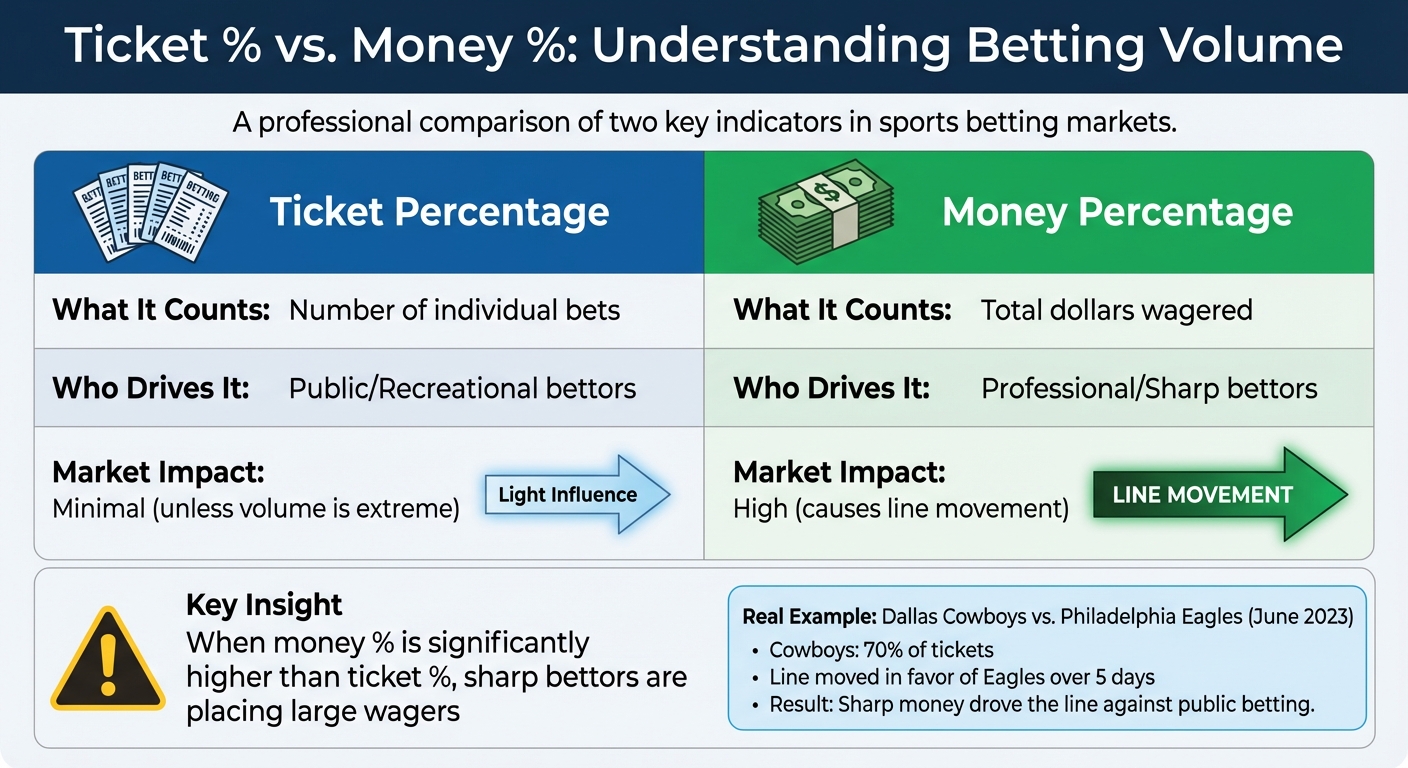
Betting volume is divided into two key metrics: ticket percentage, which counts the number of individual bets, and money percentage, which measures the total amount of dollars wagered. These metrics often diverge. For instance, a game might see a high number of bets on one side, while professional bettors place fewer but much larger wagers on the opposite side.
Ticket Percentages vs. Money Percentages
The contrast between these two metrics reveals who is placing the bets. A notable example occurred in June 2023 during a Dallas Cowboys vs. Philadelphia Eagles matchup. The Cowboys opened as 3.5-point favorites, and 70% of the tickets supported them. However, sharp money backed the Eagles, driving the line in their favor over five days.
| Metric | What It Counts | Who Drives It | Market Impact |
|---|---|---|---|
| Ticket % | Number of bets | Public/Recreational bettors | Minimal (unless volume is extreme) |
| Money % | Total dollars wagered | Professional/Sharp bettors | High (causes line movement) |
When the money percentage is significantly higher than the ticket percentage, it signals that sharp bettors are placing large wagers. This divergence highlights the influence of professional money in shaping betting markets.
How Sharp Money Affects Betting Volume
The interplay between ticket and money percentages becomes crucial when sharp money is involved. Sportsbooks prioritize who is betting rather than just the volume of bets. Professional bettors, known for their consistent success, prompt sportsbooks to adjust lines to minimize risk.
"Those large bets – most commonly placed by sharp bettors with a history of successful bets against the public – are enough to move the line in the opposite direction of the public tickets." - Jason Scott, Vice President of Trading at BetMGM
A perfect illustration of this occurred on MLB Opening Day in March 2023. The Chicago White Sox opened at +145 against the Houston Astros. Despite the Astros receiving 60% of the betting tickets, the line shifted to +130 in favor of the White Sox within hours. This movement indicated sharp money backing the underdog, who went on to win 3-1. The sportsbooks adjusted to the sharp money, recognizing its accuracy in identifying mispriced lines.
These adjustments, driven by sharp action, often result in reverse line movement. Sportsbooks aim to balance their exposure by siding with sharp bettors rather than the public. When the money percentage diverges significantly from the ticket percentage, it’s a clear sign of sharp involvement.
The Mechanics of Reverse Line Movement
Reverse line movement occurs when sportsbooks adjust betting lines in a way that goes against public betting trends. This happens because of sharp money - large, informed bets placed by professional bettors. These bets push oddsmakers to recalibrate their lines, even when the majority of wagers are on the opposite side.
Why Sportsbooks Prioritize Sharp Money
Sportsbooks care more about who is betting than simply the volume of bets. Professional bettors, or sharps, have a history of long-term success, and their large wagers often signal that a line might be off. When a sharp bettor places a significant bet on the less popular side, sportsbooks view it as a correction to the market. They adjust the line to manage their risk, even if it creates an imbalance in the betting handle.
This approach shifts away from the traditional goal of balancing bets on both sides to collect the juice. Instead, sportsbooks are willing to accept lopsided action if they believe the sharp side represents the true odds.
"Sports traders 'listen to their customers' and 'allow customer behavior to dictate the market' ... those large bets – most commonly placed by sharp bettors with a history of successful bets against the public – are enough to move the line in the opposite direction of the public tickets." - Jason Scott, Vice President of Trading at BetMGM
By respecting sharp action, sportsbooks protect themselves from being overly exposed to informed bets. This adjustment by the most influential sportsbooks - known as lead books - often triggers a ripple effect across the market.
Lead Books and Industry-Wide Adjustments
Lead books, such as Pinnacle and Circa Sports, cater to high-stakes bettors and are often the first to adjust their lines in response to sharp action. These books are closely monitored by others in the industry. When a lead book shifts its line, it often sets off a chain reaction.
Other sportsbooks, aiming to avoid risk, quickly follow suit. This practice is known as "moving on air" - adjusting lines not because of direct bets but to mirror changes made by lead books. Danny Donahue from Action Network explains this process:
"Those that [welcome sharp action] will often move first when they get a big bet from a respected player, and the rest of the books will follow quickly after. For books that quickly mirror these moves, that's called 'moving on air.'"
These swift and widespread line adjustments, often called steam moves, usually stem from sharp action at a lead book. For bettors, this creates opportunities to exploit slower-moving sportsbooks that lag behind in updating their lines.
How to Spot Reverse Line Movement Using Data
Spotting reverse line movement involves keeping an eye on two key metrics: ticket percentages and money percentages. When these two figures show a significant gap, it often indicates sharp bettors influencing the line against public opinion. Having access to real-time data is what sets sharp bettors apart from the rest.
Reading Ticket and Money Splits
The first step in identifying reverse line movement is spotting games where ticket and money percentages diverge by at least 20%. For instance, if a team has less than 40% of the tickets but more than 60% of the money, it’s a strong hint that sharp bettors are placing larger bets on that team.
Pay close attention to how the line shifts. Let’s say 70% of the public bets on a favorite at -7, but the line drops to -6.5 or -6. This is a clear sign that sharp money is backing the underdog. A real-world example occurred on April 26, 2023, during an NBA Playoffs game between the Milwaukee Bucks and Miami Heat. Despite 80% of the tickets being on the Heat, the Bucks drew 51% of the money on just 20% of the bets. The line moved from Bucks -11 to -12, signaling sharp action on Milwaukee.
Historical data also backs this strategy. During the 2022–23 NFL season, teams in games with a "sharps vs. squares" dynamic - where there was at least a 20% discrepancy between bets and money - achieved a record of 53–34–5 against the spread, delivering a +15.5% return on investment. Timing matters as well. Late line moves, closer to kickoff, are generally more trustworthy since they’re less likely to be "dummy moves" designed to mislead the market.
To make the most of these insights, having access to real-time betting platforms is crucial.
Using WagerProof for Real-Time Betting Data
Once you’ve identified these discrepancies, acting quickly is key, and that’s where real-time data tools like WagerProof come into play. Immediate access to betting data can amplify your ability to capitalize on reverse line movement.
Real-time data is particularly useful for steam chasing - this involves spotting a line move at a market-setting sportsbook and placing a bet at a slower-reacting book before the odds adjust. WagerProof provides live updates on bet percentages, money distribution, and prediction market data in a user-friendly interface. It even highlights outliers and value bets, sending alerts when prediction market spreads deviate or when it’s time to fade certain games.
Unlike pick services that simply tell you what to bet, WagerProof empowers you to spot reverse line movement yourself. By monitoring market-setting sportsbooks like Circa Sports or Pinnacle, you can catch early line moves. When these books adjust their lines but others lag behind, it creates an opportunity to act quickly. Professional bettors, using line movement data, beat the closing line 75–80% of the time, compared to 60–70% for casual bettors. With WagerProof’s real-time tools and WagerBot Chat, you can track these movements as they happen and make well-informed bets before the market catches up.
Betting Strategies Based on Reverse Line Movement
Building on the concept of reverse line movement, these strategies can help you take advantage of professional betting signals. To apply them effectively, focus on betting against public sentiment, comparing lines across sportsbooks, and keeping an eye on long-term trends.
Contrarian Betting: Going Against the Public
Contrarian betting means placing wagers on outcomes that casual bettors tend to avoid. When reverse line movement occurs, it often signals that sharp bettors - professionals with significant influence - are betting against the general public. Look for games where a team has 35% or less of the betting tickets, but the line shifts in their favor. A Pro Edge difference of +10% or more is another strong indicator of sharp, contrarian action.
The NFL is particularly suited for this approach due to its high betting volume and predictable public sentiment. For instance, NFL prime-time unders have hit at a rate of 60.2% over six seasons, with nearly 70% of prime-time games going under - highlighting the value of betting against the crowd.
To ensure you're making an informed decision, always verify line movements with reputable sportsbooks and check for late-breaking news or injury updates that could explain the shift. Then, compare odds across multiple sportsbooks to secure the best possible value.
Line Shopping to Maximize Returns
Line shopping is a crucial step in maximizing the value of your reverse line movement bets. Even a small difference, like betting at -2.5 instead of -3, can turn a potential push into a win. Since sportsbooks adjust their lines at different speeds, having accounts with multiple sportsbooks allows you to act quickly and lock in favorable odds before the market fully reacts.
Additionally, comparing lines helps confirm the legitimacy of a reverse line movement. If a shift only occurs at one sportsbook and not at trusted lead books, it could be a false signal. This extra diligence can save you from making bets based on misleading information.
Historical Win Rates and Long-Term Results
While individual bets may vary, long-term data supports the effectiveness of reverse line movement strategies. By consistently monitoring trends and verifying line movements with reputable sportsbooks, you can uncover market value over time. The table below highlights how reverse line movement scenarios perform across different sports:
| Sport | Ideal RLM Scenario | Effectiveness |
|---|---|---|
| NFL | Heavy public betting on a favorite, line moving toward the underdog | High |
| NBA | Underdogs with 30% or less of public bets | Moderate |
| MLB | Sharp money on underdogs with strong pitching | Moderate |
Success in reverse line movement betting requires a combination of thorough research, disciplined line shopping, and a focus on long-term trends rather than short-term outcomes. Using tools like WagerProof to track real-time data can further improve your ability to identify and act on these market shifts, giving you a sharper edge in your betting decisions.
Conclusion
Understanding betting volume and reverse line movement can give you an edge in sports betting. For instance, when 75% of bets favor a particular team, but the line shifts in favor of the opponent, it’s often a sign of sharp money at play. This reflects the actions of professional bettors who excel at finding long-term value and are backing the less popular side.
However, context is everything. Not every line movement is tied to sharp action - factors like injuries, weather updates, or breaking news can also cause shifts in odds. To confirm sharp activity, compare line movements across market-setting sportsbooks like Circa or Pinnacle. This extra step ensures you're basing decisions on reliable indicators.
Another crucial strategy is line shopping. Sportsbooks don’t all adjust their lines at the same pace, so having accounts at multiple books lets you grab the best odds available before the market fully reacts. Securing better lines directly improves your profitability over time.
Discipline and data-driven strategies are equally important. Professional bettors stick to betting units (typically 1–5% of their bankroll) and avoid risky parlays, focusing instead on straight bets for sustainable growth. They also keep realistic expectations, aiming for a 55–60% win rate and a 3–7% ROI over the long haul - metrics that define professional-level success.
Tools like WagerProof can help refine your approach. By combining real-time data with market insights, it highlights public betting trends, money splits, and alerts when market movements don’t align with predictions. Its transparent features help you understand why lines move, giving you the confidence to make informed bets. Incorporating these strategies and tools into your betting routine can lead to more consistent and rewarding results.
FAQs
Does reverse line movement always mean sharp money?
Reverse line movement doesn't always mean sharp money is involved. While it often points to sharp action when the line shifts against the bulk of public bets, other elements - like a sportsbook's risk management strategies - can also drive such changes. To interpret it accurately, it's crucial to grasp the full context behind the movement.
What bet% vs money% gap is strong enough to trust?
When there's a gap of 10% or more between bet% and money%, it’s usually a clear sign of sharp betting activity. This becomes even more evident when the money% is noticeably higher than the ticket%. Such a pattern often indicates that professional bettors are making moves that are impacting the market.
How can I tell RLM from injury or weather news?
Reverse line movement (RLM) becomes noticeable when you analyze market trends closely. It occurs when the betting line shifts in the opposite direction of where the majority of public bets are placed. This isn't typically caused by external factors like injuries or weather but is instead driven by sharp money - bets placed by professional bettors or insiders.
To spot RLM, pay attention to how the line moves compared to the betting volume. If the line adjusts contrary to where most of the public money is going, it’s likely influenced by these sharp bettors rather than outside events. This focus helps distinguish true RLM from shifts caused by news or other external developments.
Related Blog Posts
Ready to bet smarter?
WagerProof uses real data and advanced analytics to help you make informed betting decisions. Get access to professional-grade predictions for NFL, College Football, and more.
Get Started Free