
ROI vs. Win Rate: What Matters More?
When it comes to evaluating betting success, two metrics stand out: ROI (Return on Investment) and Win Rate. Here's the quick takeaway:
- Win Rate: Measures how often you win bets. Great for tracking accuracy but doesn't show profitability. For example, a 60% win rate can still lose money if you're betting on low-odds favorites.
- ROI: Tracks profit efficiency per dollar wagered. Even with a lower win rate, a positive ROI means you're making smart, profitable bets.
For casual bettors, win rate offers a simple way to gauge performance. But if you're serious about long-term success, ROI is the better measure of financial outcomes. Ideally, use both metrics together for a complete picture of your betting strategy.
Quick Comparison
| Aspect | Win Rate | ROI |
|---|---|---|
| Focus | Accuracy of predictions | Profit per dollar risked |
| Calculation | (Wins ÷ Total Bets) × 100 | (Net Profit ÷ Total Wagered) × 100 |
| Accounts for Odds | No | Yes |
| Short-Term Use | High | Low (needs more data) |
| Long-Term Use | Low | High |
| Best For | Beginners, casual tracking | Professionals, long-term profitability |
Bottom line: ROI reveals true profitability, while win rate highlights accuracy. Use both to refine your strategy.
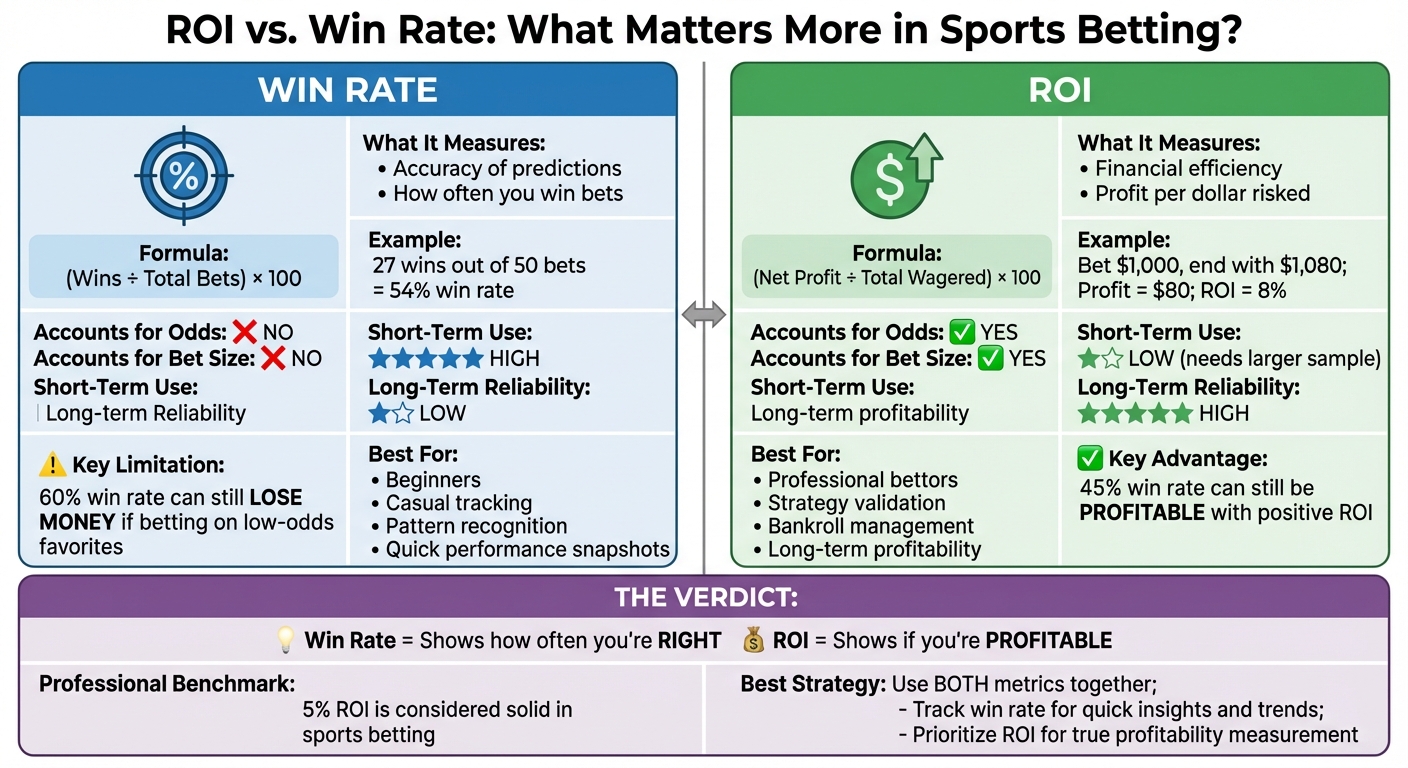
ROI vs Win Rate in Sports Betting: Complete Comparison Guide
Understanding ROI and Win Rate
What is Win Rate?
Win rate is calculated using a simple formula: (winning bets ÷ total bets) × 100. For example, if you win 27 bets out of 50, your win rate would be 54%.
This number reflects how often you're correct, but it doesn't tell the whole story. It doesn't account for the odds of your bets, the size of your wins, or your overall profit. For instance, consistently winning 70% of bets on heavy favorites might still lead to losses if the odds are low and just a few losses wipe out your gains.
What is ROI?
ROI, or return on investment, measures how profitable your bets are. It shows how much profit you make for every dollar you wager. The formula is straightforward: divide your net profit by the total amount wagered, then multiply by 100 to get a percentage.
Here’s an example: If you bet $1,000 across several wagers and end up with $1,080, your net profit is $80. Your ROI would be 8% ($80 ÷ $1,000 × 100). Interestingly, even with a win rate of 45%, a positive ROI indicates you're finding value in the odds and making smart betting decisions.
Up next, we'll dive deeper into the pros and cons of each metric.
Strengths and Weaknesses of Win Rate
When Win Rate is Useful
Win rate gives you a clear picture of how often your predictions hit the mark. This metric can be incredibly helpful for spotting trends in your betting habits. For instance, it can reveal which sports, leagues, or bet types are most successful for you. It’s also a great way to test new strategies, offering a straightforward measure of prediction accuracy without needing complex math. In head-to-head competitions or when tracking short-term results purely for fun, win rate provides quick and direct feedback on how well you’re doing. However, as we’ll see, relying on win rate alone can lead to some pitfalls in the long run.
Limitations of Win Rate
While win rate is easy to understand, it doesn’t tell the full story - especially when it comes to profitability. You could maintain a high win rate, say 60% or more, and still lose money if you’re consistently betting on heavy favorites with low payouts. Here’s an example: Imagine you place ten $100 bets on favorites at -300 odds (meaning you risk $300 to win $100). If you win seven of those bets, your win rate is an impressive 70%, and you’ve earned $700. But the three losses would cost you $900, leaving you $200 in the red.
On top of that, sportsbooks charge juice (or vigorish), which means you often need to win more than 50% of your bets just to break even - especially with standard -110 odds. So, while win rate measures how accurate your predictions are, it doesn’t account for profitability. Relying on it alone to guide long-term betting decisions can lead to misleading conclusions.
Strengths and Weaknesses of ROI
Why ROI Matters for Long-Term Success
ROI is the ultimate gauge of whether your investments are paying off. While win rate simply tracks how often you win, ROI goes deeper - it measures how effectively each dollar you risk generates value. This metric provides a clearer picture of long-term profitability, making it an essential tool for assessing the efficiency of your strategies.
A positive ROI shows that your approach is working, delivering more money than you’re putting in. This reflects smart decision-making and effective money management. What’s interesting is that even if your win rate isn’t stellar, finding consistent value can still lead to profitability. ROI captures these nuances in a way that win rate alone cannot.
That said, while ROI shines in many aspects, it’s not without its challenges.
Challenges of Using ROI
ROI has its drawbacks, and understanding them is key to using it effectively. One major issue is its sensitivity to small sample sizes, which can distort the true picture of performance. For example, if you’ve only placed 50 bets and happen to hit a few big underdogs, your ROI might look incredible - but it could just be luck. In contrast, a 5% ROI over 2,500 bets is a much stronger indicator of skill than the same return over just 250 bets.
Another challenge is that ROI doesn’t automatically account for risk levels. A high ROI from betting on longshots with odds of 10.000 might seem impressive, but such results are more expected with high-risk wagers. This doesn’t necessarily reflect greater skill compared to someone betting on safer odds like 2.000. Without considering average odds and betting history, comparing ROIs can lead to misleading conclusions about someone’s expertise.
Ultimately, ROI’s reliability grows with scale. Long-term tracking and a large dataset are critical to ensure ROI provides an accurate measure of performance. Without these, it’s easy to misinterpret short-term gains as skill rather than chance.
ROI vs. Win Rate: A Direct Comparison
Metric Comparison Table
Understanding the differences between these metrics is key to selecting the right one for your needs. Here's a side-by-side breakdown:
| Aspect | Win Rate | ROI |
|---|---|---|
| Focus | Accuracy of predictions – how often you win | Financial efficiency – profit per dollar risked |
| Calculation | (Wins / Total Bets) × 100 | (Net Profit / Total Invested) × 100 |
| Accounts for Odds | No – all wins treated equally | Yes – considers payout sizes and odds |
| Accounts for Bet Size | No – stake amounts ignored | Yes – reflects returns based on investment |
| Short-Term Usefulness | High – quick snapshot of performance | Low – needs a larger sample size for accuracy |
| Long-Term Reliability | Low – can mislead without context | High – shows true profitability over time |
| Best For | Beginners, quick tracking, pattern recognition | Professionals, strategy validation, bankroll management |
This table makes one thing clear: win rate focuses on prediction accuracy, while ROI dives into financial outcomes. For instance, a 60% win rate might sound great, but if those wins are from heavy favorites at odds of 1.20, you could still lose money once occasional losses are factored in. Knowing this distinction helps you pick the metric that aligns with your betting goals.
When to Prioritize Each Metric
If you're just starting out or want a simple way to check your performance, focus on win rate. It's easy to calculate - winning 15 out of 25 bets equals a 60% win rate. This simplicity makes it perfect for spotting basic trends in your betting habits. Casual bettors, who approach wagering as entertainment, often find win rate tracking sufficient without diving into complex math.
On the other hand, ROI becomes essential when you're aiming for consistent, long-term profitability. If you're managing a bankroll or treating betting as a potential source of income, ROI is your go-to metric. For example, achieving a 53% win rate over 3,500 bets, even with a 10% vigorish, could result in a 62% profit - far outperforming typical market returns.
Keep in mind, breaking even requires overcoming the juice (or vigorish), which highlights ROI's importance. A 54% win rate might feel promising, but without calculating ROI, you won't know if you're truly profiting or just breaking even. Generally, a solid ROI benchmark in sports betting is around 5%, accounting for odds and juice.
For the clearest picture, use both metrics together. Win rate helps you identify trends quickly, while ROI confirms whether those trends translate into actual profits. Platforms like WagerProof combine these metrics with tools like the Statistical Edge Finder and historical analytics, giving you both quick insights and deeper financial analysis in one place.
Next, we’ll look at how to combine these metrics for a well-rounded, data-driven betting strategy.
Combining ROI and Win Rate in a Data-Driven Strategy
Using Both Metrics for Complete Analysis
Pairing ROI with win rate offers a more complete view of your betting performance, revealing insights that one metric alone might miss. For instance, a high win rate can sometimes give a false sense of success if the actual value of those wins is minimal. This is where ROI steps in to provide clarity. On the flip side, a bettor with a lower win rate can still be highly profitable if their wins come from high-value wagers. Take NFL and NBA betting as an example: a 60% win rate in NFL games might not generate as much profit as a 55% win rate in NBA matchups if the NBA odds deliver greater value.
Each metric tells a different story about your betting strategy. A high win rate with poor ROI suggests you're accurate but not capitalizing on value, while a lower win rate with strong ROI indicates you're effectively spotting profitable opportunities. Breaking down your performance by sport, league, or bet type can pinpoint where your strategy thrives. This insight helps you fine-tune your bankroll allocation and focus on areas that boost profitability. To make the most of these insights, advanced analytics tools are crucial.
Using Analytics Platforms
Achieving long-term success in betting requires integrating these metrics with smart tools. Advanced platforms simplify complex calculations, making data-driven decisions more accessible. WagerProof, for example, combines win rate and ROI metrics to guide your betting strategy. Its Statistical Edge Finder compares predicted probabilities with bookmaker odds to uncover value bets.
The platform also offers tools like the AI Game Simulator, which lets you test strategies across thousands of games without risking any money, and historical analytics to refine your approach. Meanwhile, the WagerBot Chat provides real-time insights, helping you determine if a bet aligns with your profitability goals or simply boosts your win rate. These tools streamline the decision-making process, ensuring your strategy remains both sustainable and profitable.
Betting Under or Over 2.5 Goals | 75% Strike Rate, 25% ROI & A VERY Interesting Profit Breakdown
Conclusion: Which Metric Matters More?
ROI stands out as the ultimate long-term metric - it tells you how much profit you make for every dollar invested. While win rate shows how often you’re correct, ROI reveals whether your efforts are actually paying off. As Toby from Punter2Pro explains:
"Win rate is a useful statistic, but ROI is the more meaningful measure of success in betting and beyond."
This distinction highlights the specific roles each metric plays in evaluating performance.
Win rate serves as a helpful diagnostic tool, but ROI remains the key indicator of profitability. For instance, a high win rate with poor ROI suggests accuracy without value, whereas a lower win rate with strong ROI indicates you’re finding and exploiting profitable opportunities. Additionally, win rate can uncover patterns across different sports, bet types, or odds ranges, helping you fine-tune your strategy.
Here’s the bottom line: you can win most of your bets and still lose money. Conversely, a lower win rate can still yield higher profits if your ROI is strong. That’s why professional bettors prioritize ROI as their primary focus, using win rate as a secondary metric to validate and refine their strategies.
To make the most of both metrics, focus on ROI to ensure profitability, while leveraging win rate for deeper analysis. By tracking these metrics separately across various sports and bet types, you can identify where your approach performs best. This dual focus offers both a high-level view and detailed insights to help you improve.
Platforms like WagerProof make this process easier by integrating both metrics into one system. Its Statistical Edge Finder emphasizes ROI-driven value bets, while its analytics break down win rates across different contexts. This combination ensures that your wins consistently translate into meaningful profits, offering a balanced, data-driven way to refine your betting strategy.
FAQs
What’s the best way to boost my ROI in sports betting?
To get the most out of your ROI (Return on Investment) in sports betting, shift your focus to spotting high-value opportunities instead of aiming for constant wins. The key is to target bets where the odds are better than the implied probabilities, and to manage your stake sizes wisely to keep risks under control.
Using data-driven tools like WagerProof can make a big difference. These tools help you analyze real-time stats, uncover trends you might otherwise miss, and fine-tune your betting strategies. By regularly reviewing your long-term performance and sticking to well-informed decisions, you can steadily increase your profitability over time.
Why doesn’t a high win rate always mean higher profits?
A high win rate might seem like a good indicator of profitability, but it can be deceiving. It doesn't take into account the odds of the bets you're placing or the amount of money you're wagering. For instance, if you're consistently winning small bets with low odds, your win rate may look impressive. However, if you lose a few larger, higher-risk bets, your overall profits could shrink - or even turn into losses.
If you want a better measure of long-term betting success, focus on ROI (Return on Investment). ROI provides a more complete picture by factoring in both the size of your bets and the payouts. This metric helps you see how well you're managing your bankroll and whether you're finding real value in the bets you place.
When is it better to focus on win rate instead of ROI?
When you're just starting out or focusing on improving the accuracy of your predictions, win rate takes center stage. This is especially true for low-odds bets, where even small margins can have a big impact. A strong win rate helps you gain confidence and fine-tune your betting strategy.
That said, if your goal is long-term success and making a profit, ROI (Return on Investment) is what truly matters. ROI measures how efficient and effective your betting strategy is, ensuring you're consistently getting the best returns on the money you put on the line.
Related Blog Posts
Ready to bet smarter?
WagerProof uses real data and advanced analytics to help you make informed betting decisions. Get access to professional-grade predictions for NFL, College Football, and more.
Get Started Free