
Scalable Systems for Sports Betting Analytics
Sports betting platforms face intense challenges during major events, needing to process millions of updates per second with minimal delay. Advanced systems like Apache Flink, Ververica, YugabyteDB, WagerProof, and EveryMatrix are transforming this space by enabling real-time data processing, reducing latency, and handling massive workloads.
Key highlights:
- Apache Flink: Processes millions of events in milliseconds, ensuring sub-second updates and high reliability.
- Ververica Platform: Builds on Flink with higher throughput, dynamic scaling, and near-zero latency.
- YugabyteDB: Distributed SQL database for reliable, high-speed transaction processing and data consistency.
- WagerProof: AI-powered analytics for live betting predictions and insights and improved ROI.
- EveryMatrix: Enterprise-ready platform managing live data streaming and compliance across global markets.
These systems are tailored for speed, scalability, and precision, ensuring sportsbooks can handle peak traffic, comply with regulations, and deliver accurate, real-time insights.
1. WagerProof

Real-Time Processing
WagerProof tackles live sports data with a cutting-edge system that eliminates the delays common in older technologies. At the heart of this is WagerBot Chat, an AI assistant that pulls live data feeds to provide instant, data-driven insights. Ask it a question in plain English, and it dives into weather conditions, odds shifts, injury updates, and predictive models to deliver a real-time analysis.
The platform's Edge Finder works nonstop, comparing statistical models with current market odds to identify outliers and gaps in consensus. Meanwhile, the AI Game Simulator runs thousands of simulations, updating win probability percentages as new data flows in. Together, these tools ensure bettors have access to timely, actionable insights right when they need them.
Data Integration
WagerProof gathers information from over 50 statistical models using its Model Aggregator, which standardizes data through Z-score methodology to provide a clear, unified view. Unlike older systems that rely on a single model or subjective judgment, WagerProof combines diverse sources like prediction markets, historical stats, public betting splits, and money line trends into one easy-to-navigate interface.
Scalability
With its real-time capabilities and integrated data approach, WagerProof handles both pre-game and live betting scenarios with ease. The platform uses adaptive time series analysis to quickly respond to shifting market conditions. Its multi-model calibration method has delivered a +34.69% ROI, a stark contrast to the -35.17% ROI from traditional systems focused solely on accuracy. This demonstrates how WagerProof's scalable and calibrated approach excels in managing high-volume data across multiple events simultaneously.
SSAC22: How to Win at Sports Betting: Build Models & Price Odds with Data Science, pres. by FanDuel
2. Apache Flink
Apache Flink is a game-changer for meeting the fast-paced, high-volume demands of sports betting data, offering cutting-edge real-time processing.
Real-Time Processing
Apache Flink excels at processing data in milliseconds, tackling sports data as it streams in. Its event-time processing and watermarking capabilities address a common issue in sports analytics: handling data that doesn't arrive in the correct order. This is particularly useful for tracking live events like player movements or ball trajectories. A study published in March 2026 by Dr. A.H. Khan revealed that a Flink-based system managing 4.75 million basketball telemetry events achieved an 81.5% reduction in median latency and an 80.5% reduction in tail latency compared to traditional micro-batch systems.
Flink's stateful computation adds another layer of capability, retaining context to detect events such as fast breaks and refine live win probabilities. These features result in a 29.2% increase in throughput and a 13.6% improvement in event detection recall. Senior Data Engineer Saran Sai Parvataneni emphasizes the platform's importance, stating, "Apache Flink is the heart of the platform", especially for organizations needing sub-second updates during critical betting windows.
Flink’s ability to scale ensures it can handle peak traffic without breaking a sweat.
Scalability
Flink's architecture is built to manage enormous workloads and adapt to traffic surges during high-stakes events like the Super Bowl or World Cup. It processes millions of events per second and uses RocksDB as a state backend, storing data on local disks when memory is maxed out. This allows Flink to support thousands of active betting markets simultaneously without any drop in performance.
Its backpressure handling is another standout feature, preventing crashes during sudden spikes in activity - like when a goal is scored or a red card is issued. For organizations transitioning from Spark Streaming to Flink, the results have been impressive: transaction processing latency has dropped to under 100 milliseconds, and systems now operate with 99.99% uptime.
Fault Tolerance
Flink also shines in reliability, offering exactly-once semantics through distributed checkpointing. This ensures that every betting event is processed once - and only once - eliminating issues like duplicate transactions or financial errors. The system creates consistent snapshots of data streams and operator states, automatically recovering from node failures without losing data.
"Flink's checkpointing and Kafka's idempotent producers enable true end‑to‑end exactly‑once semantics, even during failures." - Saran Sai Parvataneni, Senior Data Engineer
This fault tolerance minimizes downtime and safeguards data integrity. Companies using Flink-based architectures have reported 40–60% cost reductions compared to older batch processing systems, all while maintaining financial accuracy across distributed nodes.
3. Ververica Platform
Ververica Platform builds on Apache Flink's foundation, adding features tailored for high-pressure, real-time environments like sports betting analytics.
Real-Time Processing
Ververica's VERA-X engine delivers impressive performance, achieving 5–10× higher throughput and sub-10ms latency on streaming benchmarks. Vladimir Jandreski from Ververica highlights its capabilities:
"VERA-X is the first native vectorized execution engine for Apache Flink... it delivers 5–10× higher throughput and single-digit millisecond latency".
The Streamhouse architecture merges streaming and batch analytics, eliminating the need for separate Flink and Spark pipelines. With Apache Fluss, data streams function as queryable tables, enabling instant analysis. For AI-driven betting systems, Ververica 3.0 offers SQL-based AI inference, such as ML_PREDICT(), to enhance live streams with features like real-time sentiment analysis or predictive modeling. These advancements make scaling seamless, as detailed below.
Scalability
Ververica's Autopilot 2.0 dynamically adjusts parallelism and memory by monitoring CPU, memory, and latency. Its "Adaptive" and "Stable" strategies ensure 32% faster scale-ups and 47% faster scale-downs, optimizing resources for the fluctuating demands of live betting data.
Scheduled tuning allows resource plans to scale up for major events and scale down during quieter periods, cutting costs by 40%. With the ability to handle peaks of up to 7 billion events per second, Ververica proves its capacity to manage extreme workloads. These scaling features come with robust fault tolerance to maintain uninterrupted operations.
Fault Tolerance
The Gemini State Backend slashes snapshot times by 97%, reducing state migrations from 20 minutes to just 30 seconds.
"With 97% faster snapshots, state migrations that once took 20 minutes now take 30 seconds." - Ververica Platform 3.0 Product Specifications
Additional features like the Failed TaskManager Archive and dynamic parameter updates streamline troubleshooting, cutting resolution time by 90%. Adjustments to parallelism, checkpoint settings, and timeouts can be made on live jobs within seconds, ensuring zero downtime - essential for the fast-paced world of live sports events.
4. YugabyteDB
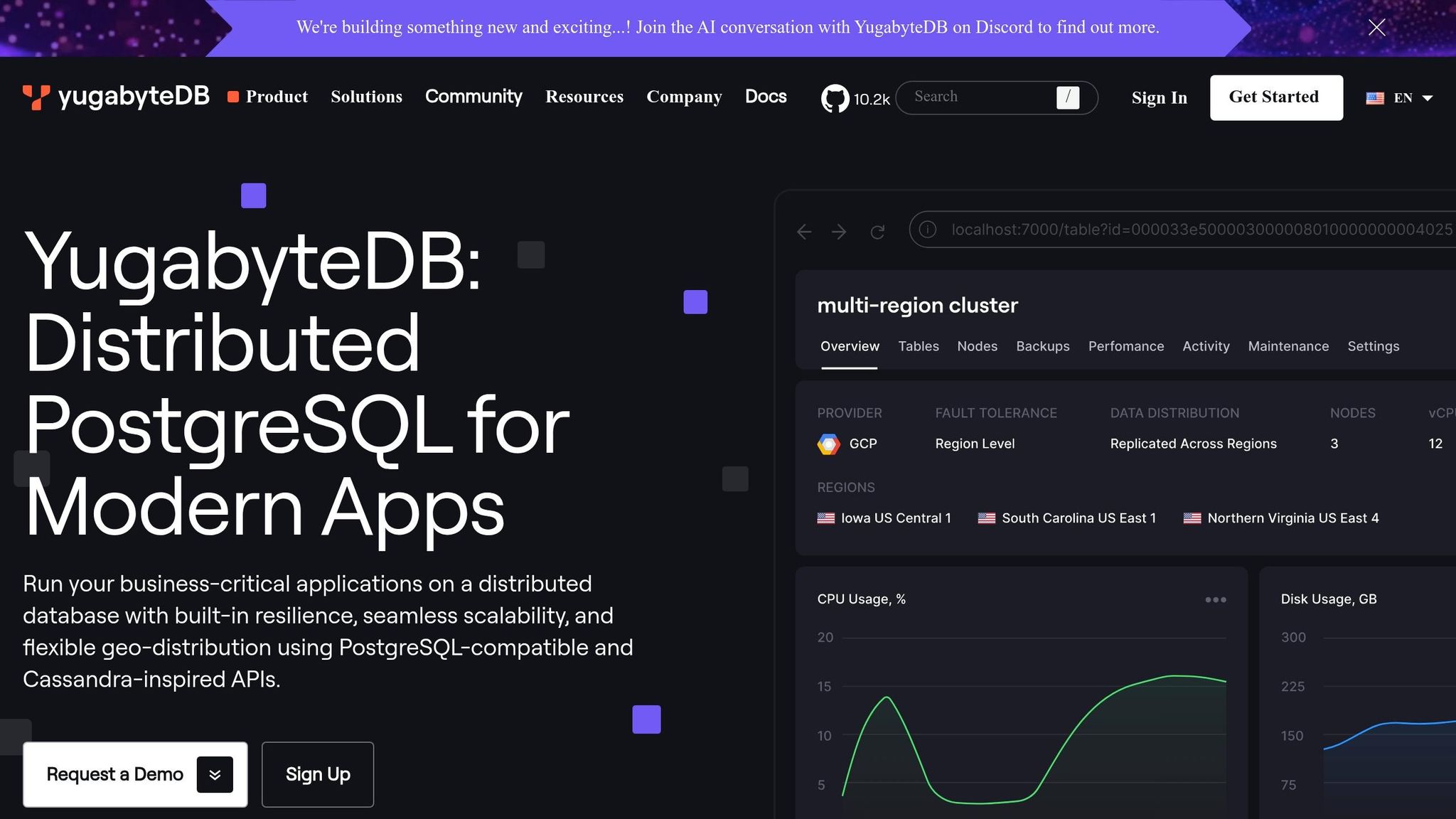
In the world of sports betting analytics, where real-time data processing and reliable storage are non-negotiable, YugabyteDB steps in with its distributed SQL capabilities. It combines the user-friendly nature of PostgreSQL with the durability and scalability of a cloud-native architecture. As Sanjeev Mohan, Principal at SanjMo, explains:
"YugabyteDB combines the familiarity of PostgreSQL with the resilience, scalability, and cloud-native architecture required by modern AI applications."
While streaming engines handle live data, YugabyteDB ensures that the underlying storage infrastructure can keep up, even under the strain of heavy betting activity.
Scalability
YugabyteDB is designed for horizontal scaling, allowing users to add nodes without any downtime. Its automatic sharding and hash sharding distribute data across multiple nodes, enabling fast and efficient parallel processing. This is particularly useful during high-stakes events like the Super Bowl, where betting patterns can be unpredictable.
The system adjusts dynamically to handle peak loads while keeping costs in check. With the sports betting industry expected to attract 214.1 million users by 2029, this adaptability is a game-changer. YugabyteDB's SportsDB sample database showcases its ability to manage the intense demands of sports data workloads.
Fault Tolerance
YugabyteDB uses the Raft consensus protocol to ensure data consistency across distributed deployments. Depending on the replication factor (e.g., RF3 or RF5), it can tolerate one or two node failures. Its self-healing architecture automatically detects issues and recovers without intervention.
For mission-critical betting operations, Point-in-Time Recovery (PITR) adds an extra layer of security. It allows precise rollbacks in case of disputes, protecting against potential losses and compliance risks. As Yugabyte highlights, "Maintain precise records for mission-critical transactions to avoid disputes, financial losses, and compliance issues."
Data Integration
YugabyteDB supports both PostgreSQL and Cassandra, making it easier to integrate with BI tools and ORMs. It’s also ready for AI-driven workloads, thanks to pgvector, which enables vector embeddings and Retrieval-Augmented Generation (RAG) architectures. Geo-partitioning allows data to be pinned to specific regions, reducing latency for live betting and ensuring compliance with local regulations. Whether running on AWS, GCP, Azure, or on-premises, YugabyteDB provides flexibility and avoids vendor lock-in.
5. EveryMatrix

EveryMatrix combines real-time data streaming with a robust enterprise infrastructure, making it a go-to solution for managing large data sets and ensuring lightning-fast response times - key for live sports betting analytics. Its DataMatrix service processes player, gaming, and payment data through dedicated Kafka clusters within 5 seconds of an event happening. This integration aligns with the focus on real-time processing and scalability seen in other advanced solutions, while also delivering a seamless enterprise-ready experience.
Real-Time Processing
The platform’s Rules Engine is designed to monitor live player behavior and execute automated actions, such as fraud detection or issuing targeted bonuses, based on pre-set conditions. This asynchronous system processes transactions incredibly quickly, with an average transaction time of 0ms. For high-stakes events where every millisecond matters, this efficiency is a game-changer.
Additionally, DataMatrix offers a replay function to reprocess historical data. Whether you’re back-testing business intelligence tools or recovering systems after a migration, this feature proves invaluable for maintaining operational continuity.
Scalability
EveryMatrix's OddsMatrix sportsbook operates on a horizontal scaling model, enabling it to handle rapid growth in high-demand markets. Tor Skeie, CEO of OddsMatrix, highlighted this capability:
"This means that we can continue to have this massive growth... and we don't need to be scared to grow as much as we've done because we can handle it through these scalable solutions".
The Player Account Management system also leverages auto-scaling policies and a sharded architecture, ensuring smooth performance during major events or promotional periods. For example, in October 2023, EveryMatrix set up a local data center with over 100 servers for Hungary’s state-owned operator Szerencsejáték, showcasing its ability to support large-scale enterprise deployments.
Data Integration
EveryMatrix’s API-first modular design makes it easy to connect with third-party CRM tools, engagement platforms, and regulatory systems. This flexibility allows operators to integrate specific components - like the OddsMatrix feed or CasinoEngine - into their existing setup without overhauling their entire platform.
The platform manages a complex database ecosystem that includes MariaDB, MySQL, and PostgreSQL. In 2024, a partnership with Percona led to a tripling of database servers under management, ensuring high availability for a growing customer base of over 300 operators worldwide. Additionally, the DataMatrix service automates the generation of over 30 daily compliance reports, streamlining regulatory processes and cutting down on manual work.
Comparison of Strengths and Weaknesses
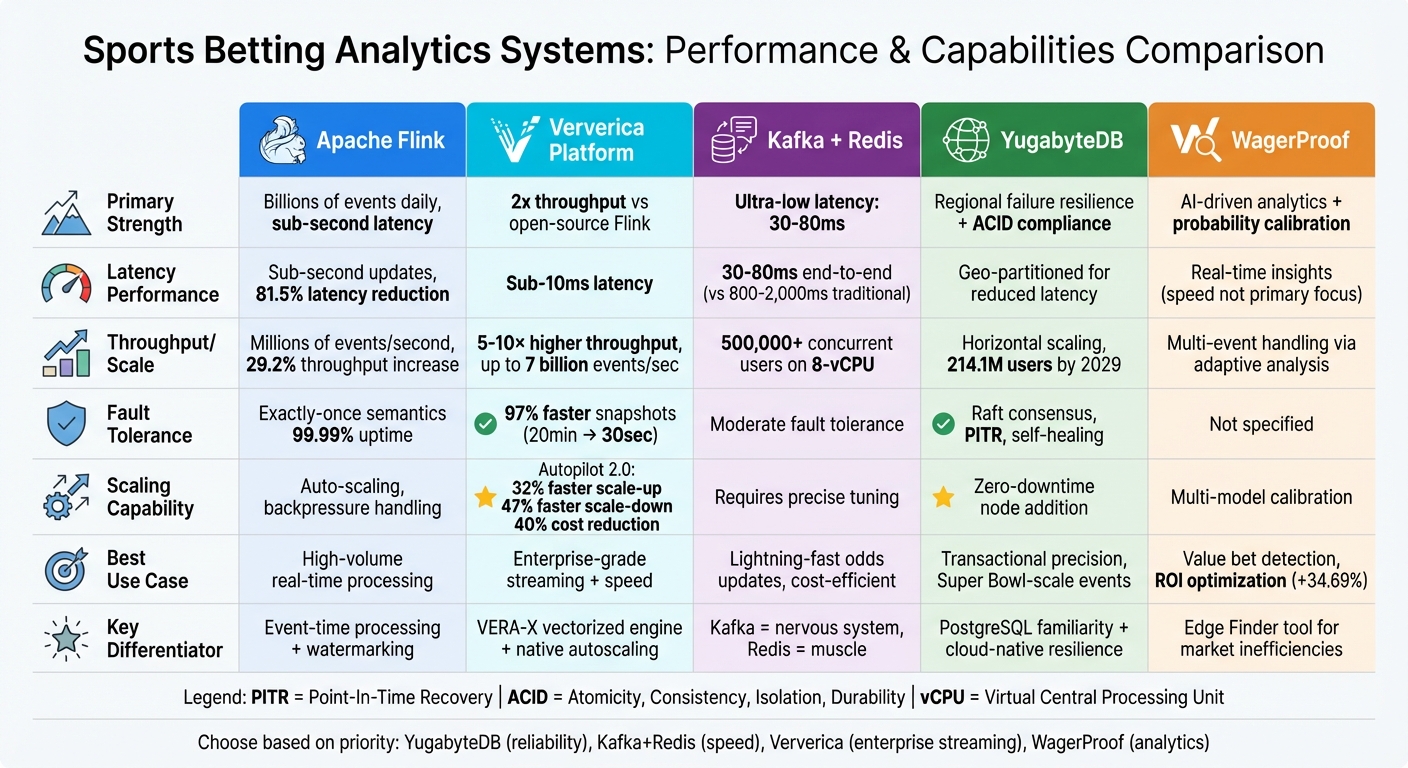
Sports Betting Analytics Systems Comparison: Performance Metrics and Key Features
Each system brings unique advantages and considerations when it comes to scalability and performance.
Apache Flink shines with its ability to process billions of events daily while maintaining sub-second latency and ensuring no data loss or duplication. This level of performance sets a high standard for real-time data processing systems.
Building on Flink's foundation, the Ververica Platform steps it up a notch with the VERA engine. This integration doubles the throughput of open-source Flink, adds native autoscaling, and improves observability. Mitchell Gray from Ververica highlights its impact:
"If your business runs on live data and split-second decisions, Ververica isn't just a tool; it's your competitive edge".
On the other hand, a combination of Kafka + Redis offers an ultra-efficient, low-latency solution. This streamlined setup achieves end-to-end latencies of just 30–80ms - drastically faster than traditional systems' 800–2,000ms - while supporting over 500,000 concurrent users on an optimized 8-vCPU server. Rendy, the tech lead behind this architecture, explains:
"Kafka is the nervous system... Redis is the muscle".
That said, this approach demands precise tuning and generally provides moderate fault tolerance compared to distributed SQL systems.
YugabyteDB stands out for its resilience, capable of handling regional failures while maintaining ACID compliance and reliable transaction processing.
Finally, WagerProof takes a different path, prioritizing data accuracy and best sports betting strategies for data-driven bettors over sheer speed. By combining probability calibration with a consensus system across multiple models, it adapts to market changes while maintaining profitability. Its Edge Finder tool identifies value bets, making it a powerful solution for scalable sports betting analytics. This blend of machine learning and time-series analysis ensures transparency and delivers research-grade insights critical for decision-making in dynamic markets.
Conclusion
Choose your system based on what your sportsbook needs most. For high-volume operations, YugabyteDB stands out with its horizontal scalability and ACID compliance - critical for ensuring financial accuracy during major events like the Super Bowl. With the sports betting market expected to reach 214.1 million users by 2029, reliability isn't just important - it's non-negotiable.
If real-time odds distribution is your focus, where every millisecond matters, the Kafka + Redis setup delivers impressive end-to-end latency of just 30–80ms. Plus, it’s a cost-efficient option.
For scenarios demanding both speed and reliability, the Ververica Platform offers advanced autoscaling to handle high-volume streaming without sacrificing performance.
Meanwhile, WagerProof takes a different approach, leveraging AI-driven analytics and its Edge Finder tool to detect mismatches between prediction markets and actual odds, helping operators uncover hidden opportunities.
Each system brings something unique to the table. Whether it’s YugabyteDB for transactional precision, Kafka + Redis for lightning-fast odds updates, Ververica for enterprise-grade streaming, or WagerProof for cutting-edge analytics, the right choice depends on your sportsbook’s specific priorities.
FAQs
What’s the simplest stack for real-time odds and live updates?
The simplest way to handle real-time odds and live updates is by combining Kafka for high-throughput data ingestion with Redis for low-latency storage and distribution. This duo provides the speed, scalability, and reliability needed for real-time applications to function seamlessly.
How do streaming systems avoid duplicate or missing bet events?
Streaming systems handle bet events with precision by employing real-time data ingestion, thorough validation processes, and strong failure management techniques. Technologies like Kafka and Redis play a key role in ensuring seamless, error-free streaming of odds and events. This approach not only reduces the chances of duplicates or missing data but also preserves data integrity while delivering updates with virtually no delay.
How does WagerProof turn live data into actionable value-bet alerts?
WagerProof analyzes live data - such as real-time odds, play-by-play updates, weather conditions, and player injuries - using advanced techniques like Bayesian updating and outlier detection. These methods highlight market inefficiencies, discrepancies, and potential betting advantages. By blending contextual information with state-of-the-art analytics, WagerProof empowers you to make smarter, data-driven betting choices.
Related Blog Posts
Ready to bet smarter?
WagerProof uses real data and advanced analytics to help you make informed betting decisions. Get access to professional-grade predictions for NFL, College Football, and more.
Get Started Free