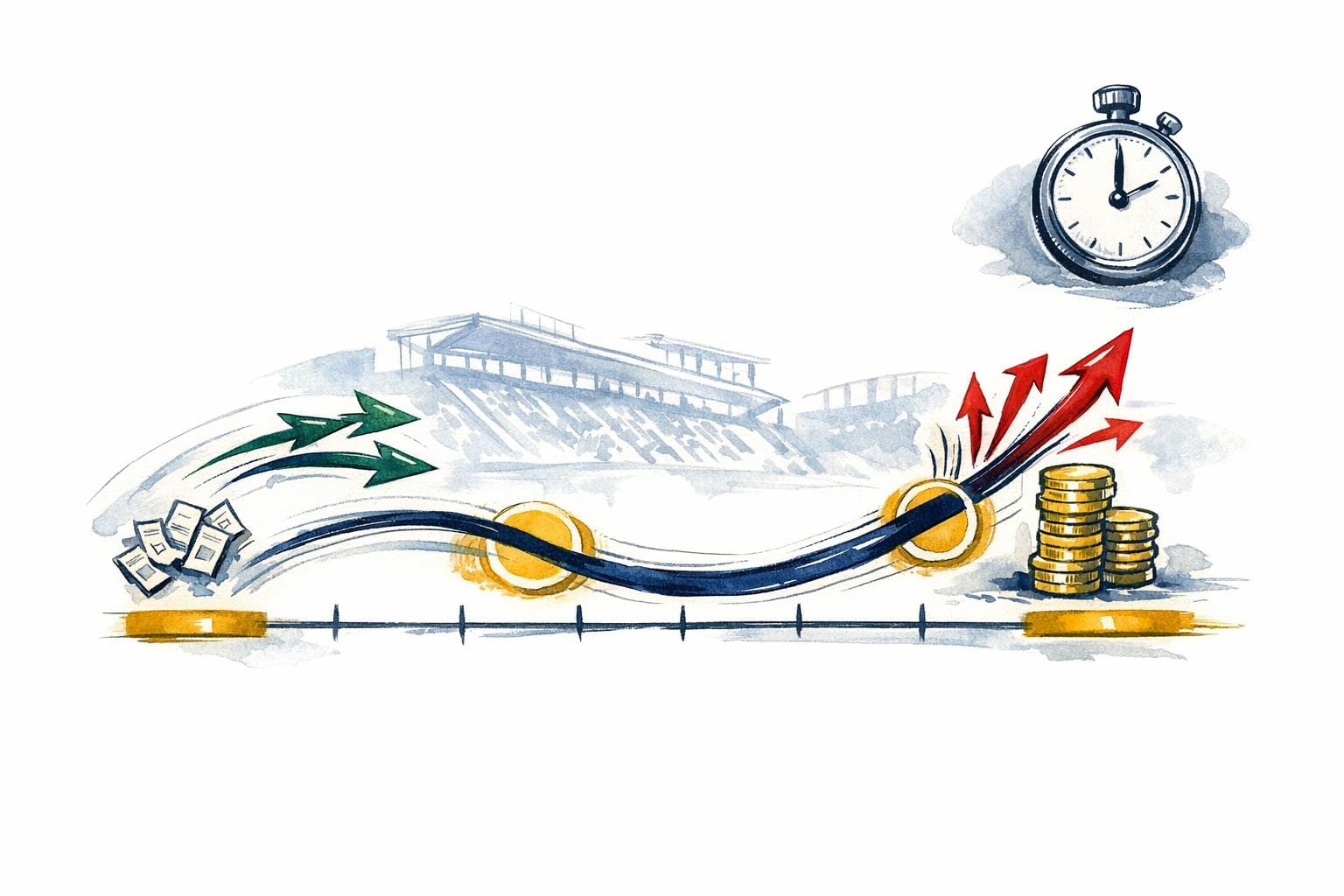
Sharp Money and Key Numbers: Spotting Line Movement Clues
Sharp money is the secret weapon of professional sports bettors. Unlike casual bettors, sharps rely on data and analytics to identify opportunities, often focusing on key numbers - like 3 and 7 in football - that represent common victory margins. When sportsbooks detect sharp action, they adjust lines quickly, creating clues for savvy bettors to follow.
Here’s what you need to know:
- Key Numbers Matter: Small line shifts around numbers like 3 or 7 in football often signal sharp money.
- Reverse Line Movement (RLM): When a line moves against public betting trends, it’s likely influenced by sharp action.
- Timing is Critical: Sharps bet early for soft lines or late when limits are higher.
- Ticket vs. Handle: A small percentage of bets accounting for most of the money indicates professional wagers.
5 Sneaky Ways to Exploit Line Movement (and Make Money!)
The Problem: Identifying Sharp Money Near Key Numbers
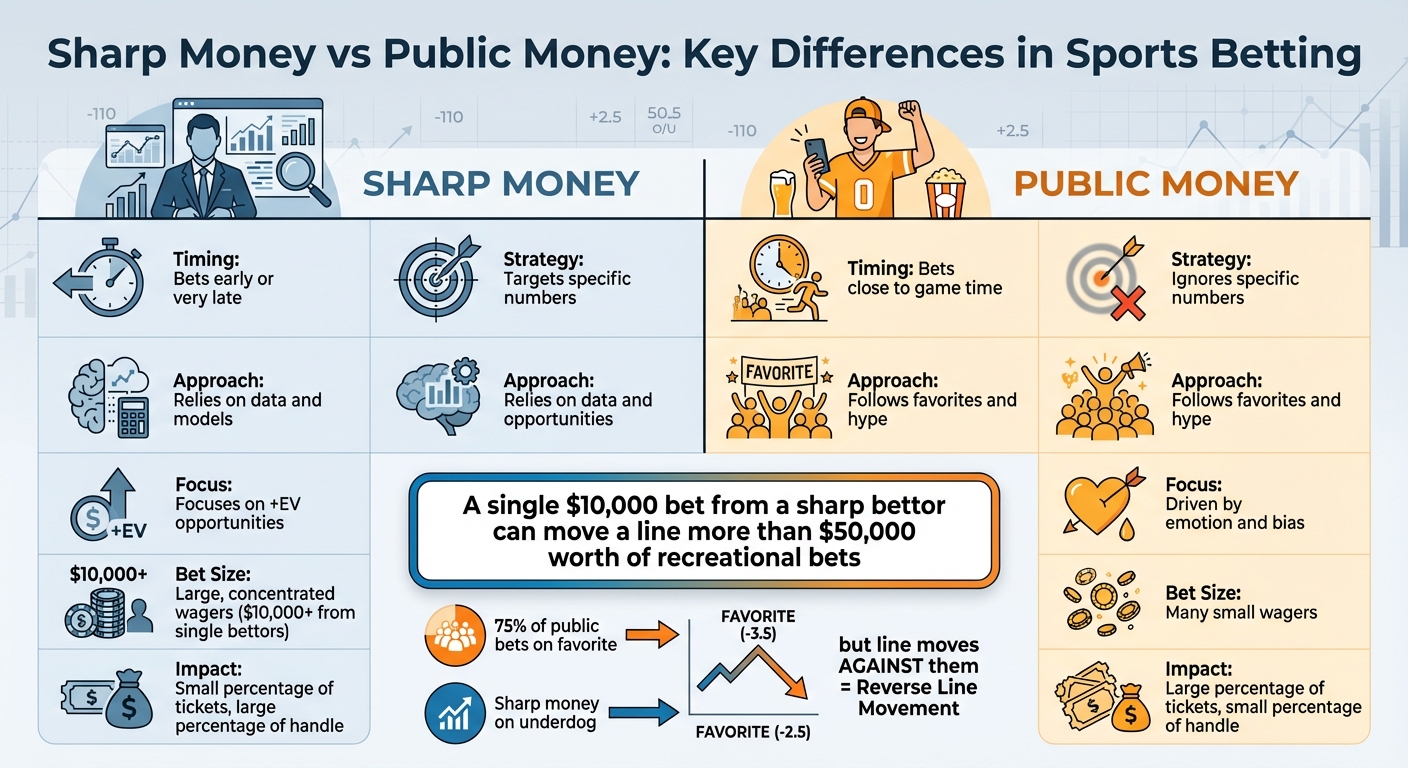
Sharp Money vs Public Money: Key Differences in Sports Betting
For most bettors, the real challenge isn't just spotting sharp money - it's doing so early enough to take advantage of favorable odds before the lines shift. Sharp bettors are quick to lock in the best prices, leaving casual bettors stuck with less favorable odds, which can turn a winning strategy into a losing one. This issue becomes even more critical near key numbers, where even a minor line adjustment can signal significant sharp money activity.
Key numbers hold particular importance in sports betting. For example, in the NFL, a shift from -3.5 to -3 carries far more weight than a move from -5.5 to -5. Yet, many casual bettors fail to grasp this distinction. When sportsbooks adjust lines away from key numbers like 3 or 7 - common margins of victory in football - it often indicates sharp money at work.
To complicate things further, not all line movements are tied to sharp money. Lines can shift due to factors like injuries, weather changes, or sportsbooks managing public betting action. Sophisticated bettors may also employ tactics like "head fakes", placing small early bets to influence the line before making larger wagers on the opposite side.
"$1M bet from Drake won't move a line, but $2,000 from a profiled sharp account may." – Jimmy Boyd
Without access to accurate ticket versus handle data, determining the influence of sharp money becomes guesswork. Free betting percentages from smaller sportsbooks often fail to reflect the broader market accurately.
Why Key Numbers Matter in Sports Betting
Key numbers represent the most frequent margins of victory in a sport. In the NFL, 3 and 7 are the most common due to field goals and touchdowns, respectively. Other margins like 6, 10, and 14 also appear frequently. In basketball, key numbers cluster around 4, 5, and 6, often influenced by late-game fouling and free throws.
The "hook", or half-point, is especially crucial near these key numbers. For instance, betting on a favorite at -3.5 means losing if the team wins by exactly 3 points. However, securing -3 instead results in a push, which can make a significant difference over the course of a season.
"The sharpest bettors aren't just picking teams - they're picking the right numbers." – Dave, Predictem
Oddsmakers frequently adjust lines toward key numbers to anticipate public betting behavior. This creates opportunities for sharp bettors who can distinguish between line moves driven by sharp action and those influenced by public sentiment.
Sharp Money vs. Public Money: What's the Difference
Understanding key numbers also highlights why identifying the source of a wager - sharp or public - is so important.
Sharp money comes from professional bettors who rely on data-driven models and analytics to find mathematical edges. These bettors focus on positive expected value (+EV) and typically place their bets either early, when lines are soft, or late, when betting limits are highest. They are highly price-sensitive, targeting specific numbers for maximum advantage.
Public money, on the other hand, comes from casual fans who often bet on favorites, popular teams, or compelling narratives. These recreational bettors tend to place their wagers closer to game time, driven more by emotion and media coverage than analysis.
Sportsbooks value sharp money more than public betting volume. A single $10,000 bet from a known sharp bettor can move a line more than $50,000 worth of recreational bets. Sharp money acts as a guide for sportsbooks, helping them fine-tune their lines.
| Sharp Money | Public Money |
|---|---|
| Bets early or very late | Bets close to game time |
| Targets specific numbers | Ignores specific numbers |
| Relies on data and models | Follows favorites and hype |
| Focuses on +EV opportunities | Driven by emotion and bias |
For example, if a line moves from -3.5 to -3 despite 75% of public bets being on the favorite, this reverse line movement (RLM) is a clear indicator of sharp money influencing the market. Recognizing and acting on these patterns is a critical skill for making smarter betting decisions - a topic we'll dive deeper into in the next sections.
How Sharp Money Moves Betting Lines
Sharp money plays a major role in how betting lines shift, especially around key numbers. Here’s how it works in practice.
When sharp bettors or syndicates place maximum-limit bets at market-making sportsbooks like Pinnacle or Circa, these books adjust their lines almost immediately. This isn't just a minor tweak - it's a strategic move to shield themselves from informed wagers. For example, a line might move from -2.5 to -3 within seconds. Since many retail sportsbooks rely on automated software to sync with these market leaders, the ripple effect spreads quickly across the industry. This kind of movement often reveals sharp action rather than routine adjustments for public betting trends.
Sharps are laser-focused on value, even down to half-point differences. For instance, they might back an underdog at +3 but lose interest if the line shifts to +2.5. When a line moves away from a key number like 3 or 7 in NFL betting, it’s often a sign that sharp money has influenced the sportsbook’s decision.
One of the clearest signs of sharp activity is reverse line movement (RLM), which we’ll dive into next.
Reverse Line Movement and What It Means
Reverse line movement (RLM) happens when a betting line shifts in the opposite direction of public betting percentages. This signals that sportsbooks are reacting to sharp money rather than the volume of recreational bets.
Take a Buffalo Bills vs. Miami Dolphins game, for example. The Bills might open as 3-point favorites, and 65% of public bets could be on Buffalo. But if the line shifts from -3 to -2.5, it suggests that while the majority of tickets favor Buffalo, sharp money is backing Miami. A key factor here is the ticket-to-handle ratio: if 75% of tickets are on one team but 60% of the money is on the other, the line tends to move toward the side with the higher monetary backing.
As an industry expert from Cloudbet explained, "Ten thousand small bets don't matter as much as one respected bet from a proven bettor".
"The bookmaker respects that sharp opinion so much that they are willing to expose themselves to massive liability from the public... just to move the line away from the sharp side." – Edgeslip
RLM becomes even more critical near key numbers. For example, during NFL Week 12, the Green Bay Packers opened as -4.5 favorites against the Vikings. Despite 75% of public bets on the Packers, the line dropped to -3 by kickoff. This significant shift, crossing a key number, indicated sharp money on the Vikings, who ultimately covered the spread.
These shifts highlight how tracking line movements can give bettors an edge in identifying sharp money trends.
Steam Moves and Quick Line Changes
Steam moves are another hallmark of sharp betting. These occur when a sudden wave of sharp money hits multiple sportsbooks at once, causing a rapid line shift - often by at least a half-point - across the market.
Syndicates often coordinate these moves by deploying several bettors, sometimes called "beards", to place large wagers simultaneously at different sportsbooks. The goal is to lock in favorable odds before the market adjusts. For instance, if a syndicate spots value on an underdog at +6, they might flood the market with maximum bets, forcing the line to drop to +5.5 or +5.
These moves usually happen during quieter times, like off-hours, when public betting activity is low, making sharp action more noticeable. They’re also more common in smaller or less-publicized games, where sportsbooks have less time to fine-tune their opening lines.
A common mistake among recreational bettors is chasing steam. By the time a line moves from -2.5 to -3.5, the value is often gone. Betting at the adjusted line typically results in poor closing line value (CLV), which can hurt long-term profitability.
Understanding steam moves helps bettors avoid falling into the trap of chasing lines after the sharp money has already shifted the market.
How to Spot Sharp Money and Line Movement Clues
To make the most of line movements around key numbers, you need to identify the signs of sharp betting activity. Look for patterns like discrepancies between tickets and handle percentages, as well as the timing of bets, to detect professional action.
Signs of Sharp Betting Activity
One clear sign of sharp betting is a mismatch between the number of tickets and the amount of money wagered. For example, if a team gets about 30% of bets but accounts for 60% of the money, it suggests that casual bettors are making smaller wagers, while professionals are placing larger, calculated bets.
Sharp bettors are strategic about timing. They may act quickly to exploit soft lines or wait until just before kickoff when betting limits increase.
Another clue is which sportsbooks move their lines first. Handicapper Jimmy Boyd explains:
"If the first book to move the line is one of the industry leaders like BetOnline, Bookmaker, Circa, or FanDuel, there's a good chance the move came from a respected bettor."
When market-leading sportsbooks like Pinnacle or Circa adjust their lines, and retail books like DraftKings follow soon after, it often signals sharp action rather than adjustments based on public betting trends.
Pay attention to line freezes near key numbers. For instance, if a team is drawing heavy public bets but the line stays steady - such as remaining at -3 instead of moving to -3.5 - it indicates that sportsbooks are waiting for sharp money before making a move.
While you can track these patterns manually, automated tools can make the process much easier.
Using WagerProof Data to Find Value Bets

WagerProof offers real-time tools to help you spot value opportunities driven by sharp money. For example, their prediction market mismatch alerts notify you when retail sportsbooks are slow to adjust to sharp market movements. If Circa moves a line from -2.5 to -3 but DraftKings still lists -2.5, WagerProof flags this "stale" line, giving you a window to act before it changes.
The platform also provides insights into ticket and handle splits, saving you from manually analyzing the data. For instance, you can quickly spot when 25% of tickets account for 65% of the handle - an indicator of professional betting activity.
With WagerBot Chat, you can ask specific questions about line movements and get detailed answers. For example, if a line shifts from -7 to -6.5 despite 75% of public money being on the favorite, the tool explains the reasoning by analyzing betting splits, prediction markets, and historical trends.
Additionally, automated outlier detection highlights significant movements across key numbers. If a line crosses an important threshold - like 3 or 7 in football - WagerProof alerts you, as such changes are typically driven by sharp betting pressure. These alerts help you separate meaningful shifts from routine adjustments.
Using Sharp Money Clues in Your Betting Strategy
Once you've learned how to identify sharp money, the next step is figuring out how to use that knowledge to improve your betting results. By combining sharp money indicators with strategic timing and tools like real-time WagerProof alerts, you can refine your approach and make smarter bets.
Timing Your Bets for Better Value
Timing is everything, especially when betting near key numbers. Early in the week, lines tend to be softer because sportsbooks have limited data to work with. Sharp bettors often act quickly during this period to lock in the best numbers before the lines adjust. These early movements can signal where sharp money is landing, giving you a chance to secure value before the market catches up.
Capturing value relative to the closing line is a cornerstone of long-term betting success. For instance, if you bet on a team at -2.5 and the line closes at -4, you've gained 1.5 points of value, regardless of the outcome of that specific wager. The key is to bet early; chasing lines after they've moved typically results in poor closing line value. Taking a team at -4 after sharps grabbed it at -2.5 is a recipe for long-term losses. As one expert wisely notes:
"Sharps bet numbers, not just teams" - Edgeslip
While timing is critical for locking in value, using modern tools can give you an additional edge.
Making Better Decisions with WagerProof
To turn sharp money insights into actionable bets, tools like WagerProof can make all the difference. WagerProof’s real-time alerts highlight steam moves and identify stale lines, giving you the opportunity to act before the market adjusts.
With WagerBot Chat, you can instantly verify sharp betting signals. For example, if you notice reverse line movement on a game you're eyeing, you can ask WagerBot to pull ticket-to-handle splits, prediction market data, and historical trends. Since it connects to live professional data, WagerBot eliminates guesswork and helps you differentiate between legitimate sharp action and routine market shifts. This allows you to confidently turn sharp money clues into well-informed, data-backed bets.
Conclusion
Understanding sharp money and how it influences line movement around key numbers can give you a real edge in sports betting. This advantage is most effectively realized by beating the market's closing line. The main difference between professional and recreational bettors often boils down to spotting price changes - identifying when the market reacts to informed betting rather than public opinion. Indicators like reverse line movement, a small percentage of tickets accounting for a large percentage of the handle, or steam moves originating from respected market-making books like Pinnacle or Circa are strong signs of professional activity.
"The closing line is generally considered the most accurate representation of true probability. It's been tested by the market." – Loserwins
Getting better numbers than the closing line is key to building long-term profitability. Key NFL numbers, for instance, represent crucial shifts in win probabilities. Moving across these numbers isn’t just a minor adjustment; it reflects a meaningful change in potential outcomes. Sharp bettors often wait for public money to push lines past these thresholds before placing their bets.
Tools like WagerProof make it easier to track these movements in real time. Features such as alerts for steam moves, discrepancies between ticket counts and handle percentages, and stale lines allow you to spot opportunities before they vanish. With WagerBot Chat, you can instantly verify sharp signals using live professional data, enabling decisions that are based on data rather than guesswork. By acting on WagerProof's insights, you can turn sharp signals into actionable, winning bets.
FAQs
How can I tell sharp money from injury or weather moves?
Sharp money often leads to early, noticeable line shifts at high-limit sportsbooks, frequently involving reverse line movement (RLM) - where the line moves in the opposite direction of public betting trends. In contrast, shifts caused by injuries or weather are reactive, tied directly to updates like reports or forecasts. By examining public betting data, spotting RLM patterns, and noting when line shifts occur, you can better identify sharp action versus reactions to external events.
When should I bet to get the best number on key lines?
When it comes to locking in the best odds on key lines, timing is everything. Placing your bet as soon as the line opens - or shortly thereafter - can make a big difference. This is because sharp bettors often jump in early, causing lines to shift quickly. Acting fast gives you a better shot at securing favorable odds before those changes take place.
How do I use ticket vs. handle data without overreacting?
When trying to identify sharp betting activity, pay close attention to the gap between ticket percentages and handle percentages. A notable indicator of professional betting is when the handle percentage is significantly higher than the ticket percentage. This suggests that larger, sharper bets are influencing the market.
When analyzing this data, it’s crucial to prioritize handle percentages over ticket percentages. Handle data reflects the total money wagered, which often carries more weight than the number of individual bets. Additionally, keep an eye out for reverse line movement (RLM) - this happens when betting lines shift in a direction that contradicts the ticket trends but aligns with the handle data. Such movement is often a sign of sharp bettors impacting the odds.
Avoid overreacting to minor changes in the data. Instead, look for clear and meaningful gaps, such as a difference of 10% or more between handle and ticket percentages. These larger discrepancies are more reliable indicators of sharp action.
Related Blog Posts
Ready to bet smarter?
WagerProof uses real data and advanced analytics to help you make informed betting decisions. Get access to professional-grade predictions for NFL, College Football, and more.
Get Started Free