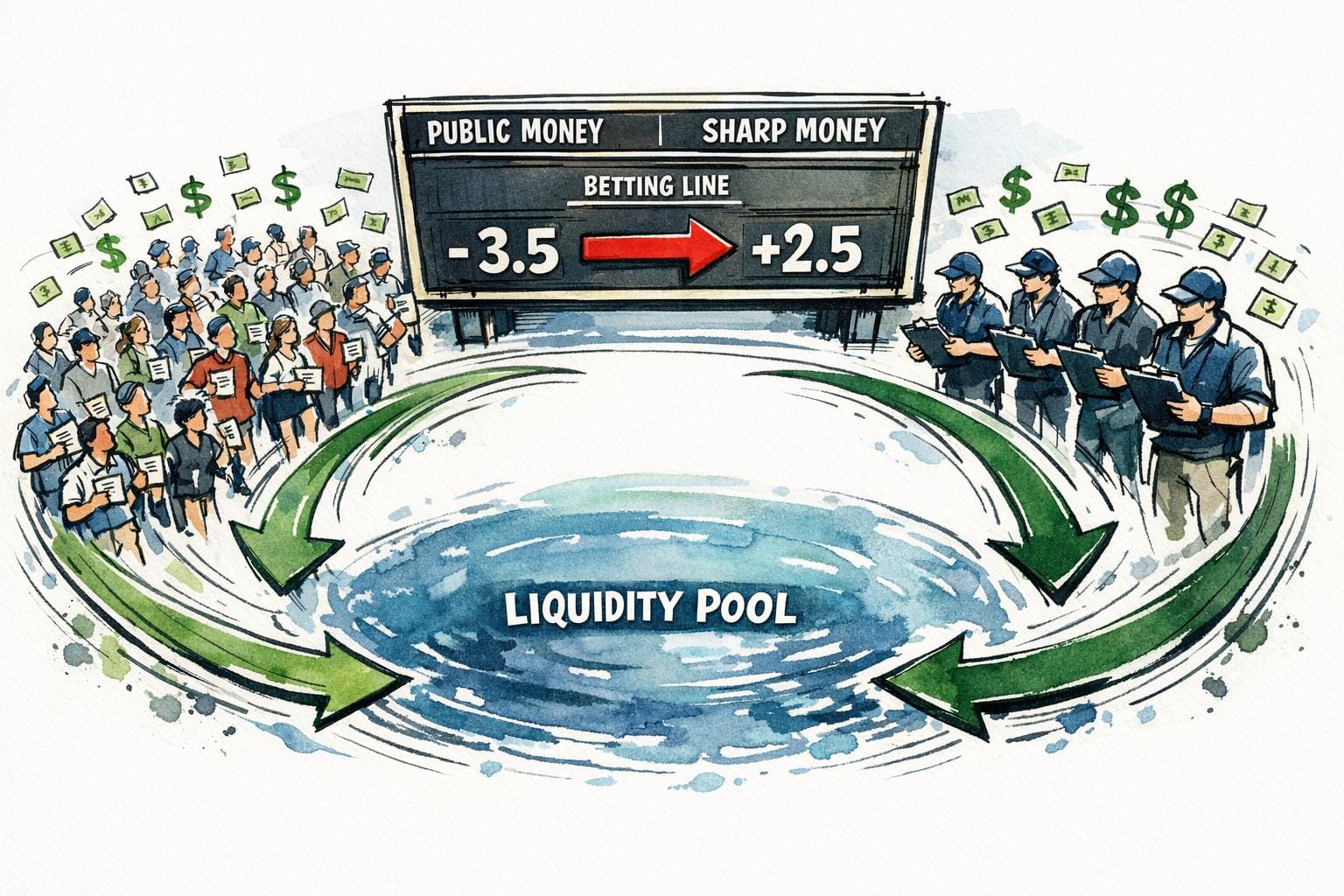
Sharp Money vs. Public Money: Liquidity Impact
In sports betting, sharp money (from professionals) and public money (from casual bettors) impact odds and liquidity differently. Sharp money relies on data, models, and strategies for data-driven bettors, often moving lines early and efficiently. Public money, driven by emotion and media influence, tends to flood markets closer to game time, causing unpredictable shifts and inflated lines.
Key takeaways:
- Sharp money: Early bets, large amounts, high influence on odds, value-focused.
- Public money: Late bets, small amounts, emotional influence, creates market "noise."
- Liquidity is higher in big markets (e.g., NFL) and lower in niche ones, amplifying sharp money's impact in the latter.
- Tools like ticket vs. money splits and reverse line movement help identify sharp action and betting opportunities.
Understanding these dynamics can help you spot value and make smarter bets.
Why Sharp Money Always Wins (And How You Can Follow It)
Sharp Money vs. Public Money: Main Differences
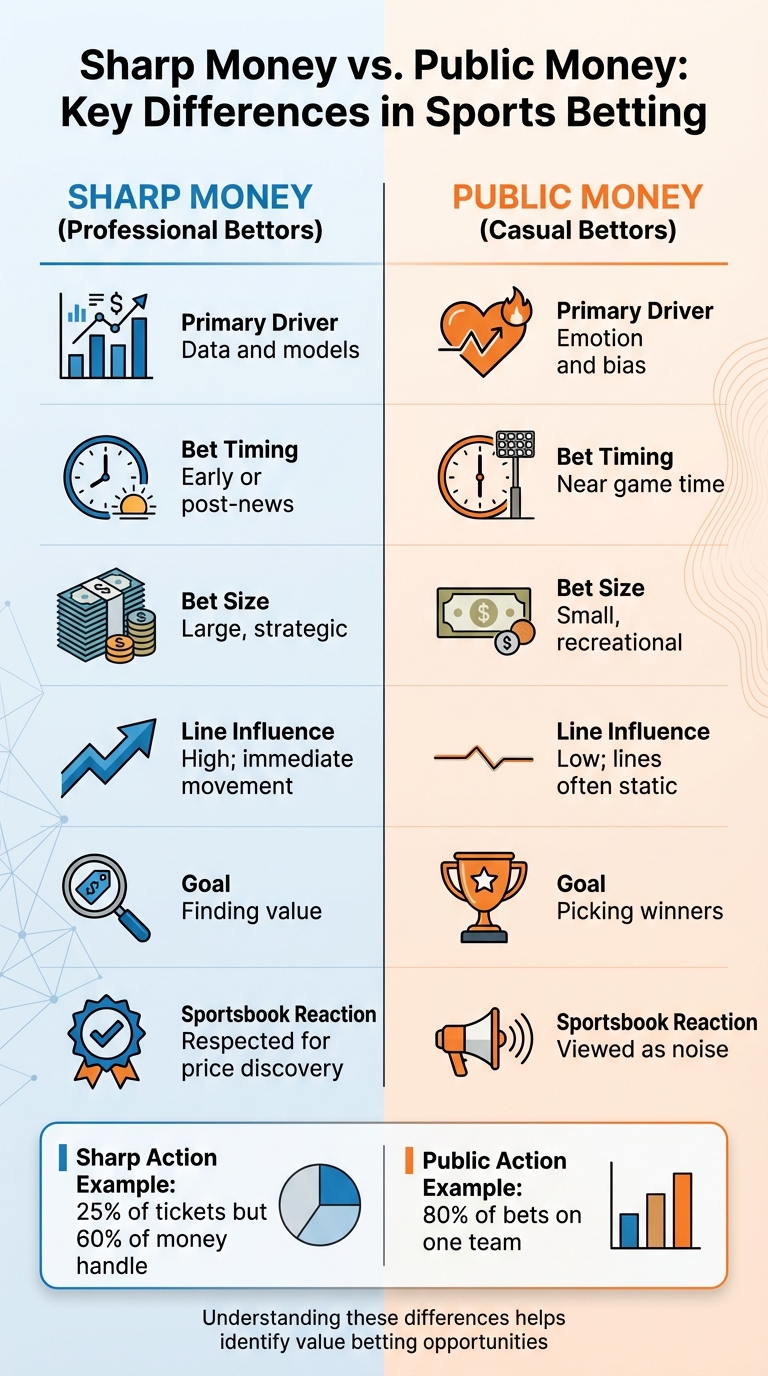
Sharp Money vs Public Money: Key Differences in Sports Betting
What is Sharp Money?
Sharp money refers to wagers placed by professional bettors or betting syndicates who approach sports betting like a full-time job or an investment strategy. These individuals rely on advanced mathematical models, analytics, and historical data to pinpoint market inefficiencies. Unlike casual bettors, sharp bettors are highly price-conscious. For example, they might pass on a team favored at -3.5 but jump on the same team if the line moves to -2.5. Their focus is on extracting value, not on team loyalty.
Sharp bettors often act quickly, placing bets early or right after significant news breaks. As Ron Raymond, Founder of ATSStats.com, puts it:
"The sharp bettor isn't trying to pick winners - they are trying to identify where the public is wrong and take advantage of the price distortion".
This disciplined, value-driven approach influences sportsbooks directly. Sharp bets can cause immediate line adjustments, as sportsbooks rely on this type of action for price discovery.
What is Public Money?
Public money, on the other hand, comes from casual bettors who wager mainly for fun. These recreational bettors are more likely to let emotions, media narratives, team loyalty, or recent performances dictate their decisions. They tend to favor popular teams, bet on "Over" totals, and gravitate toward high-profile matchups, often overlooking the mathematical value of a wager.
Public bettors usually place their bets closer to game time and in smaller amounts. This predictable behavior creates opportunities for both sharp bettors and sportsbooks to capitalize on inefficiencies. However, public money often leads to more erratic line movements, as it tends to flood in closer to kickoff or tip-off.
Side-by-Side Comparison
| Feature | Sharp Money | Public Money |
|---|---|---|
| Primary Driver | Data and models | Emotion and bias |
| Bet Timing | Early or post-news | Near game time |
| Bet Size | Large, strategic | Small, recreational |
| Line Influence | High; immediate movement | Low; lines often static |
| Goal | Finding value | Picking winners |
| Sportsbook Reaction | Respected for price discovery | Viewed as noise |
One way to identify sharp action is by looking at the relationship between ticket percentages and money handles. For example, sharp action often shows a low ticket percentage (around 25%) but a high money handle (about 60%). In contrast, public money usually results in heavy one-sided ticket counts - like 80% of bets on one team. Sportsbooks may adjust a line instantly in response to a $500 sharp bet but might ignore a $5,000 wager from a recreational bettor.
These contrasting behaviors and timing strategies play a significant role in shaping market liquidity, as explored further in the next sections.
How Sharp Money Affects Liquidity
Line Efficiency and Tighter Spreads
Sharp money plays a key role in correcting mispriced odds, pushing sportsbooks to adjust lines to reflect accurate values. When lines open, professional bettors - armed with advanced models and data - act quickly, setting a baseline for efficiency that relies on analysis rather than gut feelings. Sportsbooks often prioritize these sharp bettors over the general public, sometimes shifting a line based on a single large wager from a known sharp bettor. These professionals have a proven track record of profitability, signaling they possess a valuable edge.
In NFL betting, sharps focus on key numbers like 3 and 7, which are the most common margins of victory. By strategically placing bets around these numbers, they tighten spreads and push the market toward greater accuracy. Opening lines, shaped by sophisticated algorithms and immediate professional input, are often considered the most accurate. This rapid adjustment process ensures the market spends minimal time at incorrect prices, leading to noticeable shifts in both betting volume and pricing.
Volume and Price Changes
The influence of sharp money extends beyond line adjustments, significantly impacting market volume and stability. While sharp bettors are fewer in number, their wagers represent a substantial portion of the total money at stake. For instance, sharp action may account for just 25% of tickets but make up 60% of the money handle. This disproportionate impact helps sportsbooks balance their liabilities against the influx of smaller bets from recreational players.
Steam moves - when betting syndicates place large wagers across multiple sportsbooks simultaneously - highlight how sharp money stabilizes the market. These moves force sportsbooks to quickly align with a consensus price, creating "sticky" adjustments that hold steady across reputable platforms. Because sharp money relies on calculated decisions rather than emotional betting, it drives predictable line movements. This calculated approach enhances liquidity by creating a more stable and efficient betting environment.
How Public Money Affects Liquidity
Line Movement and Volatility
When public money floods the market, it often causes unpredictable line shifts driven more by emotion than solid data. Casual bettors - unlike sharp bettors who rely on statistical models - are influenced by factors like media buzz, team popularity, and recent performances. This creates "noise" in the market, where price changes don't necessarily align with the actual probabilities of outcomes.
Interestingly, the timing of this public-driven volatility is fairly predictable. Most casual betting activity spikes in the last 48 hours before a game, fueled by pregame shows and social media chatter. Sportsbooks, in turn, adjust lines not because the underlying probabilities have changed but to manage their liability. While public bets move lines based on volume, sharp bettors influence prices by providing information-backed insights.
A great example of this dynamic was the February 2023 Super Bowl between the Chiefs and Eagles. Early sharp betting made Philadelphia the favorite, but a late surge of public bets swung the line back toward Kansas City. Similarly, in a college football matchup between Michigan and Notre Dame, Michigan opened as a –2.5 favorite. However, public betting pressure pushed the line to –3.5, creating opportunities for value on Notre Dame's side. These swings, driven by public sentiment, force sportsbooks to make constant adjustments, exposing them to greater risk.
Wider Spreads and Sportsbook Risk
This volatility doesn't just distort odds - it also impacts market liquidity. Public money often piles up on one side of a bet, leaving sportsbooks with significant exposure. In some cases, over 80% of tickets favor one side, typically on favorites or overs.
"If 80% of the bets are on one side, that's not information - that's exposure".
To manage this risk, sportsbooks "shade" lines in anticipation of heavy public action. For instance, they might increase the cost on favorites or overs before the betting surge begins. This "public tax" can widen spreads by 0.5 to 1.5 points, creating inefficiencies that sharp bettors are quick to exploit. Retail-focused sportsbooks like FanDuel and DraftKings are more likely to adjust lines based on public volume, while market-making books such as Pinnacle or Circa rely on sharp betting activity for their adjustments.
Liquidity Outcomes Compared
| Metric | Sharp Money | Public Money |
|---|---|---|
| Primary Driver | Data, models, inefficiencies | Emotion, hype, recency bias |
| Timing | Early (at opener) or on news | Late (near kickoff) |
| Line Movement | Efficient, information-based | Erratic, volume-based "noise" |
| Spread Effect | Tighter, more accurate | Wider, inflated pricing |
| Market Efficiency | Increases (price discovery) | Decreases (creates distortion) |
| Bet Type | Value-based, often underdogs/unders | Heavy on favorites, overs, parlays |
| Sportsbook Reaction | Immediate price adjustment | Liability management and risk reduction |
Using Ticket and Money Splits to Measure Liquidity Impact
Reading Ticket and Money Splits
Understanding how liquidity affects market pricing gets even clearer when you analyze ticket and money splits. These splits uncover the influence of both the general public and sharp bettors. Here's how it works: ticket percentages show the number of individual bets placed on each side (essentially, the "crowd count"), while money percentages reveal the total dollars wagered, highlighting where the big money is flowing.
The real insight lies in the difference between these two percentages. For example, if 75% of tickets favor one side but only 55% of the money is on that side, you're seeing a classic split. This 20-point gap indicates two opposing forces - lots of smaller bets from casual bettors versus fewer, larger bets from professionals. This kind of disparity is key to understanding liquidity sources.
"The raw percentages are less important than the difference between Ticket % (public sentiment) and Money % (sharp conviction)." - Edgeslip
Certain thresholds can signal specific behaviors. If 65% or more tickets are on one side, it typically shows public bias. On the other hand, when the money percentage is at least 10% higher than the ticket percentage, it suggests sharp action. Keep in mind that early-week splits (like on a Tuesday) often reflect low-volume noise, whereas splits closer to game time - like Sunday mornings - capture sharper market activity as professional money comes in.
These patterns not only highlight betting behavior but also reflect the liquidity shifts that drive pricing adjustments.
Real Examples of Split Patterns
A great example of split patterns in action comes from an NFL game on January 4, 2025, between the Cleveland Browns and the Baltimore Ravens. Despite being heavy underdogs, the Browns attracted only 7% of moneyline tickets but pulled in 49% of the total money wagered. What does that tell us? While casual bettors overwhelmingly backed the Ravens with smaller bets, professional bettors placed significant wagers on the Browns. This sharp money caused sportsbooks to adjust their lines based on the larger, more influential bets rather than the sheer number of tickets.
This phenomenon, known as reverse line movement, occurs when the betting line shifts away from the side getting the majority of bets. It’s a telltale sign that sharp liquidity is influencing prices. During the 2025 NFL season, a study of 79 tracked bets showed that betting against teams with 70% or more public tickets - when the line moved in the opposite direction - produced a 60.8% win rate.
The source of your real-time sports data matters just as much as the numbers themselves. Retail sportsbooks often reflect public bias, while market-making books like Pinnacle and Circa are more reliable indicators of sharp action. These books take maximum-limit wagers from professional syndicates, making their splits a more accurate reflection of sharp liquidity. By paying attention to these split-driven adjustments, you can make smarter, more informed decisions in the betting market.
What This Means for Market Efficiency and Bettors
How to Use Liquidity Data for Better Bets
Sharp bettors play a key role in improving market efficiency by identifying and adjusting price distortions. In contrast, public money often introduces noise due to emotion-driven wagers. To spot sharp action, focus on ticket and money percentage discrepancies and reverse line movement. For example, when the ticket percentage is low, but the money percentage is high, it often signals strategic bets that could lead to long-term gains in closing line value (CLV). A noticeable gap between these percentages typically indicates professional betting activity.
Tracking your closing line value - the final line before a game starts - is another critical metric. Beating the closing line consistently suggests you’re finding value in the market. Professionals aim for a 55% win rate, while casual bettors often hover around 50% or less.
"The sharp bettor isn't trying to pick winners - they are trying to identify where the public is wrong and take advantage of the price distortion." - Ron Raymond, Founder, ATSStats.com
To further understand where sharp money is flowing, keep an eye on market-making sportsbooks like Pinnacle and Circa Sports. These books cater to professional bettors with high-limit wagers and often lead the market. By comparing their lines to slower-moving books, you can sometimes lock in better value before the market adjusts. Utilizing these strategies alongside advanced tracking tools can help refine your approach.
Tools for Tracking Liquidity and Market Movement
To make the most of liquidity data, you need real-time, detailed tools. Platforms like WagerProof (https://wagerproof.bet) offer professional-grade betting insights, including prediction markets, historical data, public betting trends, and statistical models. With features like integrated alerts and WagerBot Chat, the platform provides instant, data-backed insights without relying on guesswork.
WagerBot Chat stands out as the only AI tool for sports betting that’s directly tied to live professional data. It avoids inaccuracies by combining weather updates, injury reports, odds, and model predictions into actionable recommendations. Instead of simply giving picks, WagerProof focuses on providing tools, transparency, and data to help you make informed decisions. You can also join their exclusive Discord community via web, iOS, or Android for access to expert picks with detailed explanations.
Conclusion: Main Points to Remember
Sharp money helps correct market inefficiencies, while public money adds liquidity but can create noise. Use liquidity signals as a secondary tool to complement your existing analysis, rather than the sole basis for your bets. Pay attention to ticket vs. money splits, reverse line movement, and your closing line value to uncover true value and avoid overpriced lines. These strategies, combined with the right tools, can give you an edge in the betting market.
FAQs
Why does sharp money move lines more than public money?
Sharp money has a bigger impact on moving betting lines because it typically comes from professional bettors who rely on data analysis and look for weaknesses in the market. These bets are often large and carefully calculated, which pushes sportsbooks to adjust their lines quickly to minimize risk. On the other hand, public money comes from casual bettors who are often swayed by emotions or media narratives. These wagers are usually smaller and less informed, so sportsbooks don't react as strongly to them, instead prioritizing the influence of sharp action.
How do low-liquidity markets change sharp vs. public impact?
In markets with lower liquidity, sharp money holds more sway due to the smaller betting volume, which makes market movements more pronounced. Sharp bettors rely on data-driven strategies to make calculated line adjustments, often signaling where value lies. On the other hand, public money, influenced by casual bettors' emotions, can lead to exaggerated line shifts and inefficiencies. By understanding these dynamics, bettors can spot opportunities - sharp money tends to reflect accurate probabilities, while public money often overreacts, creating inflated odds or spreads.
How can I confirm reverse line movement isn’t just noise?
To determine if reverse line movement is meaningful and not just noise, focus on whether sharp money is driving the shift rather than public betting. One key indicator is a mismatch in public data - such as when the majority of bets are on one side, but the line moves in the opposite direction. By monitoring real-time line changes and leveraging tools to spot unexpected shifts, you can better identify sharp action and distinguish it from random or insignificant fluctuations. This ensures the movement is tied to informed betting activity.
Related Blog Posts
Ready to bet smarter?
WagerProof uses real data and advanced analytics to help you make informed betting decisions. Get access to professional-grade predictions for NFL, College Football, and more.
Get Started Free