
Short-Term vs. Long-Term Betting ROI
Want to know if your betting strategy is working? Focus on ROI. Return on Investment (ROI) measures how much profit you’re making relative to your total bets. But here’s the catch: short-term and long-term ROI tell very different stories.
- Short-term ROI: Based on fewer bets (e.g., 10–100), it’s highly volatile and heavily influenced by luck. A hot streak might inflate your confidence, while a losing streak could make you abandon a good strategy.
- Long-term ROI: Measured over 1,000+ bets, it smooths out short-term swings and reveals your actual skill. It’s more reliable for judging your true edge in betting.
Key takeaway: Short-term results can mislead you, but long-term performance shows if your strategy is profitable. Stay disciplined, track your bets, and manage your bankroll wisely to succeed in the long run.
Here’s how to calculate ROI and why focusing on the big picture matters.
Short-Term Betting ROI: What It Is and Why It's Risky
What Short-Term Betting ROI Means
Short-term ROI measures returns over a small sample size, typically fewer than 1,000 bets, covering a few weeks or a single season. Unlike long-term ROI, which reveals a bettor's true edge over thousands of wagers, short-term results are heavily influenced by variance. Even when placing bets with positive expected value, randomness dominates in smaller samples. For example, after just 10 bets, about 37% of bettors will end up in the red, even if they hold a mathematical edge. This makes it extremely difficult to determine whether a winning streak stems from actual skill or sheer luck.
The challenge grows because standard deviation increases with the square root of the number of bets. While uncertainty decreases as the sample size grows, it remains significant in smaller samples. Even with an impressive 60% win rate - considered excellent in sports betting - there’s still a 16% chance of being down after 100 bets. Simulations further highlight this volatility: with just a 1% edge, bettors face a 12% to 23% chance of losing money after 300 bets. These fluctuations make short-term betting inherently risky.
Risks of Focusing on Short-Term Returns
One of the biggest dangers in short-term betting is confusing luck with skill. A hot streak can lead to overconfidence, causing bettors to overbet or abandon sound bankroll management. This is often referred to as the "win-rate trap." Even if you win 90% of your bets, you could still post a negative ROI if your losses on the remaining 10% outweigh your gains. As Polyburg wisely noted:
"The market doesn't pay for being right often; it pays for being right when it's underpriced, and for sizing intelligently when the odds favor you."
Short-term hot streaks are also subject to regression to the mean, meaning they tend to balance out over time. In one simulation involving 10,000 bets with a 2.94% expected ROI, there was less than a 13% chance of achieving a 4.54% actual ROI - showing how positive variance can inflate short-term results. When variance turns negative, bettors who increased their stakes during a hot streak can face significant losses.
The emotional impact of short-term betting adds another layer of risk. Focusing on immediate results often leads to an emotional rollercoaster, with impulsive decisions, loss-chasing, and abandoned strategies after a few unlucky outcomes. Without the broader perspective that comes from tracking thousands of bets, bettors are more likely to make reactive changes that harm long-term profitability. Discipline and strategic adjustments are critical to navigating these challenges.
When Short-Term Betting Makes Sense
Despite the risks, short-term betting can be worthwhile in specific situations. It’s particularly useful for taking advantage of temporary market inefficiencies, such as mispriced lines following breaking news, or for meeting sportsbook bonus rollover requirements. These opportunities require quick action and can provide real value.
The key to approaching short-term betting is strict bankroll management. Limit individual bets to 1%–2% of your total bankroll to ensure a standard losing streak doesn’t deplete your funds. Fractional Kelly sizing - betting only 25% to 50% of the suggested amount - offers an additional buffer against volatility. Most importantly, focus on Closing Line Value (CLV) rather than short-term profits. Consistently beating the closing line is a far better indicator of a successful strategy than immediate ROI.
"Bankroll management matters more than your picks."
– BetPredictionSite
This emphasis on immediate results contrasts with the long-term strategies discussed in the next sections.
Long-Term Betting ROI: Building Consistent Profits
What Long-Term Betting ROI Means
Long-term ROI in betting is all about measuring performance over a large number of wagers - typically between 1,000 and 5,000 bets. At this scale, the randomness of short-term results fades, revealing your true edge. The focus here is on refining the process: making solid decisions, maintaining consistent bet sizing, and spotting mispriced lines.
This approach shifts the focus from short-term luck to long-term skill. A brief winning streak over 50 bets doesn’t tell the full story, but consistently outperforming the closing line over thousands of bets demonstrates expertise. The goal isn’t to win every bet but to make decisions that are mathematically sound and profitable over time. For example, even with a modest 1% edge, you might still face losses after 300 bets. But after 2,500 bets, the chance of being down drops significantly. This strategy reduces variance and builds a foundation for steady bankroll growth.
Benefits of Long-Term Betting Strategies
One of the biggest advantages of long-term strategies is protecting your bankroll. Betting just 1–3% of your total funds per wager allows you to endure losing streaks without going broke. This discipline ensures your edge has time to shine over thousands of bets, rather than being overshadowed by short-term fluctuations.
Long-term ROI also helps cut through the noise of short-term results, emphasizing the importance of a consistent, process-driven approach. Small, incremental gains can add up significantly. For instance, a 53% win rate over 3,500 bets could yield a 62% return on your bankroll. Many seasoned bettors aim for an annual ROI of 4–10%, which aligns with the challenges of competing in efficient markets. Peer-to-peer platforms, which eliminate the house edge, report much higher profitability rates - around 40% - compared to the roughly 2% found at traditional sportsbooks.
Another critical metric for long-term bettors is Closing Line Value (CLV). Maintaining an average CLV of +2% to +5% is often a reliable indicator of sustainable success.
Methods for Long-Term Success
Achieving consistent profits requires meticulous record-keeping. Tracking every bet - along with the odds, closing line, stake size, and expected value - helps you identify which sports and markets perform best for you.
Line shopping across multiple sportsbooks is another key tactic. Finding even a slight edge, such as a half-point difference in odds, can improve your win rate by 1–3%. Over thousands of bets, this small advantage can turn losses into profits. Maintaining accounts with 10–20 sportsbooks ensures you’re always getting the best possible odds.
Tools like WagerProof simplify this process. Its Edge Finder scans thousands of markets to identify mispriced odds and value opportunities that might be missed through manual analysis. WagerBot Chat connects to real-time professional data - factoring in variables like injuries, weather, and predictive models - to provide comprehensive insights without the errors often seen in generic AI tools. This data-driven system gives you the tools to spot value on your own.
Another technique for managing risk is using a fractional Kelly method. Instead of betting the full Kelly stake, strategies like Half-Kelly or Quarter-Kelly can help reduce volatility. A study examining 121,507 betting lines over 11 years showed this approach could deliver an 80% annual return.
"Data analysis is the cornerstone of effective betting systems." – Oddstrader
Lastly, fine-tuning your betting models is crucial. Ensuring that your predicted probabilities align with actual outcomes allows you to size your bets correctly using the Kelly Criterion. This balance maximizes long-term growth while minimizing the risk of significant losses. By following these steps, you can ensure that your ROI reflects genuine skill rather than short-term luck.
How To Track Your Bets, Win/Loss %, and ROI With A Bet Tracker (FREE and Easy-To-Use!)
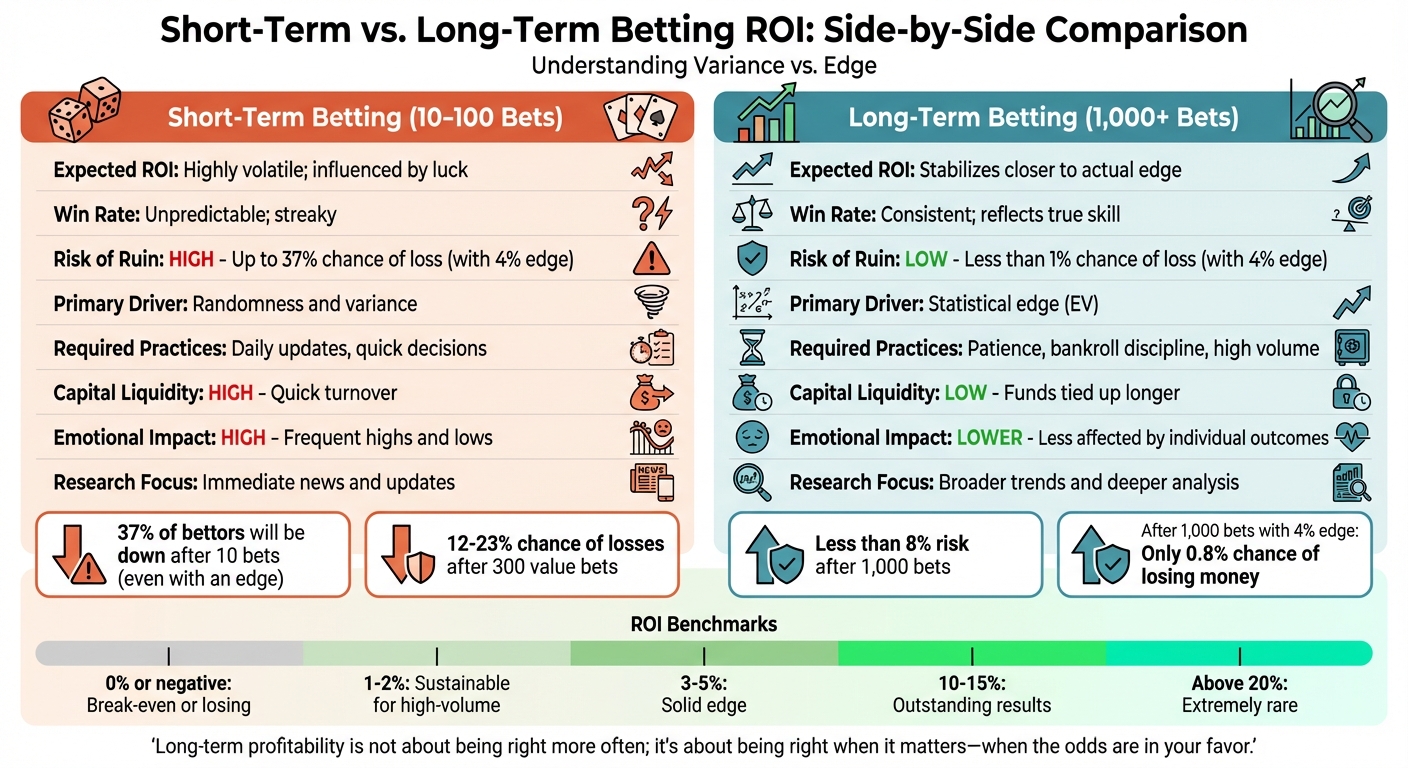
Short-Term vs. Long-Term Betting ROI: Side-by-Side Comparison
Short-Term vs Long-Term Betting ROI Comparison
Choosing between short-term and long-term betting boils down to understanding variance versus edge. In the short term, randomness often dominates results, while the long term reveals your actual skill and strategy.
The math behind this is pretty striking. Early bets are heavily influenced by variance. For example, if you place 1,000 bets with a 4% edge, the chance of losing money drops to just 0.8%. This is why seasoned bettors focus on patience and volume rather than chasing immediate wins.
Short-term betting has its perks, like quick access to your money and the ability to jump on new opportunities. On the flip side, long-term betting often ties up your bankroll for months - especially in futures markets - but it offers steadier returns and less emotional stress from daily ups and downs. This contrast highlights how short-term results can be misleading, while long-term strategies showcase true betting skill.
Consider this: most sports bettors lose between 6% and 9% of their wagers over a season. Why? Because they prioritize short-term thrills over building a lasting edge. Even with positive expected value, simulations show that after 300 value bets, bettors still lost money 12% to 23% of the time. Once they hit 1,000 bets, that risk plummeted to less than 8%.
To make this clearer, here’s a side-by-side comparison of short-term and long-term betting:
Comparison Table: Short-Term vs. Long-Term ROI
| Factor | Short-Term Betting (10–100 Bets) | Long-Term Betting (1,000+ Bets) |
|---|---|---|
| Expected ROI | Highly volatile; influenced by luck | Stabilizes closer to your actual edge |
| Win Rate Sustainability | Unpredictable; streaky | Consistent; reflects true skill |
| Risk of Ruin | High (up to 37% chance of loss with 4% edge) | Low (less than 1% chance with 4% edge) |
| Primary Driver | Randomness and variance | Statistical edge (EV) |
| Required Practices | Daily updates, quick decisions | Patience, bankroll discipline, high volume |
| Capital Liquidity | High; quick turnover | Low; funds tied up for longer periods |
| Emotional Impact | High; frequent highs and lows | Lower; less affected by individual outcomes |
| Research Focus | Immediate news and updates | Broader trends and deeper analysis |
"Long-term profitability is not about being right more often; it's about being right when it matters - when the odds are in your favor." – Survival.soe.ucsc.edu
For those looking to balance these approaches, tools like WagerProof's Edge Finder can be a game-changer. It identifies mispriced odds and value opportunities across numerous markets in real time. With instant alerts, it supports both short-term adjustments and long-term strategy building. This tool aligns perfectly with the idea of tailoring your betting approach to your financial goals.
How to Measure and Improve Your Betting ROI
ROI Calculation Formula
Calculating betting ROI is straightforward: (Net Profit / Total Staked) x 100. Here, net profit is the difference between your total returns and the total amount wagered, while "total staked" refers to the total amount you’ve bet, not your initial bankroll.
For instance, if you stake $1,000 and earn $1,150, your net profit is $150, resulting in an ROI of 15%. To break even at standard -110 odds (which include a 10% vigorish), you’d need a win rate of 52.38%.
ROI benchmarks can help gauge your performance:
- 0% or negative: Indicates a break-even or losing strategy.
- 1% to 2%: Sustainable for high-volume bettors.
- 3% to 5%: Reflects a solid edge.
- 10% to 15%: Outstanding results.
- Above 20%: Extremely rare and typically unsustainable over time.
Now that you know how to calculate ROI, let’s look at tools that make tracking and improving it easier.
Tools for Tracking Performance and Finding Value
Manually tracking bets can be time-consuming and prone to errors. That’s where tools like WagerProof come in. It simplifies tracking with real-time data and automated outlier detection, helping you spot value bets when prediction market spreads don’t align. By offering transparent insights, it shows exactly why a bet might be worth placing.
Another powerful tool is WagerBot Chat. This AI assistant, connected to live professional data, analyzes multiple factors - like weather conditions, odds movements, injury updates, and statistical models - all through plain-English queries. Unlike other tools, it avoids generating misleading or inaccurate data.
Additionally, line shopping - comparing odds across sportsbooks - can significantly improve your win rate. Even a 1% to 3% boost in odds over a season can compound into meaningful gains. These tools not only simplify ROI tracking but also help incorporate short-term insights into a broader strategy.
Why Sample Size and Variance Matter
Variance plays a huge role in betting outcomes, especially with smaller sample sizes. Even with a 5% edge (roughly a 55% win rate at -110 odds), there’s a 30% chance of losing across just 100 bets. Larger sample sizes are needed to confirm your edge.
Think of 1,000 bets as an initial testing phase. To truly validate a strategy, you’ll likely need at least 3,000 bets. For mid-range odds (1.70–2.30), ROI can swing between -5% and +12% over 1,000 bets but tends to stabilize between +4% and +8% after 3,000 bets. For higher odds (2.50–6.00+), variance remains high, and even 3,000 bets may only provide a preliminary evaluation.
Proper bankroll management is critical during these periods of variance. Experts recommend risking no more than 1% to 2% of your bankroll on any single bet. The Kelly Criterion - calculated as f* = (bp - q) / b (where b is decimal odds minus one, p is win probability, and q is loss probability) - can help determine the ideal stake size. Many bettors prefer a fractional Kelly approach, like Half Kelly or Quarter Kelly, to reduce volatility and account for potential estimation errors. Without disciplined management, high-variance swings could drain your bankroll before your edge has a chance to show.
Conclusion: Matching Your Strategy to Your Goals
Deciding between short-term and long-term betting ROI depends on your personal objectives and how much time you're willing to dedicate. Short-term strategies can yield quick profits but come with high variance and require constant attention. On the other hand, long-term approaches focus on steady growth and validating your edge over time.
Before diving into either strategy, take a moment to calculate your implied hourly rate. Divide your expected value (EV) by the time spent on betting. If the edge you’re chasing doesn’t justify the time you’re investing, even a +EV strategy might not be worth the effort. As DRatings explains:
"If the expected edge cannot justify the time investment, the value is gone".
This straightforward calculation helps you avoid sinking hours into activities that don’t pay off. It’s a reminder to align your time and effort with realistic returns. For example, a small 1% edge might feel risky at first due to high variance, but the swings decrease as your sample size grows. Short-term bettors need to be prepared for these fluctuations, while long-term players must stay disciplined during inevitable losing streaks.
WagerProof offers the tools to support either approach. With automated alerts for mispriced odds and easy-to-understand, multi-factor analysis, it replaces guesswork with clear data. Whether you’re aiming for quick wins or building a long-term edge, having reliable data makes all the difference.
FAQs
How many bets do I need before my ROI means anything?
When it comes to gauging ROI in betting, you need a large sample size - think hundreds or even thousands of bets. Why? Because smaller samples are often skewed by luck and variance, which makes them unreliable for evaluating long-term success. A bigger sample size smooths out these random swings, giving you a much more accurate view of your overall betting performance.
Is ROI or Closing Line Value (CLV) better for judging my strategy?
Both ROI and CLV are important metrics, but they focus on different aspects of performance. ROI (Return on Investment) gives you a clear picture of your overall profitability, helping you understand if your strategy consistently delivers profits. CLV (Closing Line Value), however, measures how effectively you outperform the market by comparing your betting odds to the closing odds. Many experts argue that CLV is a stronger predictor of long-term success because it highlights your ability to identify value bets and provides insight into your future ROI potential.
What bet size keeps me safe during short-term losing streaks?
When dealing with short-term losing streaks, keeping your risk in check is key. A common suggestion is to bet just 1-2% of your bankroll per wager. This cautious strategy helps protect your funds and minimizes the impact of losses.
Another option is the Kelly criterion, a formula designed to calculate the ideal bet size based on your advantage and the odds. However, many bettors opt for a fractional Kelly (like using half of the calculated amount) to add an extra layer of safety, especially during unpredictable stretches.
Related Blog Posts
Ready to bet smarter?
WagerProof uses real data and advanced analytics to help you make informed betting decisions. Get access to professional-grade predictions for NFL, College Football, and more.
Get Started Free