5 Signs of Suspicious Odds in Betting Markets
Suspicious betting odds can signal insider knowledge or market manipulation. Here's how to spot them:
- Sharp Odds Changes: Sudden drops over 10% often signal professional bets or breaking news. Cross-check across sportsbooks to confirm.
- High Betting Volume: Watch for large money spikes on one side, especially when bet percentages don’t match the money distribution.
- Odd Betting Patterns: Bets on unlikely outcomes or mismatched odds across sportsbooks can indicate manipulation.
- Contradictory Odds: Odds that don’t align with expert predictions or statistical models may point to mispricing or public-driven shifts.
- Unusual Bet Timing: Late or in-play betting surges without clear reasons often suggest insider activity.
Use real-time tools like WagerProof to analyze odds, betting volume, and timing across sportsbooks. Spotting these signs early can help you make informed decisions and avoid costly mistakes.
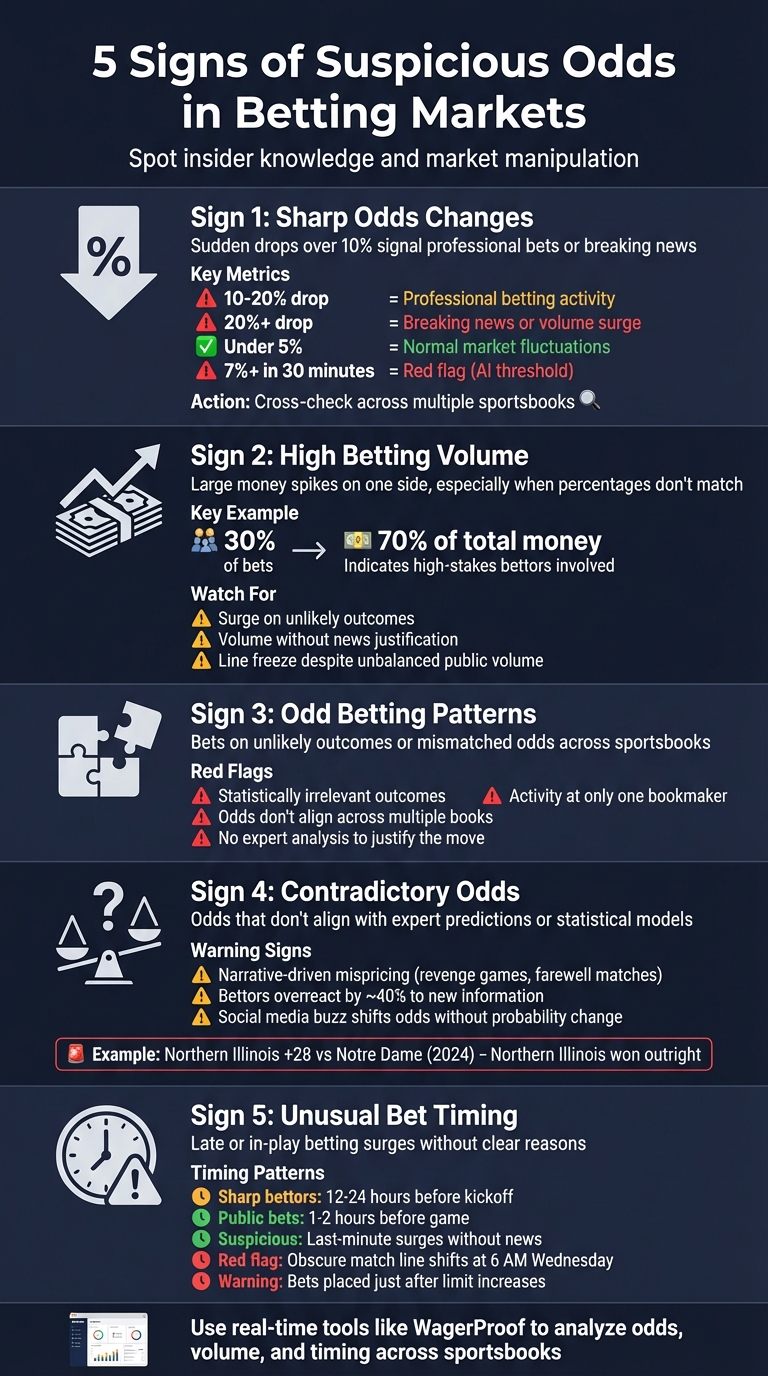
5 Signs of Suspicious Odds in Betting Markets Infographic
1. Sharp, Large Odds Changes
Magnitude of Odds Movement
When odds suddenly drop, it often signals something unusual is happening. A decrease of 10–20% typically points to professional betting activity, while drops exceeding 20% might indicate breaking news or a surge in betting volume. On the other hand, movements under 5% are usually just regular market fluctuations.
Once odds fall beyond the 10–12% range, any potential value usually disappears. Modern AI tools also flag shifts greater than 7% within a 30-minute span as noteworthy, especially if there’s no news about lineups or other justifiable reasons for the change. These sharp changes should always be cross-checked across multiple sportsbooks to confirm their significance.
Consensus Discrepancies
If only one sportsbook adjusts its line, it might be due to internal risk management or a "pump fake" strategy - where small bets are placed to nudge the line before larger bets are made at more favorable odds. However, when about 90% of sportsbooks shift their odds simultaneously, it’s a clear sign of professional betting activity.
Sharp sportsbooks, known for opening lines early and allowing higher betting limits, are often the first to reflect professional wagers. Pay close attention to odds movements that happen right after a sportsbook increases its maximum bet limits - this often points to significant money coming in from professional groups. Additionally, cross-referencing these sharp moves with performance metrics like Expected Goals (xG) can help identify potential traps. If odds drop but the underlying stats don’t support the change, it might be a public-driven move based on emotions rather than data.
Timing of Bets
Professional bets tend to come in 12–24 hours before kickoff, while public bets usually flood in 1–2 hours before the game starts. This timing difference helps distinguish data-driven market moves from last-minute, emotion-driven public activity. Odds changes close to game time are often overreactions rather than well-analyzed shifts.
Tools like WagerProof’s Edge Finder can analyze these patterns in real time. By comparing aggregated model spreads with sportsbook lines, it helps identify sharp activity versus public sentiment, giving you a chance to act on reliable signals before the opportunity passes.
Detecting Suspicious Odds Movements in Sports Betting
2. Abnormally High Betting Volume
Keeping an eye on betting volume is a valuable complement to tracking odds movement. It helps uncover unusual patterns in how wagers are distributed.
Betting Volume Analysis
When a large amount of money suddenly pours in on one side of a bet, it can signal something out of the ordinary. This type of spike might hint at attempts to manipulate odds - or even the event itself. The challenge lies in figuring out whether this surge is just regular public enthusiasm or something more suspicious.
One key indicator is when the percentage of money wagered far outweighs the percentage of tickets placed. For example, if only 30% of bets are on one side but that side accounts for 70% of the total money, it’s likely that high-stakes bettors are involved. This kind of imbalance becomes even more questionable when there’s no logical explanation - like injury updates or weather changes - to justify the sudden shift. Such anomalies often warrant closer scrutiny, as they could point to potential manipulation.
Pattern Deviations
It’s not just the raw numbers that matter - pay attention to where the money is going. Betting volume becomes suspicious when it targets outcomes that don’t make sense. For instance, a surge in wagers on niche or highly specific outcomes - like a certain player committing the first foul or a minor penalty happening early in the game - raises eyebrows. These aren’t typical betting behaviors and could suggest someone has insider knowledge about how the event will play out.
Professional bettors have become savvy at spreading their wagers across multiple accounts to avoid detection. While this makes spotting traditional volume spikes more difficult, the underlying pattern remains the same: money showing up in unexpected places without any clear reason.
Timing of Bets
The timing of betting volume can also reveal a lot. Late or in-play betting surges are often a sign of insider information or last-minute manipulation. Another red flag is when a betting line stays completely static despite unbalanced public volume. This usually means the sportsbook is giving weight to sharp bets on the other side - a phenomenon known as a "line freeze".
Tools like WagerProof’s real-time data tracking are invaluable for catching these anomalies as they happen. By analyzing public bet percentages alongside money flow across multiple sportsbooks, you can spot inconsistencies in the numbers. This allows you to decide whether to follow the sharp money or steer clear of the noise. Up next, we’ll explore how unusual bet placement patterns can further expose irregularities in the market.
3. Betting Patterns That Don't Make Sense
Sometimes, betting patterns just don't add up. Beyond sudden shifts in odds or unexpected betting volume, these odd behaviors can be a telltale sign of market manipulation. When wagers stray far from statistical norms, it's worth paying attention.
Pattern Deviations
When bets are placed on outcomes that seem statistically irrelevant or outright irrational, it’s a major red flag. These kinds of wagers often lack any logical foundation and deserve closer examination. Another clue? Odds that don’t align across multiple sportsbooks. If the numbers don’t match up, it could point to irregular betting behavior.
Consensus Discrepancies
If suspicious activity appears at only one bookmaker, and there’s no clear explanation, that’s another warning sign. This is especially concerning when expert analysis or statistical data can’t justify the move. By 2026, it’s become clear that legitimate market shifts tend to occur across multiple sportsbooks, not just one. The timing of these bets can also shed light on potential manipulation.
Timing of Bets
When a wave of large bets comes in at unusual times, it might indicate insider knowledge. For example, if there’s no breaking news about injuries or strategy changes to back up a sudden odds drop, consider it a red flag. Always check real-time updates - if the numbers don’t align with reality, something might be off.
This is where tools like WagerProof’s automated outlier detection can make a difference. By monitoring multiple sportsbooks and flagging mismatches in market spreads, it helps you catch these odd patterns in real time. Up next, we’ll dive into how odds that clash with expert analysis can expose even deeper market anomalies.
4. Odds That Contradict Expert Analysis
When odds stray far from what experts predict, it often signals something unusual - whether it's bookmakers adjusting for risk ("shading") or the result of impulsive public betting behavior.
Consensus Discrepancies
One clear sign of this divergence is when consensus odds don’t line up with expert forecasts. If odds shift significantly without an obvious reason, it’s worth digging deeper. Take the 2024 matchup between Northern Illinois and Notre Dame as an example. Northern Illinois entered the game as +28 underdogs. Despite expert predictions and heavy betting on Notre Dame, Northern Illinois pulled off an outright win. This highlighted a clear case of market mispricing.
"If the odds differ significantly from the predictions of sports analysts or experts, it can be cause for concern. It may suggest that an effort is being made to manipulate the odds to profit from the disparity." – ACGCS Staff
Such instances underline how misalignment with expert analysis can point to larger distortions in the betting market.
Pattern Deviations
Another red flag is when odds are influenced by narratives rather than actual probabilities. This "narrative-driven mispricing" often happens around compelling storylines, such as revenge games or farewell matches. Public enthusiasm can exacerbate these shifts - odds might tighten for popular teams due to social media buzz or fan-driven podcasts, even when the underlying probabilities remain unchanged. Studies show that bettors tend to overreact to new information by about 40%, leading to rapid price swings that don’t align with professional models.
A great example of this occurred in April 2025 during the Leeds vs. Manchester City match. Leeds began as 20-to-1 underdogs but flipped to 1.40 in-play after two quick counter-attacks. This dramatic shift demonstrated how live events can completely overturn pre-match analysis.
WagerProof’s automated outlier detection system is designed to monitor these discrepancies in real time across multiple sportsbooks. By flagging mismatches between market spreads and expert analysis, the tool helps bettors spot when the market has overreacted - or when a genuine value opportunity is on the table.
5. Unusual Bet Timing
The timing of a bet can reveal just as much as the amount wagered. Professional bettors and sharp syndicates often follow distinct schedules that differ greatly from casual fans. Understanding these timing patterns can help you distinguish informed betting activity from casual or emotional wagers.
Timing of Bets
Sharp bettors often act early in less-followed leagues, targeting opening lines that haven’t been thoroughly adjusted yet. By placing bets before bookmakers refine their odds, they exploit potential weaknesses in the initial lines. On the other hand, public bets tend to pour in closer to game time, influenced by emotions and media narratives.
Last-minute or in-play betting surges can be a warning sign. The Association of Certified Gaming Compliance Specialists notes:
"When a significant number of bets are placed in the final moments before an event commences, it can raise questions about insider knowledge or last-minute manipulation".
This kind of activity becomes especially suspicious when it occurs without any accompanying news, such as injury updates, weather changes, or lineup announcements. Combining these timing insights with earlier observations about bet volume can help paint a clearer picture of potential market manipulation.
Pattern Deviations
Keep an eye out for unusual timing in odds movements. For instance, if a relatively obscure soccer match sees its line shift at 6:00 AM on a Wednesday, it’s likely the work of professional syndicates rather than casual bettors. Similarly, consistent line changes at set times - like mid-afternoon on Thursdays - might indicate deliberate, timed actions by sharp groups.
Another key signal is when bets are placed just after sportsbooks increase their limits, a hallmark of professional activity. On the flip side, smaller bets placed just before limits rise may be "pump fakes", designed to manipulate the line ahead of a larger wager at a more favorable number. Tracking these patterns can help differentiate genuine sharp action from attempts to mislead the market.
Tools like WagerProof’s real-time monitoring system are particularly useful for identifying timing anomalies. By flagging synchronized early-morning movements or sudden last-minute betting spikes, these systems help bettors avoid chasing misleading trends and instead focus on uncovering true value opportunities.
Conclusion
Identifying key signs like sharp odds shifts, unusually high betting volume, irrational patterns, unexpected odds deviations, and strange timing can help you spot insider information or potential manipulation. For instance, sudden shifts right before kickoff or during in-play betting, especially with high volumes, often indicate something unusual is at play.
Emotional bias is another common pitfall. When bettors let narratives or emotions guide their decisions, odds can become mispriced because the public reacts to stories rather than hard data. Often, what seems like "dropping odds" is simply bookmakers adjusting for internal risk. That’s why relying on data-driven tools is crucial for separating real signals from distractions. Real-time monitoring is particularly valuable in this regard.
WagerProof’s tools are designed to help you cut through the noise. The Edge Finder instantly flags outliers by analyzing over 50 statistical models against market odds. The AI Game Simulator runs thousands of simulations per game to predict win probabilities. Meanwhile, WagerBot Chat delivers real-time insights using professional live data, and the Public Money Splits tool highlights discrepancies between ticket counts and money percentages - showing when sharp bettors and the public are on opposite sides.
FAQs
How can I tell sharp action from public hype?
Sharp action typically originates from professional bettors and is often responsible for early, strategic shifts in betting lines. This can include reverse line movement, where the line moves against the majority of public bets. On the other hand, public hype - often fueled by emotion or media narratives - tends to follow popular teams or recent trends, leading to less informed changes in the market. To differentiate between sharp action and market noise, tools like real-time alerts and public money data from platforms like WagerProof can be incredibly useful.
What does a “line freeze” usually mean?
A “line freeze” occurs when betting odds or lines stop shifting. This typically means the bookmaker has paused adjustments, either because the event is close to starting or to control the flow of bets. It often suggests the market has stabilized or that there’s been notable betting activity.
When should I avoid betting after a big odds move?
Avoid placing bets after a major shift in odds if you’re late to the game. That change likely happened because of sharp bettors or insider knowledge, meaning the opportunity for value is probably gone. Betting in these situations can lead to chasing poor odds and overlooking the critical factors that moved the market in the first place.
Related Blog Posts
Ready to bet smarter?
WagerProof uses real data and advanced analytics to help you make informed betting decisions. Get access to professional-grade predictions for NFL, College Football, and more.
Get Started Free