
Social Sentiment in Betting: How It Impacts Odds
Betting odds aren't just shaped by stats - they're heavily influenced by public opinion, or "social sentiment." Here's the deal:
- Odds reflect public betting trends: Bookmakers adjust odds based on where the money flows, not just the actual probability of an outcome.
- Popular teams = inflated odds: Media hype and fan enthusiasm can skew odds, often lowering payouts for favorites and creating value opportunities for underdogs.
- Social media drives sentiment shifts: Platforms like Twitter and Reddit provide real-time insights into public perception, which can predict line movements before sportsbooks react.
- Tools can help: AI-driven tools like sentiment scoring, keyword tracking, and line movement monitoring help bettors spot when odds are swayed by emotion rather than data.
The key takeaway? By combining sentiment analysis with hard data, you can identify market inefficiencies and make smarter bets.
How Social Sentiment Impacts Betting Odds: A Step-by-Step Guide
Business Analyst: What are people betting on? Rise in prediction markets
How Social Sentiment Affects Betting Odds
The betting market is far from static - it shifts constantly, influenced by public sentiment as much as by raw statistics. While bookmakers rely on statistical models to set the opening lines, the flow of public bets forces them to adjust the odds to minimize risk and protect their profits. This constant recalibration highlights the powerful role sentiment plays in shaping the odds.
"In this way, public sentiment - not raw probability - starts to bend the numbers." – BettingBarometer.com
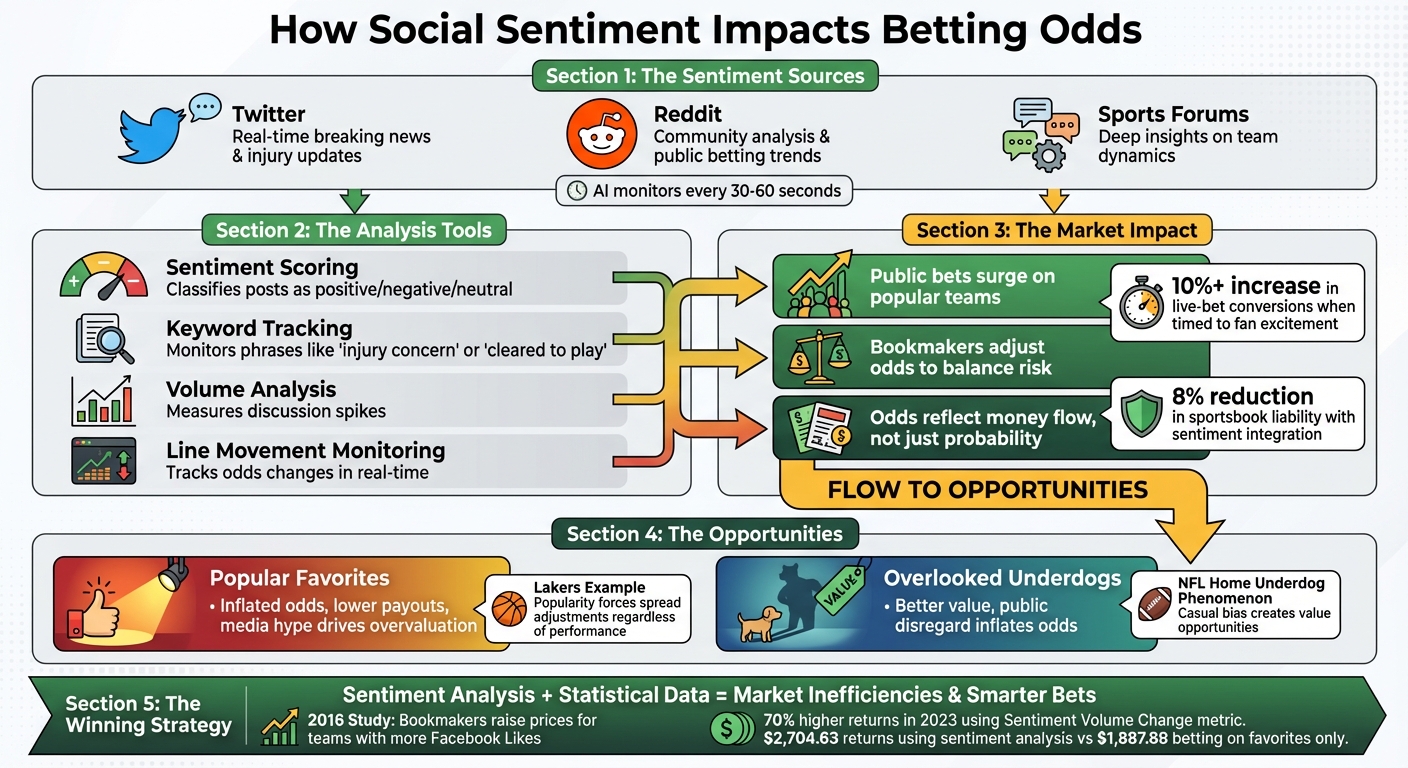
What’s fascinating is that the odds you see often reflect where the money is going, not the actual probability of an outcome. For instance, a 2016 study revealed that bookmakers tend to raise prices for bets on teams with more Facebook "Likes", showing how bettors’ emotions, rather than logic, can influence the market.
Public Perception's Effect on Betting Markets
Public sentiment doesn’t just tweak the odds; it creates opportunities for savvy bettors. Media coverage and social media chatter can spark betting trends, pushing odds in predictable ways. Take, for example, a situation where rumors of a star quarterback’s injury spread just before the Super Bowl. The ensuing panic on news platforms and social media often leads to a surge of bets against that team. Oddsmakers respond by adjusting the moneyline or spread, sometimes overcompensating and lowering the underdog’s odds beyond what the situation actually warrants.
Certain teams have an almost magnetic pull on casual bettors, regardless of their current performance. In the NBA, the Los Angeles Lakers are a prime example - they consistently attract heavy betting volume simply due to their popularity. This often forces bookmakers to adjust moneyline spreads or over/under lines, sometimes to the detriment of accurate odds. Similarly, during the FIFA World Cup group stages, public enthusiasm for heavy favorites like Brazil or Germany often drives overwhelming betting interest, reducing the potential value for those teams.
Psychological factors like herd mentality, recency bias, and media influence play a big role here. These forces push bettors to follow the crowd, leading to sharp line movements that don’t always align with the actual probabilities of a game. For bettors who can spot these trends, such shifts can unlock valuable opportunities.
Market Overreactions and Value Betting Opportunities
When public sentiment skews the odds, sharp bettors have a chance to capitalize. Bookmakers often "shade" the odds on popular favorites, offering less favorable payouts than the true statistical probabilities would suggest. On the flip side, overlooked underdogs can offer better value, as public disregard inflates their odds.
The NFL’s "home underdog" phenomenon is a classic example. Casual bettors frequently back the more famous team, even when they’re playing on the road against a lesser-known opponent. This bias distorts the betting line, historically creating better-than-average value for the home underdog.
These inefficiencies occur because bookmakers prioritize balancing their books over predicting actual outcomes. Their adjustments aim to manage the flow of bets, not necessarily to reflect the true likelihood of an event. For bettors who can separate "smart money" from "casual money", these misalignments offer a chance to find mispriced odds and refine their strategies.
Tracking Social Sentiment on Major Platforms
Keeping a close eye on social sentiment is a game-changer for spotting early market trends that can shake up betting odds. By zeroing in on shifts in public chatter, you can uncover insights that influence odds in real-time. Thanks to AI-driven sentiment analysis, platforms now capture social discussions every 30-60 seconds, giving you a near-instant pulse on the conversation.
Social Media Platforms for Sentiment Analysis
Twitter is unmatched when it comes to breaking news and quick reactions. Whether it’s a star player getting injured during warmups or a coach making a surprising lineup call, Twitter is where the news breaks first. Its real-time updates make it a goldmine for spotting sentiment changes before bookmakers catch on. For the best insights, follow verified accounts from beat reporters, team insiders, and respected analysts - they often share updates minutes ahead of mainstream outlets.
Reddit's sports betting communities offer a different kind of value, focusing on in-depth analysis and collective wisdom. Subreddits like r/sportsbook reveal what casual bettors are thinking and where public money is leaning. If a game thread shows overwhelming support for one team, it can signal an impending line shift - or present a contrarian opportunity on the other side. Niche subreddits also highlight insider knowledge from die-hard fans who track team dynamics closely.
Sports forums and message boards bring another layer of insight, often diving into details that mainstream sources might miss. From travel schedules to weather conditions to team chemistry, these platforms capture the nuances that can influence outcomes.
These platform-specific insights lay the groundwork for using advanced tools to turn sentiment into actionable data.
Tools and Metrics for Measuring Sentiment
Tracking social sentiment effectively goes beyond skimming through feeds. Advanced tools like sentiment scoring use natural language processing to classify posts as positive, negative, or neutral regarding a team or event. For example, when DraftKings tested a system that timed bet prompts to moments of heightened fan excitement, they saw live-bet conversions jump by over 10%, along with a 7% increase in average wager size.
Keyword tracking is another powerful tool, monitoring phrases that signal changing narratives. Words like "injury concern", "questionable", or "limited practice" can spark public anxiety and shift odds, while terms like "full practice" or "cleared to play" often reverse the sentiment just as quickly. Meanwhile, volume analysis measures spikes in discussion intensity, with sudden surges often predicting line movements.
Combining these metrics with line movement monitoring takes sentiment analysis to the next level. For instance, if a rumor about a key player injury surfaces on Twitter and triggers a wave of negative sentiment, systems that integrate sentiment and line monitoring can adjust odds faster. This approach not only helps sportsbooks reduce liability by up to 8% but also allows bettors to spot where bookmakers might be overreacting - or underreacting - to public sentiment. By tracking both sentiment and odds changes, savvy bettors can identify opportunities to capitalize on market inefficiencies.
How to Use Social Sentiment for Odds Analysis
Using social sentiment to gain an edge in betting requires a well-timed and structured approach. The trick lies in analyzing sentiment shifts during the brief window before sportsbooks adjust their odds. Thanks to AI-driven tools that now monitor social chatter every 30–60 seconds, you're armed with almost real-time data that reflects the public's mood in the moment. When this mood index shows sharp spikes or drops, it often hints at upcoming changes in the odds. The next step is learning how to identify these shifts as they happen.
Spotting Sentiment Trends Before Odds Adjust
The most impactful sentiment changes often occur during pivotal game moments, like a star player getting injured. Sportsbooks are increasingly factoring real-time social sentiment into their odds, allowing them to make quicker updates. Keep an eye out for sudden bursts of activity on social media - when news breaks about a player's injury, the initial wave of reactions can reveal the public's immediate leanings. By spotting these shifts early, you can anticipate how odds might move and adjust your strategy accordingly. Combining these insights with solid data ensures a more informed analysis.
Combining Sentiment Data with Betting Metrics
While social sentiment captures the market's emotional pulse, pairing it with traditional betting metrics gives you a more complete picture. Start by comparing sentiment-driven odds changes with core team statistics. If a line moves due to public excitement rather than actual changes in team performance or strategy, you might uncover a value opportunity.
To refine your strategy, merge sentiment data with NFL stats, player performance, team records, historical matchups, and even user behavior within betting apps. For example, if social sentiment overwhelmingly backs a popular team but the stats show their opponent has a strong defensive edge, the inflated line might present a chance to bet on the underdog.
Balancing public sentiment with hard data helps you separate meaningful trends from mere noise. This dual approach enables you to spot instances where social buzz has distorted the odds, giving you a chance to make smarter, more calculated bets.
Using WagerProof to Analyze Social Sentiment

WagerProof takes the concept of market-driven sentiment shifts and enhances it with advanced analytics. By combining sentiment tracking with statistical analysis, it reveals how public perception influences betting markets. Its tools are designed to identify opportunities created by sentiment shifts, offering a way to turn social trends into actionable betting insights.
Live Prediction Markets Tracking
This feature keeps an eye on moneyline spreads and over/under lines in real time, showing how odds change as public sentiment evolves. Watching these odds shift allows you to spot moments when market movements stray from what the stats suggest should happen.
Statistical Edge Finder for Value Betting
The Statistical Edge Finder compares Vegas lines with team performance metrics to uncover mismatches. For example, if public sentiment inflates a team’s spread beyond what the stats justify, this tool highlights the gap. This is especially handy during big games when social chatter tends to distort market expectations.
AI Game Simulator and WagerBot Chat
The AI Game Simulator runs countless game scenarios using data like team stats, player performance, and historical matchups. If a line movement seems driven by sentiment, the simulator provides projections to help you decide whether there’s real value in the market’s reaction. It even integrates real-time sentiment analysis, blending audience emotions with odds and game events to refine predictions.
WagerBot Chat serves as your on-the-spot analyst, offering insights into matchups, player stats, and betting angles. Wondering if the latest social media buzz justifies the odds? WagerBot can pull up key stats like strength of schedule or historical data to help you make the call. By merging social sentiment trends with statistical models, it boosts forecasting accuracy, giving you the tools to make better-informed betting decisions.
Case Studies: Sentiment-Driven Odds Changes
Research spanning seven professional sports leagues across Europe and North America uncovered an intriguing trend: bookmakers often raise prices on teams with higher Facebook "Likes." This directly ties a team's social media popularity to changes in betting odds. The implication? Bettors swayed by sentiment bias might be less sensitive to price, ultimately influencing the betting market.
Consider the 2016 NBA Finals as a prime example of how sentiment can distort odds. The Golden State Warriors, riding a wave of media hype, became the public favorite. However, savvy bettors saw through the inflated odds and placed their bets on the underdog Cleveland Cavaliers, who went on to win the championship. As NYSB Staff explained:
When the media hypes a particular team or player, it often leads to a disproportionate amount of public bets placed on them, regardless of the actual odds or likelihood of success. This hype can inflate odds to the point where betting against the media's darling offers better value.
A separate study took a closer look at sentiment's influence in a different setting. By analyzing nearly two million tweets from over 400 Premier League matches, researchers explored whether Twitter sentiment could predict in-game outcomes. While the study revealed that social media effectively captured fan emotions, it didn’t improve forecasting accuracy. Interestingly, fan sentiment on Twitter tended to decline as matches progressed, likely reflecting how quickly expectations adjusted during the game.
These examples highlight a key takeaway: sentiment-driven odds changes may not enhance market efficiency. For bettors who rely on objective analysis, this presents an opportunity to uncover better value.
Strategies for Using Sentiment Data Effectively
Combining Sentiment with Statistical Analysis
Social sentiment becomes far more impactful when paired with traditional statistical methods. Research reveals that blending sentiment insights with quantitative metrics can significantly improve forecasting accuracy. For instance, one study introduced a Sentiment Volume Change (SVC) metric that monitored both the emotional tone and the volume of discussions about betting events. The results were striking: SVC showed a much stronger correlation with next-day returns (R² = 0.0214) compared to sentiment alone (R² = 0.0006). Investment strategies based on this approach achieved 70% higher returns in 2023 and 84.4% higher returns in 2021 compared to a simple buy-and-hold strategy.
To implement this, start with statistical models as a foundation - like using the Poisson distribution for predicting sports outcomes or analyzing historical performance data. Then, layer sentiment analysis on top to pinpoint where the market might be mispricing odds. Look for situations where extreme sentiment contrasts with statistical trends. For example, a Premier League study found that analyzing tweet sentiment outperformed betting solely on odds favorites, delivering $2,704.63 in returns compared to $1,887.88 when betting on favorites. By using sentiment analysis as a complementary tool, you can uncover hidden market inefficiencies and refine your strategy.
Avoiding Emotional Bias in Sentiment Analysis
While combining sentiment with data can sharpen your insights, managing your own emotional biases is equally critical. It’s all too easy to let public sentiment sway your decisions, but successful bettors know how to stay level-headed. As Betaminic.com explains:
What differentiates successful bettors is their ability to remain calm, analyze their decisions, and adapt their strategies without letting emotions take the driver's seat.
In fact, professional bettors often go against public sentiment to find value.
To keep emotions in check, plan your bets carefully. Define your bankroll, stick to a consistent unit size (1-5%), and set clear entry and exit points for each wager. Making decisions based on facts rather than feelings is essential. Todd Fuhrman, a former Caesars Oddsmaker and co-founder of the Bet the Board Podcast, offers this advice:
The best thing a struggling sports bettor can do is give himself a day off to clear his head. There's always another bet and winner out there.
Finally, consider keeping a betting journal. Document your wagers, outcomes, and any emotional influences you notice. This habit can help you spot patterns, refine your approach, and avoid repeating mistakes.
Conclusion: Using Sentiment for Better Betting Decisions
Social sentiment offers a unique lens for spotting mispriced odds, especially when public opinion clouds actual probabilities. This creates opportunities that many casual bettors overlook, as common biases - like herd mentality, recency bias, and media-driven hype - often lead to market overreactions.
Pairing sentiment analysis with solid data is the key to making smarter betting decisions. While sentiment shows where the crowd is leaning, statistics keep you anchored to reality. This combination helps you sidestep emotional traps and pinpoint situations where public overreaction inflates betting lines, paving the way for well-informed, contrarian bets.
WagerProof's suite of tools makes it easier to put these insights into action. Features like the Statistical Edge Finder, AI Game Simulator, and WagerBot Chat are designed to highlight when public sentiment skews the odds. The Statistical Edge Finder identifies discrepancies between odds and statistical probabilities, while the AI Game Simulator runs multiple scenarios to predict outcomes that go beyond public sentiment. Meanwhile, WagerBot Chat provides real-time analysis, blending statistical insights with market behavior to help you separate genuine opportunities from emotion-driven trends.
FAQs
How does social sentiment influence betting odds?
Social sentiment has a powerful influence on betting odds, shaping how the public views teams, players, or events. Trends on social media, widespread news coverage, and passionate fan reactions often sway bettor behavior, pushing odds toward teams or outcomes that are getting a lot of attention.
To keep up with this public interest, bookmakers frequently tweak the odds, which can sometimes lead to market inefficiencies. These shifts don’t always reflect the true likelihood of an outcome, creating opportunities for sharp bettors to find value bets. By diving into social sentiment data, you can uncover these patterns and make more strategic betting choices.
How can bettors analyze social sentiment to improve their betting decisions?
Bettors have the option to use specialized tools designed to analyze social sentiment, providing a window into public opinion and emerging trends. These tools can monitor live discussions, detect shifts in sentiment, and highlight potential betting opportunities.
Take WagerProof, for instance. This platform delivers advanced analytics, such as real-time sentiment tracking and predictive tools, enabling users to make informed, data-backed decisions. By grasping how public perception can influence odds, bettors can position themselves to make more strategic wagers.
How can bettors spot value opportunities when odds shift due to social sentiment?
Bettors can find opportunities by keeping an eye on odds that shift due to social sentiment - like when a team gains sudden popularity on social media. These changes often happen because betting lines are adjusted to match public opinion rather than actual on-field performance.
To make the most of these scenarios, dig deeper to see if the odds truly reflect the team's strength or if they're inflated by media buzz and fan enthusiasm. Using tools that track real-time data, monitor betting line changes, and analyze social sentiment can give you an edge in spotting value in these sentiment-driven adjustments.
Related Blog Posts
Ready to bet smarter?
WagerProof uses real data and advanced analytics to help you make informed betting decisions. Get access to professional-grade predictions for NFL, College Football, and more.
Get Started Free