
ROI Trends in Sports Betting Analytics
Sports betting success in 2026 revolves around ROI (Return on Investment). It's not just about winning bets anymore - it's about making smart, data-driven decisions that maximize profits. Here's what you need to know:
- ROI Calculation: The formula is simple: (Net Profit ÷ Total Amount Wagered) × 100. For instance, a $400 profit on $5,000 wagered equals an 8% ROI.
- AI Tools: Platforms like WagerProof use AI to analyze thousands of data points in real time, identifying value bets and reducing human error.
- Key Metrics: Beyond ROI, bettors track Expected Value (EV), Win Rate, and Bankroll Growth to refine strategies.
- Micro-Betting: Betting on in-game moments is on the rise, with real-time data creating more opportunities for profit.
- Challenges: Poor data, fraud, and short-term thinking can distort ROI. Transparent platforms and disciplined strategies are essential.
AI-powered tools and real-time data are reshaping the betting landscape. Success depends on precise ROI tracking, value-focused decisions, and avoiding impulsive bets. Want consistent profits? Stick to the numbers and let AI handle the heavy lifting.
This Sports Betting Strategy Consistently Makes 30%+ ROI Every Year
Core Metrics for Calculating ROI in Sports Betting
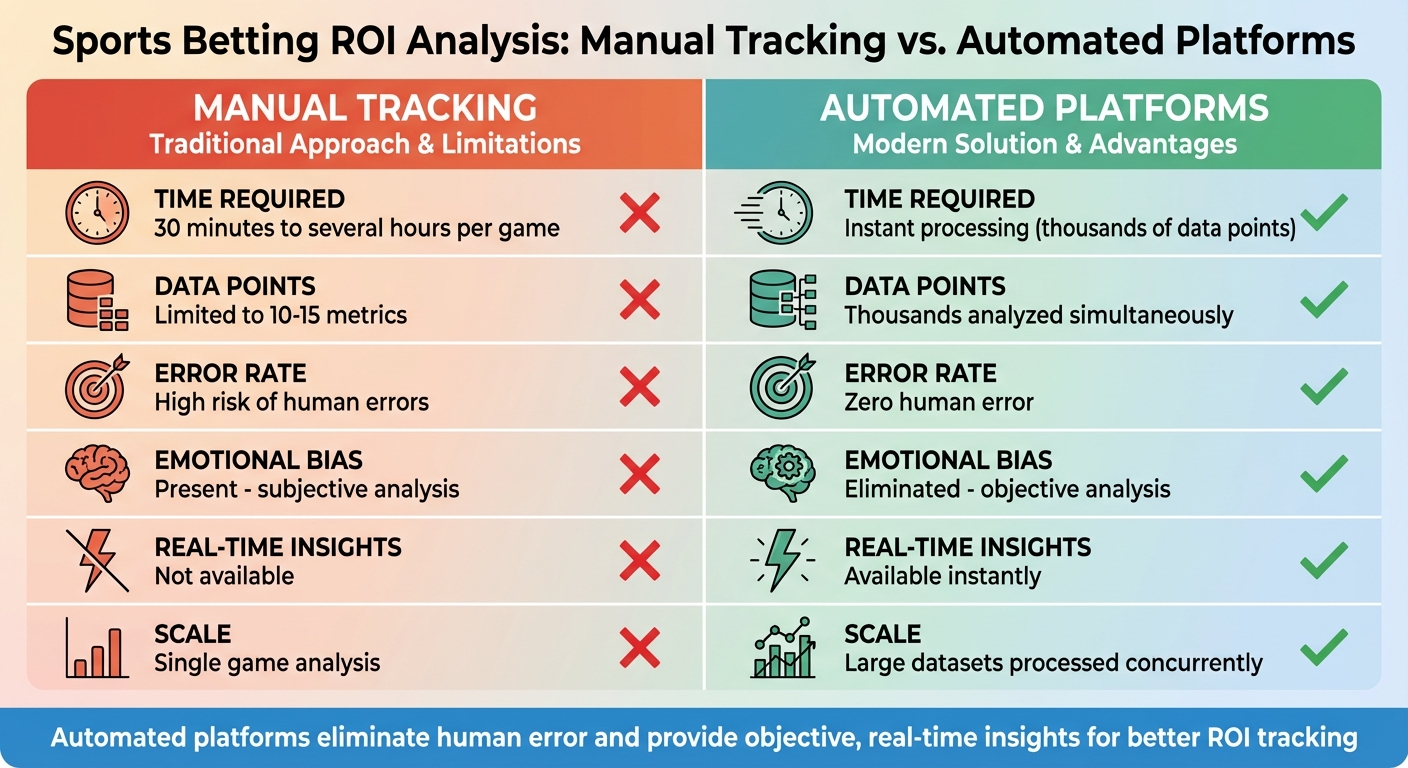
Manual vs Automated ROI Tracking in Sports Betting: Speed, Scale and Accuracy Comparison
In the world of sports betting, where real-time data plays a crucial role, accurately calculating ROI (Return on Investment) is the foundation of any successful strategy. Without clear metrics, it's impossible to evaluate how effective your approach is. Whether you're a casual bettor placing a few wagers here and there or a professional managing a significant bankroll, having precise data is essential for making informed adjustments.
Manual tracking can be time-consuming, requiring anywhere from 30 minutes to several hours per game. It often limits analysis to just 10–15 metrics and increases the risk of errors. On the other hand, automated platforms can process thousands of data points instantly, analyze large datasets simultaneously, and eliminate human error. These systems also remove emotional bias, offering objective, real-time insights that bettors can rely on.
How to Calculate ROI: The Formula
Calculating ROI in sports betting is simple: (Net Profit ÷ Total Amount Wagered) × 100. For instance, if you wager $5,000 and make a $400 profit, your ROI would be 8%. This percentage clearly shows how much return you're getting for every dollar you risk.
Why is this important? Consider this: a bettor with a 55% win rate might have a lower ROI than someone who wins only 48% of their bets, simply because the latter is finding better odds or value in their bets. By focusing on ROI, you can cut through the noise and pinpoint what's actually effective. Regularly tracking this metric - weekly or monthly - can help you identify trends and address potential issues early.
Advanced Metrics Beyond Basic ROI
While ROI is a key metric, it only scratches the surface. To get a fuller picture of your betting performance, you need to consider additional metrics like:
- Expected Value (EV): This measures whether a bet is mathematically profitable over time. A positive EV bet might lose in the short term but will generate profits when repeated over hundreds of bets.
- Win Rate: This shows the percentage of bets you’re winning, giving you insight into your overall performance.
- Bankroll Growth: This tracks changes in your total funds, helping you understand how well you’re managing risk and variance.
When combined, these metrics provide a more complete analysis. For example, a 6% ROI with steady bankroll growth and consistent positive EV bets signals a sustainable strategy. On the flip side, a 15% ROI paired with erratic bankroll changes and negative EV bets suggests luck, not skill, is driving results.
How AI Improves ROI Analysis
AI-powered tools have revolutionized ROI analysis by addressing the limitations of manual methods. They excel in speed, scale, and accuracy. For instance, WagerProof's AI research agents work tirelessly to process prediction markets, historical data, public betting trends, and statistical models - all at once. These agents identify value bets by spotting inefficiencies in prediction market spreads versus actual odds, which are the key opportunities for boosting ROI.
Another game-changer is WagerBot Chat, which connects to live professional data without generating false information. You can ask it straightforward questions, and it provides a detailed response by pulling together real-time odds, weather conditions, injury updates, and model predictions. This ensures your ROI calculations are based on accurate, up-to-date information. Plus, the transparency of these tools means you can verify every data point and understand exactly why a bet qualifies as a positive EV opportunity.
2026 Trends in ROI Optimization
As the sports betting world evolves, 2026 is shaping up to be a game-changer with trends that are reshaping how bettors maximize their returns. Key developments like real-time data integration, micro-betting opportunities, and custom AI agents are making betting strategies more precise and efficient. These innovations are driving smarter decision-making and helping bettors boost their ROI.
Real-Time Data for Better Betting Decisions
In sports betting, timing is everything. Real-time data allows bettors to act quickly on new information - like a star player getting injured or unexpected weather changes - before the odds adjust. Acting fast in these moments can mean the difference between locking in value or missing out.
Platforms like WagerProof are leading the charge by providing instant alerts when market spreads don't match current odds, flagging valuable opportunities as they happen. Their WagerBot Chat taps into professional-grade data sources, ensuring bettors have the latest updates and insights to address common questions in sports betting data analysis to make informed decisions.
This real-time approach is especially powerful in the growing world of micro-betting, where every second counts.
Micro-Betting and In-Game ROI Opportunities
Micro-betting is changing the way people think about sports betting. Instead of betting on the overall outcome of a game, micro-betting lets you wager on individual moments - like a player’s next action or a specific play. This creates constant opportunities to find value, especially when AI tools can analyze and act faster than any human.
The stats tell the story: bettors who take advantage of frequent micro-betting opportunities wager 269% more daily compared to single-day players. Additionally, in-game bets, parlays, and exotic wagers now make up more than 50% of all bets placed. As gambling law expert I. Nelson Rose explains:
Today, more than half the bets are in-game, parlays, and exotic wagers, e.g., betting on individual athletes. There is much faster action and higher profits for operators.
For bettors, this means more frequent chances to use their analytical skills and find positive expected value throughout the game. This fast-paced betting style naturally calls for advanced AI tools that can keep up.
Custom AI Agents for ROI Growth
Personalized AI agents are becoming an essential tool for improving ROI. These agents can be tailored to fit your specific betting style, using over 50 parameters like risk tolerance, sports preferences, and strategic goals. Running around the clock, they analyze matchups, process historical trends, and highlight value bets you might otherwise miss.
WagerProof's AI research agents take customization to another level. They let you tweak settings based on performance data, helping you fine-tune your strategy for better results. By identifying outliers and surfacing value bets automatically, these agents handle the heavy lifting, freeing you to focus on refining your overall approach to betting.
Common ROI Measurement Problems and Solutions
Measuring ROI in sports betting isn’t as straightforward as it might seem. Even with advanced tools and strategies, challenges like low-quality data, fraudulent activities, and a focus on short-term gains can skew results and lead to poor decisions. To achieve long-term profitability, it’s crucial to understand these issues and address them effectively. Let’s break down the main challenges and explore practical solutions.
Poor Data Quality and Lack of Transparency
Flawed data can derail accurate ROI calculations. When you’re working with incomplete stats, unverifiable odds, or missing public betting information, your assessments are likely to be off. Research shows that bettors using platforms with limited transparency could overestimate their ROI by as much as 20–30%, often due to hidden fees or selective reporting. Some platforms even manipulate records or conceal cappers, making it almost impossible to evaluate the true effectiveness of a strategy.
Transparency has a measurable impact. For example, Optimove’s analysis of 34.5 million bets during March Madness found that players segmented transparently - like those betting on Selection Sunday - had a six-month retention rate of 92%, compared to just 17% for other first-time depositors. This kind of insight is only possible with clear, accurate data.
Platforms like WagerProof tackle this issue head-on by offering full transparency across all AI agent results and data sources. This ensures that bettors and operators alike can trust their numbers. But data quality isn’t the only hurdle - fraudulent activity poses another major problem.
Fraud and Bot Activity Effects on ROI
Fraudulent behavior can wreak havoc on ROI measurements. Fake accounts and bots placing coordinated bets create patterns that mislead analytics. For instance, undetected bot activity in the March Madness dataset could significantly distort retention rates, reducing true ROI by 15–20% for operators who mistake inflated volume for genuine value.
Bots and duplicate clickers can also corrupt optimization signals, driving up costs unnecessarily. With the US sports betting market projected to hit $15 billion in revenue by 2027, these distortions could lead to massive financial losses.
WagerProof’s AI agents help combat this issue by identifying outliers and mismatches in prediction market spreads, making it easier to avoid fraud-driven errors in ROI calculations. Together with improved data quality, this creates a more reliable foundation for evaluating performance.
Building Long-Term ROI vs. Chasing Quick Wins
Focusing on short-term gains often comes at the expense of long-term profitability. Overbetting on high-variance events, like single-game parlays, can lead to boom-and-bust cycles that erode your bankroll. Studies suggest that using the full Kelly Criterion for bet sizing can be risky, while a partial Kelly approach offers a safer path to steady returns.
The solution lies in prioritizing value over volume. Instead of chasing every game, bettors should focus on data-driven betting strategies, sustainable bankroll management, and advanced metrics like pace-of-play and injury impacts. Leveraging AI tools to identify value bets can also help reduce impulsive decisions.
WagerProof’s AI research agents are designed with long-term success in mind. Operating around the clock, they analyze matchups, highlight value bets, and maintain complete transparency. Customizable risk tolerance settings allow you to align the agents with your personal strategy, steering clear of the pitfalls of short-term thinking. The goal isn’t to chase quick wins - it’s to build a consistent edge that grows over time.
Conclusion
The sports betting world in 2026 looks nothing like it did just a few years ago. Success now hinges on data-driven strategies rather than gut feelings. The global sports betting market is expected to hit $124.88 billion in 2026, up from $112.26 billion in 2025, with much of this growth fueled by AI-powered analytics. Bettors who lean into advanced metrics, real-time data, and AI insights are setting themselves up for consistent wins, while those sticking to outdated methods risk falling behind.
Key to thriving in this environment is a focus on precise ROI tracking, cutting-edge metrics, and AI-driven analysis. Whether you're exploring micro-betting during live games, using AI tools to analyze matchups around the clock, or finding hidden value bets automatically by finding a betting edge, these strategies are transforming the way bets are placed. This data-driven approach is essential for navigating the fast-paced betting landscape.
That said, poor data quality and manipulative practices can skew ROI. To avoid these pitfalls, stick to platforms that verify data accuracy and highlight anomalies.
Achieving sustainable ROI requires a disciplined approach. It's not about chasing high-risk bets or betting on every game. Instead, consistent returns come from long-term value, proper bankroll management, and focusing on quality over quantity. For example, players who bet for over 10 days wager 269% more daily than one-time bettors, proving that retention and consistency are key drivers of real returns. AI can take on the heavy lifting by analyzing data, allowing bettors to focus on strategy rather than guesswork.
Platforms like WagerProof are at the forefront of this shift. With tools like AI research agents and WagerBot Chat, WagerProof delivers real-time insights to help bettors maintain long-term ROI growth. These AI agents run 24/7, analyzing matchups and tailoring picks based on your personal betting style and risk preferences. WagerBot Chat integrates live data - covering everything from weather and injury reports to odds and predictions - offering multi-layered analysis without errors. The platform also identifies outliers, mismatches, and value bets automatically. With over 50 customizable parameters for each AI agent, WagerProof enables you to build a system designed for sustained success in 2026 and beyond.
FAQs
What’s a good ROI in sports betting in 2026?
In 2026, achieving a solid return on investment (ROI) in sports betting typically falls between 3% and 7% annually for professional models. However, advanced strategies that emphasize precise calibration and integrate multiple models can push returns significantly higher - sometimes reaching 34.69%. The key to success lies in leveraging accurate data and continuously improving your methods over time.
How many bets are needed for ROI to be meaningful?
When it comes to achieving a meaningful ROI in betting, the number of bets you place plays a crucial role. To reduce variability and limit the impact of luck, professional bettors often target 100–200 bets as a baseline for evaluating their performance accurately.
In this context, a long-term ROI of 5–10% is typically seen as a strong indicator of success. However, the real measure of performance lies in consistency across a larger sample size. The more bets you analyze over time, the clearer the picture of your true performance becomes.
How do I size bets to grow my bankroll without huge swings?
If you want to grow your bankroll steadily while avoiding major ups and downs, proper bankroll management is key. Start by betting a small, consistent percentage of your total bankroll - most experts recommend sticking to 1-2% per bet. This approach helps reduce risk and smooth out the natural swings that come with betting.
It’s also important to keep an eye on your return on investment (ROI). By analyzing your performance metrics, you can make informed adjustments to your bet sizes. Staying disciplined and following these rules can help you manage losses effectively while working toward gradual, long-term growth.
Related Blog Posts
Ready to bet smarter?
WagerProof uses real data and advanced analytics to help you make informed betting decisions. Get access to professional-grade predictions for NFL, College Football, and more.
Get Started Free