
How to Spot Travel Fatigue in Betting Data
Travel fatigue affects athletic performance, especially in sports with demanding schedules and frequent travel. For bettors, understanding this impact creates opportunities to exploit inefficiencies in betting markets. Here's a quick summary:
- What is travel fatigue? It’s the physical and mental toll from long flights, time zone shifts, and back-to-back games, leading to reduced performance (e.g., lower scoring, slower reaction times).
- Why it matters for betting: Sportsbooks often fail to fully adjust for fatigue factors like travel distance or rest days, leaving gaps for sharp bettors.
- Key fatigue signals: Back-to-back games, cross-country travel, long road trips, and post-road-trip home games often lead to performance drops.
- Betting strategies: Fade tired favorites, target player prop unders (especially for older players), and explore live betting opportunities during games.
Schedule Patterns That Signal Travel Fatigue
Back-to-Back Games with Cross-Country Travel
Back-to-back (B2B) games can be a major challenge for teams, especially when they involve crossing multiple time zones. The real trouble starts when teams travel eastward, as this disrupts players' sleep cycles much more than heading west, where adjustments tend to feel more natural.
The toughest scenario is what’s often called the Dead Zone: a team plays in one time zone, flies overnight, and then has to compete the next day in a completely different time zone. This double hit - travel-induced fatigue and circadian rhythm disruption - can significantly impact performance. Take the Boston Celtics in December 2023, for instance. They were riding a five-game winning streak but lost 132-126 to the Warriors on December 19 after traveling to California on December 17. It’s a clear example of how travel schedules can derail momentum.
Coast-to-coast B2Bs are especially punishing. In the NBA, performance in these situations can drop by 5-7%, compared to the usual 3-5% decline seen in same-timezone back-to-backs. Another common pitfall is the West Coast Trip Starter, where Eastern Conference teams often struggle in the first game of a West Coast swing due to abrupt time zone changes and disrupted routines.
Long Road Trips and Fatigue Accumulation
Extended road trips bring their own set of challenges, as fatigue tends to build up over time. The longer the trip, the more exhaustion accumulates, especially during compressed schedules like "3 games in 4 nights" or "4 games in 6 nights." In leagues like the NBA and NHL, this cumulative fatigue can cause offensive efficiency to dip by 5-8%. Similarly, NHL teams on prolonged road trips often experience a 5-8% drop in winning percentage.
One often-overlooked factor is the "Post-Road Trip Home Game." Teams returning home after a long stretch on the road frequently struggle in their first game back, dealing with lingering travel fatigue and a psychological letdown. Consider the Los Angeles Dodgers’ grueling schedule in June 2024. After traveling east to face the Reds on May 24 with only one day of rest, they lost 9-6. Then, following another cross-country flight to Pittsburgh on June 4, again with just one day of rest, they fell 1-0 to the Pirates. These examples highlight how travel strain can affect performance - key details that bettors can use to spot undervalued opportunities in the market.
Reading Betting Data for Travel Fatigue
Public Money on Tired Favorites
Public bettors often lean toward well-known teams, even when those teams face grueling travel schedules. This creates a chance to bet against these "fatigued favorites" and find value.
When 70% or more of public bets back a fatigued favorite, the team's reputation can inflate its perceived strength, while the toll of extensive travel is overlooked. This is a classic case of recency bias. Bettors might focus on a team's recent strong performance but fail to consider how long road trips can impact their play.
"The betting public thinks games are won by talent. Professionals know games are won by context." - Ron Raymond, Founder, ATSStats.com
Take the May 2025 game between the Minnesota Twins and Seattle Mariners as an example. Despite 72% of public bets favoring the Mariners, sharp bettors saw value in the Twins. Why? They recognized that the betting public ignored crucial situational factors tied to travel fatigue. This kind of oversight is common and often leads to underperformance by the favored team.
These scenarios open the door for sharp bettors to spot reverse line movement signals and capitalize on market inefficiencies.
Sharp Money Targeting Fatigued Teams
While public bettors often misjudge the impact of fatigue, sharp bettors use it to their advantage, adjusting their strategies to exploit these situations.
Reverse line movement is a key indicator of sharp money. For instance, if 75% of public bets are on a well-rested favorite, but the point spread shifts from -7 to -6 in favor of the fatigued underdog, it’s a sign that sharp bettors are going against the public.
"The most powerful fade opportunities occur when the line moves against heavy public action. This signals sharp money is taking the opposite position of the public." - WagerLens
Sharp bettors also find opportunities in player prop markets, where sportsbooks often apply a flat 5% adjustment for back-to-back games. However, this doesn’t account for factors like player age or travel distance. For example, a veteran over 30 playing the second game of a back-to-back after significant travel might experience a 5–10% performance drop, but the market may only adjust by 5%.
Professional handicappers treat travel schedules as a "second point spread." Using tools like the "24HR Rule", they analyze travel itineraries before diving into team stats. One effective strategy involves betting on rested home teams hosting opponents playing the second night of a back-to-back. These teams have historically covered the spread over 55% of the time.
Finding Fatigue Edges in Prediction Markets
Comparing Prediction Markets to Sportsbook Lines
Prediction markets tend to price travel fatigue more effectively than traditional sportsbooks. Why? They focus on critical situational factors - like rest differentials and travel schedules - rather than being swayed by public sentiment. When prediction market spreads differ from sportsbook lines, it often signals that fatigue factors are being mispriced.
For example, sportsbooks typically apply a flat 5% adjustment for back-to-back games but fail to consider variables like travel distance or the age of players. Prediction markets, on the other hand, adapt more precisely to specific situations, such as the "dead zone" effect. These differences can create opportunities. After an eastward trip, prediction markets might adjust the home team's spread to favor the visiting team. Sharp bettors often treat the schedule itself as a secondary point spread, relying on prediction markets to reflect these nuances faster than public sentiment-driven sportsbook lines.
Live Market Shifts During Games
Fatigue effects aren't just visible before games - they often emerge during live action. Take the NHL, for instance: teams playing the second game of a back-to-back can see goals against rise by 8–12% in the third period as defensemen and goaltenders tire out. If a fatigued team is leading after the first or second period, live markets frequently present value on the rested opponent.
Another example involves West Coast teams traveling east for early games. A 1:00 PM ET start feels like 10:00 AM to their internal clocks, often leading to sluggish first periods due to circadian misalignment. Conversely, East Coast teams playing late on the West Coast may fade in the final moments, giving their fresher opponents a boost. Tools like WagerProof's live data can help you track these shifts in real time, signaling when prediction market movements point to mounting fatigue. These insights allow you to seize fatigue-driven opportunities as they unfold during the game.
Understanding the East Coast vs West Coast Travel Impact on Sports Betting - Baseball and Basketball
Using WagerProof to Track Travel Fatigue

WagerProof takes the guesswork out of understanding travel fatigue's impact by combining prediction market insights with advanced tools. Here's how it breaks down.
Historical Stats and Public Money Tracking
WagerProof uses historical performance data alongside public betting trends to uncover how travel fatigue has influenced teams over time. Its Edge Finder tool compares 50 different models to current market odds, flagging discrepancies where travel fatigue might be miscalculated. If there's a gap between model consensus and sportsbook lines, it could signal that the public is overestimating a tired favorite or overlooking a well-rested underdog.
The Public Money Splits tool digs even deeper, showing differences between ticket percentages and money percentages. These splits can serve as a clue for sharp bettors, especially when historical data shows that teams playing back-to-back games tend to allow 1.5–2.5 more points per 100 possessions than their usual season average.
WagerBot Chat for Travel Fatigue Analysis
WagerBot Chat takes things a step further, offering real-time data on travel schedules, rest days, and betting models. Ask something like, "How do the Lakers perform on back-to-backs after West Coast road trips?" and you'll get instant insights that consider rest differentials, performance trends, and current betting lines.
The AI Game Simulator adds another layer by running thousands of game simulations to calculate win probabilities while factoring in travel and rest. For instance, it can identify the "first game back home" letdown effect - a common phenomenon for teams returning from extended road trips - and adjust its predictions accordingly. With AI-powered analysis boosting success rates by 15–20%, this tool offers a clear advantage over traditional handicapping methods.
Here's a quick look at WagerProof's key tools for analyzing travel fatigue:
| Tool | Primary Function for Fatigue Tracking | Key Output |
|---|---|---|
| Edge Finder | Compares 50 models to market odds | Flags outliers and consensus gaps |
| WagerBot Chat | Answers specific situational questions | Real-time travel and rest insights |
| Public Money Splits | Tracks ticket % vs. money % | Highlights sharp vs. public betting trends |
| AI Game Simulator | Simulates thousands of games | Provides win probability percentages |
How to Bet on Travel Fatigue
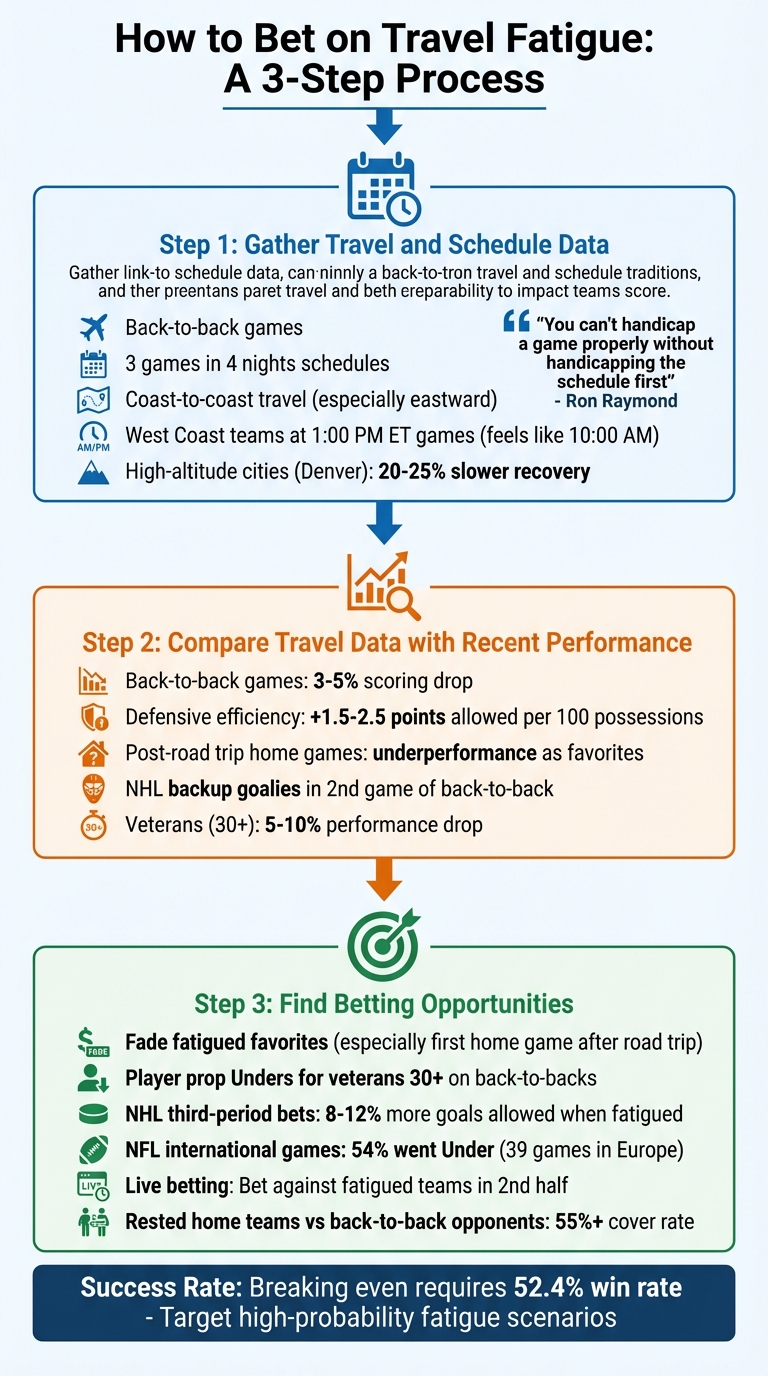
3-Step Process to Bet on Travel Fatigue in Sports
Transforming insights about travel fatigue into winning bets requires a structured, disciplined approach. This isn't about guesswork - it's about identifying patterns and using data to make informed decisions.
Step 1: Gather Travel and Schedule Data
Start by analyzing rest differences between teams. As Ron Raymond, Founder of ATSstats.com, emphasizes:
"You can't handicap a game properly without handicapping the schedule first".
Pay attention to key scheduling patterns, such as back-to-back games, three games in four nights, or coast-to-coast travel that involves crossing multiple time zones. These situations often lead to fatigue, especially when teams travel eastward. For example, when a West Coast NFL team plays a 1:00 PM ET game, their internal clock feels like it’s only 10:00 AM, which can impact reaction times and overall performance.
Altitude is another critical factor. Playing in high-altitude cities like Denver can slow recovery by 20–25%, amplifying fatigue effects. Once you've gathered this data, compare it with recent team trends to uncover potential inefficiencies.
Step 2: Compare Travel Data with Recent Performance
Match your travel data with team performance metrics to spot patterns. For instance, teams playing back-to-back games often see scoring drop by 3–5%, while defensive efficiency declines - these teams typically allow 1.5–2.5 more points per 100 possessions than their season average. Additionally, teams returning home after long road trips often underperform, particularly as home favorites.
In the NHL, check if a team is using their backup goalie during the second game of a back-to-back. A weaker goalie can create significant value for bets against that team. Veteran players (30 and older) are another factor to consider - they often show a 5–10% drop in performance during back-to-backs, making player prop Under bets more appealing.
With this data, you can pinpoint specific betting opportunities where travel fatigue has a measurable impact.
Step 3: Find Betting Opportunities
Now it’s time to turn these insights into actionable bets. Look for scenarios where travel fatigue creates market inefficiencies:
- Fade fatigued favorites: Teams playing their first home game after a long road trip often struggle. Betting against them on the moneyline or spread can provide value.
- Player prop Unders: Focus on veterans (30+) during back-to-backs, as their performance tends to dip due to the demanding schedule.
- Third-period NHL bets: Fatigued hockey teams often concede 8–12% more goals in the final period. Consider betting the Over on total goals or fading the tired team live in the third period.
- NFL international games: About 54% of the first 39 games played in Europe went Under the posted total, likely due to disrupted offensive rhythm.
Live betting also presents unique opportunities. If a fatigued team starts strong, their energy may drop off significantly in the second half. This is a prime time to bet against them. On some nights, travel schedules can outweigh even the most talented rosters.
Conclusion
Travel fatigue isn't just a buzzword - it’s a measurable factor that impacts athletic performance and, by extension, betting markets. When teams deal with challenges like circadian misalignment, back-to-back games, or long cross-country trips, their reaction times slow, decision-making falters, and physical performance drops. These biological realities directly influence win probabilities, often in ways sportsbooks don't fully account for.
While sportsbooks may adjust game lines for rest, player prop markets often lag behind, leaving exploitable opportunities. Statistical trends consistently highlight this gap, and it’s far from random - it’s a predictable pattern that savvy bettors can leverage.
This is where advanced tools like WagerProof come into play. By analyzing schedule misalignments before the market catches up, WagerProof helps identify rest mismatches and fatigue patterns that most bettors miss. With real-time access to prediction markets, public betting trends, historical data, and WagerBot Chat’s live pro insights, users can uncover outliers - like mismatched spreads between sportsbooks and prediction markets - and capitalize on these discrepancies.
Considering that breaking even in sports betting requires a 52.4% win rate, targeting high-probability fatigue scenarios can make all the difference. For example, rested home teams hosting opponents on back-to-back games have historically covered more than 55% of the time. With consistent data and the right tools, these patterns can help secure your edge in the betting world.
FAQs
How do I quantify travel fatigue for a team?
To measure travel fatigue, take into account factors like travel distance, number of rest days, time zone shifts, altitude changes, and unusual scheduling patterns. These elements can disrupt circadian rhythms and lead to physical exhaustion, which ultimately affects performance. By studying trends like extended trips, consecutive games, or erratic schedules, you can better evaluate fatigue levels and make smarter betting choices.
What’s the best way to spot sharp money on a fatigued team?
To identify sharp money on a team that might be struggling with fatigue, keep an eye on live betting data, particularly reverse line movement (RLM). This occurs when the betting line shifts in the opposite direction of public sentiment, often indicating sharp action. Pay close attention to a 10% or greater gap between the percentage of tickets and the percentage of money wagered - this discrepancy often points to sharp bets. Additionally, factor in how travel fatigue or back-to-back games could affect a team's performance; sharp bettors frequently capitalize on these situations to find potential mispricings.
Which player props are most affected by travel fatigue?
Player props that focus on individual performance stats are heavily influenced by travel fatigue. Metrics such as passing yards, scoring, and overall athletic performance can take a hit when players face the physical and mental toll of long travel or tight schedules. It's worth paying close attention to these figures when evaluating betting data for games involving significant travel or back-to-back matchups.
Related Blog Posts
Ready to bet smarter?
WagerProof uses real data and advanced analytics to help you make informed betting decisions. Get access to professional-grade predictions for NFL, College Football, and more.
Get Started Free