Teasers vs. Parlays: EV Comparison
Looking to choose between parlays and teasers? Here's what you need to know:
- Parlays combine multiple bets into one, offering high payouts but requiring all selections to win. They're high-risk, high-reward, with sportsbooks often holding a significant edge (e.g., 19.9% in New Jersey in January 2024). Adding more legs compounds both risk and house edge.
- Teasers let you adjust point spreads (e.g., 6 points in football), making bets easier to win but with reduced payouts. They shine in NFL betting when crossing key numbers like 3 and 7, but each leg needs a high win rate (around 72.4% at -110 odds) to break even.
Quick Takeaway:
Parlays are great for chasing big payouts if you have an edge on each leg. Teasers work better for increasing win probability, especially when betting on NFL spreads around key numbers. Both require careful evaluation of expected value (EV) to avoid unnecessary losses.
Quick Comparison:
| Bet Type | Payout | Win Probability Needed | House Edge | Best Use Case |
|---|---|---|---|---|
| Parlays | High (+260 for 2 legs) | Low (27.4% for 2 legs) | High (up to 35%) | Chasing large payouts with positive edges |
| Teasers (-110) | Lower (-110 for 2 legs) | High (72.4% per leg) | Lower (but still significant) | NFL spreads crossing key numbers (e.g., 3, 7) |
Choosing between them depends on your betting strategy and willingness to balance risk and reward.
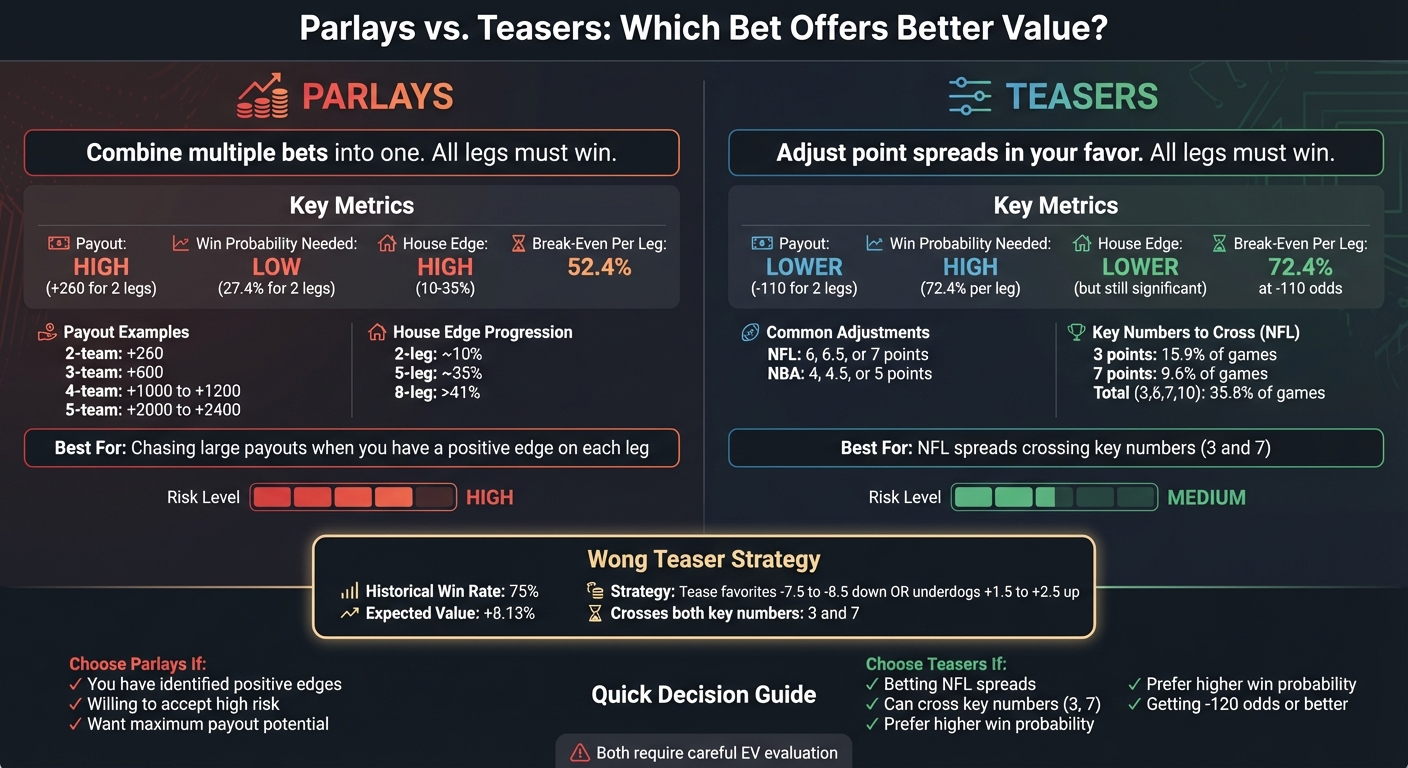
Parlays vs Teasers: EV Comparison Chart for Sports Betting
Teaser Bets EXPLAINED: Smarter Than Parlays?
What Are Parlays?
Understanding how parlays work is essential when comparing their expected value to teasers. A parlay is a single bet that combines two or more individual wagers, often referred to as "legs". The concept is straightforward: every leg must win for the parlay to pay out.
Parlays offer the allure of high payouts from small stakes, but this comes with the challenge of winning multiple independent events. For example, a $100 bet on a five-team parlay at -110 odds can yield around $2,400. In contrast, placing five separate $20 straight bets results in far smaller returns. Many sportsbooks allow you to mix different bet types - like point spreads, moneylines, and totals - across various games or sports. If one leg ends in a "push" (a tie against the spread), that leg is usually removed, reducing the parlay to fewer bets. Next, let's break down how payouts and odds work in parlays.
Payout Structure and Odds
Parlay payouts increase exponentially because the winnings from each leg roll over as the stake for the next. For standard -110 odds, typical payouts look like this:
- A 2-team parlay pays +260 (13/5)
- A 3-team parlay pays +600 (6/1)
- A 4-team parlay pays between +1000 and +1200 (10/1 to 12/1)
By the time you move to a 5-team parlay, the payout rises significantly to between +2000 and +2400 (20/1 to 24/1).
However, these payouts don’t align with the true mathematical odds. For instance, a five-team parlay with 50/50 outcomes has true odds of 31/1, but sportsbooks typically offer only 20/1 or 24/1.
"Parlays are the lottery tickets of sports betting. They are the only way to turn a small amount of money risked into an outsized return." - Ben Brown, PFF
While the potential for big payouts is enticing, these odds also result in a higher house edge, as explained below.
House Edge in Parlays
For a standard -110 straight bet, the house edge is approximately 4.5%. But when bets are combined into a parlay, this edge multiplies. For example, a two-team parlay has a house edge of about 10%, while a five-team parlay sees it climb to nearly 35%. For an eight-team parlay, the house edge typically exceeds 41%.
This compounding edge is why sportsbooks favor parlays. In January 2024, New Jersey sportsbooks reported a 19.9% hold on parlays - more than four times the 4.6% hold on straight bets.
"The edge for the books on parlays is significant... You are sacrificing a ton of value to try and 'win big' quickly." - Jason Katz, BettingPros
What Are Teasers?
A teaser is a type of parlay bet where you adjust the point spreads or totals in your favor. However, for the bet to pay out, every leg must win.
The main difference between a teaser and a standard parlay lies in the trade-off. With a teaser, you get a more favorable point spread, making each individual bet easier to win. But, in return, the payout is lower. For instance, instead of betting on a team favored by –7 at standard odds, you could tease the line down to –1, giving yourself a six-point cushion. The downside? Your potential winnings decrease significantly.
Teasers are especially popular in sports like football (NFL and college) and basketball (NBA and college), where point spreads play a significant role. While adjusting points reduces the risk of losing individual legs, it increases the overall win probability needed to break even. Interestingly, about 40% of NFL games are decided by margins of 3 to 7 points, making it a smart move to tease through these key numbers.
"The teaser bettor is essentially adjusting points on each game, trading a lower payout for a higher probability of winning." - Alyssa Waller, Betting Analyst
Now, let’s dive into the common point adjustments offered in teaser bets.
Common Teaser Options
In football, the most common teaser adjustments are 6, 6.5, or 7 points. Basketball teasers, on the other hand, usually offer 4, 4.5, or 5 points. Some sportsbooks also feature "Sweetheart" or "Monster" teasers, which allow for adjustments of 10 or 13 points. These options, however, require at least three legs and come with even smaller payouts.
The primary goal of a teaser is to shift the line through key numbers. For NFL games, 3 and 7 are the most critical, as they represent the most frequent margins of victory. Margins of 3, 6, 7, and 10 points account for 35.8% of all NFL outcomes.
Savvy bettors often stick to two-leg teasers to manage the balance between risk and reward. Adding more legs increases the house edge and the likelihood of losing the entire bet due to a single misstep. A popular strategy, known as the "Wong teaser" (named after Stanford Wong), involves teasing NFL favorites of –7.5 to –8.5 down or underdogs of +1.5 to +2.5 up. This approach crosses the key numbers of 3 and 7, with historical data showing a 75% success rate for these types of bets.
These adjustments directly impact payouts and the overall house edge in teaser betting.
Payouts and House Edge in Teasers
Teasers offer lower payouts compared to standard parlays because the point adjustments come at the cost of reduced potential winnings. For example, a 2-leg, 6-point NFL teaser typically pays between –110 and –130. In contrast, a standard 2-team parlay might pay around +260. Essentially, you’re giving up the chance for a big payout in exchange for better odds of winning.
To break even on a 2-leg, 6-point teaser at –110 odds, each leg must win about 72.4% of the time. If the odds shift to –120, the required win rate jumps to 73.9%. Historical data shows that teasing every NFL spread by 6 points results in a cover rate of roughly 69%, which doesn’t meet the break-even threshold for –110 odds.
For "Sweetheart" or "Monster" teasers with –110 odds, the required win rate climbs even higher - over 80.6% for each leg. While a 3-leg, 6-point NFL teaser might pay between +160 and +180, the added risk of an extra leg makes it much harder to win consistently. Even though teasers generally have a lower house edge than standard parlays (which range from 10–35%), they still require careful consideration of the balance between payout size and win probability.
"Almost 40% of NFL scores end with margins of 3-7 points... If you can get –120 or better on the 6-point, two-team teaser, it's likely to be profitable over the long term." - Steven Petrella, Deputy Editor, Action Network
Expected Value Basics for Multi-Leg Bets
Expected Value (EV) is a key concept in betting, used to estimate the average outcome of a wager over time. It’s calculated using this formula:
(Win Probability × Payout) - (Loss Probability × Stake)
If the EV is positive (+EV), the bet is expected to be profitable in the long run. On the other hand, a negative EV (–EV) signals that the wager will likely result in losses over time.
For parlays and teasers, EV helps evaluate whether the potential high payout of a parlay or the improved win probability from a teaser offsets the sportsbook's commission (often called the "vig"). This is especially important for multi-leg bets, where the cumulative probabilities tend to magnify the house edge compared to single-leg wagers.
How EV Works in Single-Leg Bets
Take a standard –110 bet as an example. To break even, you'd need a win rate of 52.4%. If your win rate is only 50%, the average loss per $110 wager is about $10. This results in a negative EV of around –4.5% to –4.6%. Here’s how it breaks down: for every $110 bet, you’d win $100 half the time and lose $110 the other half, averaging out to a $10 loss for every $220 wagered.
Compounded EV in Multi-Leg Bets
When you combine bets, the probabilities interact in a way that amplifies both potential rewards and risks. For instance, a two-leg parlay where each leg has a 50% win probability results in just a 25% chance of winning the overall wager. While a single –110 bet might have a –4.6% return on investment (ROI), combining two such bets into a parlay can push the ROI down to roughly –9%. This shows how compounding can significantly increase the negative ROI.
"Parlays compound your edge, whether it's positive or negative... compounded losses can escalate rapidly beyond 9% with additional legs."
- Jack Miller, Establish The Run
Teasers face similar challenges. A 2-leg, 6-point teaser at –110 odds requires each leg to hit about 72.4% of the time to break even. However, historical win rates often fall short of this benchmark.
EV Comparison: Parlays vs. Teasers
Let’s break down how parlays and teasers stack up when it comes to expected value (EV). A 2-team parlay with +260 odds offers a larger potential payout, but it demands an overall win probability of roughly 27.4% to break even. On the other hand, a 2-team, 6-point teaser at -110 odds requires a much higher overall win probability of 52.4%, meaning each leg must hit at a 72.4% success rate.
Historical trends reveal that 6-point NFL teaser legs win about 69% of the time, which falls short of the 72.4% break-even mark. Parlays, however, compound the house edge. For example, a single -110 bet has a -4.6% ROI, but combining two such bets into a parlay drops the ROI to -9%.
Here’s a table summarizing the critical metrics for each bet type, highlighting their different break-even points and outcomes:
| Bet Type | Typical Payout | Win Prob (Random) | Break-Even Leg % | Expected Value (EV) |
|---|---|---|---|---|
| 2-Team Parlay | +260 | 25.0% | 52.4% | -10.0% |
| 3-Team Parlay | +595 | 12.5% | 52.4% | ~-13.0% |
| 2-Team Teaser (-110) | -110 | 47.6% | 72.4% | -10.04% |
| 2-Team Teaser (-120) | -120 | 47.6% | 73.9% | -15.28% |
| 3-Team Teaser (+160) | +160 | 32.9% | 72.7% | -14.59% |
| Wong Teaser (2-leg, -110) | -110 | 56.3% | 72.4% | +8.13% |
One standout is the Wong Teaser, which targets NFL spreads that cross key numbers like 3 and 7. These legs historically hit at a 75% rate, surpassing the 72.4% break-even threshold. For instance, a $110 wager on a Wong Teaser generates an expected profit of $8.13, compared to a $10 loss on a standard 2-team parlay with no edge.
The pricing of bets also plays a huge role. A 2-team teaser priced at -120 instead of -110 raises the required per-leg win rate to 73.9%, making it a much worse option with a -15.28% EV. Similarly, adding a third leg to either a parlay or teaser increases the house edge unless you’re consistently betting on legs with a positive edge. These insights help clarify when each bet type might be worth considering.
When Parlays Offer Better EV
Parlays can work in your favor when you have a statistical edge on each leg. For instance, if two legs each carry a true win probability of 55% (above the 52.4% break-even point), their combined probability rises to 30.3%. This shift transforms a potential –$10 expected loss into a positive expected value (EV) scenario. Essentially, the edge compounds in your favor, just as the house edge typically works against you.
This strategy is most effective when wagering on unrelated events where the sportsbook has mispriced the line. Say your NFL spread model shows a team with a 58% chance to cover, while the sportsbook prices it at 52.4%. Combining two or three such edges in a parlay amplifies your return on investment (ROI). For example, a bettor achieving a 5% ROI on straight bets could see that grow to 10.1% on a two-leg parlay of similar quality. The concept extends further when exploiting multiple positive edges in a single parlay.
"Parlays effectively make you bet more... they compound your edge, whether it's positive or negative." - Ed Miller and Matthew Davidow, The Logic of Sports Betting
Using Positive Edges in Parlays
When you consistently identify bets with a 3% to 5% edge over the sportsbook's implied probability, parlays can help you maximize total EV on a single ticket. This approach becomes even more useful if sportsbooks limit your straight bets - parlays can sometimes bypass those restrictions.
To ensure you're getting fair value, compare the parlay payout to the product of the individual odds. If a sportsbook uses a "fixed" payout table offering less than the calculated value, the house edge increases unnecessarily. For example, a five-team parlay at +2000 odds requires an average win expectancy of at least 54.5% per leg to make sense.
Avoiding Common Mistakes
One of the most common errors is adding legs without an edge just to boost the payout. Each additional leg without a positive edge compounds the house edge instead of your advantage. Sportsbooks tend to hold a much higher percentage on parlays than on straight bets, often due to bettors including legs with no statistical advantage.
Stick to two- or three-leg parlays when you’ve verified positive edges. Adding more legs increases variance and amplifies the compounded house edge. Also, avoid "story" parlays where all legs are positively correlated, such as betting on a team to win, their quarterback to throw for 300+ yards, and the game to go over the total. These combinations are typically priced efficiently by sportsbooks, offering minimal value.
When Teasers Offer Better EV
Teasers can provide a positive edge when used strategically, especially in NFL betting. They shine when they cross key numbers in NFL spreads - namely 3, 7, and 10. These numbers are crucial because they represent the most frequent scoring margins in professional football. For instance, 15.9% of NFL games are decided by exactly 3 points, and 9.6% end with a 7-point margin. Altogether, 35.8% of NFL games finish with margins of 3, 6, 7, or 10 points. Adjusting spreads to cross these key numbers increases the likelihood of favorable outcomes.
The "Wong Teaser" is a popular approach that focuses on crossing these key numbers. It involves teasing favorites of -7.5 to -8.5 down to -1.5 to -2.5, or underdogs of +1.5 to +2.5 up to +7.5 to +8.5. Historically, teaser bets crossing both 3 and 7 have won approximately 75% to 76% of the time. This aligns with earlier data showing how adjustments around key numbers can significantly improve expected value (EV).
Key Numbers and Spread Adjustments
Win rates highlight the importance of crossing key numbers. For example, in games with a total of 47 or fewer points, underdogs of +1.5 to +2.5 covered a 6-point teaser 77% of the time, compared to only 70% in higher-scoring games. In low-scoring matchups, each point becomes more impactful, making a 6-point teaser shift even more valuable.
"Almost 40% of NFL scores end with margins of 3-7 points. If you can get -120 or better on the 6-point, two-team teaser, it's likely to be profitable over the long term." - Steven Petrella, Deputy Editor, Action Network
One common error is teasing through zero, such as moving a line from -2 to +4. Since NFL games rarely end in ties, zero is not a key number, and this adjustment wastes teaser equity. By focusing on spreads that cross key numbers, you can improve your win probabilities and manage risk more effectively.
Reducing Risk in Teasers
To maintain an edge, disciplined execution is key. For starters, stick to two-leg teasers. Adding more legs increases variance and amplifies the house edge, even when crossing key numbers. Also, shop around for the best pricing. For example, moving from -110 to -130 increases the break-even win rate from 72.4% to roughly 75.5%, which can erase your advantage.
Avoid dependent selections, such as teasing both the side and the total in the same game. If one leg wins, the other is often less likely to succeed, reducing your overall chances of cashing the ticket. Additionally, always check the sportsbook's push rules. If a push results in a loss rather than reducing the teaser to a straight bet, the house edge increases significantly.
Using Tools to Maximize EV: The Role of WagerProof
When it comes to optimizing expected value (EV) in teasers and parlays, precision is everything. That’s where WagerProof steps in. This real-time sports data platform is built to uncover outliers and highlight value bets by analyzing prediction markets, statistical models, and public betting trends. It’s the kind of tool that helps bettors identify mispriced lines and market inefficiencies in real time, giving them an edge in a competitive landscape.
How WagerProof Spots EV Opportunities
WagerProof works by creating a "consensus line" derived from odds across multiple sportsbooks. This baseline acts as a reference point to detect when a sportsbook is offering value odds. Using AI-driven probability models, it flags discrepancies - known as "model disagreements" - between a sportsbook's implied probability and the platform's statistical projections. For example, if a sportsbook's odds suggest a lower likelihood of an outcome than WagerProof’s models predict, the platform highlights that as a potential value bet.
This is especially helpful for teasers. WagerProof can spot intentional line shifts, such as when a sportsbook moves a line from -7.5 to -9. This tactic discourages bettors from using a 6-point teaser to cross critical numbers like 3 and 7, which are key in football betting. Additionally, the platform’s value bet signals alert users to favorable lines - like +2.5 or -7.5 - before sportsbooks adjust them to limit sharp betting activity. These automated notifications provide a foundation for deeper analysis using WagerBot Chat.
Using WagerBot Chat for Smarter Betting
WagerBot Chat takes the insights from WagerProof a step further. It integrates live professional data, historical trends, and statistical models to give you a real-time EV assessment of teasers and parlays. For instance, you can ask it whether a Wong Teaser (e.g., shifting a favorite from -7.5 to -1.5) offers positive EV at current odds. Or, you can evaluate whether adding a third leg to your parlay increases the house edge too much.
The tool also helps you sidestep common betting pitfalls. It can confirm if you’re getting -120 or better on a two-team, 6-point teaser - critical for ensuring long-term viability. Plus, it warns against suboptimal moves like teasing through zero or including dependent selections, which can reduce your overall win probability.
Choosing Between Teasers and Parlays
When deciding between teasers and parlays, it all comes down to your approach to expected value (EV) and your tolerance for risk. These options cater to different betting styles: parlays are for those chasing bigger payouts and willing to accept higher risk, while teasers are ideal for bettors looking to improve their win rate by "buying" points - especially in NFL games, where key numbers like 3 and 7 are crucial. As highlighted in EV analysis, your choice should align with whether you're aiming to exploit a positive edge or reduce variance.
Neither option is universally better - it depends entirely on your goals. If you're confident in spotting mispriced lines and want to maximize potential returns, parlays can amplify your advantage. On the other hand, if you're focused on managing risk and crossing key numbers in football, teasers offer a way to increase your chances of winning. The trick is knowing which tool works best for a given scenario. Let’s break down when each bet type shines.
Parlays: High Risk, High Reward
Parlays are the go-to for bettors who are comfortable with lower win probabilities in exchange for the chance at larger payouts. By combining multiple bets, parlays offer exponential returns through compounded edges. This is why they’re often referred to as "lottery bets" - they’re all-or-nothing wagers, and the house edge grows with each added leg.
The best time to use parlays is when you’ve identified multiple bets with a positive edge and want to combine them for a bigger payoff. However, keep in mind that adding more legs increases variance. To manage this, it’s smart to limit your parlays to two or three selections and wager smaller amounts - typically between 0.25% and 1% of your bankroll. Unlike teasers, which adjust spreads to improve hit rates, parlays rely on each leg hitting for a payout.
Teasers: Lower Risk, Lower Reward
Teasers are all about improving your win probability by buying points, particularly in NFL games where crossing key numbers like 3 and 7 can make a big difference. For example, a six-point teaser could adjust a -8.5 favorite down to -2.5 or move a +1.5 underdog up to +7.5. Historically, "Wong teaser" legs - those that cross key numbers - have hit at a rate of around 75%.
The trade-off is that teasers offer smaller payouts. A two-leg, six-point teaser typically pays out at odds of -110 to -120, compared to the +260 payout of a two-team parlay. To break even, each teaser leg needs to win about 72.4% of the time. This makes teasers particularly effective in low-scoring NFL games, where point adjustments hold more value. However, they’re generally not a good option in high-variance sports like basketball. If you can find teasers priced at -120 or better and stick to crossing key numbers, they can be a solid strategy for managing risk while maintaining a reasonable chance of success.
FAQs
What’s the difference between teasers and parlays when it comes to expected value (EV)?
Teasers and parlays might seem similar at first glance, but they operate quite differently, especially when it comes to expected value (EV).
Teasers let you adjust point spreads or totals to make the bet feel more favorable. For example, you might shift a football team's spread from -7 to -3, giving them a better chance to cover. However, this adjustment comes at a price - usually in the form of reduced payouts. While teasers might seem like a safer option, the lower EV can make it harder to achieve long-term profitability.
Parlays, on the other hand, combine multiple bets into a single wager. This can lead to much higher payouts, but the trade-off is the increased risk. Every leg of the parlay needs to win for your bet to pay out, which makes them harder to hit. Unless you can identify correlations between the bets or uncover specific value opportunities, parlays often carry a negative EV.
If you want to refine your betting strategy and uncover value bets, tools like WagerProof can be a game-changer. They analyze real-time data, highlight outliers, and help you make smarter, more informed decisions.
What is a Wong Teaser, and why is it a popular betting strategy?
A Wong Teaser is a specialized type of teaser bet aimed at boosting expected value (EV) by focusing on key NFL point spreads. This strategy, named after professional bettor Stanford Wong, leverages small but impactful adjustments to betting lines to give you better odds of winning.
Wong Teasers work best with NFL game spreads of -7.5 to -8.5 or +1.5 to +2.5. By using a six-point teaser, these spreads can be shifted to cross key numbers like 3 and 7 - two of the most common victory margins in football. This approach makes Wong Teasers an appealing option for bettors aiming to enhance their long-term betting performance.
When should you choose a parlay instead of a teaser?
Parlays are a solid option when you're chasing bigger payouts and are willing to take on more risk. The catch? Every single pick in your parlay has to hit for you to win. This higher-risk, higher-reward setup makes parlays a good choice if you're confident in your picks and ready to exchange a bit of security for the chance at a larger profit.
Teasers, on the other hand, are better for those looking to lower their risk. By adjusting point spreads in your favor, teasers offer more flexibility, but the downside is smaller payouts. So, if your main goal is to maximize potential returns and you’re okay with the all-or-nothing gamble that parlays bring, they can be a better fit in certain situations.
Related Blog Posts
Ready to bet smarter?
WagerProof uses real data and advanced analytics to help you make informed betting decisions. Get access to professional-grade predictions for NFL, College Football, and more.
Get Started Free