Time-Series Models: Accuracy vs. Profitability
Winning bets isn’t just about accuracy - it’s about profitability. Sports betting data analysis models often focus on predicting outcomes, but even the most precise forecasts can fail to generate profits if they don’t align with market inefficiencies. The real game is about calibration: how well a model balances risk and reward to identify profitable opportunities.
Here’s what you need to know:
- ARIMA: Simple and effective for stable trends but struggles with unpredictable events. Best for linear patterns like point spreads.
- LSTM: Handles complex patterns and dependencies but requires extensive data and fine-tuning. Excels in dynamic, data-rich scenarios.
- Prophet: User-friendly and great for seasonal trends but lacks adaptability for unpredictable sports outcomes.
- WagerProof AI Agents: Combines real-time data with machine learning to focus on calibration over accuracy, offering tools to exploit market inefficiencies.
Key takeaway: High accuracy doesn’t guarantee profitability. Models that focus on calibration and identifying value bets outperform those chasing precise predictions. Betting success lies in finding edges, not just predicting scores.
Building profitable sports betting models #sportsbetting #mgcovers #sportsgambling
1. ARIMA
ARIMA models analyze linear patterns in sequential data by relying on historical observations. In the world of sports betting, ARIMA works best for predicting variables that show consistent growth over time, like the number of away tickets sold. However, it struggles with highly unpredictable outcomes, such as final betting spreads.
For example, in September 2018, researcher D. Levine used an ARIMA(1, 2, 2) model to forecast away ticket sales for a Week 2 NFL game between the Minnesota Vikings and Green Bay Packers. While the model successfully captured the upward trend in ticket sales, it fell short when predicting final point spreads. The ARIMA model recorded a Mean Absolute Error (MAE) of 3.4088, significantly higher than the 1.4152 MAE achieved by a Bayesian Dynamic Linear Model.
One of ARIMA's biggest weaknesses is its inability to account for irregular events like player injuries, sudden weather changes, or shifts in team momentum. This limitation stems from its core assumption: the future will closely resemble the past. Interestingly, research suggests that focusing on model calibration - how well a model balances risk and reward - can be more valuable than raw accuracy. Models optimized for calibration delivered a +34.69% return on investment (ROI), while those targeting accuracy led to a -35.17% loss. For instance, ARIMA might predict a 60% win probability when the actual rate is closer to 49%, which can lead to poor bankroll decisions.
ARIMA also struggles in live betting scenarios, where rapid momentum changes demand quick adaptability. While its simplicity and transparency make it appealing for beginners, its limitations in volatile, real-time markets mean ARIMA is more suited as a supplementary tool rather than a primary betting strategy.
Up next, we’ll look at how LSTM models tackle these challenges.
2. LSTM
LSTM models address some of ARIMA's shortcomings by offering better raw prediction accuracy, but they still require meticulous fine-tuning to translate that accuracy into profitability.
Long Short-Term Memory (LSTM) networks stand out for their ability to handle long-term dependencies in sequential data, making them particularly effective in identifying complex patterns, such as those in sports outcomes. A 2022 study by Uppala Meena Sirisha, Manjula C. Belavagi, and Girija Attigeri from the Manipal Institute of Technology, published in IEEE Access, revealed that LSTM achieved 97.01% accuracy in profit forecasting. This performance outpaced ARIMA's 93.84% and SARIMA's 94.378%. While these numbers highlight LSTM's potential, achieving profitability requires more than just high accuracy.
Interestingly, research emphasizes that calibration often outweighs raw accuracy when it comes to maximizing returns. This means even LSTM models need careful adjustments to align prediction confidence with actual risks.
"Model calibration is more important than accuracy for sports betting." - Conor Walsh and Alok Joshi, University of Bath
One key technique for calibrating LSTM models is Temperature Scaling. This method adjusts prediction probabilities by introducing a learned parameter (T), ensuring that the model's confidence levels better reflect real-world uncertainty. While LSTM has the ability to uncover intricate data patterns, its true value in betting comes from proper calibration, which helps bridge the gap between predictions and profitability.
3. Prophet
Prophet is designed with user-friendliness and clarity in mind, prioritizing these aspects over sheer predictive accuracy. Developed by Facebook (now Meta) as an open-source tool for business forecasting, it’s important to note that Prophet wasn’t specifically created for sports betting. This distinction can influence its effectiveness when applied to wagering scenarios.
Between April 17 and May 18, 2021, developer Kevin Tomas tested Prophet in a football betting strategy. His findings highlighted that while Prophet’s straightforward design and ability to handle seasonal patterns make it appealing to casual bettors, these strengths come with limitations. The model struggles to adapt predictions for more complex and unpredictable outcomes, which are common in sports betting. However, its ability to identify seasonal trends and shifts in data can be useful in sports with consistent cyclical behaviors.
Prophet uses an additive modeling approach, which works best when the historical data shows clear seasonal trends. Unfortunately, this assumption often doesn’t align with the unpredictable nature of sports outcomes, where factors like player performance, injuries, and team dynamics introduce significant variability that the model might overlook.
One of the main challenges with Prophet is adjusting its forecasts to make them profitable in betting contexts. While the model is efficient at generating predictions, turning those into successful bets often requires additional tweaking. Bettors may need to refine Prophet’s confidence intervals and uncertainty estimates to better reflect real-world betting odds.
For those aiming to maximize returns, Prophet might require further calibration or even the use of more advanced models. Like other approaches, Prophet’s success isn’t just about prediction accuracy - it’s about whether it can consistently lead to profitable betting decisions. This highlights the ongoing challenge of balancing simplicity with the complexity needed for reliable sports betting predictions.
4. WagerProof AI Research Agents
WagerProof AI Research Agents stand out by blending machine learning with real-time data, moving beyond the limitations of traditional time-series models like ARIMA or Prophet. Instead of focusing solely on historical patterns, these agents continuously analyze matchups using factors such as weather conditions, injury updates, odds fluctuations, and prediction market insights. With over 50 adjustable parameters - covering elements like risk tolerance, sport preferences, and betting style - users can tailor these agents to align with their specific strategies. This approach bridges historical data with the dynamic nature of live game variables.
The platform prioritizes calibration over raw accuracy. While models like LSTM typically achieve around 43.5% accuracy in predicting English Premier League outcomes, WagerProof agents focus on aligning their probability estimates with actual results. This calibration is critical for profitability, enabling effective stake sizing through methods like the Kelly Criterion. The process involves five key steps: gathering historical data, building predictive models with algorithms like XGBoost, validating predictions with reliability plots, assessing performance using metrics such as the Brier Score, and refining probabilities through recalibration techniques like Platt Scaling or Isotonic Regression.
A standout feature is the system's ability to detect value in real time. Tools like the Edge Finder highlight mismatches between predicted probabilities and sportsbook odds, while WagerBot Chat provides easy-to-understand, step-by-step analyses based on live data.
Transparency is central to the platform’s design. All results are publicly accessible and verifiable, with no hidden metrics. Key indicators, such as Closing Line Value (CLV), are closely monitored. Models are retrained regularly - quarterly for stable leagues like the NFL and weekly for more volatile sports markets. Additionally, automatic recalibration is triggered whenever the Expected Calibration Error exceeds 0.015.
To further enhance profitability, the system incorporates a consensus mechanism that combines long-term simulations with real-time news analysis. This reduces the risk of overfitting and allows the agents to exploit market inefficiencies, such as negatively autocorrelated line changes, ensuring users can maximize their returns.
Pros and Cons
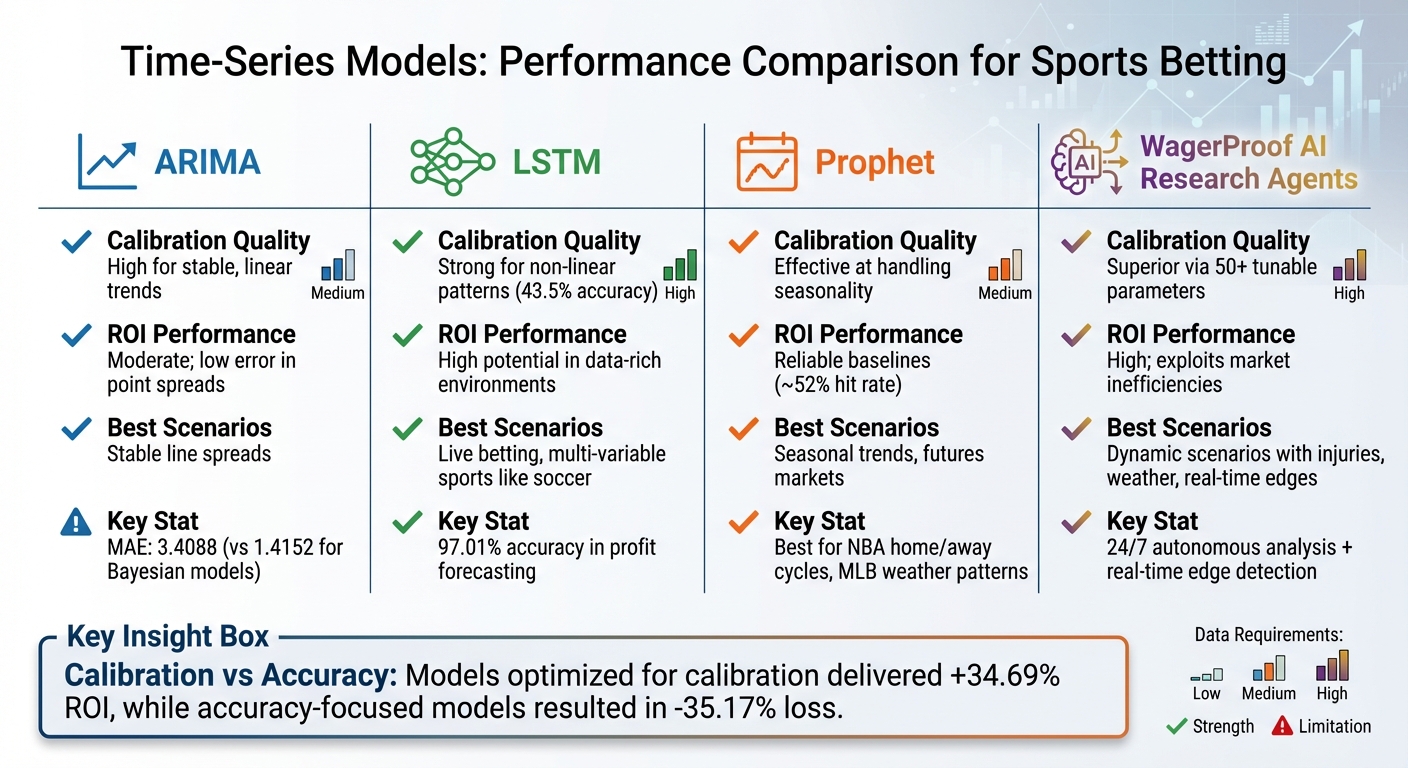
Sports Betting Time-Series Models Comparison: Calibration Quality, ROI Performance and Best Use Cases
This section outlines how different models stack up in terms of calibration quality and profitability, highlighting their strengths and limitations for sports betting.
ARIMA performs well when dealing with linear trends, making it a good fit for scenarios like NFL point spreads or MLB betting lines. However, it struggles with non-linear patterns and unexpected events, which can negatively impact return on investment (ROI). This makes it less versatile compared to more advanced models.
LSTM stands out in handling complex, non-linear scenarios, especially when long-term dependencies need to be captured. Its ability to recognize intricate patterns often leads to higher ROI in data-rich betting environments. On the flip side, LSTM requires vast amounts of data and significant computational resources, which increases the risk of overfitting. While it thrives in dynamic situations, its steep data and tuning requirements can be a challenge for users.
Prophet is particularly effective at managing seasonality and trends, automatically adjusting for variables like holidays and outliers. This makes it ideal for scenarios such as NBA home/away cycles or MLB over/under totals influenced by weather. However, its slower adaptation to fast-paced betting markets can limit ROI in high-frequency scenarios.
| Model | Calibration Quality | ROI Performance | Best Scenarios |
|---|---|---|---|
| ARIMA | High for stable, linear trends | Moderate; low error in point spreads | Stable line spreads |
| LSTM | Strong for non-linear patterns (43.5% accuracy) | High potential in data-rich environments | Live betting, multi-variable sports like soccer |
| Prophet | Effective at handling seasonality | Reliable baselines (~52% hit rate) | Seasonal trends, futures markets |
| WagerProof AI Research Agents | Superior via 50+ tunable parameters | High; exploits market inefficiencies | Dynamic scenarios with injuries, weather, real-time edges |
WagerProof AI Research Agents combine LSTM's ability to adapt to complex patterns with Prophet's strength in capturing seasonal trends. They also incorporate real-time edge detection, offering 24/7 autonomous analysis that identifies value bets and market mismatches. While these agents can drive profitability beyond raw accuracy, users must effectively manage their 50+ tunable parameters to maximize returns.
Conclusion
Winning more bets doesn’t automatically translate into making a profit. The real secret lies in calibration, not just raw accuracy. A model that predicts 60% of winners might still drain your bankroll if its probability estimates are off. As ML engineer Francisco Cardoso explains:
"The forecast with higher error made you money. The forecast with lower error lost you money".
This distinction separates casual bettors from those who consistently profit. The balance between accuracy and calibration is what ultimately determines success.
Even models with impressive accuracy can fall short without well-calibrated probability estimates. Metrics like RMSE or R² fail to capture the most critical factor: making bets that align with true market inefficiencies. Proper calibration doesn’t just spot mispriced odds - it’s what fuels long-term profitability. A model with higher numerical error that correctly identifies an underdog win will always outperform a "close" model that misses the mark entirely.
FAQs
What does “calibration” mean in sports betting?
In sports betting, calibration ensures that a model's predicted probabilities align with actual outcomes. For instance, if a model predicts a 70% chance of a team winning, that team should win roughly 70% of the time. This alignment is crucial for improving the accuracy of predictions and building trust in the model's reliability, making calibration an essential aspect of evaluating sports betting models.
Which metric best predicts betting profit: accuracy, Brier Score, or CLV?
The most reliable metric for gauging betting profit is Closing Line Value (CLV). This metric evaluates how your bets compare to the market's closing line, which serves as a critical benchmark for long-term success.
Other metrics, like accuracy or the Brier Score, can measure the quality of predictions, but they fail to consider market odds. CLV stands out by focusing on the value your bets generate relative to the market, making it the go-to predictor for betting profitability.
How do I turn model probabilities into bet sizes safely?
To turn model probabilities into bet sizes safely, start by calibrating your probabilities with techniques such as Platt Scaling or Isotonic Regression. These methods help ensure your probabilities are as accurate as possible. Once calibrated, concentrate on identifying value bets - situations where your calculated probability indicates a potential advantage.
After identifying value opportunities, apply a risk-aware staking approach, such as the fractional Kelly criterion, to determine optimal bet sizes. This method helps you avoid overbetting, reduces potential losses, and supports long-term profitability.
Related Blog Posts
Ready to bet smarter?
WagerProof uses real data and advanced analytics to help you make informed betting decisions. Get access to professional-grade predictions for NFL, College Football, and more.
Get Started Free