
Time Series Trends in Sports Betting Data
Time series analysis in sports betting helps track how odds, point spreads, and team stats evolve over time. This process reveals market inefficiencies, offering bettors an edge. Key insights include:
- Market Adjustments: Betting lines often overreact to new information, creating opportunities when they reverse.
- AI Accuracy: Models analyzing time series data can predict unusual patterns with over 92% accuracy, aiding in spotting inefficiencies and irregular betting activity.
- Team Performance: Advanced models like Kalman filters and LSTMs improve predictions by dynamically updating team strengths and identifying trends.
- Public Behavior Impact: Odds are influenced by public betting trends, often corrected later, which sharp bettors can exploit.
Tools like WagerProof make this analysis easier, offering real-time alerts, simulations, and insights to help bettors make informed decisions.
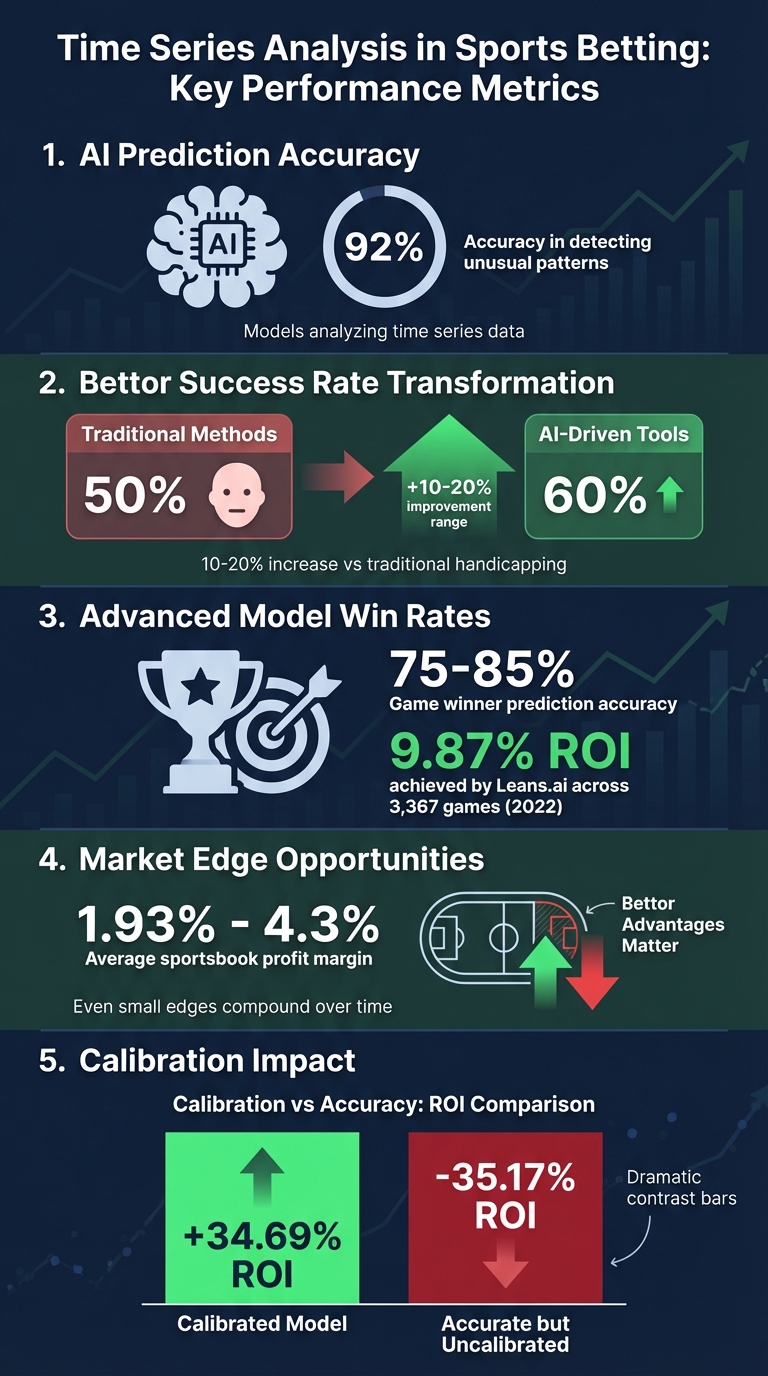
Time Series Analysis Impact on Sports Betting Success Rates and ROI
Research Findings on Time Series in Sports Betting
In-Play Odds Dynamics
Live betting lines often reflect market reactions that tend to overcorrect, creating opportunities for sharp bettors. A December 2024 study analyzed 3,681 MLB games across major sportsbooks, tracking 14,724 betting line sequences at ten-minute intervals. The findings revealed a pattern of negative autocorrelation in sharp line movements, meaning these shifts often reverse direction over time.
"Betting lines tend to overreact, exhibiting significant negatively autocorrelated changes that could be exploited by sophisticated bettors." – Jay Simon, Kogod School of Business
This suggests that during certain moments, the market becomes less efficient, opening up a window for knowledgeable bettors to capitalize on these inefficiencies.
Modeling Team Performance Over Time
Analyzing team performance over the course of a season helps separate skill from randomness. Researchers employ state-space models and Kalman filters to update team strength after each game, offering a more dynamic and accurate assessment compared to static rankings.
In 2016, Hans Manner from the University of Cologne applied this method to eight NBA seasons. His work demonstrated that while consistently beating the betting market is challenging, combining model-based forecasts with market odds slightly improved prediction accuracy. More recently, a January 2026 study in Information used recurrent neural networks with Monte Carlo dropout to predict NBA games. By incorporating team metrics and shot-chart data, the model achieved better calibration, particularly in less-efficient market segments.
The research also underscores the need for sport-specific approaches. For instance, the NBA is generally easier to predict due to a wider talent gap among teams, whereas outcomes in MLB and NHL games are more random, often resembling a coin flip. Understanding these nuances allows bettors to tailor their strategies to the characteristics of each sport.
Market Trends and Public Betting Behavior
Public betting behavior significantly influences odds. When unexpected events - like a star player's injury or sudden weather changes - occur, the market often reacts strongly before gradually correcting itself. Time series analysis tracks these fluctuations, showing that past line movements can offer clues about future changes.
On average, sportsbooks maintain a profit margin (or "vig") ranging from 1.93% to 4.3%, depending on the platform and year. Even a small edge can make a big difference when betting regularly.
AI-driven prediction tools have shown promise in boosting betting success rates by 10% to 20% compared to traditional handicapping methods. Modern machine learning models can correctly pick game winners about 75% to 85% of the time. One such system, Leans.ai, achieved a 9.87% ROI on $100 bets across 3,367 games in 2022 by using automated time series models to identify inefficiencies in the market.
Ultimately, odds are shaped by both new information and behavioral factors. By examining how public betting percentages shift over time, bettors can identify where sharp money is flowing - often revealing valuable opportunities. These insights provide a strong foundation for refining advanced time series models to enhance betting strategies further.
Time Series Models for Sports Betting Predictions
Common Time Series Models in Betting
Mathematical models play a central role in helping bettors predict outcomes by analyzing patterns in historical data. One widely used approach is ARIMA (Autoregressive Integrated Moving Average), which relies on past values and forecast errors but requires the data to be stationary to work effectively. For sports with seasonal trends, SARIMA takes ARIMA a step further by factoring in cyclical patterns.
Another popular method is Bayesian Dynamic Linear Models, which adjust predictions over time by using time-varying parameters to assess team strength. These models use an observation equation to reflect the current spread and an evolution equation to track how these parameters evolve. Similarly, State Space Models with Kalman Filtering refine predictions by continuously updating latent variables, like team strength, through a cycle of prediction, observation, and updating.
For short-term forecasts, Exponential Smoothing methods, such as Holt-Winters, prioritize recent games, making them especially useful when a team’s current form is critical. On the other hand, LSTM (Long Short-Term Memory) Networks, a type of recurrent neural network (RNN), excel at capturing long-term patterns in player performance and team strategies, offering a more nuanced perspective.
Each of these models not only helps analyze historical trends but also enhances the ability to make real-time betting predictions.
Benefits of Time Series Models
Time series models provide a significant edge in forecasting by offering adaptability and precision. For example, Bayesian Dynamic Linear Models, which continuously update predictions, have been shown to outperform ARIMA in forecasting point spreads, achieving a lower median absolute error (0.54 compared to 0.76). This improved accuracy is particularly valuable in live betting, which now accounts for a large share of betting activity. Such advancements enable bettors to make more informed decisions and respond more effectively to real-time market changes.
Limitations and Challenges
However, accuracy alone doesn’t guarantee profitability. Studies show that even highly accurate models can fail if their predictions align too closely with bookmaker odds. The key lies in calibration - ensuring predicted probabilities closely match actual outcomes. In one NBA betting study, calibrated models achieved a +34.69% ROI, while accurate but poorly calibrated models resulted in a -35.17% ROI.
"A highly accurate predictive model is useless as long as it coincides with the bookmaker's model." – Conor Walsh and Alok Joshi, Machine Learning for Sports Betting
Data quality poses another challenge. Traditional models struggle under unusual conditions, such as NFL games played in London, which often see unpredictable betting patterns. Additionally, model drift - where shifting team dynamics reduce a model’s effectiveness - requires constant retraining with fresh data to maintain accuracy. Lastly, the Kelly Criterion, a method for determining optimal bet sizes, can lead to risky strategies. Its full version often suggests wagering large portions of a bankroll, which researchers warn could result in "almost sure ruin" in volatile sports markets.
Practical Applications of Time Series in Sports Betting
Identifying Value Bets with Time Series
Research shows that betting lines tend to overreact to new information, often leading to negatively autocorrelated changes. This means that when a line shifts dramatically in one direction, it may overcorrect, creating a potential opportunity for bettors to find value by betting on the original side.
Timing also plays a critical role. For example, MLB forecasts for weekend day games are often less accurate at game time compared to 90 minutes before the game starts. This highlights the advantage of placing bets early, before the influx of public money distorts the lines.
Modern machine learning models take this a step further by analyzing time series data in real time to pinpoint these opportunities. Bettors using such tools have been able to increase their accuracy from around 50% to approximately 60%. WSC Sports emphasizes the significance of this edge:
"Even a few percentage points of extra accuracy can turn break-even gamblers into long-term winners."
These tools not only help identify value bets but also offer insights into broader team performance trends, which we’ll explore next.
Tracking Team Performance Trends
Time series analysis isn’t just about finding value bets - it’s also a powerful way to track team performance over time. By comparing a team’s current spread to its historical spreads, bettors can uncover patterns where sportsbooks may consistently overrate or underrate a team’s abilities.
This goes deeper than just win–loss records. It involves analyzing the split between the percentage of public bets and the percentage of total money wagered. When these figures diverge significantly, it often signals where professional bettors - who are typically more informed - are placing their money.
Sharp bettors, known for maintaining long-term win rates of 55% or higher, often act early in the week before lines adjust to public sentiment. They look for scenarios where a team is receiving most of the public bets but attracting less of the total money - a classic indicator to "fade the public". Tracking these patterns over time can reveal teams that frequently attract uninformed bets, offering consistent opportunities to bet against them.
Using WagerProof for Real-Time Analysis

WagerProof takes these time series insights and turns them into actionable, real-time tools for bettors. Its Edge Finder scans thousands of wagers live, identifying patterns by comparing prediction market spreads with sportsbook lines. It provides key metrics like public bet percentages, money distribution, and historical performance data - all displayed side by side.
Additionally, WagerBot Chat connects users to live professional data, offering detailed insights into a team’s trends over their last 10 games. It combines historical stats with real-time line movements, giving bettors a transparent view of the same data that experts use. Available on web, iOS, and Android, WagerProof simplifies access to these time series insights, making them practical for everyday use.
How to Read the Sports Betting Market (The Complete Beginner’s Guide)
Conclusion
The importance of time series analysis in sports betting is undeniable. Instead of relying on outdated static averages, bettors now have access to dynamic tools that process real-time data - capturing line movements, public betting trends, injury reports, and even weather updates as they unfold.
For casual bettors, leveraging these insights has proven transformative. Success rates have climbed from roughly 50% to about 60%, a shift that can make the difference between breaking even and consistent profitability.
Modern tools are key to this evolution, creating a feedback loop that combines accurate models with rapid live data interpretation. Platforms like WagerProof are at the forefront, offering solutions such as the Edge Finder, which analyzes thousands of wagers in real time to highlight discrepancies between prediction market spreads and sportsbook lines, and WagerBot Chat, which delivers professional-grade data without the shortcomings of generic AI tools. These features simplify the complexities of time series analysis, making them accessible across web, iOS, and Android.
Serious bettors can no longer rely purely on intuition. The edge lies in adopting a systematic, data-driven approach that identifies value consistently over time. Time series analysis, paired with tools like those from WagerProof, empowers bettors to stay ahead in an increasingly competitive landscape.
FAQs
How does time series analysis help improve sports betting strategies?
Time series analysis is a game-changer for sports betting strategies, offering insights into patterns and trends within sports data over time. By diving into factors like team performance, market odds, and line movements, bettors can spot inefficiencies or shifts in the betting market. For example, if betting lines shift dramatically right before a game, it could hint at an opportunity for a well-timed value bet.
More advanced methods, such as structured time-series modeling, take things a step further by improving prediction accuracy. This approach equips bettors to make smarter, data-backed decisions. It’s not just about spotting anomalies; it’s about adapting strategies in real-time to stay ahead, resulting in sharper and more effective wagers.
What are the benefits of using AI for predicting sports betting outcomes?
AI brings a fresh edge to predicting sports betting outcomes by processing massive amounts of historical and real-time data. It digs deep into patterns and trends that might go unnoticed with traditional approaches. Whether it’s analyzing team performance, player statistics, market fluctuations, or public betting behavior, AI delivers insights that feel sharper and more informed.
What’s more, AI thrives on new data. Its ability to adjust quickly ensures that predictions stay relevant and up-to-date. For bettors, this means pinpointing value bets, spotting market inefficiencies, and identifying anomalies that could lead to smarter decisions. Instead of relying purely on gut instinct, bettors can lean on data-driven strategies that stand up over time.
By handling an overwhelming amount of information with ease, AI doesn’t just make predictions - it makes them clearer, more precise, and ready to act on in the fast-paced world of sports betting.
How does public betting behavior impact sports betting odds?
Public betting behavior significantly influences sports betting odds, as it reflects the collective opinions and reactions of the betting community. When new information surfaces - such as team updates, in-game developments, or breaking news - bettors often adjust their wagers. This can lead to noticeable shifts in both betting volume and odds. For example, during a game, odds may fluctuate as public perception of a team's performance changes in real time.
This constant ebb and flow can sometimes create inefficiencies in the market. Bettors may overreact or underreact to recent events, causing odds to temporarily stray from the actual probabilities. For savvy bettors, these moments can offer opportunities to identify value bets or predict market corrections. Tools offered by platforms like WagerProof help users analyze these trends, enabling more informed and data-driven betting strategies.
Related Blog Posts
Ready to bet smarter?
WagerProof uses real data and advanced analytics to help you make informed betting decisions. Get access to professional-grade predictions for NFL, College Football, and more.
Get Started Free