How to Track Sharp Money in Sports Betting
Tracking sharp money in sports betting is all about identifying where professional bettors, often referred to as "sharps", are placing their wagers. These individuals rely on data, advanced models, and disciplined strategies to exploit market inefficiencies. Unlike public bettors, sharps focus on long-term profitability rather than emotional or team-driven bets.
Here’s how you can spot sharp money:
- Reverse Line Movement (RLM): When betting lines shift against the majority of public bets, it often signals sharp action.
- Bet vs. Money Percentage Gaps: A significant difference between the percentage of bets and the percentage of money on a team indicates sharp interest.
- Steam Moves: Rapid line changes across multiple sportsbooks suggest coordinated sharp betting.
- Line Freezes: When lines stay unchanged despite heavy public betting, it may point to sharp influence.
To track sharp money effectively, monitor market-leading sportsbooks like Pinnacle or Circa, compare public betting data, and use tools like WagerProof for real-time insights. Sharps often act early in the week or during high-liquidity periods, so timing is key. By identifying these patterns, you can make more informed betting decisions.
Line Movement in Sports Betting: How to Track Movements as a Sharp Bettor (Easy-To-Follow Tutorial)
What Is Sharp Money and Why Track It?
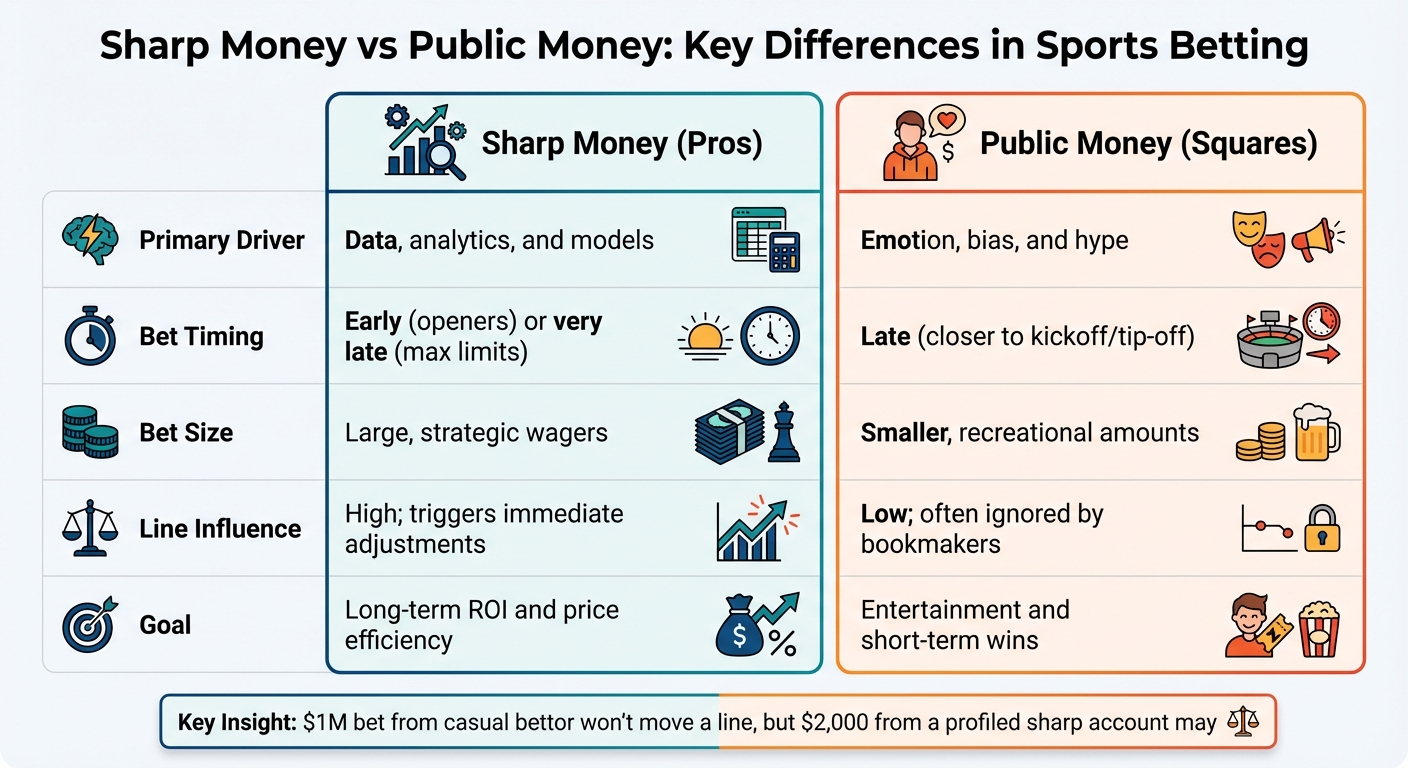
Sharp Money vs Public Money in Sports Betting: Key Differences
Sharp money refers to bets placed by professional gamblers, betting syndicates, or highly skilled individuals who rely on advanced models and disciplined bankroll strategies to find inefficiencies in betting markets. These sharp bettors create their own power ratings to determine ideal betting lines. When they identify a mismatch between their calculated line and the sportsbook's posted line, they seize the opportunity to gain an edge.
Tracking sharp money helps reveal market distortions caused when public sentiment shifts betting lines. Sportsbooks treat wagers differently, depending on the bettor's history and expertise. Betting analyst Jimmy Boyd explains it well: "$1M bet from Drake won't move a line, but $2,000 from a profiled sharp account may". This is because sportsbooks profile bettors, and once an account is flagged as sharp, its bets become a critical signal for adjusting odds in real time.
Sharp Money vs. Public Money
Public money, often referred to as "square" or "recreational" money, comes from casual bettors who make decisions based on team loyalty, media narratives, recent performances, or emotional attachments. The difference between sharp and public money lies in their strategy and timing.
| Feature | Sharp Money (Pros) | Public Money (Squares) |
|---|---|---|
| Primary Driver | Data, analytics, and models | Emotion, bias, and hype |
| Bet Timing | Early (openers) or very late (max limits) | Late (closer to kickoff/tip-off) |
| Bet Size | Large, strategic wagers | Smaller, recreational amounts |
| Line Influence | High; triggers immediate adjustments | Low; often ignored by bookmakers |
| Goal | Long-term ROI and price efficiency | Entertainment and short-term wins |
Sharp bettors prioritize pricing and long-term profitability over simply picking winners. This approach ensures sustainability in betting. They often place their bets early in the week to capitalize on "soft" opening lines or wait until late when betting limits are at their highest.
How Sharp Money Moves Betting Lines
Professional bettors frequently use "market-making" sportsbooks like Pinnacle or Circa, which welcome sharp action to help establish accurate lines. When sharp money causes line movement at these sportsbooks, recreational books often adjust their lines to align with the market and minimize risk.
One key indicator of sharp money is a line freeze, where the line remains unchanged despite heavy public betting. This suggests sportsbooks are adjusting to counteract sharp action. Another telltale sign is a significant gap - typically 10% or more - between the "percentage of bets" and the "percentage of money" on a team, signaling sharp interest.
Recognizing these patterns is essential for identifying sharp money in action. Up next, we’ll dive into specific techniques for spotting sharp money's influence in real time.
Signs That Sharp Money Is Active
Spotting the signs of sharp money is a must for anyone looking to understand market dynamics. These betting patterns reveal how professional bettors influence the odds, and they’re key to tracking where the sharp action is flowing.
Reverse Line Movement (RLM)
One of the clearest indicators of sharp money is reverse line movement. This happens when the betting line moves in the opposite direction of where most of the public bets are going. For example, imagine 75% of wagers are on a team as a 7-point favorite, but the line shifts to -6.5 or even -6. This shift suggests sportsbooks are reacting to fewer but much larger bets from sharp players rather than the bulk of smaller recreational bets.
RLM often shows up early in the week when lines are still soft or right after major news, like an injury or weather update. Sharp sportsbooks tend to adjust their lines first, so keeping an eye on them can provide early clues about sharp action.
Bet Percentage vs. Money Percentage Gaps
Another key signal is the gap between the percentage of bets placed and the percentage of money wagered. When there’s a significant difference - say, only 35% of the tickets are on one side, but that side accounts for 60% of the money - it’s a strong sign that sharp bettors are heavily involved.
A gap of 10% or more between ticket and money percentages is particularly telling. This is especially useful in totals markets, where casual bettors often favor the Over. If the Under has fewer bets but a higher percentage of the money, it could point to sharp bettors taking a contrarian position. When combined with RLM, these splits offer a more complete picture of sharp activity.
Steam Moves and Coordinated Line Changes
Steam moves are another hallmark of sharp money. These occur when betting lines shift rapidly across multiple sportsbooks within seconds or minutes. For instance, a line might move from -3 to -3.5 or -4 almost simultaneously at several books. This kind of sudden adjustment is a clear sign that sharp money has hit the market in force.
Other signs include line freezes - when the line doesn’t budge despite heavy public betting - or situations where the line moves even with a 50/50 split in bets. Watching for these coordinated changes across multiple sportsbooks helps confirm that sharp money is driving the action.
Tools and Methods for Tracking Sharp Money
Tracking sharp money requires precise tools, whether you prefer automated platforms or manual methods.
Using WagerProof to Track Sharp Money

WagerProof brings together real-time data, offering a side-by-side view of public bet percentages and money lean. Its automated outlier detection highlights when prediction market spreads diverge from sportsbook lines, signaling sharp action.
With WagerBot Chat, you can access professional data in plain English, making it easy to query game details and betting trends. Key insights like injury reports, weather conditions, and model predictions - factors sharp bettors rely on - are readily available. The platform’s prediction markets also help clarify whether a line move stems from sharp action or public sentiment.
If automated tools aren't your preference, manual tracking methods can still be effective.
Manual Tracking Methods
Start by monitoring market-leading sportsbooks like Pinnacle and Circa, especially early in the morning or during off-peak hours. These books cater to professional bettors and set efficient lines. A line move at Pinnacle often prompts the rest of the market to adjust within minutes.
Compare these fast-reacting books with slower-moving ones to identify stale lines. For instance, if Pinnacle adjusts a line from -3 to -3.5 but a recreational book still lists it at -3, that gap could represent a valuable opportunity. Keeping accounts funded at multiple sportsbooks allows you to act quickly when such discrepancies arise.
Sharp Money Indicators by Sport
Sharp betting patterns can vary depending on the sport. In the NFL, reverse line movement on key numbers like 3 and 7 often signals sharp action, usually occurring early in the week on Monday or Tuesday. NBA markets, on the other hand, frequently experience rapid steam moves - sudden shifts, particularly in point totals, that happen overnight or just 1–2 hours before tip-off. In MLB, sharp activity often becomes evident through mismatches between bet percentages and money percentages, especially on the moneyline after morning pitching changes.
These methods serve as a foundation for the step-by-step process of tracking sharp money, which will be detailed in the next section.
How to Track Sharp Money: Step-by-Step Process
Identifying sharp money takes a structured approach. Follow these three steps to help spot professional betting activity before placing your wagers.
Step 1: Check Public Betting Percentages
Start by comparing public bet percentages with money percentages. Pay attention to situations where the ticket percentage is below 40%, but the money percentage exceeds 60%. This mismatch often signals sharp bettors backing that side. Platforms like WagerProof make this comparison straightforward by displaying both metrics side-by-side.
Focus your analysis on game day when betting limits increase, and the market sees higher liquidity. This is when professional money typically enters the fray. Early-week splits can be misleading due to lower liquidity, often reflecting noise rather than meaningful trends.
After identifying discrepancies, check if the line movement supports these findings.
Step 2: Watch for Reverse Line Movements
Reverse line movement (RLM) is a key indicator of sharp action. It happens when the line moves in the opposite direction of public betting trends. For example, if the Dallas Cowboys opened as 4-point favorites against the NY Giants, with 75% of tickets and 80% of money backing the Cowboys, but the line drops to Cowboys -3, this suggests sharp bettors influenced the adjustment.
Another example: the New England Patriots were listed at +6 against the Buffalo Bills, with 80% of tickets on the Bills. When the line shifted to Patriots +5.5, it clearly pointed to sharp money backing New England.
Once you identify reverse line movements, strengthen your analysis by incorporating predictive tools.
Step 3: Confirm with Prediction Markets and Models
Before finalizing your bet, use prediction markets and statistical models to validate sharp signals. WagerProof provides tools like automated outlier detection to highlight discrepancies between prediction market spreads and sportsbook lines. This helps confirm whether the movement is driven by sharp money or public betting trends.
Additionally, watch for steam moves - sudden and significant line changes caused by coordinated sharp action. A "line freeze" is another telling sign. For instance, if 80% of bets are on one side, but the line doesn't budge, it indicates the sportsbook is comfortable with its liability because sharp money is backing the opposite side.
Tracking Sharp Money in Different Sports
When it comes to spotting sharp money, each sport has its own quirks. These differences stem from the unique structures, betting volumes, and timing of their markets. By understanding these nuances, you can better identify where the professionals are placing their bets.
NFL and College Football
In football, key numbers like 3 and 7 hold significant weight since they’re the most common margins of victory. A line moving off these numbers - like dropping from -3 to -2.5 - despite heavy public betting on the favorite, is a strong sign of sharp money at work. For example, if 75% of the public is backing a team at -3, but the line shifts to -2.5, it’s likely due to professional bettors influencing the market.
Timing also plays a big role. Sharp bettors often strike early in the week, usually within 12 to 24 hours after lines are posted. This is when the odds are still soft and haven’t adjusted to reflect public sentiment. For the NFL, where lines are notoriously tight, even a half-point shift against public betting can speak volumes. Watching early-week action on Monday and Tuesday can give you a head start before casual bettors flood the market closer to game day.
NBA and College Basketball
Basketball markets are much more fast-paced than football, with sharp money often triggering steam moves - sudden line shifts of two or more points across multiple sportsbooks. These shifts are a hallmark of syndicate betting, where groups of professional bettors act in unison.
In college basketball, overnight line movements are particularly revealing. Sharp bettors often place their wagers between 11 PM and 3 AM, a time when sportsbooks increase their betting limits but recreational bettors are largely inactive. Any significant line changes during these hours are almost always driven by professional money. This late-night action is a stark contrast to the in-game adjustments that dominate sports like baseball and hockey.
MLB and Other Sports
In baseball, sharp bettors tend to focus on underdogs and totals rather than favorites. A clear gap between the percentage of tickets and money on an underdog is a strong indicator of sharp action.
The nature of baseball betting also makes early-day events, like pitcher confirmations and weather updates, key triggers for sharp bets. Similarly, in hockey, goalie announcements - often made in the afternoon - can lead to quick market adjustments. For lower-profile sports, where markets are less efficient, these early moves can be even more telling.
To help track these patterns, tools like WagerProof’s automated outlier detection can highlight discrepancies between sportsbook lines and prediction markets. This makes it easier to spot sharp action across different leagues and times, no matter the sport. By recognizing these sport-specific trends, you can refine your approach to tracking sharp money and make more informed decisions.
Conclusion
This guide has outlined how to spot professional betting activity and uncover market inefficiencies. The key takeaway? Tracking sharp money relies on recognizing specific market signals.
One of the clearest indicators is reverse line movement - when the betting line moves against the majority of public bets. This shift often signals that professional bettors are influencing the market. Another critical sign is the disparity between ticket volume and the amount of money wagered. These splits often reveal where sharp bettors are focusing their action.
Sharp bettors excel at identifying when public sentiment creates mispriced odds, and they capitalize on these distortions. Timing plays a huge role here. Observing market-maker sportsbooks like Pinnacle or Circa, which cater to professionals and adjust lines quickly, gives you a more accurate read than relying on retail books that reflect public betting trends.
While manual tracking of these signals is possible, it can be overwhelming. Tools like WagerProof simplify this process by automating outlier detection. WagerProof flags discrepancies between prediction market spreads and sportsbook lines, highlights reverse line movements, and identifies sharp money splits - all in real time. Instead of juggling dozens of games manually, you get instant alerts whenever professional money impacts the market.
The goal is to use these insights to make informed, data-driven bets. By combining sharp money tracking with real-time analytics, you can move beyond guesswork and bet with confidence. WagerProof's tools are designed to help you turn these strategies into actionable betting decisions.
FAQs
How reliable is reverse line movement?
Reverse line movement (RLM) is a term frequently associated with sharp bettors in the world of sports betting. It occurs when the betting line shifts in the opposite direction of where most public bets are placed. This often points to substantial wagers coming from professional or well-informed bettors.
That said, RLM isn’t a guarantee of sharp money or a winning strategy on its own. To make the most of it, you need to pair it with other insights, such as identifying large bets from trusted sources and understanding the broader market dynamics. This helps reduce the chances of misreading the signals.
What causes a steam move vs. fake noise?
A steam move occurs when sharp bettors or betting syndicates place substantial wagers, leading to a sudden and noticeable shift in betting lines across several sportsbooks.
On the other hand, fake noise looks like sharp activity but is actually driven by factors like public betting trends, algorithmic tweaks, or deliberate price adjustments - not by genuine large bets. While steam moves represent authentic market activity, fake noise can mislead bettors by creating the illusion of sharp money influence.
How do I use WagerProof to confirm sharp action?
Use WagerProof’s real-time tools to keep an eye on sharp action by tracking reverse line movement (RLM) and spotting unusual betting patterns. Pay close attention to the Ticket % and Money % - when there’s a gap of 10% or more, it often signals sharp money at play. Plus, WagerProof sends alerts for mismatched prediction market spreads, giving you an edge in identifying professional-level betting activity and making smarter decisions.
Related Blog Posts
Ready to bet smarter?
WagerProof uses real data and advanced analytics to help you make informed betting decisions. Get access to professional-grade predictions for NFL, College Football, and more.
Get Started Free