Ultimate Guide to Multi-Model Consensus Betting
Multi-model consensus betting combines predictions from multiple statistical models to improve accuracy and reduce risk. Instead of relying on one model, this approach pools insights from various algorithms, each analyzing different aspects of a game. By blending these forecasts, errors balance out, leading to better predictions. Bettors can use tools like z-score standardization, weighted averaging, and advanced aggregation methods to refine results. Platforms like WagerProof simplify this process with automated tools, visual overlays, and real-time insights, helping both casual and experienced bettors make data-driven decisions.
Key takeaways:
- What it is: Combines predictions from diverse models for more reliable outcomes.
- Why it works: Reduces overfitting, balances errors, and improves accuracy.
- Who benefits: Casual bettors, sharps, and live bettors looking for better insights.
- Tools: Z-scores, weighted averages, and platforms like WagerProof for automation.
- Strategies: Use techniques like Kelly Criterion for bet sizing and track metrics like ROI and CLV to measure performance.
This method turns betting into a calculated, data-driven process, offering a smarter way to approach wagering.
Five Formulas to Make Money Sports Betting (Step by Step Tutorial)
How Multi-Model Consensus Improves Betting Accuracy
When it comes to betting, combining different streams of information can significantly improve accuracy. Multi-model consensus does just that by pooling data from various models, each focusing on distinct aspects of a game. For example, one model might analyze recent team performance, another could evaluate historical matchups, and a third might delve into player statistics. Together, these models create a broader and more detailed view of the game. Researchers refer to this as the partial information framework - each model contributes a piece of the puzzle, and their combined insights provide a more complete picture.
The Statistical Edge of Model Diversity
One of the biggest advantages of using diverse models is their tendency not to make the same mistakes at the same time. This concept, known as uncorrelated error patterns, is the foundation of consensus betting. For instance, if one model overestimates a team’s offensive power while another underestimates their defensive flaws, these errors can cancel each other out when combined. The end result? More accurate predictions than any single model could achieve.
While simple averaging can work, it often lacks precision. Advanced techniques like extremizing and z-score standardization refine predictions by pushing them closer to decisive outcomes (e.g., toward 0 or 1) while ensuring that reliable, low-variance signals carry more weight. This statistical refinement also helps manage risk by leveraging the independence of different models.
Reducing Risk Through Independent Models
The real strength of consensus lies in using models that are truly independent from one another. This means choosing algorithms that differ in their structure, training data, and analytical methods. If models are too similar, their errors become correlated, which undermines the benefits of consensus.
To address this, platforms like WagerProof use z-score normalization to standardize outputs, ensuring each model’s unique variance is weighted appropriately. Some systems go even further with recalibration techniques like the Beta Linear Pool (BLP) or Spread-adjusted Linear Pool (SLP), which fine-tune the final consensus predictions. This focus on independence is critical for reducing correlated risks and improving the reliability of betting forecasts.
Real-World Impact on Sports Betting
These consensus methods have a direct impact on performance in actual betting markets. Multi-model consensus is particularly effective for point spreads, where it aggregates the "spread-diff" - the difference between predicted and actual spreads - across numerous models. This approach uncovers value bets that single models might overlook due to their inherent biases. Z-score standardization further ensures that each model’s contribution aligns with its reliability.
Consensus methods also excel in fast-changing situations, like last-minute player injuries or unexpected weather changes. This adaptability makes them especially useful for live betting, where conditions shift in real-time and the ability to quickly synthesize multiple perspectives gives bettors a competitive edge.
Building a Multi-Model Consensus System
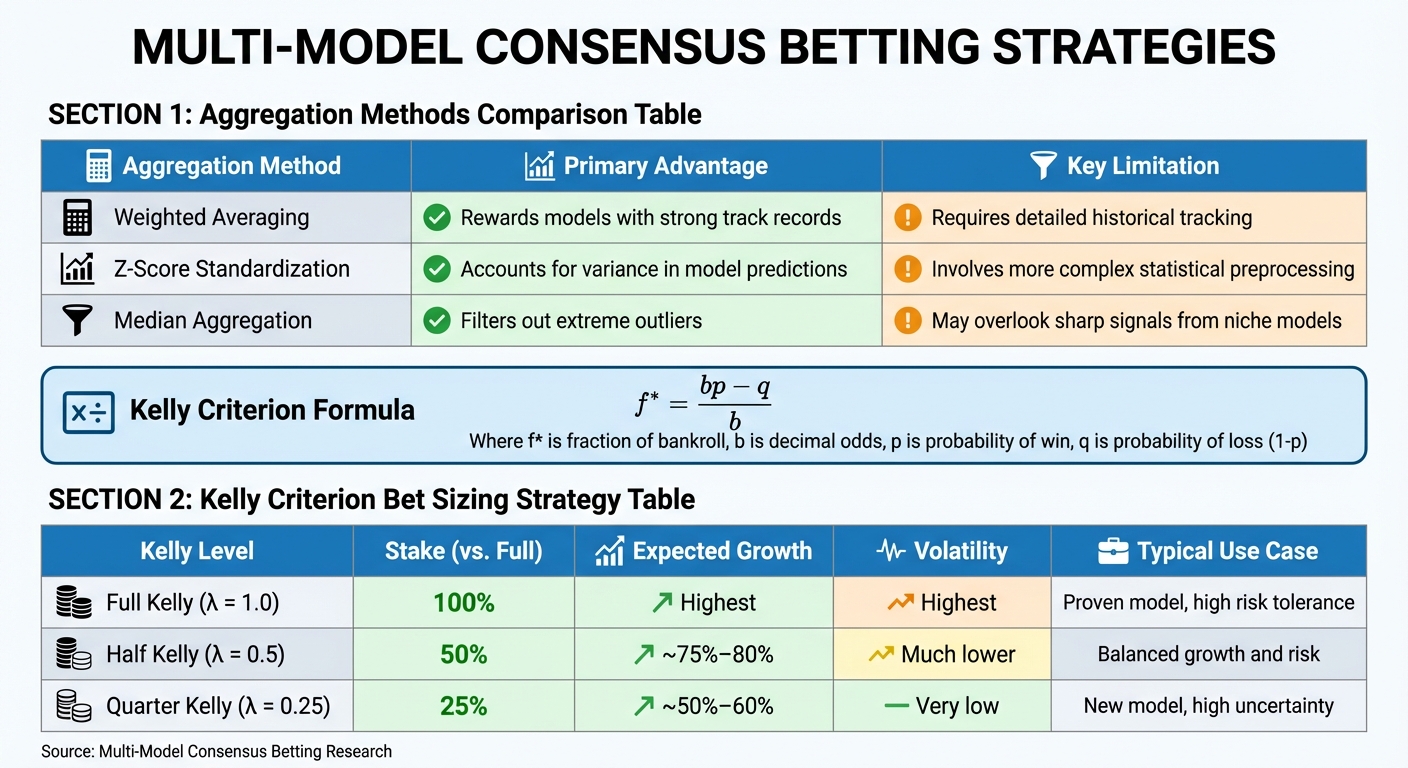
Multi-Model Consensus Betting Strategy Comparison: Aggregation Methods and Kelly Criterion Bet Sizing
Creating a multi-model consensus system involves blending predictions from various models to reduce errors and improve accuracy. The key lies in selecting diverse models and feeding them well-matched data inputs.
Selecting the Right Models
The backbone of a consensus system is model independence. This means picking models that approach predictions differently, use varied data sources, and operate on unique assumptions. For example, you might combine a Poisson regression for scoring rates, an Elo rating system for evaluating team strength over time, and a machine learning ensemble to analyze player-level metrics. The goal is to ensure that errors from these models are uncorrelated.
When choosing models, focus on those with proven historical performance and transparent methodologies. Some bettors rely on aggregators like ThePredictionTracker, which compiles predictions from over 50 models. Others develop custom models using publicly available statistics. Regardless of your approach, make sure each model operates on distinct inputs and uses different calculation methods to maintain independence.
Data Inputs for Consensus
Once your models are selected, the next step is aligning them with the right data. The quality of your consensus system depends heavily on the data it processes. Start with historical statistics such as team records and scoring averages. Add player metrics like injury updates and recent performance trends. Including prediction markets and betting trends can also provide valuable real-money insights.
Each model requires specific data to perform effectively. For instance, a Poisson model needs scoring distributions, while an Elo system focuses on game outcomes and margins of victory. Machine learning models, on the other hand, can handle a wide range of variables simultaneously. Research has shown that calibrated models can achieve a 23.13% ROI compared to 10.9% for uncalibrated ones. This highlights the importance of clean, relevant data inputs.
Aggregation Methods for Consensus
After generating predictions, the next step is to combine them effectively. Simple averaging is a quick method but assumes all models are equally reliable. A better option is weighted averaging, which gives more influence to models with strong historical accuracy. However, this requires keeping detailed performance records for each model.
To further refine predictions, consider Z-score standardization, which adjusts each model's predictions based on its historical variance. For example, a 3-point edge from a low-variance model will carry more weight than the same edge from a high-variance model. This method ensures that each model’s "confidence level" is factored into the consensus without manual adjustments. Another option is median aggregation, which takes the middle value of all predictions, filtering out extreme outliers.
| Aggregation Method | Primary Advantage | Key Limitation |
|---|---|---|
| Weighted Averaging | Rewards models with strong track records | Requires detailed historical tracking |
| Z-Score Standardization | Accounts for variance in model predictions | Involves more complex statistical preprocessing |
| Median Aggregation | Filters out extreme outliers | May overlook sharp signals from niche models |
"Calibration prevents the overconfidence that burns bankrolls, offering a clearer picture of risk and reward." - Adam Wickwire, OpticOdds Blog
Using WagerProof for Consensus Visual Overlays

WagerProof takes the idea of multi-model consensus and simplifies it with automated visual tools, helping you refine your betting strategy. Instead of relying on time-intensive manual systems, it collects data and presents model insights in a way that makes spotting value bets quick and straightforward.
Automated Consensus Tools
At the heart of WagerProof is the Model Aggregator, which pulls forecasts from 50 different models. It uses z-score standardization to rank games based on how strongly the models agree. A higher absolute z-score means there’s stronger consensus that a sportsbook line might be off.
The Edge Finder goes a step further by comparing these aggregated model spreads with sportsbook lines. It calculates a "spread-diff" for each game, flagging opportunities where model probabilities differ significantly from market odds. For deeper analysis, WagerBot Chat connects to live professional data sources to answer specific game-related questions. Unlike generic AI tools, it’s backed by real-time stats and historical trends.
These tools work together seamlessly, pairing automated analytics with visual outputs to deliver actionable insights.
Visualizing Model Agreement
WagerProof’s visual overlays make it easy to see where models either strongly agree or diverge from sportsbook lines. For instance, the platform uses outlier flags and consensus gaps to highlight potential opportunities. A z-score above 2.0 in the Edge Finder, for example, signals strong agreement among models that a line might be mispriced.
The AI Game Simulator adds another layer by running thousands of game simulations, generating win probability percentages based on current team stats. Meanwhile, Public Money Splits provide additional context by showing the difference between Ticket % and Money %, helping you spot where sharp bettors might be placing their wagers.
These visuals make complex data easier to interpret, giving you a clear path to apply these insights in your betting strategy.
Practical Examples with WagerProof
A typical workflow with WagerProof starts with the Edge Finder. Scan for games with high absolute z-scores to identify strong consensus plays. Focus on data from the last four games to account for recent performance and injuries. Then, use the AI Game Simulator to run scenarios and confirm whether the consensus aligns with your own analysis.
Don’t forget to set alerts for factors like weather changes or injury updates, as these can shift probabilities before sportsbooks adjust their lines. This proactive approach ensures you stay ahead of market movements.
By showing the data and calculations behind every recommendation, WagerProof eliminates the guesswork. You’re not relying on gut feelings - it’s all evidence-driven.
| Tool | Primary Function | Key Visual Output |
|---|---|---|
| Edge Finder | Compares models to market odds | Outlier flags and consensus gaps |
| AI Game Simulator | Runs thousands of simulations per game | Win probability percentages |
| WagerBot Chat | Answers game-specific queries | Instant, data-backed insights |
| Public Money Splits | Tracks Ticket % vs. Money % | Highlights gaps between sharp and public betting |
Advanced Strategies for Multi-Model Consensus Betting
Bet Sizing Techniques
The Kelly Criterion is a well-known formula for determining the ideal bet size: f* = (bp - q) / b, where:
- b = net odds
- p = true win probability
- q = loss probability
While effective, betting double the recommended Kelly amount eliminates any long-term growth potential, and exceeding that can even lead to a shrinking bankroll over time.
For a safer approach, many bettors turn to Fractional Kelly. Starting with a fraction - like "Quarter Kelly" (0.25x) or "Half Kelly" (0.5x) - can help reduce risk and counter overconfidence in predictions. If you're placing multiple bets at once, adjust further by dividing your chosen Kelly fraction by the square root of the total number of bets. For instance, with five simultaneous wagers, divide your Kelly stake by √5 (about 2.24). On top of that, setting a hard limit on any single wager - typically 2–3% of your total bankroll - can act as a safeguard against unexpected losses.
| Kelly Level | Stake (vs. Full) | Expected Growth | Volatility | Typical Use Case |
|---|---|---|---|---|
| Full Kelly (λ = 1.0) | 100% | Highest | Highest | Proven model, high risk tolerance |
| Half Kelly (λ = 0.5) | 50% | ~75%–80% | Much lower | Balanced growth and risk |
| Quarter Kelly (λ = 0.25) | 25% | ~50%–60% | Very low | New model, high uncertainty |
In addition to proper bet sizing, spotting market overreactions can further tip the scales in your favor.
Contrarian Plays with Model Divergence
When models disagree with market odds, it often points to opportunities where the market may have overreacted. Start by stripping the sportsbook's vig (commission) to calculate Fair Odds, then compare them to your model's probabilities. A positive expected value (+EV) bet often emerges when your model's probability is at least 2% higher than the no-vig market probability.
To pinpoint mispricings, use z-score normalization. Large absolute z-scores across multiple models are strong indicators of market inefficiencies. In live betting, applying a decay model can help you distinguish between lasting events, like injuries or red cards, and temporary noise, such as a quick scoring streak. To avoid overfitting, validate these strategies with walk-forward backtesting, where historical data is split into training and testing segments. This method works hand-in-hand with conservative bet sizing to manage risk in unpredictable markets.
By combining contrarian insights with advanced tools, you can refine your betting strategy even further.
Optimizing with WagerProof Tools
WagerProof provides a range of tools designed to enhance your multi-model consensus betting. The AI Game Simulator runs extensive simulations, offering a distribution of possible outcomes instead of a single prediction. This approach allows for more informed and flexible bet sizing.
WagerBot Chat is another game-changer. It provides real-time updates during pre-game analysis, letting you ask specific questions - like how strong winds (15+ mph) might impact a team's passing game. This kind of dynamic insight gives you an edge in adapting to evolving conditions.
Tracking rolling averages can also uncover "acceleration" signals. For example, if a player's recent performance over their last three games outpaces their longer-term averages (like five or eight games), it could signal a trend before the market adjusts.
Finally, the Edge Finder continuously compares aggregated model spreads with sportsbook lines, flagging instances where your model's probabilities significantly differ from market odds. These tools collectively help refine your approach, ensuring your consensus betting strategy stays sharp and effective.
Measuring and Improving Consensus Performance
Key Performance Metrics
To confirm your system's effectiveness, track metrics that truly matter. ROI (Return on Investment) is the ultimate benchmark - most solid multi-model systems yield returns between 3% and 7% over time. But profitability alone doesn't paint the full picture.
Closing Line Value (CLV) is a critical indicator. It shows whether your bets consistently outperform the sharpest market price before kickoff. Beating the closing line by 1–2% signals that your model has predictive power. Additionally, calibration metrics like Brier Score and Log Loss measure the accuracy of your predictions. Research shows that calibrated models can deliver a 23.13% ROI compared to 10.9% for non-calibrated systems, while also reducing losses from -26.78% to -9.77%.
Keep an eye on bankroll volatility, as it can guide adjustments to stake sizing. To draw reliable conclusions about performance, aim for at least 1,000 bets as a statistically meaningful sample size.
Once you've established these metrics, focus on refining your system through detailed backtesting.
Backtesting and Refinements
Backtesting on historical data is invaluable for gaining practical insights. Use methods like train-test splits or k-fold cross-validation to evaluate how well your model performs on unseen data. Rolling window validation is another effective approach to simulate real-time conditions.
For example, in June 2025, a soccer model that initially broke even over 600 bets was refined after identifying a 0.10 odds point gap in Closing Line Value. This adjustment boosted ROI from 0% to 4.2% over the next 1,200 bets. Such refinements not only validate past performance but also improve future predictions.
To fine-tune model weights, techniques like Platt Scaling (logistic regression) or Isotonic Regression can adjust probability estimates and improve calibration. Additionally, applying z-score standardization ensures a consistent basis for comparison and minimizes the impact of outliers. Monitoring metrics like Brier Scores and Log Loss during backtesting helps align predictions more closely with actual outcomes.
Dynamic Adjustments for Consistency
Even after initial evaluation, continuous adjustments are key to maintaining strong performance. Recalibrate your consensus system regularly - at least once per season or after major rule changes - to adapt to evolving market conditions. Use losing streaks as opportunities to refine model weights or integrate additional factors like injury updates or weather forecasts.
A/B testing can help pinpoint which parameters yield better results. For instance, run two versions of your system - each with different model weights or aggregation methods - and compare their real-market performance. If your bets consistently fail to beat the closing line, it may be time to re-weight your underlying models.
For real-time updates, consider Bayesian calibration to refine predictions on the fly. Pair automated market screening with manual research to identify high-value opportunities, especially in areas like coaching changes or team dynamics that may not be fully captured by models.
Conclusion and Key Takeaways
Why Multi-Model Consensus Works
Multi-model consensus betting offers three standout advantages over single-model methods. First, accuracy improves when you combine diverse predictive approaches. By aggregating different models, you achieve better forecasting, as shown by enhanced Brier scores. Second, risk decreases when predictions are standardized using z-scores across models with varying variances, providing a more stable decision-making framework. Lastly, agreement across multiple independent models strengthens confidence in your bets.
AI-driven predictions aren’t just a gimmick - they deliver measurable results. Studies show they improve betting success rates by 15% to 20% compared to relying solely on intuition. This happens because combining models that draw from various data sources and methodologies reduces individual biases and creates a broader, more accurate view of each game. These strengths make tools like WagerProof a game-changer for anyone serious about betting.
How WagerProof Simplifies Betting
With WagerProof, you don’t need to create or maintain your own complex system. Tools like the AI Game Simulator, WagerBot Chat, and automated alerts handle the heavy lifting, offering real-time consensus insights and identifying value bets.
"Always use algorithms as tools to inform your decisions, but remember that gambling inherently involves risk... Set limits and never wager more than you can afford to lose." - Sol Fayerman-Hansen, rg.org
For those just getting started, the Free Plan provides access to the Edge Finder demo and basic stats. Upgrading to Premium unlocks the full suite of features, including historical analytics, the AI Game Simulator, and access to a private Discord community where experienced bettors share insights in real time. These tools are designed to make smarter, more consistent betting decisions achievable for everyone.
Building a Winning Strategy
To achieve long-term success, focus on disciplined execution and continuous improvement. A data-driven approach replaces emotional decision-making with insights based on historical trends and multi-factor analysis. The best results come from blending automated tools for data processing with manual research to validate your final choices. Consider factors like recent team performance, head-to-head matchups, injuries, and even weather conditions before placing bets.
For a structured approach:
- Compare implied probabilities to consensus estimates to spot value opportunities.
- Allocate 80% of your bankroll to high-confidence bets and 20% to riskier plays.
- Enforce a cooling-off period to avoid impulsive decisions.
The tools are ready, the data is there, and your success depends on sticking to a disciplined, methodical process. With consistent refinement and a clear strategy, you’ll give yourself the best chance to come out ahead.
FAQs
How does using multi-model consensus improve betting accuracy and reduce risk?
Multi-model consensus betting combines predictions from several statistical models to enhance accuracy and decrease risk. By doing so, it reduces the influence of mistakes or biases from any one model, resulting in a more balanced and dependable forecast.
Using a mix of algorithms allows you to identify mispriced odds and spot value bets more effectively. This approach offers a broader perspective on the betting landscape, enabling smarter decisions and boosting your confidence when placing wagers.
What are the essential tools and strategies for multi-model consensus betting?
Multi-model consensus betting combines predictions from several models to boost accuracy and find value bets. By pulling data from different statistical approaches, this method reduces individual biases and errors, leading to more dependable predictions. Essentially, it taps into the collective power of various algorithms to uncover opportunities that might otherwise slip through the cracks.
A key part of this strategy involves using real-time sports data platforms like WagerProof. These platforms offer access to prediction markets, historical stats, public betting trends, and advanced statistical models. With these tools, bettors can identify outliers, spot mispriced odds, and detect inefficiencies in the market. On top of that, calibration-focused methods help ensure predictions align closely with actual outcomes, improving long-term return on investment (ROI). By combining these strategies and tools, bettors can make sharper, data-driven choices on the spot.
How does WagerProof make consensus betting easier and more effective?
WagerProof takes the guesswork out of consensus betting by delivering real-time professional sports data through a user-friendly and transparent platform. By integrating tools like prediction markets, historical statistics, public betting trends, and money lean insights, it enables users to spot crucial patterns - like where sharp money is flowing or mismatches between public and professional wagers.
What sets WagerProof apart is its ability to pinpoint value bets and anomalies automatically. With alerts and actionable signals, users can make smarter, data-backed decisions without spending hours sifting through endless data. By streamlining multiple data sources into a single, intuitive system, WagerProof makes it easier than ever to identify profitable betting opportunities.
Related Blog Posts
Ready to bet smarter?
WagerProof uses real data and advanced analytics to help you make informed betting decisions. Get access to professional-grade predictions for NFL, College Football, and more.
Get Started Free