Wong Teasers: EV Analysis for 2026
The Wong teaser betting strategy, once a highly effective method for NFL betting, has faced significant challenges by 2026. Key changes in sportsbook pricing and line adjustments have nearly erased its profitability. Here's a quick breakdown:
- What is a Wong Teaser? A strategy that moves NFL point spreads to cross key numbers (3 and 7), increasing the likelihood of winning bets.
- Why it worked: Historically, each leg hit 75–76% of the time, exceeding the 72.4% breakeven rate at -110 odds.
- What changed: Sportsbooks increased teaser pricing to -120 to -135, raising the breakeven rate to 75.2% or higher. They also adjusted lines to make the strategy less effective.
- Current viability: Wong teasers are only profitable if priced at -120 or better. At -130 odds, the strategy becomes break-even or slightly negative.
The math still supports Wong teasers, but the higher costs and stricter conditions make it harder to find value in 2026.
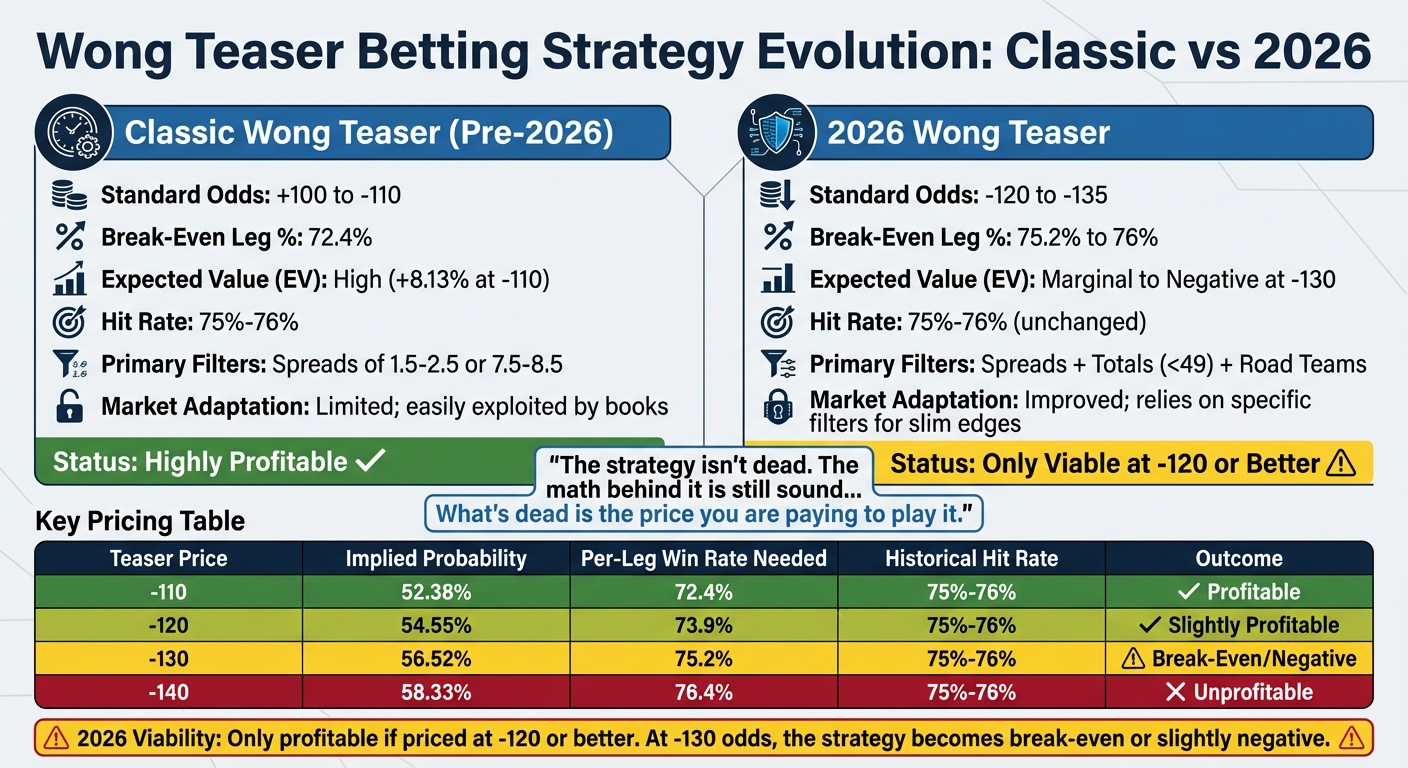
Wong Teaser Betting Strategy: Classic vs 2026 Comparison
1. Classic Wong Teasers
Leg Selection Criteria
The classic Wong teaser operates with precise rules for selecting bets. Bettors focus on favorites between -7.5 and -8.5, teasing them down to -1.5 or -2.5. For underdogs, the range is +1.5 to +2.5, teasing them up to +7.5 or +8.5. This approach ensures that both key numbers - 3 and 7 - are crossed, which is crucial for maximizing the strategy's effectiveness.
One golden rule: never tease through zero. Why? Since 1995, only 18 out of 7,992 NFL games (a minuscule 0.23%) ended in a tie. Teasing a -3 favorite to +3 essentially wastes points on an outcome that almost never happens. Additionally, smart bettors stick to games with lower totals, typically under 49 points. In low-scoring matchups, each teased point becomes more impactful.
Expected Value (EV)
The success of classic Wong teasers lies in their hit rate. Each leg hits about 75%–76.1% of the time, which translates to a positive EV of 3%–4% per leg when placed at -110 odds.
"Wong teasers are perhaps the most profitable bet in NFL betting history." - Alan Penny, Editor-in-Chief, SBO.net
This combination of favorable odds and consistent success is what made the strategy so effective.
Teaser Pricing
Originally, Wong teasers were priced at -110 or even +100 (even money) at many sportsbooks. At -110 odds, a bettor needed each leg to hit just 72.4% of the time to break even. Even at -120 odds, the breakeven rate rose to only 73.9%, still below the typical 75%–76% success rate.
Market Adjustments
The dominance of Wong teasers didn't go unnoticed. Sportsbooks quickly adapted, shifting lines to -9 or +1 to keep bets out of the "Wong range." They also increased teaser pricing, moving from -110 to -120 or even higher. These adjustments were designed to reduce the profitability of this once highly effective strategy.
2. 2026 Wong Teasers
Market Adjustments
The betting world has seen some major shifts. Sportsbooks are now moving favorites beyond the traditional Wong teaser range, setting lines at -9 instead of the usual -7.5 or -8.5. They’re also adding extra juice to non-key numbers - like pricing a +9 spread at -125 - to make profitable teasers less appealing. This adjustment has led to a surprising trend: underdogs in the +7.5 to +9 range have gone 29-15 against the spread over the past two years. Because of these changes, straight bets on these underdogs are often more appealing than teasers.
Teaser Pricing
As lines have shifted, teaser pricing has climbed as well. The days of -110 or even money odds are mostly gone at regulated U.S. sportsbooks. In 2026, major players like DraftKings and FanDuel typically price a standard two-team, 6-point teaser between -130 and -135. Some Kambi-powered books even push alternate parlay lines to -133 or higher.
This pricing shift significantly impacts the math behind teasers. At -130 odds, each leg must hit 75.2% of the time just to break even. While the historical success rate of Wong teasers hovers around 75%–76%, the slim margin makes this strategy far less profitable than it once was.
| Teaser Price | Implied Probability | Per-Leg Win Rate Needed | Historical Hit Rate |
|---|---|---|---|
| -110 | 52.38% | 72.4% | 75%–76% |
| -120 | 54.55% | 73.9% | 75%–76% |
| -130 | 56.52% | 75.2% | 75%–76% |
| -140 | 58.33% | 76.4% | 75%–76% |
With these higher prices, the margins are razor-thin, leaving bettors close to breaking even.
Expected Value (EV)
The increased juice has essentially wiped out the historical edge of 3%–4% that Wong teasers once provided. While NFL scoring still clusters around key numbers - 15.2% of games end with a 3-point margin, and 9.0% with a 7-point margin - the higher teaser costs have eroded the expected value. At -110, Wong teasers offered a solid edge, but at -130, they’re either break-even or slightly negative for most bettors.
The only way to salvage any edge is by shopping for better prices. Offshore books or heritage sportsbooks that still offer odds of -120 or better can help maintain a small advantage, but at -130 odds, the strategy becomes largely unworkable.
Leg Selection Criteria
In 2026, the Wong teaser strategy has evolved. Bettors still focus on crossing key numbers like 3 and 7, but they’re now more selective. Games with totals of 49 or less are preferred since teased points carry more weight in lower-scoring matchups. Road teams are also prioritized, as they’ve shown a 3.0% to 4.5% higher hit rate than home teams - likely due to the reduced impact of home-field advantage.
The traditional rules still hold: tease favorites from -7.5 to -8.5 down to -1.5 to -2.5, or underdogs from +1.5 to +2.5 up to +7.5 to +8.5. Avoid teasing through zero, and always check push rules - some sportsbooks now count a push as a loss instead of reducing the teaser, which can completely eliminate any remaining edge. These adjustments highlight just how challenging it’s become to maintain a positive EV with Wong teasers in today’s market.
NFL teaser strategy (Wong teasers) in 2026: key numbers, totals, and pricing traps
Pros and Cons
The shift from classic Wong teasers to their 2026 counterpart reveals major changes in profitability and how bettors must adapt to the market. Classic Wong teasers thrived under favorable odds - typically ranging from +100 to -110 - which provided a clear mathematical advantage and an expected value (EV) of about +8.13%. These conditions made them a reliable strategy for many bettors.
Fast forward to 2026, and that advantage has all but disappeared. Sportsbooks now price standard two-team, six-point teasers between -120 and -135, which raises the break-even point to a daunting 75.2% or higher. At these odds, the strategy teeters on the edge of break-even or even negative EV for most bettors.
| Feature | Classic Wong Teaser | 2026 Wong Teaser |
|---|---|---|
| Standard Odds | +100 to -110 | -120 to -135 |
| Break-Even Leg % | 72.4% | 75.2% to 76% |
| Expected Value (EV) | High (+8.13% at -110) | Marginal to Negative at -130 |
| Primary Filters | Spreads of 1.5–2.5 or 7.5–8.5 | Spreads + Totals (<49) + Road Teams |
| Market Adaptation | Limited; easily exploited by books | Improved; relies on specific filters for slim edges |
The 2026 Wong teaser has evolved to better align with modern betting markets, but only under strict conditions. Bettors now focus on road teams and games with totals under 49 points to uncover a slight edge. However, this edge only exists if the teaser is priced at -120 or better. At -130, even the most selective filters fail to make the strategy profitable.
While classic Wong teasers provided a comfortable profit margin, the 2026 version demands precision, relentless line shopping, and the willingness to accept razor-thin returns. Without securing pricing at -120 or better, the strategy is no longer viable.
Conclusion
After examining both classic and 2026 Wong teasers, it's clear that while the core math holds steady, the betting landscape has shifted. Wong teasers still work because key numbers like 3 and 7 account for 25–30% of NFL outcomes. But here's the catch: the edge isn't automatic anymore - it all comes down to the cost of playing.
"The strategy isn't dead. The math behind it is still sound... What's dead is the price you are paying to play it." – Betting Forum Administrator
To make Wong teasers worthwhile, bettors must lock in pricing at –120 or better. At –130, the break-even point jumps to 75.2%, wiping out the advantage and making even a large sample of bets unprofitable. This means Wong teasers are only viable if you stick to strict conditions. Line shopping has become non-negotiable; without careful filtering and a disciplined approach, this strategy can quickly turn into a losing proposition.
The opportunity still exists in 2026, but only for bettors who secure the right price. If you can't get –120 or better, it's best to sit this one out.
FAQs
How do I calculate if a teaser price is worth it?
To figure out if a teaser price is worth your bet, you need to calculate the expected value (EV). This involves comparing the likelihood of the teased spread covering against the sportsbook's odds. A teaser calculator can help estimate the chances of success and determine EV. If the probability of winning is higher than the implied probability based on the odds, the teaser could be a good bet. If not, it's probably not a profitable choice.
Which games are best for Wong teasers in 2026?
The best games for Wong teasers in 2026 remain NFL matchups, particularly those involving key numbers like 3 and 7. These numbers are crucial in football betting because they represent common margins of victory. Teasers work best when they cross these critical points, significantly improving their potential value.
To make the most of this strategy, target games where the spreads allow you to cross both numbers. For example, teasing a +1.5 underdog up to +7.5 or moving a -7.5 favorite down to -1.5 ensures you're taking full advantage of these key thresholds. Keep an eye on updated league trends and data for the season to refine your choices and maximize your edge.
What teaser rules can turn a push into a loss?
When it comes to teaser bets, certain rules can transform what might have been a push into a loss. This often happens when the point spread is adjusted to land on a critical number, such as 3 or 7 in NFL betting. If the game’s final score matches that exact number, your bet could end up as a loss rather than a push. It’s essential to carefully review the specific rules tied to your wager type to avoid surprises.
Related Blog Posts
Ready to bet smarter?
WagerProof uses real data and advanced analytics to help you make informed betting decisions. Get access to professional-grade predictions for NFL, College Football, and more.
Get Started Free