The bottom line
A useful result keeps its limits attached.
Almost every popular betting hunch we tested landed between 47% and 52%, short of the 52.4% needed to break even at -110. Long-shot moneylines were the worst bet in all four sports. Only three NFL results reached a professional's roughly 55%: primetime unders, windy-game unders and fading heavy public sides, and the last two rest on small samples. The strongest, Sunday and Monday night unders, has nearly closed over the last two seasons.
Every season, the same betting hunches make the rounds: take the home underdog, back the team coming off a bye, bet the under when it's freezing, fade the public. Some of them have been repeated for decades. Very few people have checked them against what actually happened.
So we did. We took 11 of the most popular betting hunches and tested each one against the real closing lines and final scores of 20,419 games: eight NFL seasons, ten college football seasons, three and a half MLB seasons and the 2025-26 NBA season. Then we judged every result against the bar that matters, the win rate a professional bettor needs.
The short answer is that almost every hunch landed between 47% and 52%, which loses money once the sportsbook takes its cut. Long-shot moneylines were the worst bet in every sport. Only three results reached a professional's win rate, all of them in the NFL, and the strongest one has nearly stopped working over the last two seasons.
This is research, not betting advice. Nothing here is a recommendation to place a bet, and past results do not guarantee future ones.
What a real betting edge looks like
Sportsbooks don't charge a fee you can see. They build it into the price. At standard -110 odds you risk $110 to win $100, so a win pays less than a loss costs. That is why you need to win 52.4% of your bets just to break even, and why winning exactly half of them loses about $4.55 for every $100 you risk.
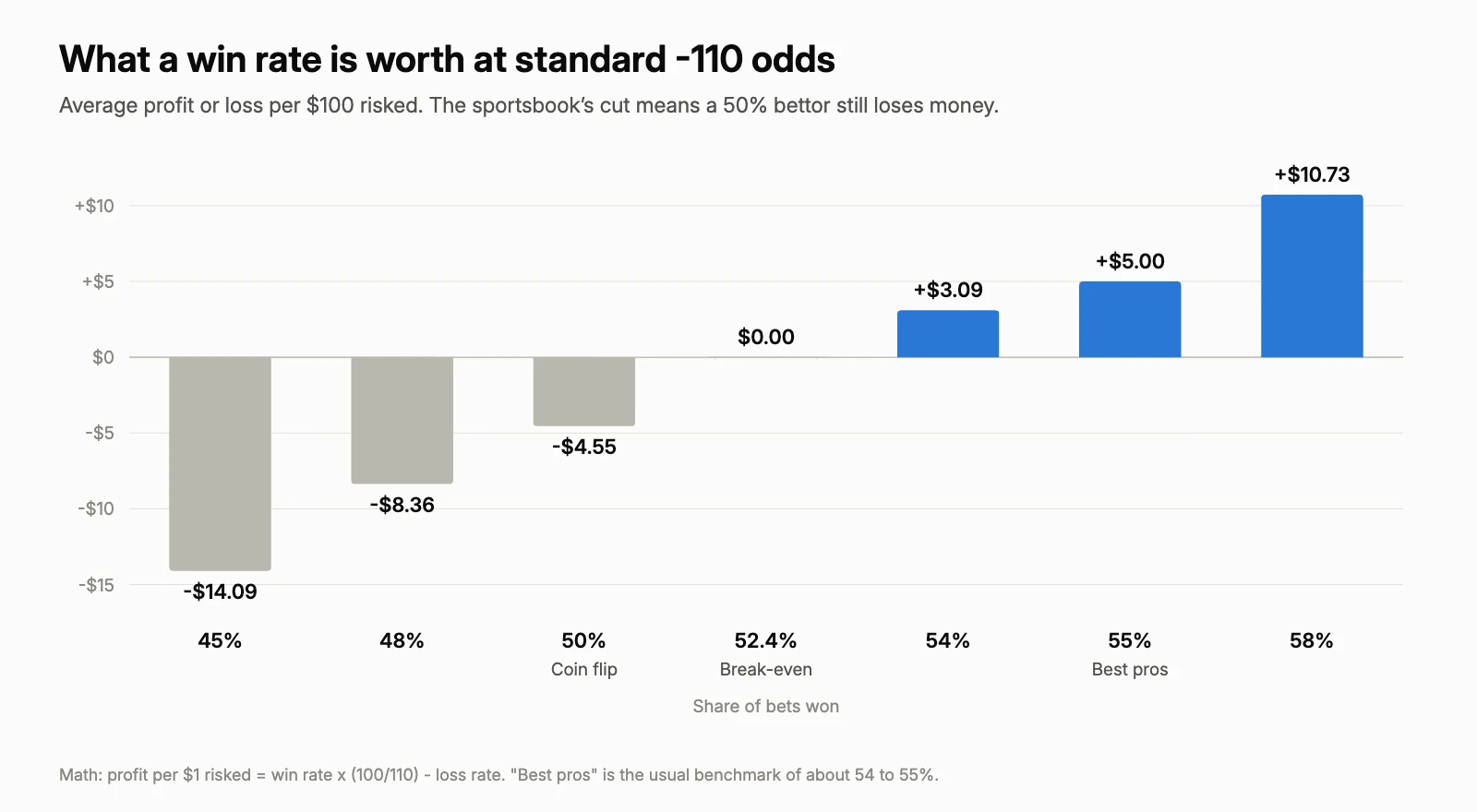
Professional bettors don't clear that bar by much. David Frohardt-Lane, a Chicago trader who won the biggest football handicapping contest in Las Vegas in 2013, told the University of Chicago Magazine that the best sports bettors win about 54% of the time and that "anything higher is luck." Many handicappers use 55% as their benchmark. At 55% you make about $5 for every $100 you risk. That sounds small, but repeated over thousands of bets with steady bet sizes, it is how the best bettors beat the house. It is also the bar we used for every hunch below.
How we compared moneylines with spreads
Spreads and totals are usually priced close to -110, so their win rate can be read straight against 52.4%. Moneylines are different. A +300 underdog only needs to win 25% of the time to break even, so its raw win rate says very little on its own.
For every moneyline hunch, we took the actual profit or loss at the real prices and converted it into the win rate that would produce the same result at -110. A moneyline system that lost 13.5 cents per dollar, for example, scores 45.3%, the same as a spread bettor who wins 45.3% of the time. That puts every hunch in every sport on one scale.
How we tested the hunches
All of the data comes from the WagerProof sports database, which stores closing lines and final scores for every game.
| Sport | Seasons | Games | Lines used |
|---|---|---|---|
| NFL | 2018 to 2025 | 2,225 | Closing spread, total and moneyline |
| College football | 2016 to 2025 | 7,026 | Closing spread, total and moneyline |
| MLB | 2023 to October 7, 2026 | 9,852 | Closing moneyline and total |
| NBA | 2025-26 | 1,316 | Last pregame spread, total and moneyline |
The rules were the same for every hunch:
- Every bet is graded against the closing line, the last price before the game started.
- Pushes are removed.
- Each hunch uses only what a bettor could know before the game, such as rest days, the previous result or the weather at kickoff.
- A hunch gets the same definition in every sport where it applies. Some don't apply at all: there is no weather in an NBA arena and no bye week in baseball.
- Spreads and totals are scored at standard -110. Moneylines are scored at their real prices.
- The NBA sample covers a single season, so treat those results as an early read.
We ran 38 tests in total, one for each hunch in each sport where it applies. With that many tests, one or two can look strong by luck alone. That is why we also checked whether each strong result held up in both halves of its sample.
The results at a glance
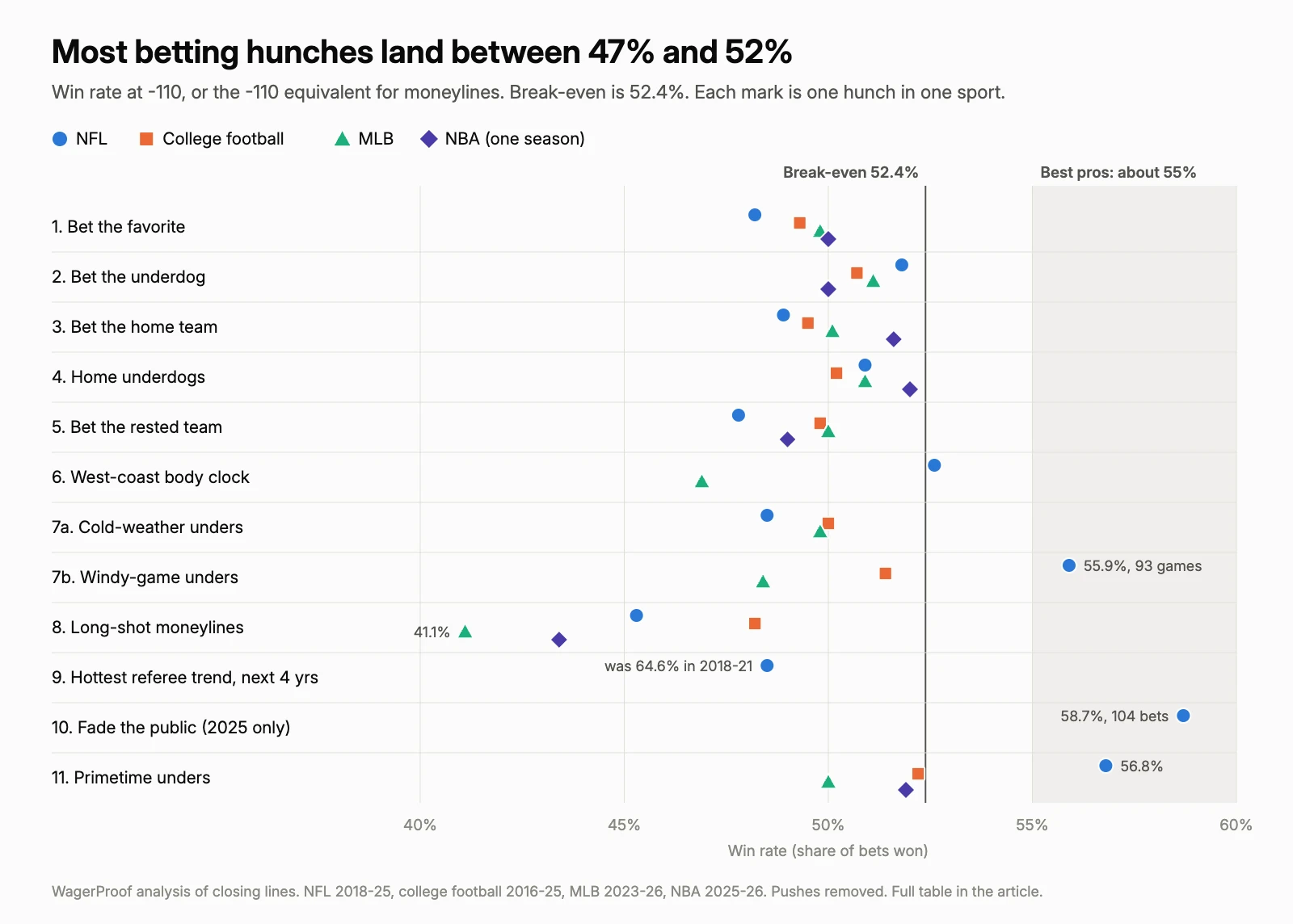
Of the 38 results, 34 fell short of break-even. Four cleared 52.4%, and three of those reached the pro bar of about 55%. All four were in the NFL.
The 11 hunches, one by one
1. Bet the favorite
The favorite is usually the better team, so this feels like the safe default. It was the weakest of the basic bets. NFL favorites covered 48.2% of the time over eight seasons, losing about $7.90 for every $100 risked. College favorites covered 49.3%. Betting every MLB favorite on the moneyline lost $4.90 per $100, which works out to 49.8% at -110, and NBA favorites covered exactly 50.0% last season.
2. Bet the underdog
Underdogs beat favorites in three of the four sports and tied in the NBA. They still lost money. NFL underdogs covered 51.8%, just short of break-even, and even that faded over time: 53.9% from 2018 to 2021, then 49.8% from 2022 to 2025. College underdogs covered 50.7%, and MLB underdogs on the moneyline lost $2.50 per $100.
3. Bet the home team
Home teams do win more often. NFL home teams won 54.5% of their games straight up, yet they covered only 48.9% against the spread. The line already gave the home team about 1.75 points on average, and home teams won by an average of 1.78. The advantage was real, and it was fully priced in. During the 2020 season, when most stadiums had no fans, NFL home teams won exactly half their games.
Other sports told the same story. College home teams covered 49.5%, MLB home teams lost $4.30 per $100 on the moneyline, and NBA home teams covered 51.6%.
4. Home underdogs
"Home dogs bark" may be the most repeated saying in football betting. It doesn't pay. NFL home underdogs covered 50.9%, college home underdogs 50.2%, and MLB home underdogs lost $2.90 per $100. NBA home underdogs came closest at 52.0%, from one season and 529 games.
5. Bet the rested team
Extra rest sounds like a built-in advantage. NFL teams coming off a bye covered only 47.8%, one of the worst results in the study. College teams off a bye covered 49.8%. When an NBA team with at least a day off faced an opponent on the second night of a back-to-back, the rested team covered 49.0%. A baseball team coming off a day off against an opponent that played the day before lost $4.50 per $100. Sportsbooks can read a schedule too.
6. The west-coast body clock
The theory goes like this: a team from the West Coast playing a 1 p.m. Eastern game is playing at 10 a.m. on its body clock, so it should look sluggish. NFL teams didn't. West Coast NFL teams won 58.1% of those early road games. Straight-up wins mostly reflect how good the teams were, though, so the spread result is the fairer test, and it was 52.6%, right around break-even.
Baseball was the opposite. West Coast MLB teams playing road games that started before 2 p.m. Eastern won only 42.3% of the time and lost $10.50 per $100 on the moneyline. College football had too few of these games to judge.
7. Bad-weather unders
Cold weather is supposed to kill scoring. It didn't, at least not beyond what the total already expected. NFL games played at or below freezing went under 48.5% of the time. Cold college games went under 50.0%, and MLB games at 50 degrees or colder went under 49.8%.
Wind looked different in the NFL. Games with winds of 15 mph or more went under 55.9% of the time, but that is only 93 games over eight seasons, too few to trust. Windy college games went under 51.4%. Baseball's famous "wind blowing in" under hit just 48.4% when the wind blew in at 10 mph or more.
8. Long-shot moneylines
Betting a big underdog feels like the smart contrarian play, and one hit pays a lot. Over time it was the worst hunch we tested, in every sport.
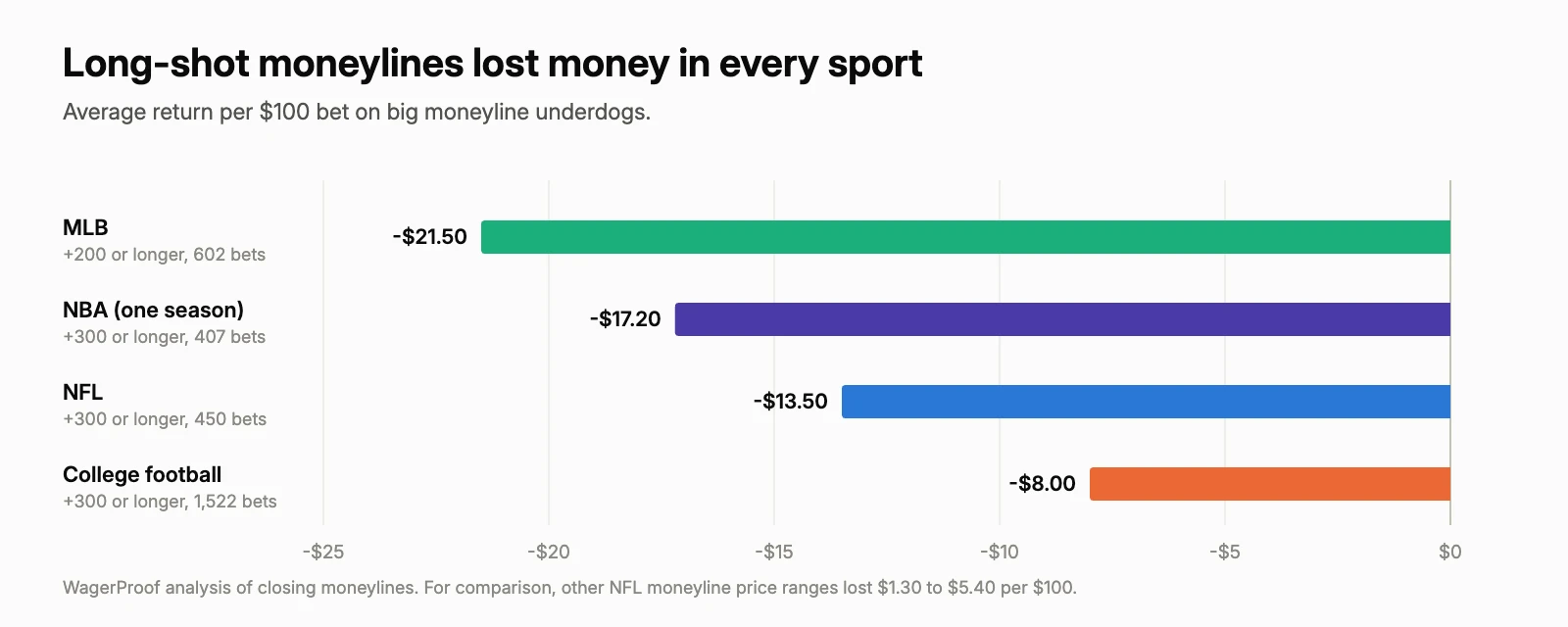
NFL underdogs of +300 or longer won 16.9% of the time and lost $13.50 per $100. The same bet lost $17.20 per $100 in the NBA and $8.00 in college football. Baseball rarely posts +300 underdogs, so we used +200 or longer there, and those lost $21.50 per $100. For comparison, every other NFL moneyline price range lost between $1.30 and $5.40 per $100.
Researchers call this the favorite-longshot bias. Bettors pay too much for a small chance at a big payout, so long-shot prices carry the most hidden cost on the board.
9. Referee trends
You can find a referee trend for almost any game, such as "this crew's games have gone under 65% of the time." We tested what happens after you find one. For the 12 NFL referees who worked at least 40 games in both 2018 to 2021 and 2022 to 2025, we compared their under rate in the first four seasons with the next four.
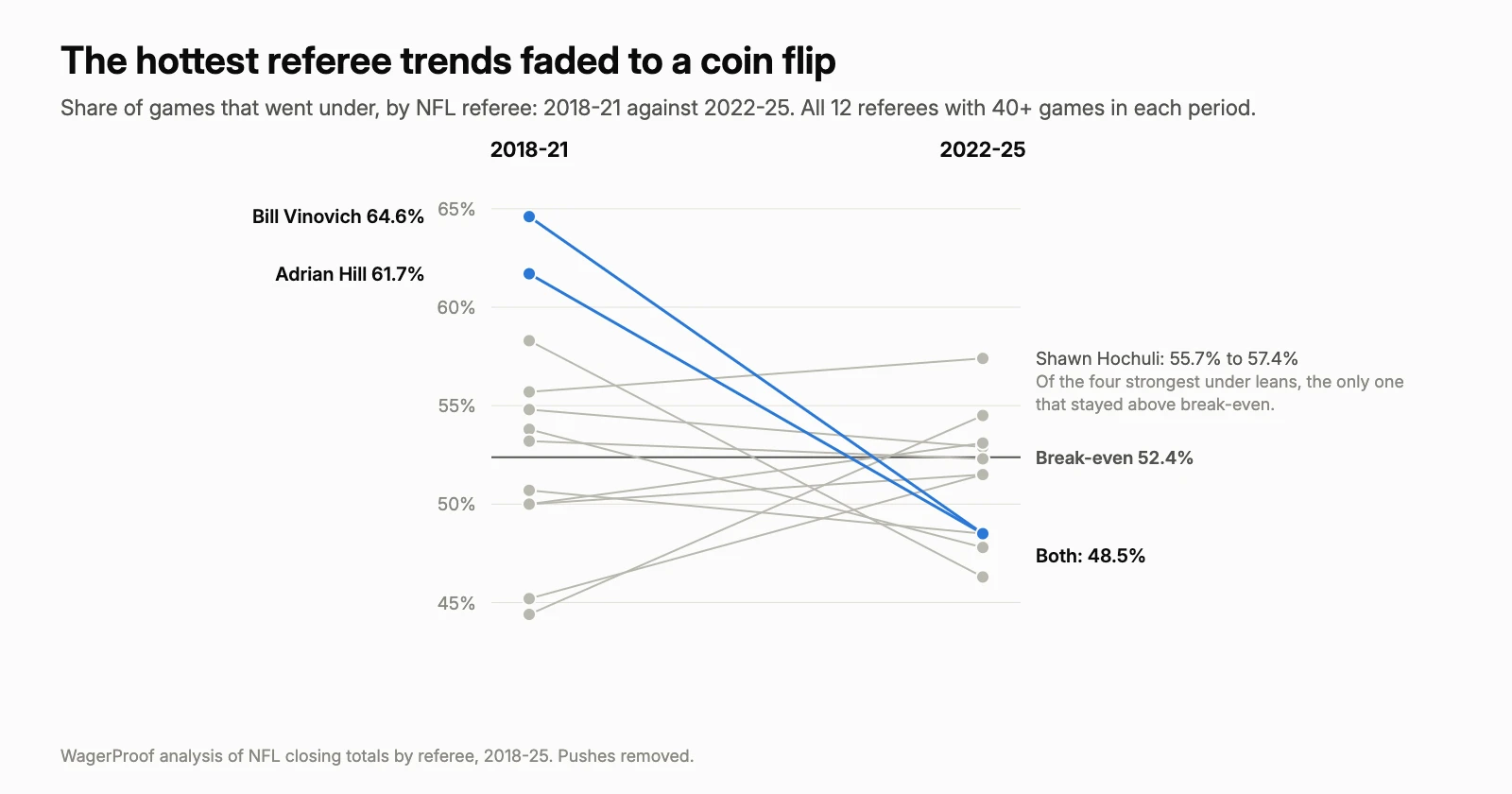
Bill Vinovich's games went under 64.6% of the time from 2018 to 2021. Over the next four seasons, they went under 48.5%. Adrian Hill's games went from 61.7% to 48.5%, and Clay Martin's from 58.3% to 46.3%. Of the four referees whose games went under 55% or more of the time early on, only Shawn Hochuli's stayed above break-even, moving from 55.7% to 57.4%.
This is the trap behind most trends you see online. Search through enough referees, teams or situations and some will look amazing by chance. The real test is what happens after the trend is found.
10. Fade the public
The idea is that casual bettors pile onto popular teams, so you should bet the other side. We only have ticket counts for the 2025 NFL season, so this is one season of evidence rather than eight.
Betting against every team that drew more than half the tickets went 52.2%, right at break-even. Betting against teams with 70% or more of the tickets did much better: 61 wins and 43 losses, or 58.7%, over 104 games. That result is promising but small, and a sample of 104 bets can land that high by luck. It needs more seasons before anyone should rely on it.
Totals didn't follow the pattern. The public bet the over in 81% of games, yet betting against the public on totals went 51.1%.
11. Primetime unders
This was the strongest result in the study. NFL primetime games went under the closing total 56.8% of the time from 2018 to 2025, 260 times in 458 games. The edge came from Sunday and Monday nights, which went under 59.9% and beat break-even in seven of eight seasons. Thursday night, the game people call sloppy, went under only 50.8%.
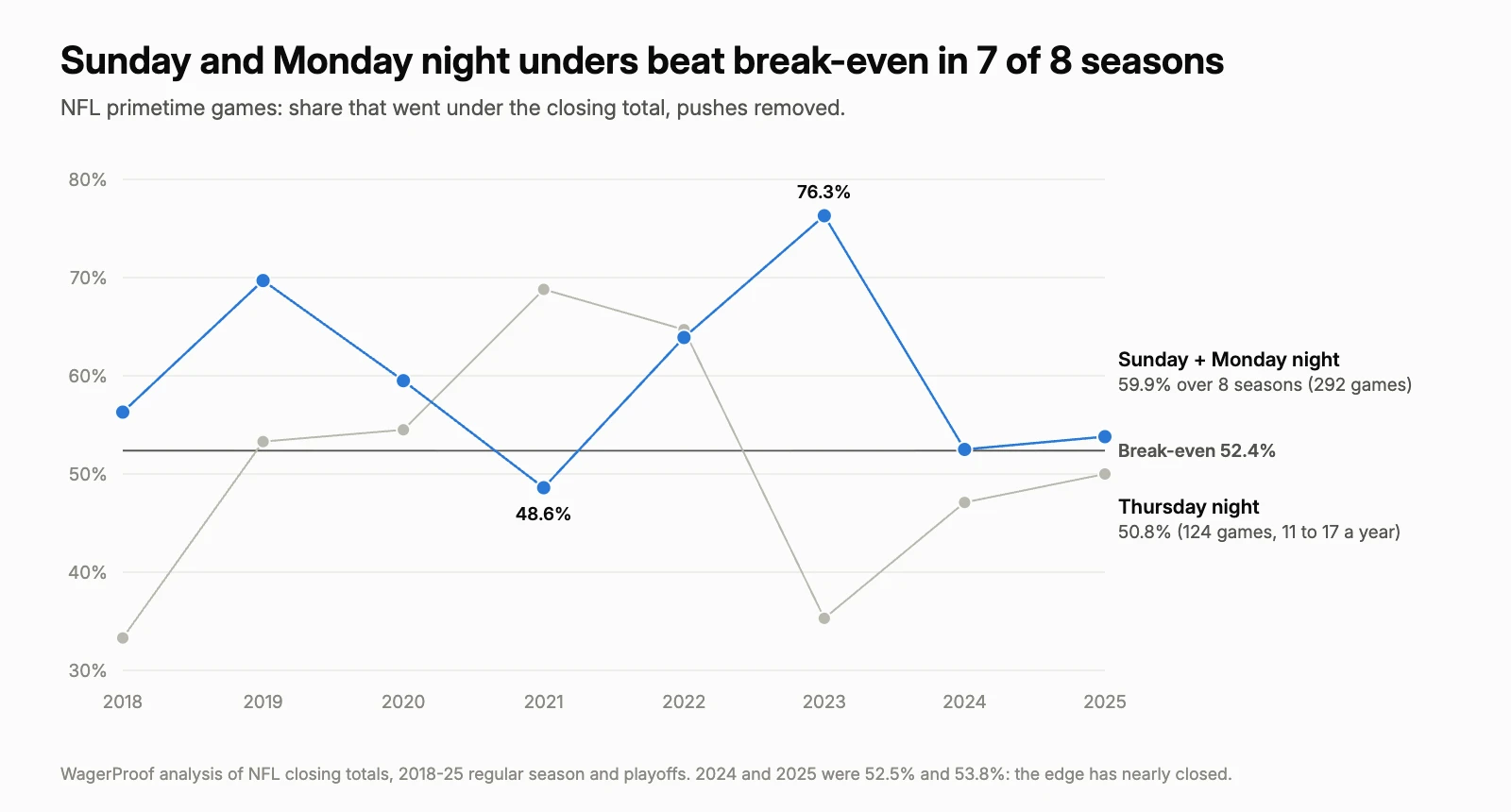
Two details explain where the edge came from. Sportsbooks set primetime totals about 1.2 points higher than other games on average, 46.3 against 45.1, while primetime games actually scored 0.7 points fewer, 45.4 against 46.1. And the public wasn't the obvious cause, at least in 2025: bettors took the over in 80% of primetime games and 81% of all other games.
The edge is shrinking, though. Sunday and Monday night unders hit 52.5% in 2024 and 53.8% in 2025, barely above break-even. The hunch didn't carry over to other sports either. College football primetime unders went 52.2%, NBA national TV unders 51.9% over one season, and MLB Sunday night unders 50.0%.
Why most hunches fail
Three reasons came up again and again.
- The line already knows. Sportsbooks set prices with the same schedule, weather report and injury news you have. A hunch built on public information is usually priced in before you bet it.
- Small samples mislead. A trend built on 50 or 100 games can look like an edge by luck alone, and the referee results show how quickly those trends fade.
- Markets adjust. Even a pattern that held for years, like Sunday and Monday night unders, can shrink, as it did in 2024 and 2025.
How to test a hunch yourself
Before you trust any betting trend, put it through four questions:
- How many games is it based on? Under a few hundred, assume it is luck until it proves otherwise.
- Did it hold in both halves of the sample, or only in one hot stretch?
- Is it judged against 52.4%, or the right break-even for its price, rather than against 50%?
- Is there a reason the price would be wrong, or is it only a pattern?
You can run checks like these yourself. The WagerProof connector gives AI assistants access to the same historical database we used here, so a signed-in user can ask a question like "how often do road underdogs cover after a bye?" and get back the record, the sample size and the split by season. Our guide to connecting an AI agent to real sports data shows how to set it up. For judging your own bets, closing line value is a better measure of skill than any trend, and our guide to implied probability explains how to read the break-even rate hidden in any price.
Full results
Every number is a win rate at -110. For moneyline hunches it is the -110 equivalent of the real profit or loss. Sample sizes are in brackets.
| Hunch | NFL (2018-25) | College football (2016-25) | MLB (2023-26) | NBA (2025-26) |
|---|---|---|---|---|
| 1. Bet the favorite | 48.2% (2,173) | 49.3% (6,882) | 49.8% (11,387) | 50.0% (1,316) |
| 2. Bet the underdog | 51.8% (2,173) | 50.7% (6,882) | 51.1% (8,317) | 50.0% (1,316) |
| 3. Bet the home team | 48.9% (2,173) | 49.5% (6,325) | 50.1% (9,852) | 51.6% (1,316) |
| 4. Home underdogs | 50.9% (833) | 50.2% (2,387) | 50.9% (2,777) | 52.0% (529) |
| 5. Bet the rested team | 47.8% (249) | 49.8% (1,936) | 50.0% (731) | 49.0% (298) |
| 6. West-coast body clock | 52.6% (152) | Too few games | 46.9% (241) | Not tested |
| 7a. Cold-weather unders | 48.5% (97) | 50.0% (114) | 49.8% (259) | Doesn't apply |
| 7b. Windy-game unders | 55.9% (93) | 51.4% (562) | 48.4% (386) | Doesn't apply |
| 8. Long-shot moneylines | 45.3% (450) | 48.2% (1,522) | 41.1% (602) | 43.4% (407) |
| 9. Top referee trend, next 4 seasons | 48.5% (66) | No data | No data | No data |
| 10. Fade the heavy public | 58.7% (104, 2025 only) | No data | No data | No data |
| 11. Primetime unders | 56.8% (458) | 52.2% (2,843) | 50.0% (106) | 51.9% (339) |
A few definitions: the rested-team hunch means coming off a bye in football, facing a back-to-back opponent in the NBA, and an off day against a team that played the day before in MLB. Cold means at or below freezing in football and 50 degrees or colder in baseball. Wind means 15 mph or more in football and 10 mph or more blowing in for baseball. Primetime means national night games in the NFL and college football, national TV games in the NBA and Sunday night games in MLB.
If betting stops being fun, our responsible betting guide has practical limits, and free, confidential help is available at 1-800-GAMBLER.
Plain answers
Frequently asked questions
Do betting trends work?
Most don't. We tested 11 popular hunches across 20,419 NFL, college football, MLB and NBA games, and 34 of the 38 results fell short of the 52.4% win rate needed to break even at -110. Only three NFL results reached a professional's win rate of about 55%, and two of those rest on small samples.
What win percentage do you need to be profitable in sports betting?
At standard -110 odds you need to win 52.4% of your bets to break even, because you risk $110 to win $100. Winning exactly half your bets loses about $4.55 for every $100 risked. At 55% you make about $5 per $100.
What win rate do professional sports bettors have?
The best sports bettors are usually put at about 54% to 55% against the spread. David Frohardt-Lane, a Chicago trader and handicapping contest winner, told the University of Chicago Magazine in 2014 that the best win about 54% and that anything higher is luck.
Do primetime unders still work in the NFL?
From 2018 to 2025, NFL primetime games went under the closing total 56.8% of the time, and Sunday and Monday night games went under 59.9%. Thursday night went under only 50.8%. The edge has shrunk: Sunday and Monday night unders hit 52.5% in 2024 and 53.8% in 2025.
Do home underdogs cover the spread?
Not often enough to profit. NFL home underdogs covered 50.9% from 2018 to 2025 and college home underdogs covered 50.2% from 2016 to 2025, both below the 52.4% break-even. MLB home underdogs lost $2.90 per $100 on the moneyline.
Is betting long shots a good strategy?
In our data it was the worst one. NFL underdogs of +300 or longer lost $13.50 per $100, NBA long shots lost $17.20 and MLB underdogs of +200 or longer lost $21.50. This matches the favorite-longshot bias, where bettors overpay for small chances at big payouts.

About the author
Chris Habib
Chris builds WagerProof and writes practical guides about sports research, product methodology, and responsible use of betting data. He focuses on inspectable workflows rather than outcome promises.
Research inside WagerProof
Put the model, market, and record on the same screen.
WagerProof organizes model probabilities, current lines, agents, trends, and graded records. It does not guarantee an outcome.
Have a correction or a newer first-party source? Email the editorial team.