The bottom line
A useful result keeps its limits attached.
A parlay's odds are the product of its legs' decimal odds, so the payout is easy to check. The harder number is what that price costs you: every leg carries the book's margin, and the margins multiply. Strip the vig from each leg and compare the fair parlay price with the one you are offered before you decide anything.
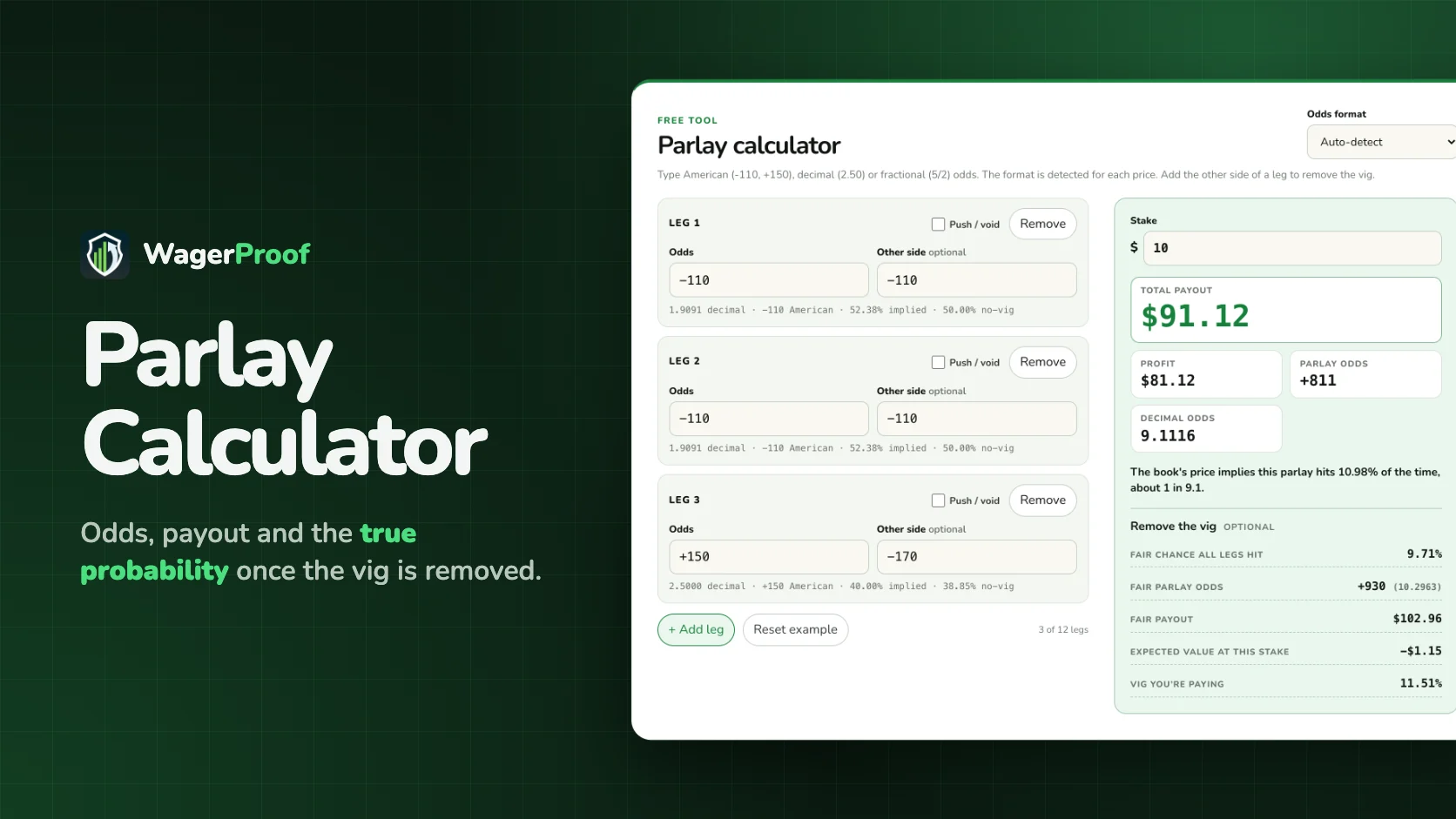
A parlay calculator multiplies the decimal odds of every leg to give you one price. The calculator above does that for 2 to 12 legs, in American, decimal or fractional odds, and shows the payout, the profit and the chance the price implies.
It also does something most parlay calculators skip. If you enter the other side of each leg, it removes the sportsbook's margin and shows the fair parlay price, the expected value at your stake and how much vig you are paying. That last number is usually the one that matters.
How to use the parlay calculator
- Type the odds for each leg.
-110,2.50and5/2all work, and the format is detected per price. If a number is ambiguous, pick the format from the menu. - Add or remove legs. You can have up to 12.
- Set your stake. Payout, profit, combined odds and implied probability update as you type.
- Optional: put the opposite side's price in "Other side" for every leg to see the no-vig numbers.
- If a leg pushed or was voided, tick "Push / void" and it drops out of the math.
Each leg shows its decimal odds, American odds and implied probability, so the calculator doubles as an odds converter.
How parlay odds are calculated
Every leg has to win, so the payout compounds. The calculation has four steps, and the calculator's default example walks through all of them: three legs at -110, -110 and +150, with a $10 stake.
Step 1: convert each leg to decimal odds. Decimal odds include your stake, which makes them easy to multiply.
| Leg | American odds | Decimal odds | Implied probability |
|---|---|---|---|
| 1 | -110 | 1.9091 | 52.38% |
| 2 | -110 | 1.9091 | 52.38% |
| 3 | +150 | 2.5000 | 40.00% |
For negative odds, the conversion is 1 + 100 / 110 = 1.9091. For positive odds, it is 1 + 150 / 100 = 2.50.
Step 2: multiply the decimal odds. 1.9091 × 1.9091 × 2.50 = 9.1116. Keep the unrounded values while you calculate. Rounding each leg to two decimals first (1.91 × 1.91 × 2.50) would give 9.12 and a $91.20 payout, eight cents too high.
Step 3: multiply by the stake. $10 × 9.1116 = $91.12 total payout. Subtract the stake and the profit is $81.12.
Step 4: convert back to American odds. When the decimal price is 2.00 or higher, subtract 1 and multiply by 100: (9.1116 - 1) × 100 = 811. The parlay is +811.
The implied probability is 1 / 9.1116 = 10.98%, about 1 in 9.1. That is the hit rate you would need just to break even at this price. It is not an estimate of the real chance, because each leg still carries the book's margin.
Converting American, decimal and fractional odds
You can use the calculator as a plain odds calculator: enter a price as one leg and read the conversions under it. The formulas are short.
| From | To decimal | Example |
|---|---|---|
| American, negative (-A) | 1 + 100 / A |
-125 becomes 1.80 |
| American, positive (+A) | 1 + A / 100 |
+250 becomes 3.50 |
| Fractional (N/D) | 1 + N / D |
5/2 becomes 3.50, 10/11 becomes 1.9091 |
| Decimal (D) | already decimal | 2.50 stays 2.50 |
To go from decimal back to American: if the price is 2.00 or more, use (D - 1) × 100. Below 2.00, use -100 / (D - 1). So 1.80 becomes -125 and 3.50 becomes +250.
Implied probability is always 1 / decimal. At 1.80 that is 55.56%, at 3.50 it is 28.57%. The no-vig odds guide covers these conversions and their edge cases in more detail.
Why parlays cost more than they look: the vig compounds
A single bet at -110 on both sides has a small margin built in. Each side implies 52.38%, the pair adds up to 104.76%, and the extra 4.76 points is the book's cut. Remove it proportionally and each side is a fair 50%, or +100.
Now parlay two of those coin flips. If both legs really are 50/50, the chance both win is 0.5 × 0.5 = 25%, and the fair price is decimal 4.00, or +300. The book pays 1.9091 × 1.9091 = 3.6446, which is +264. On $10, that is $36.45 back instead of a fair $40.00.
| Legs at -110 (fair 50% each) | Offered price | Fair price | Offered payout on $10 | Fair payout on $10 | Vig you pay |
|---|---|---|---|---|---|
| 1 | -110 | +100 | $19.09 | $20.00 | 4.55% |
| 2 | +264 | +300 | $36.45 | $40.00 | 8.88% |
| 3 | +596 | +700 | $69.58 | $80.00 | 13.03% |
| 4 | +1228 | +1500 | $132.83 | $160.00 | 16.98% |
"Vig you pay" here is the expected loss per dollar staked if the no-vig probabilities were exactly right. At two legs, $10 has an expected value of about -$0.89 under that assumption. At four legs, it is about -$1.70. The margin roughly adds up with every leg, which is why long parlays pay a lot and cost a lot.
The calculator does this for any mix of prices. Back at the default example, enter -110 as the other side of the first two legs and -170 against the +150 leg. The fair chance all three hit becomes 9.71% (fair odds +930, a fair payout of $102.96), while the offered +811 implies 10.98%. Expected value at $10 is -$1.15 and the vig is 11.51%.
These no-vig numbers are estimates. Proportional margin removal is one method among several, and it assumes the legs are independent.
Pushes, voids and same-game parlays
Pushes and voids. FanDuel's house rules say that when a parlay selection is void, the remaining selections decide the bet and the odds are recalculated. If every selection but one is void, the bet settles as a straight wager. The same rules treat a refunded whole-number line as an excluded parlay leg in some sports, and most U.S. books handle pushes the same way. Boosted parlays can be the exception: FanDuel voids the entire Odds Boost if any selection is void.
In the example, if one of the -110 legs pushes, the parlay becomes -110 and +150: 1.9091 × 2.50 = 4.7727, or +377, and $10 pays $47.73. Tick the push box on that leg to see it.
Same-game parlays. Multiplying legs assumes each result has nothing to do with the others. Legs from one game break that assumption. A quarterback's passing yards and his top receiver's yards tend to rise and fall together, so the chance both hit is higher than the product of the two. FanDuel's rules only allow correlated selections where they are explicitly offered, such as its Same Game Parlay, and books price those with their own adjustments. Treat the calculator as a rough reference for same-game parlays, not the price you should expect.
Round robins. A round robin splits your picks into every smaller parlay of a chosen size. Three legs "by 2s" is three two-leg parlays, each with its own stake. At $10 each on the default legs, that is $30 staked: the -110/-110 pair pays $36.45 and each -110/+150 pair pays $47.73. All three winning returns $131.90. Run each combination through the calculator separately.
How WagerProof fits
The calculator shows what a price implies and what it costs. It cannot tell you whether a leg is worth taking. For that you need a separate estimate of each outcome and a price that beats it after the margin.
In WagerProof, model probabilities sit beside current sportsbook lines, so you can see where the model and the market disagree before you build anything. The analysis guide explains what those numbers are and are not. Models are wrong often, and a parlay multiplies the error along with the odds.
If you do bet parlays, record the price you took and the no-vig price at the time, then review them against the closing line and a complete record, as in the performance tracking checklist. A few big parlay wins are easy to remember. The losing tickets are easy to forget.
Set a budget before you open the calculator, and treat a parlay's small hit rate as the real cost of the big number. If betting stops feeling like entertainment, the responsible research guide lists practical limits, and free, confidential help is available at 1-800-MY-RESET by call, text or chat.
Repeatable method
How to calculate parlay odds
Work out a parlay's odds and payout by hand, using the calculator's default three-leg example at -110, -110 and +150 with a $10 stake.
- 1
Convert every leg to decimal odds
For negative American odds, divide 100 by the odds and add 1: -110 becomes 1.9091. For positive odds, divide by 100 and add 1: +150 becomes 2.50. For fractional odds, divide and add 1: 5/2 becomes 3.50.
- 2
Multiply the decimal odds together
1.9091 x 1.9091 x 2.50 = 9.1116. Keep the unrounded values until the end. Leave out any leg that pushed or was voided.
- 3
Multiply by your stake for the payout
$10 x 9.1116 = $91.12 total payout, which includes your $10 back, so the profit is $81.12.
- 4
Convert back to American odds
For decimal odds of 2.00 or more, subtract 1 and multiply by 100: (9.1116 - 1) x 100 = 811, so the parlay pays +811.
- 5
Read the implied probability
Divide 1 by the decimal odds: 1 / 9.1116 = 10.98%. That is the break-even rate the price implies, not the real chance, because each leg still includes the sportsbook's margin.
Plain answers
Frequently asked questions
How do you calculate parlay odds?
Convert each leg to decimal odds, multiply them together, and multiply the result by your stake for the total payout. For -110, -110 and +150, that is 1.9091 x 1.9091 x 2.50 = 9.1116, or +811 in American odds.
How much does a $10 3-leg parlay pay?
It depends on the legs. Three legs at -110 pay $69.58 in total on $10 (+596), a $59.58 profit. Swap one leg for +150 and the same $10 pays $91.12 (+811), an $81.12 profit.
Why is my sportsbook's parlay payout different?
The usual reasons are rounding (books round each leg or the final price differently), a same-game parlay priced with a correlation adjustment, a boost or promotion, a price that moved before you placed the bet, or a house rule. Check each leg's current price and your book's parlay rules.
What happens to a parlay if one leg pushes?
At most U.S. sportsbooks the pushed or voided leg drops out and the parlay is paid at the odds of the remaining legs. If only one leg is left, it is usually settled as a straight bet. Boosted and some promotional parlays can void entirely, so check your book's house rules.
What is the true probability of a parlay?
No calculator knows it. A no-vig estimate removes the book's margin from each leg and multiplies the results, which assumes the legs are independent. Two -110 legs come out at 25% fair, while the offered +264 price implies 27.44%.
Can I use this for same-game parlays?
Only as a rough check. Legs from the same game are often correlated, so multiplying them as if they were independent can overstate or understate the real chance. Sportsbooks price same-game parlays with their own correlation adjustments.
Evidence ledger
Sources
Sources were opened on the listed date. Product features, prices, platform coverage, fees, and help information can change.
- FanDuel Sportsbook House Rules (Colorado), section 19: Parlays, Round Robins and TeasersFanDuel Sportsbook · Accessed September 28, 2026
Void parlay legs drop out and the odds are recalculated; a parlay with one remaining selection settles as a straight bet; correlated selections are only allowed where offered, such as Same Game Parlays; Odds Boost parlays void entirely if one selection is void; a whole-number line that lands exactly is refunded and treated as an excluded parlay leg (rugby league rules)
- National Problem Gambling Helpline (1-800-MY-RESET)National Council on Problem Gambling · Accessed September 28, 2026
Free, confidential U.S. help by call, text or chat

About the author
Chris Habib
Chris builds WagerProof and writes practical guides about sports research, product methodology, and responsible use of betting data. He focuses on inspectable workflows rather than outcome promises.
Research inside WagerProof
Put the model, market, and record on the same screen.
WagerProof organizes model probabilities, current lines, agents, trends, and graded records. It does not guarantee an outcome.
Have a correction or a newer first-party source? Email the editorial team.